The Lover Archetype Examples: 8 Characters Worth Studying
Most Lover archetypes don't collapse because the chemistry is wrong. They collapse because the manuscript forgets who knows what, who has already been wounded, who has already said no, and which version of intimacy the character has been performing. That's where a vivid romantic dynamic turns into a continuity problem three hundred pages later.
The useful lover archetype examples below aren't personality stickers. They're working models for novelists handling 80,000-plus words, series continuity, multiple viewpoints, and large casts. Each one creates a different tracking burden. A seductive character needs a revelation record. A wounded character needs a stable wound state. A forbidden relationship needs a knowledge map. Another questionnaire won't solve that. A living character-tracking system might. For broader archetype context, compare this stock character guide for writers.
1. The Seducer
The Seducer doesn't just fall into connection. They pursue it, shape it, and often use it as an advantage. That doesn't make every feeling fake. It creates a double layer that the manuscript must preserve: what the Seducer feels and what they're deliberately performing.
Cleopatra in Rome strategically reveals vulnerability across different relationships. Don Draper in Mad Men presents different selves to different people, and Villanelle in Killing Eve masks genuine fascination with predatory performance. Rochester in Jane Eyre deepens Jane's attachment through intimacy and secrecy while retaining control over the situation.
The continuity problem
Writers lose track of which confession has gone to which recipient. A vulnerability revealed to Jane cannot later function as a secret from her just because it remains unknown to the rest of the cast. The same problem appears when a Seducer changes tactics without a triggering failure. If charm worked in the previous chapter, why has the character suddenly become emotionally transparent?
Track the following across scenes:
- Recipient-specific revelations: Record exactly what vulnerability the Seducer has shown to each person.
- Persona distance: Note where public presentation and private motive diverge, then mark when that gap narrows.
- Seduction outcomes: Record whether each attempt succeeds, fails, or produces a consequence the character didn't anticipate.
Practical rule: A Seducer can change tactics, but the manuscript must show what forced the change.
Search the draft for repeated behavior toward the same target. If the character has already used a particular secret, gesture, or confession, later scenes need to acknowledge that history. Otherwise the Seducer stops feeling calculating and starts feeling author-controlled.
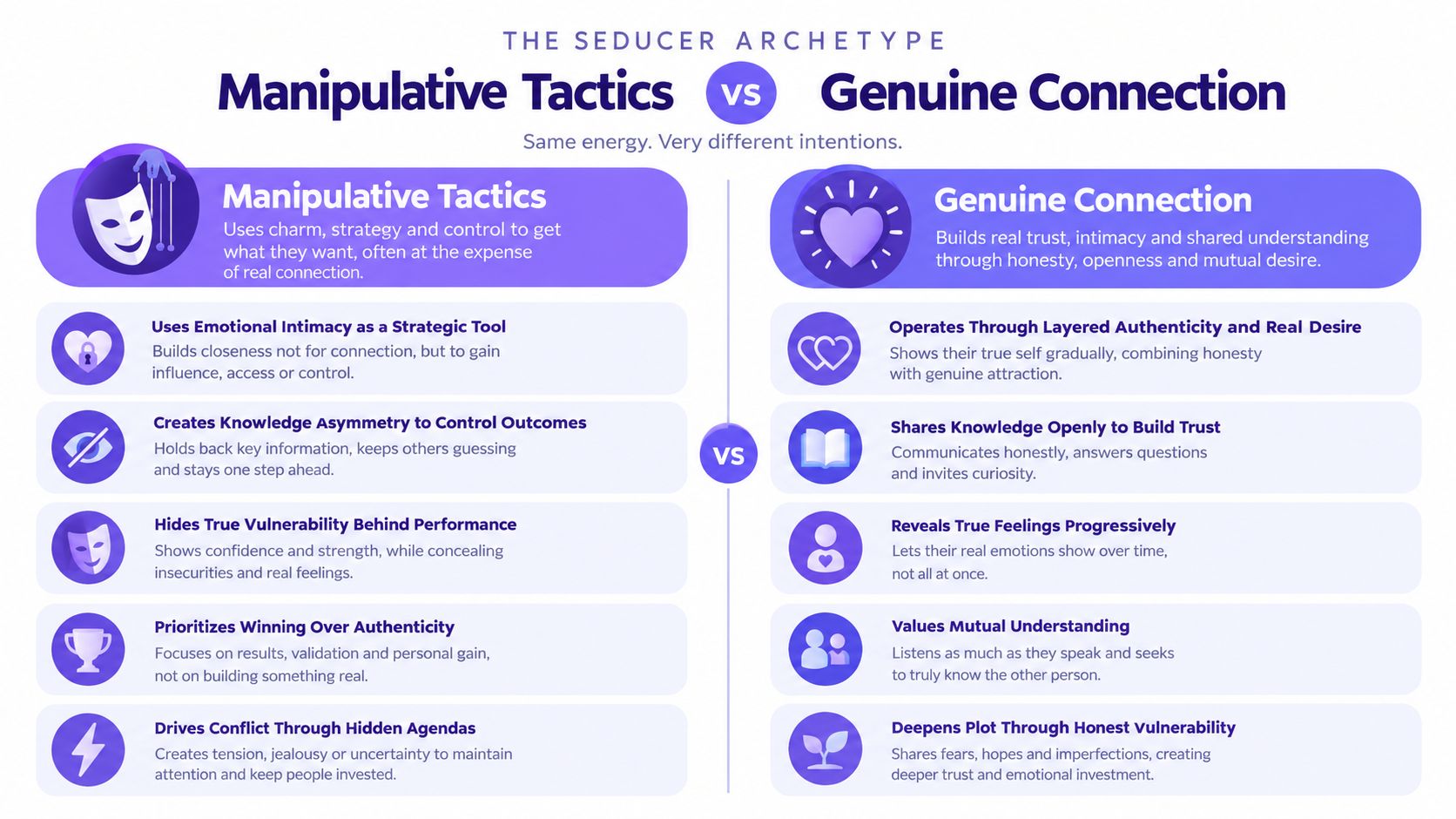
The distinction between manipulation and genuine emotional connection is where this archetype either earns its complexity or becomes a costume.
2. The Wounded Romantic
The Wounded Romantic falls apart on the page when the wound only appears on cue. In a long manuscript, that old injury has to govern what the character notices, what they misread, and how quickly they punish closeness after wanting it.
Estella in Great Expectations keeps intimacy at a distance because childhood abandonment trained her to treat attachment as exposure. Jamie Fraser in Outlander carries trauma into both protectiveness and sexual restraint, which means tenderness and refusal can sit in the same scene without contradicting each other. Sarah in A. S. Byatt's Possession has to sort present desire from inherited romantic scripts. Cathy Linton in Wuthering Heights inherits emotional damage, but the interesting part is not the inheritance alone. It is whether she repeats the pattern once she has enough information to choose differently.
The wound has to remain operational
A wound that reads the same in every scene is flat. A wound that changes shape whenever the plot needs a reveal feels rigged. Betrayal by a spouse, abandonment by a parent, public humiliation, and coercive control each produce different defenses, different blind spots, and different thresholds for trust.
Use a character wound reference that records the event, the belief it created, who knows about it, and which behaviors reliably follow. Then track the knowledge state of each partner. Who has the full story, who has a partial version, who is guessing, and who is using the truth badly.
That is the manuscript test: who knows about the wound, and what do they do differently because they know?
Once a partner has heard the truth, they cannot keep reacting as if the avoidance came from nowhere. If they miss the pattern, give them a reason. If the Wounded Romantic regresses, mark the trigger. Intimacy, conflict, perceived abandonment, and even unexpected kindness can all reactivate the defense. Healing does not need to move in a straight line, but the pattern has to stay legible from chapter to chapter.
3. The Devoted Pursuer
Pip's pursuit of Estella in Great Expectations continues despite clear evidence that she doesn't reciprocate. Heathcliff structures his life around proximity to Cathy and continues pursuing her through her daughter after death. Emma Woodhouse confidently interferes in other people's romantic lives while ignoring repeated evidence that her interpretations are wrong. Captain Ahab redirects the emotional force of devotion into obsessive pursuit of the whale.
These characters aren't defined by romance alone. They're defined by how attachment controls interpretation. The Pursuer may possess accurate information and still decide that it means something else.
Separate knowledge from interpretation
That distinction matters more than a conventional emotional arc. Pip can know Estella is cold while interpreting the coldness as a test. Emma can see contradictory evidence and classify it as an exception. A manuscript that tracks only facts misses the actual engine of the archetype.
The Pursuer's belief system must update, even when it updates incorrectly.
Record the beloved's actual responses separately from the Pursuer's reading of them. Mark each point where hope rises, weakens, becomes denial, or turns dangerous. Then identify whether the character changes strategy or just repeats the same approach with fresh language.
The common failure is a late-stage collapse into obsession that has no documented escalation. If the Pursuer has accepted rejection for six chapters, the next act can't suddenly portray them as incapable of hearing the word no without a new event, revelation, or psychological turn. Track the threshold that separates persistence from coercion. Passion doesn't excuse continuity gaps.
4. The Cynic-Turned-Believer
Mr. Darcy begins with pride, social judgment, and a dismissive view of Elizabeth, then revises his assessment through accumulated evidence. Scrooge McDuck in DuckTales develops genuine familial attachment without surrendering every protective instinct. Han Solo moves from mercenary indifference toward trust and ideological commitment through repeated contact with Luke and Leia. The characters in Magnolia begin in isolation and defensive cynicism before crisis forces them to confront their need for connection.
The useful version of this archetype doesn't turn a cynic into a sentimental optimist. It changes the specific proposition they rejected. Darcy must revise his judgment of Elizabeth. Han must revise his belief that commitment is a liability. Scrooge can care profoundly and remain suspicious.
Track objections, not moods
Write down the core cynical belief: love is weakness, people are selfish, affection is transactional, or dependence leads to humiliation. Every meaningful scene should challenge a particular objection. A grand gesture that contradicts nothing won't move the character. It's just expensive decoration.
Watch the difference between skepticism becoming wisdom and skepticism remaining emotional armor. Darcy's caution can become better judgment. A character who keeps calling everyone untrustworthy after repeated evidence of loyalty may be preserving the wound, not expressing insight.
Use the manuscript timeline to identify belief shifts that happen too quickly. The character needs evidence that addresses the objection they hold. If they distrust promises, give them consistent action. If they distrust selflessness, make them witness sacrifice without immediate reward. The final acceptance should feel like the only conclusion compatible with the record, not a switch flipped because the romance needs to resolve.
5. The Forbidden Other
The Forbidden Other gains force from circumstance. Guinevere and Lancelot are constrained by Arthur's legitimate claim. Anna Karenina and Vronsky face marriage and social position as the central barriers. Romeo and Juliet are divided by family hostility rather than by an inherent mismatch in their personalities. Heathcliff and Catherine in Wuthering Heights are separated by class and existing commitments.
That distinction matters. The obstacle isn't automatically a flaw in either lover. It's the cost that connection exposes.
Build the barrier as a changing condition
Track whether the external barrier is fixed, weakening, or becoming more dangerous. A family feud, marriage, legal status, political allegiance, or religious prohibition can't remain both absolute and casually negotiable. If the characters behave as though the barrier has changed, the manuscript needs to show who changed it and who knows.
The most frequent failure is knowledge asymmetry. Does the Forbidden Other know the protagonist is in love? Do they suspect it? Are they hiding reciprocal feeling, or are they genuinely unaware? Those states produce different dialogue, choices, and risks.
Forbidden love works when the barrier produces decisions, not just yearning.
Mark temptation points where one lover considers abandoning the obstacle. Use them sparingly and make them costly. If every chapter threatens a breakthrough, the prohibition loses weight. If neither character ever tests it, the relationship becomes atmospheric rather than dramatic.
6. The Rescue Narrative Lover
Rochester and Jane in Jane Eyre demonstrate how rescue can move in both directions. Jane gives Rochester moral clarity and emotional contact, while he offers security and material protection. Christian and Ana in Fifty Shades frame dominance as protective rescue, which makes consent and control impossible to ignore. Mr. Knightley and Emma in Emma blur guidance with rescue, forcing Emma to determine whether she's being helped or managed. Marlow's mission toward Kurtz in Heart of Darkness turns rescue into a framework for obsession.
The rescue dynamic isn't stable by default. The person who appears capable in one scene may become dependent in the next. A savior can also be protecting their own need to remain necessary.
Track power, not just care
Record who is saving whom in each major sequence, whether the supposed rescued person wants intervention, and what changes when they resist. If one character must remain broken for the relationship to function, the manuscript has created dependency, not intimacy.
This archetype fails when the power shift arrives without behavioral consequences. The rescued person becomes independent, but the rescuer continues issuing commands. The rescuer becomes vulnerable, but the other lover keeps treating them as invulnerable. Those aren't subtle contradictions. They're state-tracking failures.
Monitor consent, power, access to money or information, and the ability to leave. A rescue scene should alter the relationship's balance. If it doesn't, it's probably there to flatter the rescuer.
7. The Reluctant Reciprocator
Captain Wentworth in Persuasion still loves Anne but refuses to pursue her after years of restraint. Mr. Knightley suppresses recognition of his feelings while observing Emma's development. Jaime Lannister in A Song of Ice and Fire oscillates between reciprocating and refusing Cersei as his principles shift. Dorothea and Will in Middlemarch maintain distance despite attraction because social position and existing commitments make action costly.
The Reluctant Reciprocator differs from the cynic. They believe love exists. They feel it. They refuse to permit it into the life they've chosen.
Make every refusal earn its page space
The refusal needs a concrete cause: duty, loyalty, ideology, fear of vulnerability, or a commitment to another future. Repeating “no” without changing the reason turns restraint into authorial stalling. The character's threshold must be visible.
A reliable enemies-to-lovers framework helps only if the hostility or resistance changes in relation to new knowledge. Track every near-break, not as romantic tease but as evidence of pressure accumulating. What did the character learn? Whom did they disappoint? Which obligation became less defensible?
The final breakthrough should meet a previously established condition. If Wentworth needs proof that Anne's loyalty has endured, the story must supply it. If another character must choose between desire and duty, the choice needs a consequence. Reluctance is compelling when it has a price. It's tedious when it's just delayed consent to the plot.
8. The Complicating Love Interest
Jack in Titanic disrupts Rose's socially approved engagement and forces her to question an entire life path. Edward in Twilight complicates Bella's attachment to the werewolf world through a competing supernatural and emotional claim. Cathy in Wuthering Heights complicates Heathcliff's devotion through her marriage to Linton. Lucia in The Talented Mr. Ripley enters an existing web of attachments and creates pressure without becoming the central protagonist.
This role carries the heaviest tracking load because it creates at least three live relationship arcs. You're managing the new interest and protagonist, the established relationship, and the knowledge cascade between them.
Give the complication an independent life
The new love interest needs goals that don't depend on being chosen. If they exist only to make the primary pairing look difficult, readers will feel the machinery. They should be appealing for specific reasons, but not so perfect that the protagonist's existing attachment becomes inexplicable.
Track who suspects what, when attraction becomes mutual, which secrets travel, and how each revelation changes the established relationship. A protagonist can hide a kiss from one partner while openly discussing the new person with another. Those are different knowledge states, and later confrontations depend on the distinction.
A love interest framework is only useful when it records departure as well as arrival. If the complicating character leaves, dies, withdraws, or chooses another path, that exit needs emotional weight. Otherwise the manuscript has spent hundreds of pages on a person the story discards.
Comparison of 8 Lover Archetypes
| Archetype | Implementation Complexity 🔄 | Tracking Effort ⚡ | Expected Outcomes 📊⭐ | Ideal Use Cases 💡 | Key Advantages ⭐ |
|---|---|---|---|---|---|
| The Seducer | High, layered public/private performances to maintain | High, track who's seen which mask and vulnerability | High reader investment; sustained subtext and tension | Long-form character-driven plots exploring power and intimacy | Rich subtext; generates plot complications as performances slip |
| The Wounded Romantic | Medium, maintain consistent origin and behavioral patterns | Medium, record who knows the wound and how it shapes choices | Deep empathy and believable internal conflict | Trauma-informed arcs, healing vs. dependency stories | Authentic vulnerability that drives internal stakes |
| The Devoted Pursuer | Medium, manages one-sided intensity vs. reciprocity | High, track rejections, hope level, and interpretive errors | Propulsive momentum; high-stakes tension (can become pathology) | Obsession/tragic devotion narratives or unrequited-love arcs | Drives forward narrative through relentless pursuit |
| The Cynic‑Turned‑Believer | Medium‑High, requires incremental, specific worldview shifts | Medium‑High, log each micro-shift and required evidence | Satisfying payoff if transformation is earned; high emotional payoff | Redemption arcs or characters whose identity is threatened by belief | Clear emotional journey with strong payoffs when earned |
| The Forbidden Other | Medium, barrier-focused rather than personality-heavy | Medium, track knowledge state and timing of revelations | High dramatic stakes without villainizing characters | Forbidden/forbidden-by-circumstance romances, moral dilemmas | Stakes derived from circumstance; explores cost of connection |
| The Rescue Narrative Lover | High, maintain power asymmetry and shifting rescuer/rescued roles | High, flag power-dynamic shifts and consent/power issues | Tension around dependency and autonomy; risk of romanticizing harm | Caregiving dynamics, rescue-versus-independence storylines | Explores caregiving, dependency, and how relationships survive change |
| The Reluctant Reciprocator | Medium, must keep reasons for refusal principled and consistent | Medium, record near-breakthroughs and evolving costs of refusal | Strong dramatic irony; slow-burn payoff when justified | Slow-burn romances, duty-bound or principled refusal arcs | Intensifies subtext as readers know the truth before other characters |
| The Complicating Love Interest | High, juggling three+ relationship arcs and knowledge states | High, maintain separate knowledge maps for all participants | Re-evaluation of choices; subplot momentum and moral ambiguity | Love-triangles, catalysts that test existing relationships | Forces protagonist to reassess commitments; creates rich secondary tension |
Keeping Your Lovers Honest From the First Draft to the Last
Pick the archetype the story needs, not the one that sounds most marketable. Then write down the one thing that character can never forget and the people who already know it. That single fact may be a betrayal, a vow, a death, a debt, a forbidden desire, or proof that someone once chose them.
Keep the record outside your memory and outside a static character profile. A development document describes who the character is supposed to become. A tracking system records what has changed, what remains true, and what each person can reasonably know at this point in the manuscript. Those are different jobs. Confusing them is how a character who rejected marriage in chapter nine proposes it in chapter forty without a visible change in belief.
Novelium's Character Tracker automatically follows character traits, knowledge states, relationships, and events across chapters. Its World Codex keeps details available as the manuscript expands, while the visual timeline exposes impossible sequences, missing transitions, and relationship changes that the prose has failed to support. The app processes drafts locally, with encrypted storage and no training on your work, so the continuity record doesn't require sacrificing manuscript privacy.
Set up tracking before the book grows beyond the point where one read-through can catch drift. In a series, do it before the next volume starts. The Lover archetype depends on accumulated emotional evidence, and accumulated evidence is exactly what memory handles badly.
Use Novelium to track your Lover's revelations, wounds, refusals, attachments, and changing knowledge states across the full manuscript. Start with the Character Tracker and World Codex, then keep the romantic history intact as your novel and series grow.