Writing in Present Tense: What Actually Works
Present tense gets sold as a shortcut to immediacy. Put the verbs in the present, the advice goes, and the reader lands inside the scene. That's the sort of guidance that survives because it's easy to repeat, not because it's complete.
Writing in present tense is a structural decision. It governs how your narrator occupies time, how your viewpoint handles memory, how scenes sequence action, and how readers interpret information that hasn't happened yet. The vividness is a consequence. The work is continuity.
Present-tense fiction has a documented history reaching back at least to Middle English verse narrative, and contemporary scholarship traces the form through earlier literature into current fiction, so it isn't a fashionable grammatical stunt (Benjamin's scholarly overview). University writing guides also use the literary present as the standard for discussing fictional events, while historical events remain in the past (Vanderbilt's guide to literary present tense).
That distinction matters most in a long manuscript. A tense choice that feels effortless at page ten can become a continuity nightmare by the midpoint, especially when the novel carries multiple viewpoints, embedded memories, recurring characters, and information that changes from scene to scene.
Why Present Tense Is a Structural Choice, Not a Mood
The popular claim that present tense “feels more vivid” is true in the same limited way that a close camera feels intimate. It describes an effect, not the mechanism. The mechanism is a narrator who appears to experience events as they unfold, with less grammatical distance between perception and narration.
That stance commits you to tighter temporal sequencing. If your protagonist enters a room, notices the open window, remembers the argument that happened there, and returns to the room, the prose must tell readers where each event sits. Past-tense narration can make retrospective movement feel native. Present-tense narration has to mark the movement or risk making memory look like current action.
Editorial rule: Choose present tense because it serves the novel's time architecture, not because you want every scene to sound urgent.
Present tense also reduces the buffer between narration and thought. A character's perceptions can arrive with the speed and unevenness of live attention. Corpus research has found that contemporary present-tense fiction shares more lexical and syntactic characteristics with spoken discourse than past-tense fiction, which supports the sense that present tense often works through proximity to speech, not merely through a vague impression of vividness (the corpus-driven study in Language and Literature).
That proximity creates obligations. You need to control what the viewpoint character knows now, what they remember, and what they infer. You also need to distinguish an action currently in motion from a state, a habit, a completed event with present relevance, and a general truth.
Drafts usually go wrong when authors treat tense as surface decoration. The opening chapters receive a deliberate present-tense treatment, then backstory arrives in past tense without a cue, a new viewpoint inherits the previous chapter's habits, and a later revelation is narrated as though the character is discovering it for the first time even though the prose has already presented it retrospectively. None of those failures requires a bad sentence. They require a manuscript that hasn't been managed as a temporal system.
The Three Aspects That Actually Drive Present Tense
Present tense gives you several aspect choices, and they don't do interchangeable jobs. Simple present reports the scene's primary beats, establishes states, and handles habits. “Mara opens the drawer” moves the action forward. “The house smells of bleach” establishes a condition. “Every Tuesday, he calls his sister” describes recurrence.
Present progressive places an action in motion. “Mara is opening the drawer” slows the reader down and emphasizes the unfolding gesture. It can create pressure during a physical sequence, but too much of it makes every movement feel artificially prolonged. “He is running” doesn't automatically create more urgency than “he runs.” It changes the action's shape, presenting it as ongoing rather than as a clean event.
Present perfect connects a completed event to the current frame. “Mara has hidden the letter” tells us the hiding is complete, but its consequence remains active now. It can bridge into recent experience without abandoning the present-tense contract. It can also summarize accumulated experience, provided the viewpoint could plausibly hold that knowledge in the current moment.
The common mistake is using the progressive whenever an action feels important. That produces paragraphs where characters are “walking,” “looking,” “turning,” and “thinking” even when the prose needs clean sequential beats. Use aspect to control event boundaries, not to decorate verbs.
| Aspect | What It Does in a Scene | Example | Common Mistake |
|---|---|---|---|
| Simple present | Reports a beat, state, habit, or general condition | “Mara opens the drawer.” | Treating it as interchangeable with progressive action |
| Present progressive | Shows an action in motion or background activity | “Mara is opening the drawer when the phone rings.” | Stretching every action until the scene loses shape |
| Present perfect | Connects a completed event to the current moment | “Mara has hidden the letter.” | Using it to summarize material outside the viewpoint's believable reach |
A present-tense novel can mix these forms freely. The discipline lies in making each switch meaningful. If the paragraph's frame is simple present and one sentence shifts to progressive, readers should understand why the action has become ongoing. If present perfect appears, readers should feel the current consequence or accumulated relevance.
The literary effect is not grammar for grammar's sake. It's control over whether a moment feels like a point, a process, or a result.
Historical Present Versus True Present Tense Narration
The historical present is a local effect. A narrator describing past events in the past tense may shift briefly into present to dramatize a moment: “I open the door, and there he is.” The surrounding narrative still belongs to a retrospective account. The present tense spotlights the memory.
True present-tense narration is a different contract. The novel's primary narrative frame runs in present from scene to scene. “I open the door, and there he is” isn't a sudden theatrical flare inside a past account. It's the normal temporal position of the narrator.
The historical present is a recognized literary device, also called the dramatic or narrative present, and major novels use it extensively (John Mullan's discussion in The Guardian). The confusion comes from reading a local tense shift as though it establishes the whole book's narrative mode.
A memoir can recount childhood in past tense, switch to present for the instant a parent enters the kitchen, then return to past. A novel written in true present can include that same remembered kitchen scene, but it needs to frame the memory clearly. Without a cue such as “she remembers” or “he thinks back,” the reader may assume the kitchen is happening now.
Narrative attention and temporal orientation overlap. Writers working in any medium can learn from resources on attention tactics in training video design, especially the principle that an audience needs clear signals when focus or sequence changes. Fiction doesn't need crude signposting, but it does need an intelligible contract.
If your manuscript includes historical settings, keep the distinction especially sharp. The glossary of historical fiction can help separate a story's historical subject matter from the tense system used to narrate it. A past setting doesn't require past-tense narration, and a present-tense novel doesn't become historical present just because it contains memories.
Where Present Tense Earns Its Keep and Where It Falls Flat
Present tense earns its place when the story depends on proximity. Close-third literary fiction can use it to keep perception, thought, and external action in one narrow channel. YA fiction often benefits when the protagonist's decisions need to feel immediate rather than pre-processed. Thrillers can use it for pursuit, crisis, and compressed danger, where each beat needs to arrive before the reader has time to settle.
It also handles kinetic sequences cleanly when the action is sequential. “She reaches the stairwell. The alarm starts. Someone shouts below.” Simple present gives each beat a hard edge. Progressive aspect can then widen one moment: “Smoke is pouring under the door.” The contrast creates pacing. Present tense alone doesn't.
The trade-off appears across the long arc. A multi-POV thriller with planted timelines may need retrospective distance to conceal what a viewpoint character already knows. Present narration can make every chapter feel equally immediate, even when one chapter is meant to explain a consequence after the fact. A mystery often benefits from revelations that acquire meaning retrospectively. If the prose keeps insisting that every discovery is live, it can flatten the difference between discovery and interpretation.
Omniscient narration has a related problem. An omniscient narrator may need to reach forward, summarize consequences, or tell readers what a character cannot know. Present tense can do that, but the narration must distinguish forecast from current perception. Large-cast sagas face an additional burden. Viewpoint rotation already asks readers to rebuild location, knowledge, and emotional alignment. Present-tense shifts can add another layer of temporal recalibration.
| Genre | Lifts | Flattens | Net Call |
|---|---|---|---|
| Close-third literary fiction | Perception, interiority, psychological pressure | Retrospective breadth | Strong fit when the novel stays close |
| YA | Immediate decisions and emotional velocity | Deliberate distance in reflective passages | Effective, provided memories are clearly framed |
| Thriller | Chases, crises, and compressed sequences | Timeline concealment and aftermath | Use when live pressure matters more than retrospective control |
| Mystery | Present investigation and active uncertainty | Revelations that need retrospective weight | Choose carefully around explanation scenes |
| Omniscient saga | Broad current commentary | Forward reach and historical sweep | Often creates unnecessary management work |
| Large-cast series | Local intensity in selected viewpoints | Viewpoint and timeline legibility | Demand strict scene-level tracking |
The acquisition question isn't whether present tense is fashionable or acceptable. It's whether the pacing lift in the scene justifies the structural drag across the book.
Aspect and Sequence Rules That Keep Present Tense Clean
Start with event order. When two actions occur together, write the relationship into the sentence: “As Lena opens the gate, Tomas checks the road.” “While the engine idles, she studies the map.” The conjunction tells readers that the actions overlap. “She opens the gate and checks the road” can imply sequence, depending on context.
Use simple present for the primary chain of scene beats. Reserve progressive aspect for action that forms a live background or remains unfinished at the moment another event interrupts it. “Tomas is checking the road when the headlights appear” makes the interruption legible. If every clause uses the progressive, the scene loses its hierarchy.
When the viewpoint enters memory, mark the departure. “She remembers the summer after the fire. Her brother slept in the car.” The past tense belongs to the remembered scene, not to the present frame. When the memory ends, return with a physical or perceptual cue: “The kettle clicks off, and she is back in the kitchen.” A brief cue is enough. An unmarked switch isn't sophistication. It's missing infrastructure.
Present perfect works for a completed event whose effects remain active: “He has lost the key, and the locked door is now a problem.” It's a poor substitute for a narrated history the viewpoint couldn't have witnessed. Don't use “has happened” to summarize an entire unseen stretch unless the sentence clearly presents knowledge, report, or inference rather than live observation.
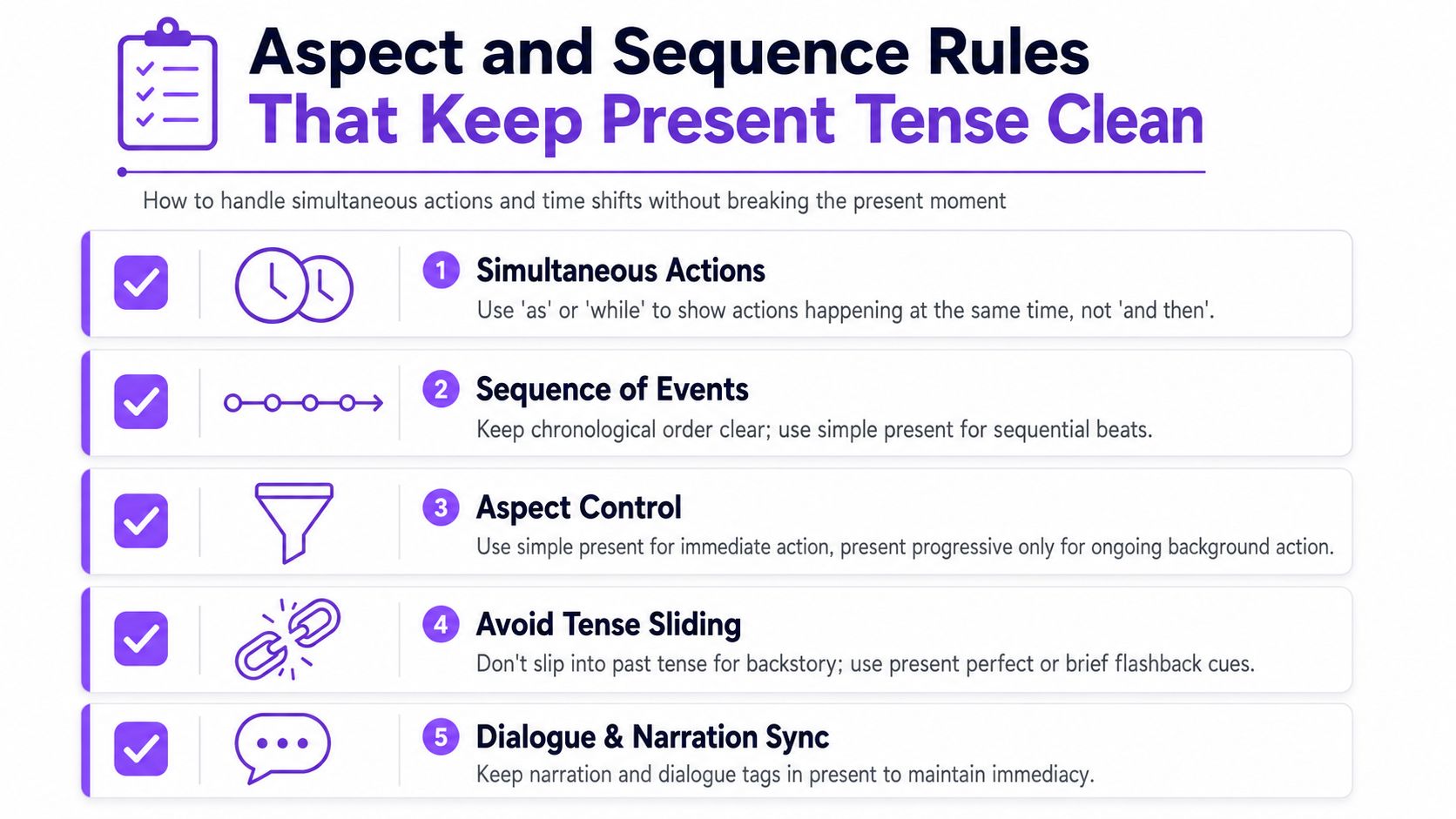
Dialogue can shift tense without damaging the surrounding narration because the speaker controls a separate semantic frame. “I saw him yesterday,” a character says inside present-tense narration. The dialogue's past is correct. The dialogue tag and surrounding action remain in the novel's present frame: “She says,” not “she said,” unless the narration has deliberately moved.
Clause coordination deserves a ruthless pass. “She opens the letter and has been reading it for an hour” combines a current beat with an ongoing prior duration. That can be right, but it creates a specific timeline. Don't let mixed aspect enter a sentence by accident. The timeline in fiction glossary is useful when a manuscript's time markers become dense, but the principle is simple: every aspect choice should tell readers how an event relates to the scene's now.
The Tense Drift Problems Long Drafts Actually Produce
The first failure usually looks harmless. A present-tense chapter reaches a memory: “Nadia remembers the hospital corridor. Her father waits beside the vending machine.” Then the paragraph continues, “He turns when she enters,” without making clear whether the remembered event has ended or the current scene has absorbed it. The reader has to stop and solve a timeline the author never intended to present as a puzzle.
Another draft moves from simple present into historical present during summary. “The town closes its shops after sunset. In 1987, the mayor declares a curfew and soldiers arrive.” The second sentence may be a deliberate historical-present flourish, but without a frame it creates two apparent nows, one belonging to the town's current routine and another belonging to the old event.
The viewpoint handoff creates a quieter problem. Chapter four ends in present, and chapter five follows a secondary character. The author begins writing that chapter in past tense because the character's voice feels more reflective, then returns to present halfway through a conversation. The shift often survives because each sentence sounds grammatical. At chapter scale, it looks like the manuscript has changed its narrative contract without telling anyone.
The most expensive failure appears at the climax. A character realizes that the trusted witness has lied, but the prose narrates the realization retrospectively even though the scene has been running live: “She understands now that he has been working for them.” If the setup promised a shock in the moment, this sentence can make the revelation feel pre-digested. The reader receives the conclusion without experiencing the mental turn that the scene built toward.
Tense drift rarely announces itself as a bad sentence. It announces itself as a reader who no longer knows which moment deserves attention.
Long drafts magnify these errors because repetition normalizes them. A single unmarked memory may pass. Several hundred pages of unmarked memories, viewpoint inheritance, and summary shifts train the reader to distrust every tense signal. Revision then becomes more than verb correction. You have to restore the distinction between current action, remembered action, reported knowledge, and retrospective meaning.
Why Manuscript Intelligence Beats Spreadsheets for Tense Consistency
A 90,000-word manuscript contains roughly 18,000 verb phrases, based on the planning assumptions used for this workflow. Human reviewers can catch perhaps five tense slips per pass before attention fatigue erases the rest. Those figures aren't a published performance study, so treat them as an editorial workload model, not as universal measurement. The underlying problem is familiar: sentence-by-sentence proofreading doesn't scale to a novel-length temporal system.
Manual proofreading works well for a short excerpt. Once the manuscript grows beyond 15,000 words, the same workflow becomes increasingly vulnerable to fatigue and inconsistent revisiting. A color-coded spreadsheet improves visibility, but it makes the writer maintain a second record, copy scene information into cells, and decide whether a tense change is intentional each time. That transcription layer creates its own errors.
Real-time manuscript analysis takes a different approach. It should identify simple present, present progressive, present perfect, and past-tense occurrences by scene, then compare them against the established frame. It should flag a progressive sentence wedged inside a simple-present passage, an unclosed flashback, or a secondary viewpoint chapter that has inherited the previous narrator's tense.
| Workflow | Word Limit Before Errors Slip | Revision Speed | Aspect-Level Detection |
|---|---|---|---|
| Manual proofreading | Effective for shorter excerpts, but errors become easier to miss as length increases | Slow during repeated passes | Limited to what the reviewer notices |
| Color-coded spreadsheet | Stalls when scene and chapter tracking become complex | Moderate, with maintenance overhead | Depends on manual classification |
| Manuscript-intelligence scanning | Built for long-form drafts and recurring checks | Faster for targeted revision | Can compare aspect and tense patterns by scene |
The useful output isn't a red underline under every past-tense verb. Past tense may belong inside dialogue, memory, reported history, or a deliberate historical-present contrast. The useful output is a contextual warning that says, in effect, this sentence doesn't match the temporal behavior around it.
That's the difference between proofreading and manuscript intelligence. Proofreading asks whether a sentence is grammatical. Continuity analysis asks whether the sentence belongs at this point in the novel.
A focused self-editing workflow for novels still matters, because no tool can decide every intentional stylistic move. But a scalable system can surface the places where your intention needs to be confirmed, rather than making you hunt through thousands of verbs from memory.
Novelium's Character Tracker and World Codex automatically extract and track character details across a manuscript, while its manuscript editor can surface tense, timeline, character, and continuity inconsistencies as you draft. Visit Novelium to check how its scene-level tracking can help you keep present-tense aspect, viewpoint knowledge, and embedded timelines under control across a full novel.