Why Is Continuity Important
The popular advice is that continuity is what you check after the writing is done, once the manuscript has already found its shape. That advice is wrong for any novel large enough to contain a substantial cast, several timelines, or a series of recurring locations. Continuity isn't proofreading with a detective hat. It's the system that keeps a reader's understanding of the story stable from scene to scene.
Every fact you establish becomes part of the reader's working model. A character has a scar, knows about a betrayal, lives three days from the capital, or keeps a key in the desk drawer. Later scenes must account for those conditions. Research on developmental continuity describes consistency as a gateway to prediction and links stability with reliability and predictive validity (the NIH-hosted review of continuity and stability). Fiction works on the same basic principle. Readers predict what follows from what came before.
That's why continuity failures cost more than a laughable eye-color mistake. They cause immersion loss, trust erosion, pacing drag, and avoidable review damage. Once readers stop accepting the manuscript's facts, they start checking them instead of inhabiting the story.
Continuity Is the Backbone Your Reader Stands On
The useful definition is simple: continuity is coherent state across scenes. State includes what a character looks like, what they know, what they possess, where they are, what has happened to them, and how much time has passed. A continuity audit asks whether those conditions still make sense when the manuscript moves forward.
Narrative coherence depends on temporal order, context, and causal connection. Research distinguishes temporal, causal, and thematic coherence, because a story can preserve dates while losing the reason one event leads to another (research on narrative coherence and comprehension). A scene doesn't merely need to happen after the previous scene. It needs to inherit the consequences of that scene.
Practical rule: Treat every established fact as a promise with a future cost.
Willing suspension of disbelief gets misunderstood. Readers will accept extraordinary premises if the manuscript applies its own conditions consistently. They won't object because a world contains magic, ghosts, or impossible technology. They object when the rules change only when the plot needs a shortcut. That distinction is central to willing suspension of disbelief.
A continuity failure therefore behaves like an architectural crack. One loose detail may remain unnoticed, but a contradiction in a character's knowledge can damage every decision that follows. A late revelation feels unearned, a chase loses urgency because travel time no longer works, or a relationship appears to reset without emotional cause. The reader doesn't need to name the problem. They feel that the novel has stopped carrying its own weight.
The most reliable manuscript analyses don't begin by asking whether a detail is beautiful, plausible, or thematically interesting. They ask whether the detail remains operationally true wherever the story depends on it.
The Four Kinds of Continuity That Actually Break
Writers often call every inconsistency a plot hole. That label is too blunt to help. Different failures require different evidence, different searches, and different revision decisions.
Character continuity
This covers physical traits, age, voice, temperament, habits, relationships, and identity. The obvious examples are a vanished tattoo or a character described with a different eye color. The more damaging examples involve relational knowledge. A sister suddenly uses an intimate nickname she hasn't learned, or a rival behaves as if an earlier betrayal never happened.
Character development documents describe intended change. Character tracking records actual state changes and their locations. Those aren't interchangeable. A profile may say that Mara becomes more suspicious. A tracking system needs to show when she learned the information that made suspicion rational, which scenes changed her relationship with Theo, and whether her later dialogue reflects those changes.
Timeline continuity
Dates, seasons, ages, durations, travel, appointments, and scene order all belong here. Revision makes this category particularly dangerous. Move one meeting earlier, and a letter may arrive before it was sent. Compress a journey, and a character may appear in two distant places without enough time to travel.
A reliable timeline is built from explicit dates, durations, and ages, then tested against every interval, including casual phrases such as “three weeks later” (a practical continuity guide to timeline construction). Those throwaway phrases are often where the arithmetic breaks.
Knowledge-state continuity
This is the category most profile documents barely touch. Track who knows what, when they learned it, and what they could reasonably infer. A character can't react to a secret merely because the author has already written it. The manuscript must show how that information reached them.
Prop and setting continuity
Objects and physical conditions create a second state layer. Keys move, letters get delivered, weapons are lost, injuries worsen or heal, coats become wet, rooms change configuration, and bodies occupy actual positions. A character can't lock a door with a key left in a drawer unless the text accounts for the key's movement.
These categories fail independently. A manuscript can have a flawless date sequence and still give a character impossible knowledge. It can preserve character identity while teleporting an important object. Treating continuity as one vague “consistency read” is why writers fix the visible typo and miss the structural contradiction.
Character and Timeline Failures You Have Probably Missed
The failures that survive a draft usually aren't dramatic. They're small state changes that nobody recorded when the scene was revised.
A scar heals between chapters, then appears as fresh and painful during a later confrontation. A character's eyes shift from green to gray because two descriptions were written months apart. Two siblings exchange birth order, which changes the emotional meaning of an inheritance dispute. A guarded character's voice becomes conversational in one late scene because the author is writing the emotional destination before fully carrying the voice there.
Timeline errors spread through revision rather than initial drafting. A chapter originally set on Tuesday moves to Friday, but the protagonist still receives Tuesday's letter. A birthday appears after the character has already passed the established age marker. A subplot depends on a meeting happening before another event, while the revised order puts the consequence first.
A search can find every mention of “scar.” It can't reliably tell you that the scar's condition conflicts with an injury described earlier, or that the character's changed knowledge invalidates a later decision. That's why self-editing by keyword alone is a weak remedy. It finds words, not dependencies.
The timeline error glossary is useful language for separating an impossible sequence from a simple date typo. The distinction matters because one needs local correction, while the other may require restructuring several scenes.
| Failure Type | Typical Example | Why It Slips Through | Remedy |
|---|---|---|---|
| Physical state | A healed wound reopens without explanation | Descriptions are separated by chapters | Track injury condition at each appearance |
| Identity detail | Eye color or birth order changes | Different drafts carry different versions | Establish a canonical fact and audit every mention |
| Voice and behavior | A guarded character speaks with sudden openness | The emotional arc advances faster than the evidence | Compare dialogue against accumulated relationship state |
| Elapsed time | A Friday scene contains Tuesday's unread letter | Revision moves scenes without recalculating intervals | Build a dated event log and verify each dependency |
| Age and milestones | A birthday occurs twice in the same progression | Dates live in separate character and plot notes | Reconcile ages, birthdays, and historical anchors together |
Published novels aren't immune to these problems. The practical assumption is that a long manuscript contains at least one missed dependency. That assumption produces a better audit than confidence in memory.
How a Small Slip Becomes a Credibility Collapse
Consider a representative failure. In chapter twelve, the protagonist reacts to a conversation she supposedly overheard. Two scenes earlier, however, the blocking places her in another room with a closed door, and no later scene gives her the information.
The local fix looks easy. Add a line saying she heard the exchange, or move her into the corridor. But if the correction isn't made, chapters thirteen through nineteen inherit a poisoned knowledge state. The reader now has to reconsider her decisions. Was her suspicion justified? Did she know about the threat? Was her silence strategic, or did the author forget what she had and hadn't learned?
Computational narrative research models this problem as a story graph in which characters, places, and events connect through causal relations. Later edits can contradict earlier facts, while event-indexed memory can audit whether a character or object remains aligned with prior mentions (formal work on computational narrative consistency).
A continuity error rarely stays where it occurs. It changes the reader's confidence in everything built on top of it.
That suspicion slows reading. Readers begin auditing instead of anticipating. Pacing feels heavier because every reveal requires verification, and reviews may focus on the manuscript's reliability rather than its intended effect. The problem isn't the incorrect overheard conversation by itself. The problem is that it makes the reader unsure which version of the protagonist exists.
What Manuscript Tracking Tools Actually Solve
The useful tools aren't judgment machines. They're externalized memory systems for facts no writer can safely hold across a long manuscript.
A manuscript-intelligence platform can parse character entities, record first and last appearances, and compare physical attributes across scenes. That catches a tattoo that disappears, a wound that changes condition, or an object that resurfaces after the text has established it was destroyed. It can also expose timeline conflicts such as overlapping commitments or travel intervals that don't fit the surrounding events.
Knowledge state needs a different check. The relevant question isn't whether a secret appears somewhere in the manuscript. It's whether the character has a defensible path to learning it. A tracking system can flag a reference to information that the text never showed the character receiving, leaving the author to decide whether to add a scene, revise the dialogue, or preserve the mystery.
Research on narrative systems describes coherence as a relationship between neighboring situations and the intermediate situation they support. If adjacent scenes don't make the next state plausible, coherence drops. That gives continuity a practical shape: inputs are established facts and state changes; outputs are contradictions, unsupported transitions, and unresolved dependencies.
Novelium's Character Tracker and World Codex automatically extract and track character details, relationships, locations, objects, knowledge states, and events across a manuscript. It can surface timeline inconsistencies and contradictions while leaving the creative decision with the writer.
The limitation matters. Tools can't decide whether a subplot feels earned, whether a character's choice is thematically right, or whether a contradiction is an intentional revelation. They can only test declared facts against later usage. For a manuscript of 80,000 or more words, that narrowness is a strength, not a weakness. The system handles retrieval and comparison so the writer can spend revision time on meaning.
Running Your Own Continuity Pass Before You Publish
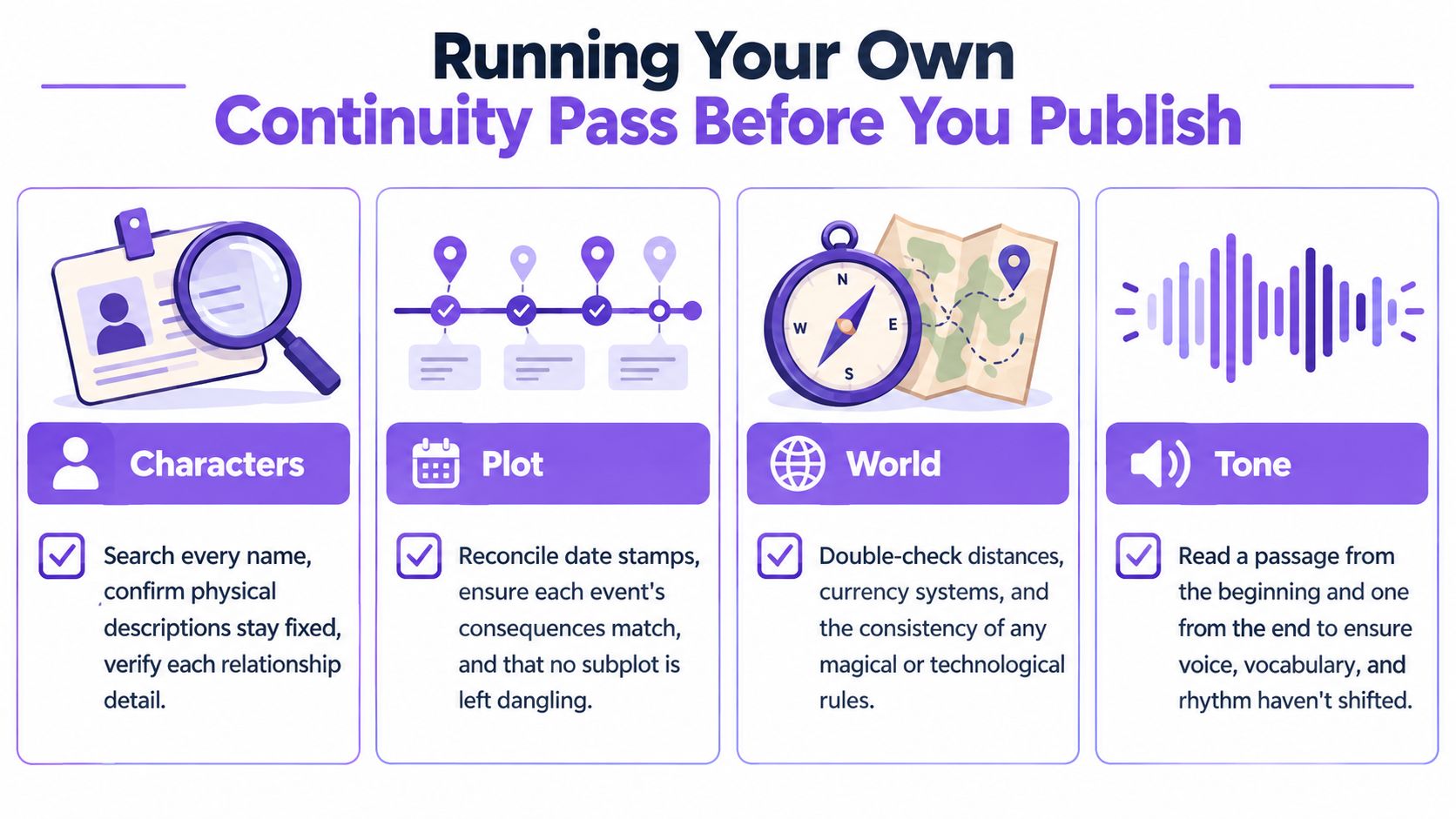
Don't run one enormous “consistency read.” Run separate passes for separate failure modes. A practical continuity workflow looks like this:
- Characters: Search every name, confirm physical descriptions, and verify relationship details. Record what each major character knows after every revelation.
- Timeline: Build a chapter-by-chapter event log with dates, ages, durations, and travel. Test every “later,” “the next morning,” and “three weeks after” against the actual sequence.
- Props: Tag significant objects such as keys, letters, weapons, documents, and heirlooms. Trace where each one is before and after every scene that depends on it.
- World rules: Write down each magical, technological, legal, or social constraint. Check scenes for exceptions that haven't been earned or explained.
Use two passes, not one heroic marathon. The broad pass finds orphaned facts, duplicate milestones, missing objects, and obvious timeline collisions. The targeted pass interrogates each suspect line by searching backward for its cause and forward for its consequences.
A running reference for names, dates, objects, relationships, and spatial layout is more reliable than memory, especially as small inconsistencies accumulate across a long manuscript (guidance on diagnosing continuity problems). Separate passes for timeline, character knowledge, physical state, and relationships also prevent one category from hiding another (a revision continuity checklist).

A structured self-editing process for your novel beats repeated rereading because it turns vague unease into traceable questions. Continuity is a state-tracking problem, and systematic work wins against memory every time.
Novelium's Character Tracker and World Codex extract details across your manuscript, then track characters, relationships, objects, knowledge states, locations, and timeline dependencies as the draft changes. Visit Novelium to run a continuity-focused analysis before publication and find the contradictions your memory has been protecting.