Timeline for a Story: A Practical Guide for Novelists
Most advice about a timeline for a story starts with a spreadsheet. Put every event in chronological order, add dates, and continuity will supposedly take care of itself. That works until the manuscript becomes long enough to contain multiple point-of-view characters, parallel plots, flashbacks, delayed revelations, travel, injuries, secrets, and consequences that arrive well after their causes.
A timeline is not just a list of dates. It's a control system for when events happen, who knows what, what the reader has been shown, and when consequences become visible. Those clocks often diverge on purpose. The trouble starts when the author tracks only one of them.
Why Most Story Timelines Fail at Scale
A flat chronology can tell you that the murder happened before the investigation. It can't tell you whether the detective knows the victim's identity, whether the reader has seen the killer's motive, or whether the victim's family has had enough time to react. Those are different continuity questions, and a single row of dates has nowhere to put them.
Narrative theory separates story time, the chronological sequence of events as they happen to the characters, from narrative time, the order in which the author presents those events. Fiction can move linearly, backward, through nested flashbacks, or in fragments while still preserving an underlying chain of causes and effects. That distinction is central to guidance on narrative time in fiction, particularly in manuscripts where a misplaced scene can make a later action appear unmotivated.
Editorial rule: A chronology answers “when did this happen?” It doesn't answer “who can know it now?”
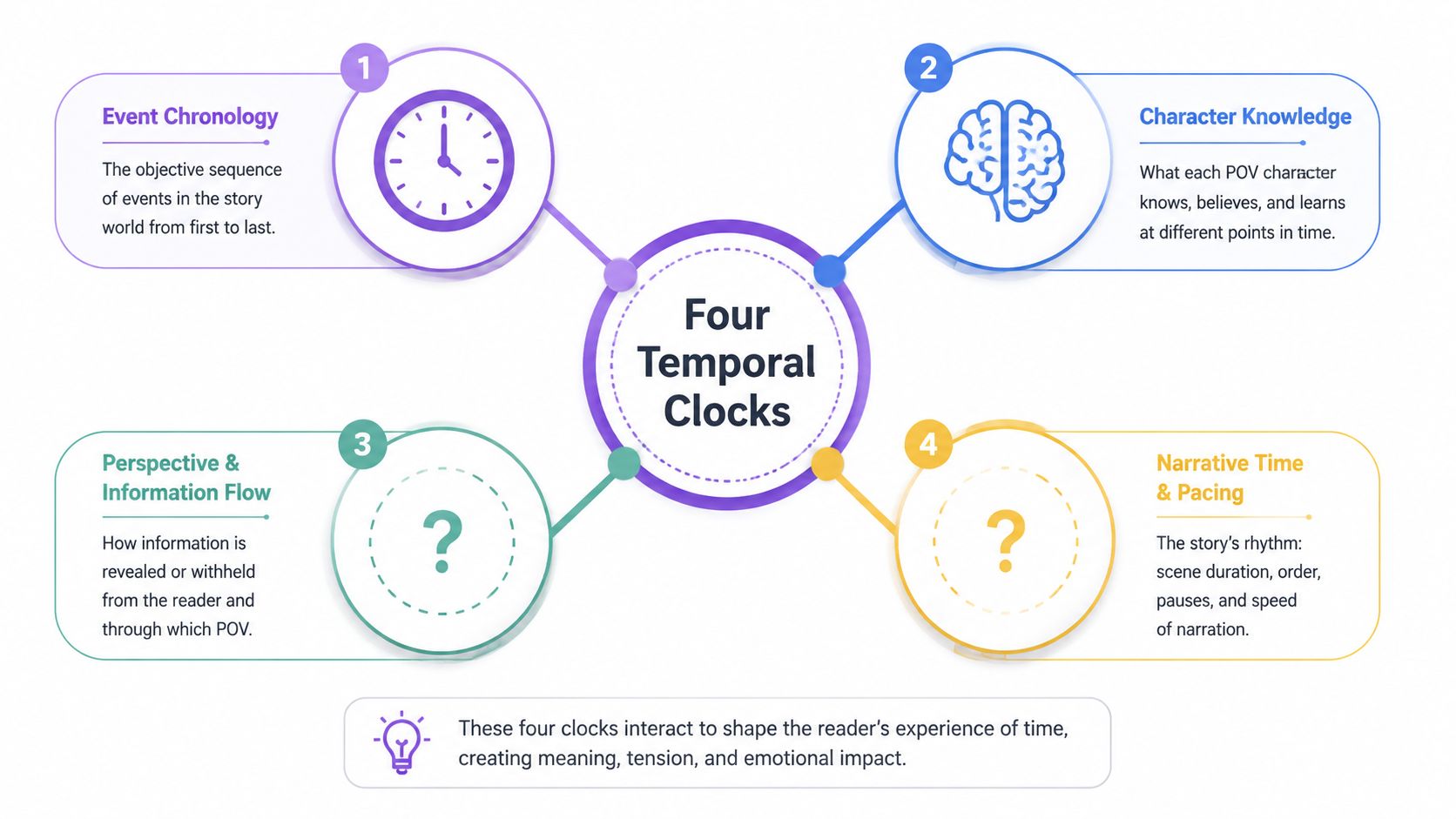
In a 90,000-word multi-POV novel, the operational problem usually involves four clocks. Event order records what happened in-world. Character knowledge records what each person has learned. Reader access records what the manuscript has revealed. Consequence timing records when an event changes behavior, relationships, physical condition, or plot direction.
That's why a murder can occur early, its motive can surface much later, and the family's response can arrive after another delay without creating an error. The structure may be sound. The tracking is what fails. Writers managing subplots need a system that connects chronology to narrative placement, which is why tracking subplots across a manuscript belongs beside timeline work rather than in a separate planning file.
The same principle applies outside fiction. A roadmap has to distinguish the order of work, dependencies, ownership, and delivery consequences, not merely list tasks. The practical thinking behind product manager roadmap tips translates neatly to complex novels: track dependencies, not just milestones.
Building a Two-Track Timeline System
The minimum workable system for nonlinear fiction has two tracks. The first is the story chronology, the order events occur in the fictional world. The second is the reading order, the order in which scenes appear on the page.
Start with chronology. Record each event at the level the manuscript requires. A thriller may need something like “Day 1, 9:00 AM, Mara discovers the body.” A family saga may need only “late autumn, after the eviction.” Precision should serve a continuity question, not satisfy an urge to catalogue everything.
Then build the reading-order track separately. Chapter 1 might open with Leon receiving a phone call. Chapter 4 reveals the earlier discovery of the body through a flashback. The chronology says the discovery came first. The book says the phone call came first. Both records are correct, and keeping them separate makes the divergence visible.
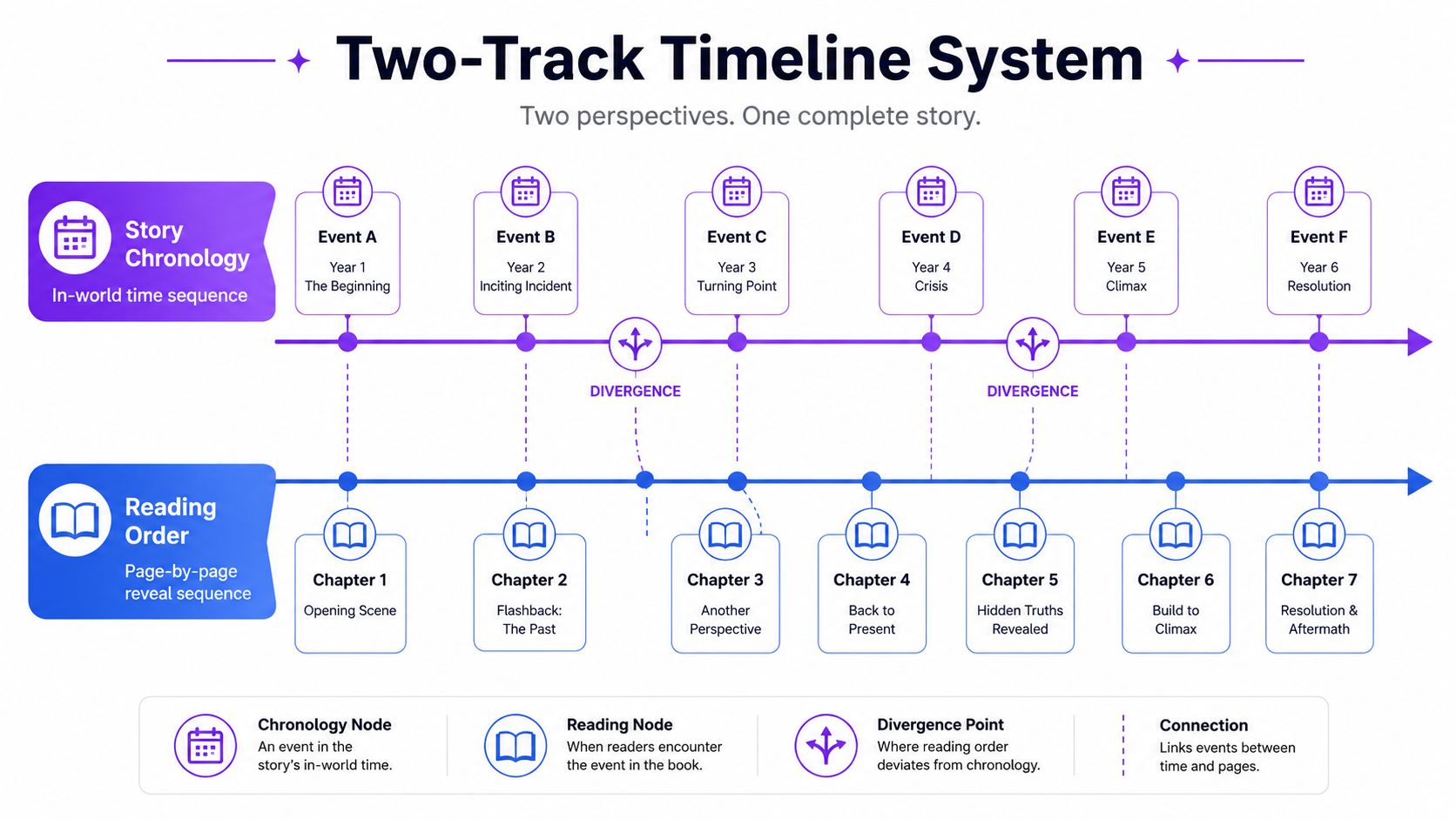
For every scene, record at least four fields in one working view:
- In-world placement, including date, season, or relative position.
- Chapter placement, including POV and scene position.
- Knowledge change, meaning what a character learns, forgets, suspects, or misunderstands.
- Dependency, meaning the earlier event that makes the scene possible.
That last field catches the errors a conventional outline misses. If Chapter 7 contains a confrontation caused by a letter, the letter must exist in chronology, reach the correct location, and become available to the character before the confrontation. If the letter appears in Chapter 9, either the confrontation needs a different cause or the reading order needs to change.
Dual-timeline novels benefit from colour or labels for each temporal strand, but don't mistake visual separation for analysis. The alternating chapters in a historical novel still need links between past and present. Circular structures such as Pulp Fiction can work because the reader eventually reconstructs causality. The author still needs a private chronological record, even when the published order loops.
A story-timeline guide notes that fiction commonly uses linear, reverse, nested, and out-of-order structures, while serialized storytelling has long depended on ordered beats and continuity. Wilkie Collins's The Woman in White appeared serially from 26 November 1859 to 25 August 1860 in one venue, across 40 parts, and from 26 November 1859 to 8 September 1860 in another, across 42 parts. The publication history is documented in this guide to story timelines, and the lesson still holds: readers can tolerate unusual order, but not causal confusion.
The Four Clocks Every Complex Manuscript Needs
A timeline can be factually correct and still break a novel. In a long, multi-POV manuscript, the event order may work while a character knows too much, the reader receives a fact too soon, or a consequence disappears between chapters. Static timelines record sequence. They do not manage these four separate clocks.
Event chronology
Event chronology records what happens, when it happens, and how much time passes. Track dates, seasons, travel, waiting, sleep, recovery, and chapter-level story time. Those transitions determine what a character can plausibly do next. A continuity method built around day-by-day chronology recommends separate passes for timeline, knowledge and objects, motivation, and reader promises, so each review isolates a different class of error. See the continuity guidance on recording elapsed time and scene plausibility.
Character knowledge
Each POV character needs a knowledge state, not only a biography. Mark when the character witnesses an event, hears a report, makes an inference, receives a document, or remains unaware. A common leak occurs when a character refers to a later conversation or reacts to a secret they had no credible route to learn.
Track knowledge by character and scene. “The truth is revealed in Chapter 12” leaves too much unresolved. Write, “Nadia learns the name in Chapter 12, but believes the source is lying until Chapter 15.” This record also helps with tracking continuity errors, including character-description drift and timeline inconsistencies.
Reader access
The reader's clock controls suspense, surprise, and dramatic irony. A fact may be true in the chronology and known to one character while remaining hidden from the audience. Record the first page or scene where the reader gains each significant fact, then check later references against that access point.
A ticking clock in fiction works only when the pressure is legible. Track what the reader understands about the deadline, what the characters misunderstand, and when the consequences become unavoidable. Revealing the same fact at the wrong point can flatten suspense even when the underlying chronology remains sound.
Consequence timing
An injury, betrayal, discovery, or public accusation changes the story's state. Record that change and carry it into every later scene. If a character breaks a wrist in Chapter 5, the hand cannot function normally in Chapter 12 unless the manuscript provides recovery time or explains why the limitation no longer applies. If a secret changes a relationship, later scenes must show that altered relationship, even when nobody names the secret.
Small mismatches expose weak tracking. One scene gives a journey a full day, while the next places the arrival before lunch. A character carries an object left behind. A dead character appears in a flashback without a clear temporal label. These are state-tracking failures across four clocks, not failures of imagination.
Catching Timeline Errors Before Your Editor Does
Don't revise chronology while polishing sentences. That mixed pass asks your brain to judge voice, pacing, dialogue, motivation, geography, and calendar logic simultaneously. It misses exactly the errors that hide inside otherwise strong prose.
Run a dedicated timeline pass in three lenses. Start with the calendar, then use the map, then audit information flow.
The calendar pass
Extract every temporal anchor into a separate document. Include dates, weekdays, seasons, holidays, “the next morning,” “three weeks earlier,” ages, anniversaries, pregnancy references, moon phases, and chapter transitions. Assign each chapter a story-time index instead of trusting manuscript order. Small mismatches in elapsed time are common continuity failures, as explained in this discussion of elapsed-time errors in fiction.
The notorious Tuesday problem appears when a character says it's Tuesday, a later chapter places the same event on Thursday, and no intervening days account for the shift. Pregnancy math and moon phases expose the same weakness. If the exact detail doesn't matter, remove false precision. If it matters, calculate it once and make the manuscript obey it.
The map pass
List each scene's location and the movement between them. Check whether the characters have enough time for travel, recovery, meals, sleep, and emotional transition. Calendars alone won't catch a character who crosses a country between breakfast and a late-morning confrontation.
Penguin Random House copy-editing guidance treats calendars as tools for working out when events happen and maps or atlases as essential for understanding place. That spatial logic belongs inside timeline checking, not in a separate worldbuilding folder. The relevant continuity advice from a copy editor makes the point clearly.
The information pass
For each scene, ask what every participating character knows, what the reader knows, and what changes by the end. Flag reactions that require unavailable information. Then check objects, injuries, identities, and promises against those knowledge states.
A separate continuity pass can save substantial revision work. A 2022 survey of 340 fiction authors reported an average of 14.3 hours spent on continuity-related revisions by writers without a dedicated continuity system, compared with 3.1 hours among writers using a story bible. The survey also reported that 78% of self-published authors found at least one major continuity error in a debut novel, with timeline inconsistencies reported by 51% and character-description drift by 62%. Those figures come from this story-bible survey summary.
When Strict Chronology Helps and When It Hurts
Exact timestamps help when the reader is expected to reconstruct events. Thrillers, legal procedurals, and converging multi-POV plots often need firm tracking because a missed hour can alter an alibi, a pursuit, or the order of evidence. Strict chronology also helps when travel, aging, pregnancy, injury, or deadlines drive the plot.
Other manuscripts need atmosphere more than arithmetic. A romance may gain more from “after the first frost” than from an exact date that invites an unnecessary factual audit. Literary fiction can use weather, seasons, and emotional distance as temporal markers without pretending every transition has been measured.
| Manuscript Type | Recommended Precision | Key Risk if Mismatched |
|---|---|---|
| Thriller or procedural | Scene-level dates and travel intervals | Loose tracking can break alibis and evidence order |
| Multi-POV epic | Dates plus parallel strand labels | A flat calendar can hide POV and knowledge conflicts |
| Dual-timeline historical fiction | Firm anchor dates, flexible scene detail | Overprecision can create false certainty around minor transitions |
| Romance or character-driven fiction | Seasons, intervals, and state changes | Exact dates can distract from emotional rhythm |
| Literary or fragmented structure | Event anchors with deliberate gaps | Overtracking can flatten ambiguity and interpretive space |
The test is simple. Ask whether readers need to calculate time to understand the plot. Ask whether a date changes a character's available action. Ask whether an inconsistency would damage causality or merely contradict a decorative detail. Track the first category strictly. Keep the second elastic unless the manuscript makes it consequential.
Moving Beyond Spreadsheets to Real Continuity Tracking
Spreadsheets are useful during planning, but they become fragile when the manuscript contains several linked documents, character states, objects, locations, and plot strands. The problem isn't the grid itself. It's drift. You update the chronology, forget the character sheet, revise the chapter order, and leave the old assumption alive somewhere else.
A story timeline becomes reliable when it connects to the states that make events meaningful. A journey changes location. An injury changes physical capability. A confession changes knowledge. A stolen key changes object ownership. A death changes who can appear in the present. Treating each as a separate spreadsheet turns one continuity problem into several synchronization problems.
Relational databases and writing applications with timeline modules can link those records more effectively. They still require setup and disciplined naming. Automated consistency checkers reduce the burden of locating repeated details, but they don't replace editorial judgment about whether a contradiction is intentional, a red herring, or a mistake.
A timeline is infrastructure, not decoration. Build only the detail you'll use to make a decision.
For a complex manuscript, choose a system that can connect event dates with character knowledge, parallel storylines, object states, and durations such as journeys or pregnancies. Novelium's Character Tracker and World Codex extract and track character and world details across a manuscript, while its timeline view arranges events chronologically and helps identify conflicts and time jumps. That approach addresses a key weakness of static profiles: they describe a character, but they don't maintain the character's changing state across scenes.
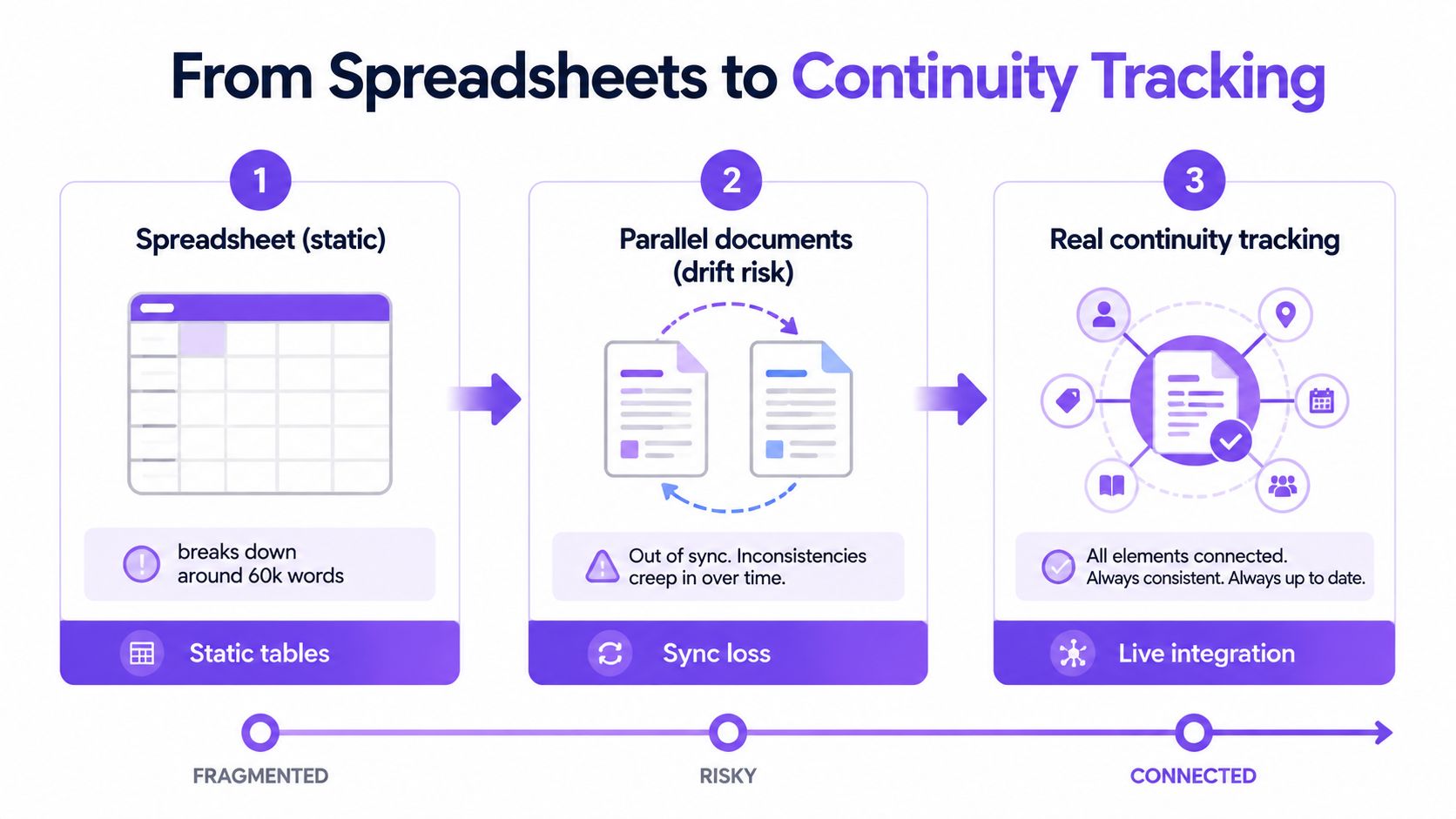
Use a spreadsheet when you're mapping a premise or testing a sequence. Move to connected tracking when revisions begin changing dates, chapter order, knowledge states, and physical continuity in different places. The payoff isn't more documentation. It's fewer silent contradictions surviving until the final edit.
Novelium's Character Tracker and World Codex extract details from your manuscript and connect them to evolving character states, world rules, objects, events, and chronology. Visit Novelium to check a complex draft for timeline conflicts and continuity breaks before they become expensive editorial repairs.