Structure of a Story That Survives Revision
Hitting every beat doesn't mean you've built a working novel. Say your 90,000-word draft has a setup, midpoint, and climax exactly where the outline says they belong, yet the middle still reads like interchangeable obstacles. Moving the midpoint won't fix that. You need to inspect what changes between scenes.
Why Finished Beat Sheets Still Sag
The structure of a story is the sequence of changes that makes later events necessary, not a costume of act labels. A betrayal matters structurally because it changes who can be trusted, which plan remains possible, and what someone does next. Calling it the midpoint adds no strength.
If you're managing a long manuscript, recurring series characters, or a sprawling cast, you've already tried questionnaires and spreadsheets. You don't need another exercise about goals and flaws. You need to find the places where an apparently complete outline conceals a broken dependency.
A scene can occupy the correct position and still do the wrong job.
Aristotle's Poetics, generally dated to the 4th century BCE, offers the older completeness test: beginning, middle, and end should form one causally connected action, not unrelated incidents, as Videomaker's account of dramatic structure explains. That's more demanding than dividing a document into acts.
Diagnose the change, not the label
The expensive revision problems appear when a turn pays off the wrong conflict, a subplot repeats an earlier decision, or someone acts on information they haven't received. Those aren't cosmetic continuity errors. They alter what the plot can credibly do.
Use word-count checkpoints to locate the major turns, then test whether their scenes change knowledge, options, or consequences. A beautifully proportioned outline is only useful if the manuscript underneath it obeys its own history.
Checkpoint Positions in a Long Novel
Drop structural markers into the draft before moving chapters. The conventional 25% setup, 50% confrontation, 25% resolution split gives a 90,000-word novel act lengths of approximately 22,500, 45,000, and 22,500 words, according to Deckle's three-act outlining guide. Scaled to a 100,000-word manuscript, those lengths become 25,000, 50,000, and 25,000 words.
Act lengths aren't turn positions. Zach Simms's story-structure guide places the inciting incident within the first 10% to 15%, the first act break around 20% to 25%, the midpoint around 50%, the late turn around 70% to 75%, and the climax within the final 10% to 20%. The paired positions below apply those ranges arithmetically; Deckle's narrower first-plot-point range is included within the broader window.
Structural checkpoints for long novels
| Mark | Share of book | 90,000-word position | 100,000-word position | Job |
|---|---|---|---|---|
| Act I | About 25% | About 22,500 words | About 25,000 words | Setup before the binding commitment |
| Act II | About 50% | About 45,000 words | About 50,000 words | Confrontation and the stretch most prone to sag |
| Act III | About 25% | About 22,500 words | About 25,000 words | Resolution of the conflict already opened |
| Inciting incident | 10% to 15% | 9,000 to 13,500 words | 10,000 to 15,000 words | First disturbance, not the lock-in |
| First plot point | 20% to 25%, often 21% to 23% | 18,000 to 22,500 words | 20,000 to 25,000 words | Protagonist bound to the central conflict |
| Midpoint | 50% | 45,000 words | 50,000 words | Reversal so Act II isn't a flat obstacle list |
| Second plot point | 70% to 75% | 63,000 to 67,500 words | 70,000 to 75,000 words | Low or last major turn before recovery |
| Climax | Final 10% to 20% | 72,000 to 81,000 words | 80,000 to 90,000 words | Confrontation with runway left for consequence |
Give each marker a distinct job
A disturbance isn't a commitment. Finding the murdered ambassador starts trouble. Destroying the evidence to protect the accused binds your protagonist to it. If those events perform the same function, your setup probably contains duplicated preparation.
The midpoint must change the operating conditions, not merely supply a larger obstacle. Exposing the protagonist's secret can invalidate alliances and make the original strategy impossible. Another failed attempt to enter the fortress may accomplish nothing comparable.
Checkpoint rule: Measure where the protagonist's available choices change, not where the spectacle gets bigger.
The late turn must leave room for recovery, confrontation, and consequences that answer the opening's binding conflict. These are diagnostic checkpoints, not a law. Pay particular attention to Act II, where repetitive subplot business can masquerade as development.
Cause and Effect as the Real Spine
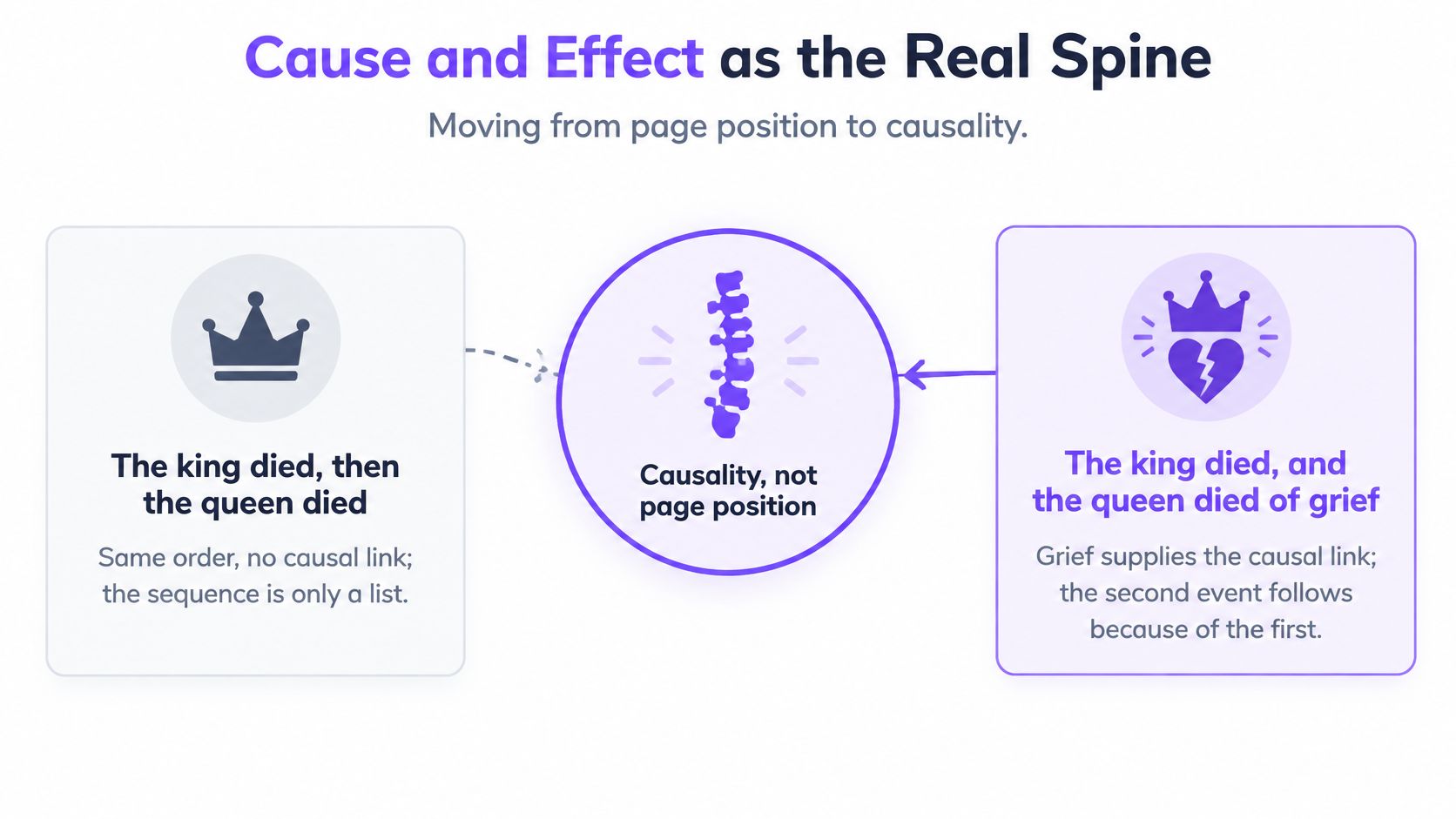
The king died, then the queen died gives you order. The king died, and the queen died of grief gives you causality. The distinction matters because causal connections support readers' comprehension and memory, as discussed in this cognitive review of narrative comprehension.
Treat each major event as a node with an initiating cause, immediate consequence, and unresolved effect. Your story spine isn't merely the sequence of dramatic highlights. It's the connected action those highlights produce.
Delete the scene and inspect the damage
Remove a scene temporarily. If later decisions, obstacles, knowledge, and outcomes remain untouched, it's structurally weak, however good the dialogue is. If cutting it makes a later action impossible or inexplicable, you've found a dependency.
This exposes failures a beat sheet can't see: an effect without a cause, a consequence placed before its trigger, or a choice based on knowledge the character doesn't possess. Say you move an interrogation earlier but leave the discovery of the suspect's alias later. The interrogation still sounds convincing, but the detective can no longer ask its decisive question.
For this audit, accept momentum through four routes: create a problem, intensify a problem, reveal information that changes options, or force a decision that closes a path. Physical action isn't required. A private refusal can eliminate more possibilities than a chase.
Track what a scene makes possible and what it makes impossible.
A character-development document helps you invent a person. A character-tracking system records that person's changing condition: what they know, believe, conceal, possess, and owe at a particular scene.
Eye color, childhood wounds, and family history can matter, but they aren't substitutes for those updates. Revise the tracking record whenever a disclosure, injury, allegiance, or chapter position changes. A profile that never changes can't tell you what a late chapter is allowed to do.
Where Each Classic Model Actually Helps
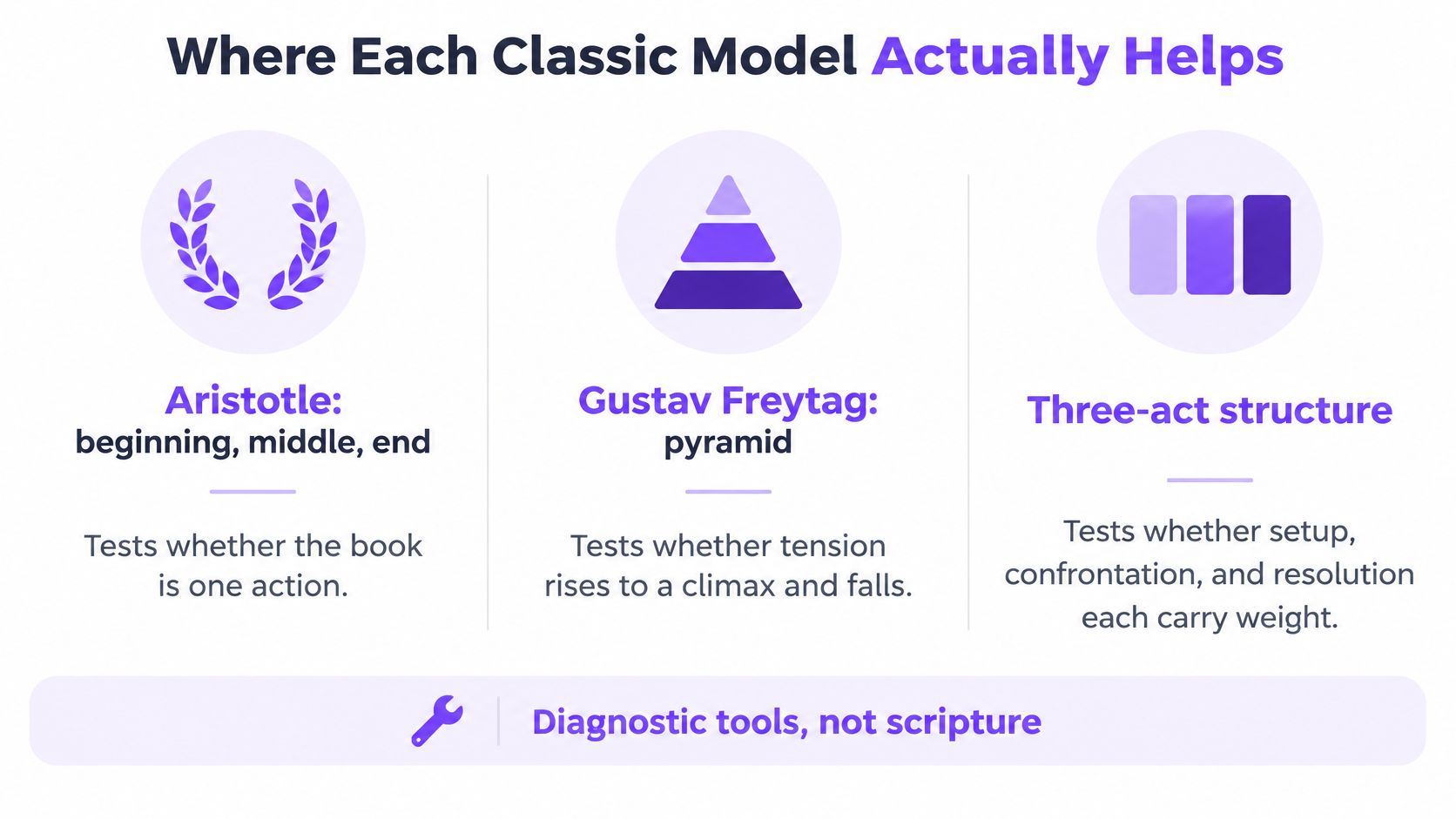
Climax doesn't always mean final battle. Gustav Freytag's 1863 model places the climax at a central reflection point, followed by substantial falling action, rather than automatically treating it as the final confrontation, as the Authors Publish narrative-structures guide explains.
Freytag developed his model through Greek and Shakespearean drama, identifying exposition, rising action, climax, falling action, and denouement, as Editor World's account of Freytag's Pyramid describes. The older catastrophe terminology and later resolution terminology shouldn't obscure the important distinction: something consequential happens after the peak.
What each story model is for
| Model | Parts | Where the peak sits | Question it answers |
|---|---|---|---|
| Aristotle | Beginning, middle, end | The end resolves the one central action | Is this one causal action or a pile of incidents? |
| Freytag, 1863 | Exposition, rising action, climax, falling action, denouement or catastrophe | Central turn, with substantial falling action afterward | Is there a middle reversal and real consequence? |
| Three-act | Setup about 25%, confrontation about 50%, resolution about 25% | Climax in the final 10% to 20% | Are the turns placed, or is the middle a flat list? |
The placement figures in the comparison use the checkpoint conventions above, not an additional prescription.
Choose the tool that exposes the fault
Reach for Aristotle when the manuscript reads like a string of adjacent episodes. Ask whether the inheritance dispute, the investigation, and the exile alter one another, or whether they merely share a protagonist.
Reach for Freytag when the closing stretch is a sprint and nobody has time to live with what happened. The useful question behind five-act structure is whether a central reversal generates sustained consequences, rather than leaving all meaningful change for the last confrontation.
Use three-act placement when you suspect the middle contains activity without a genuine turn. It gives you a practical distribution check, not permission to pad an act until the arithmetic looks respectable.
Save the Cat and the Hero's Journey don't need another beat-by-beat rehearsal here. Used as single-track templates, they assume one dominant promise. That application collapses when you assign the same priority to competing arcs without deciding which reader contract governs each major turn.
When Two Promises Share One Book
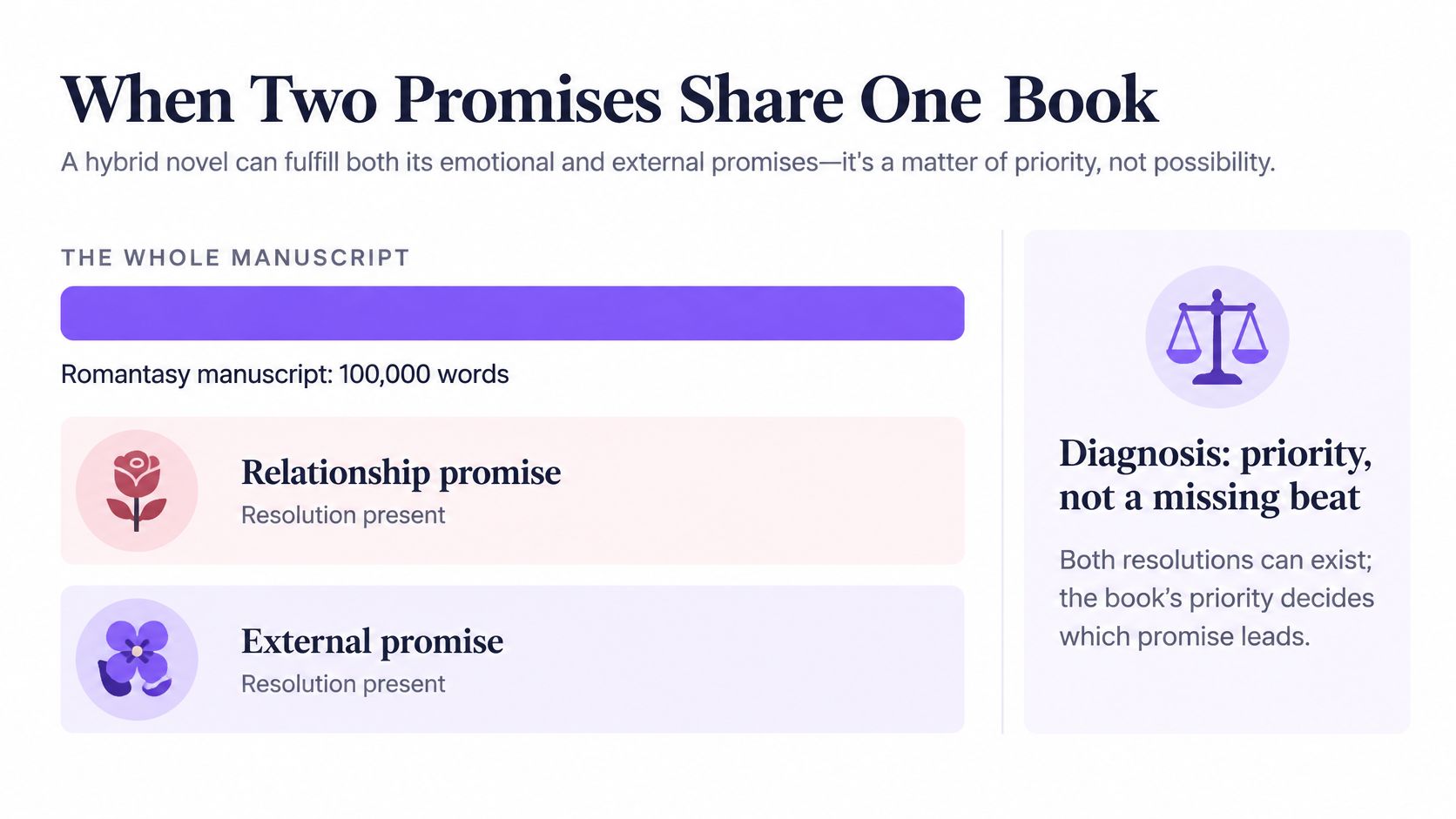
Say you're revising a 100,000-word romantasy. Both the relationship and the war reach a resolution, yet the book feels incorrectly paced. The problem can be priority, not a missing beat: the midpoint transforms the siege while readers are waiting for the romantic contract to change.
Before arranging scenes, make the hierarchy explicit. Let the romantic contract control the midpoint and ending while the war controls the climax. Reverse that hierarchy if the siege is the dominant promise, but don't drift between priorities by accident.
Separate speed from tension
Track external action, information revealed, and emotional change separately. A quiet chapter can advance the structure if the commander learns her lover authorized the blockade, then decides to keep fighting beside him. No explosion required.
Demand for bingeable, rapid-release genre fiction and cliffhanger thrillers doesn't mean every reader wants uninterrupted acceleration: SelfPublishing.com's fiction analysis cites a U.S. survey in which 40% of adults read zero books in 2025, while heavy readers accounted for a disproportionate share of consumption. Don't turn that uneven audience into a universal chapter-speed rule.
Give the fast reader consequential choices at regular intervals. Give the reader who needs air emotional or explanatory scenes that still change knowledge, loyalty, or options. Raising stakes in every chapter flattens the contrast and makes the major turn feel ordinary.
Breathing room isn't structural downtime if someone leaves the scene unable to continue as before.
Check the shape beneath the spectacle
An analysis of millions of texts, described by the Association for Psychological Science, found that narratives generally establish context early, build agency or cognitive tension toward the middle, and develop causal plotting toward culmination near the ending. Use that shape as a diagnostic baseline, not a compulsory waveform.
Flag intensity before the controlling conflict is legible, protagonist agency that stays flat through the middle, and a climax that solves a different problem from the opening's binding conflict. In the romantasy, winning the siege doesn't automatically settle whether either lover can trust the other.
Then inspect the falling action. If the commander grants a pardon using information she receives only in a conversation placed after the climax and pardon scene, the resolution is unearned. Every percentage checkpoint can match while the knowledge sequence remains impossible.
Mark the Turns and Test the Draft
Mark the inciting incident, binding commitment, midpoint, late turn, and climax in the manuscript you're revising. Compare their positions against the paired word-count table, then write a reverse outline that records what each scene changes, not just what happens.
Run the deletion test on the ten scenes you'd fight hardest to keep. Defend each with dependencies, not affection. Cutting it should change what someone knows, which options remain, or what consequence follows. Otherwise, move its best material into a scene that earns the space.
Revision priority: Fix impossible knowledge and chronology before polishing transitions.
Compare the turns with the manuscript's state
For a draft past 80,000 words, a series, or a large cast, hand tracking can fall behind. Move a chapter and every affected dependency may need updating. A static bible or spreadsheet also struggles to distinguish an established world fact from something only one character knows.
Import your draft into Novelium, or start with a blank page. Novelium never writes your story. Its Character Dashboard extracts characters from the text and shows what information each character has at every moment. Timeline View builds chronology automatically from dates in the text, helping you spot a consequence placed before its cause.
Set those knowledge states and dated events beside your structural markers. You choose the structure; the comparison shows where the turns you intended and the manuscript's actual history have split. Novelium also tracks story elements such as characters, world details, and timeline entries automatically from the manuscript, with no manual data entry. Bring an existing draft to Novelium and test its chronology and character knowledge against the turns you intended to write.