Relationship Tracker App for Novelists: What Actually Works
You're in chapter twenty-three, and a secondary character suddenly reacts like they've forgotten the last hundred pages. Last month they were protective. Now they're hostile for no reason you put on the page. Or worse, two characters who spent six chapters rebuilding trust are back to speaking like strangers because you moved one confrontation, cut another, and forgot that the emotional sequence changed underneath the prose.
That's the use case for a relationship tracker app in fiction. Not romance quizzes. Not personality cards. Not a prettier spreadsheet. Continuity engineering. When you're handling a long manuscript, a series cast, or a web of alliances that keeps shifting under revision, relationship tracking stops being optional admin and starts becoming structural support.
Why Your Character Dynamics Keep Collapsing
The failure usually looks subtle at first. A brother forgives too early. A rival knows something before the reveal. A love interest goes cold in chapter twelve even though the scene that justified the fracture got deleted in draft four. On the sentence level, everything reads fine. On the manuscript level, the emotional logic is broken.
That break almost never comes from lack of imagination. It comes from state drift. You revise in pieces. You move scenes. You compress travel time. You merge characters. Then the relationship arc that used to develop in one order now develops in another, and nobody updates the invisible ledger in the background.
Revision scrambles relationship state
Continuity errors tend to come from elapsed time and sequence, not elegant prose. One practical editing approach is to list events in story order rather than chapter order so you can catch impossible chronology slips before readers do, as discussed in guidance on timeline and chronology errors. Relationship logic works the same way. If scene B depends on an emotional shift from scene A, and scene A moved or vanished, the dependency doesn't vanish with it.
Practical rule: if a relationship change matters to motivation, it needs to be trackable scene by scene, not remembered vaguely.
Writers often get this half-right by learning how to identify a dramatic foil. That helps with contrast on the page. It doesn't solve continuity when the foil relationship evolves, fractures, or reverses under revision. Structural contrast is one thing. Tracked relational state is another.
What a relationship tracker app actually does for a novelist
For manuscript work, a relationship tracker app should record how characters relate to each other across scenes, what each person knows, when that changed, and whether later scenes contradict the established state. If it can't do that, it's decoration.
The stakes aren't small. When relationship tracking fails, the book feels unstable. Readers may not articulate the exact problem, but they feel it. Editors feel it faster. The manuscript starts giving off that grim revision smell where every scene works alone and the whole thing doesn't hold pressure.
Core Features That Actually Matter for Novelists
Most feature lists in this category are nonsense for fiction writers. You don't need mood stickers. You don't need generic collaboration fluff. You need tools that catch the kinds of contradictions that survive into late drafts.
Track perception, not just connection
A static map that says Character A knows Character B is worthless. The useful layer is how A currently sees B, and whether that differs from how B sees A. Distrust, obligation, resentment, false loyalty, concealed attraction, political dependence. Those states drive scene behavior.
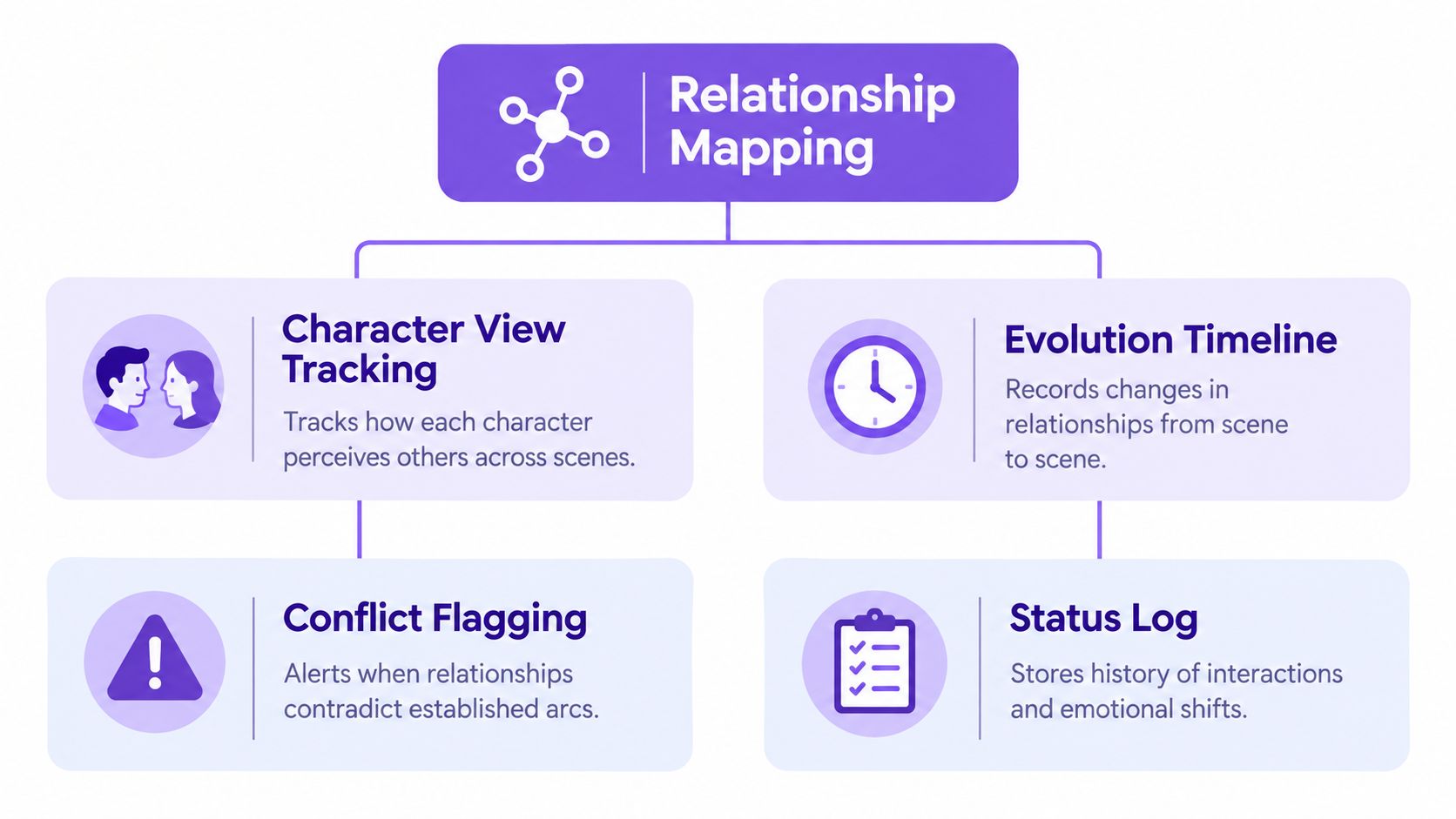
A visual map can help, but only if it updates with the manuscript. That's where many tools collapse. They look polished in demos and then become stale the minute chapter nine gets rewritten. If you like planning in spatial layouts, some of the visual workspace features in broader organizing tools show why visual structure is appealing, but for fiction continuity the picture has to stay tied to scene-level changes or it becomes wall art.
Timeline logic has to be built in
Chronology checks are not optional in long fiction. Story order matters more than document order. If a relationship thaw happens on Tuesday, and a scene on Monday refers to it as settled history, the tool should flag it. If a character is estranged in one scene and suddenly confiding in the next without any bridge, the system should surface the jump.
What matters most is whether the app connects these layers:
- Relationship state: who trusts whom, fears whom, wants something from whom
- Knowledge state: who knows the affair, the murder, the inheritance clause, the location of the key
- Scene timing: when the shift happened, and what scenes depend on it
The best continuity tools don't just store facts. They expose dependencies.
Privacy isn't a side issue
Writers dealing with unpublished manuscripts should care where this material goes. Some systems process sensitive data locally by default, which is a far more sensible model for unfinished fiction than pushing raw manuscript content into remote systems for basic analysis. A relationship tracker app isn't handling grocery lists. It's handling book-length work, spoilers, contract material, and often series plans you haven't announced.
The Difference Between Profiles and Tracking Systems
A character profile is a snapshot. A tracking system is a motion picture. Confusing the two is why so many otherwise competent writers still ship continuity mistakes.

You can have a beautiful profile document. Eye color, age, scars, first job, favorite whiskey, childhood wound, all tastefully arranged. Fine. That's useful reference data. It's also not enough. If you need a baseline definition, a character bible is where most writers start. The problem is that a bible usually tells you who the character is, not what changed in chapter fourteen after the betrayal scene got split in half.
Static documents fail in moving manuscripts
Suppose Mara begins the novel treating Elias as a threat. By the midpoint she trusts him enough to lie for him. By chapter fifteen she realizes he used her and shifts from loyalty to controlled retaliation. A profile can note that Mara is suspicious, intelligent, and slow to forgive. It does not reliably track the sequence of trust, alliance, rupture, and strategy.
That sequence is the book.
Writers often over-invest in profile detail because it's concrete and pleasant. Relationship state is messier. It requires updates. It forces you to admit when a revision broke causality. That's exactly why it matters more.
What actually deserves tracking
Physical continuity still matters. Editing guidance often recommends explicitly recording details like eye color, hair, height, age, distinguishing features, and what each character knows, then checking later mentions against the record in this editing checklist for authors. That's solid practice. But in large manuscripts, physical details usually aren't what wreck the reading experience.
These are worse:
- Emotional reversals without cause: hatred to tenderness with no intervening event
- Knowledge leaks: a character reacts to information they haven't learned yet
- Relationship amnesia: chapter eighteen ignores the fallout from chapter sixteen
The second category kills plot logic faster than the first category kills polish.
A useful demonstration of scene-level character tracking is below, because this problem only really clicks when you see the moving parts rather than the static notes.
Privacy and Workflow Considerations for Writers
For unpublished fiction, privacy architecture is part of craft infrastructure. If a relationship tracker app handles your manuscript locally by default, that's not marketing garnish. That's the difference between keeping sensitive draft material on your device and transmitting it elsewhere for routine analysis.
One privacy-forward model is local-first processing. Core relationship data such as check-ins, notes, and interaction metrics can remain on-device in browser storage by default, with sync only if the user chooses it, as described in this local-first privacy explanation. For a novelist, the appeal is obvious. If the app isn't shipping your relationship history or manuscript-derived signals to remote servers by default, the exposure surface is smaller.
The tradeoff nobody should ignore
Local-first has a cost. If the data stays on your device and you clear storage, uninstall, or lose the machine without a proper export, you can lose the tracking layer you built around the manuscript. That's not theoretical. It's the same old continuity problem wearing a different hat. You solved drift, then failed backup discipline.
If the tool doesn't make export, backup, and recovery obvious, the workflow is incomplete.
Some systems also generate insight from on-device metadata rather than raw cloud uploads. One example describes analyzing timestamps, interaction frequency, response-time calculations, initiation patterns, and balance metrics on device, with data stored in encrypted local storage and not transmitted externally, in this privacy policy description. The writing equivalent is straightforward. You want local analysis of scene relationships, knowledge states, and chronology where possible, plus clear disclosure about storage and recovery.
If privacy matters to you, read the actual handling model, not the homepage adjectives. Novelium's own privacy approach is relevant here because manuscript intelligence only makes sense if writers know where their draft lives, how it's processed, and how little unnecessary data movement is involved.
How to Choose a Relationship Tracker for Your Manuscript
Ignore the category name for a minute. A relationship tracker app built for couples and one built for fiction may share vocabulary and almost nothing else. One is trying to support personal rituals. The other needs to survive an eighty-thousand-word manuscript, recurring characters, and five rounds of structural revision.
Evaluate the failure modes first
Start with the problems your current system misses. If you already use Scrivener, Word, Google Docs, or plain text, the right tool shouldn't force a ceremonial migration just to become useful. It should help you answer practical questions quickly.
| Evaluation Factor | Why It Matters | Red Flag |
|---|---|---|
| Scene-level relationship tracking | Catches shifts in trust, fear, loyalty, and resentment where they actually occur | Only stores one static label per character pair |
| Knowledge state tracking | Prevents reveal logic from breaking after scene moves | No way to mark who learned what, and when |
| Timeline handling | Surfaces impossible sequences after structural edits | Timeline is manual only and disconnected from scenes |
| Series support | Keeps recurring characters and old history usable across books | Each manuscript exists in isolation |
| Workflow fit | Reduces friction inside tools you already use | Requires rebuilding the manuscript in a new environment |
| Privacy model | Protects unpublished work and limits unnecessary transmission | Cloud upload required for basic analysis |
| Manual override | Lets you correct edge cases and intentional ambiguity | System treats every inference as fixed truth |
Ask rude questions before you commit
Does it track changes, or just relationships as nouns? Can you see when a rivalry softened, when trust broke, and what scene established that? Can it handle recurring side characters without turning the cast into sludge? If the answer is no, skip it.
Then check whether the tool supports both automatic extraction and manual mapping. Purely manual systems die from neglect. Purely automatic systems miss nuance. A workable middle ground is better. Novelium, for example, tracks character details, relationships, and event continuity across manuscripts while fitting into existing drafting workflows, which is the sort of function that matters more than category labels.
A tool earns its keep when it removes rework, not when it gives you another dashboard to maintain.
Common Continuity Failures Tracking Prevents
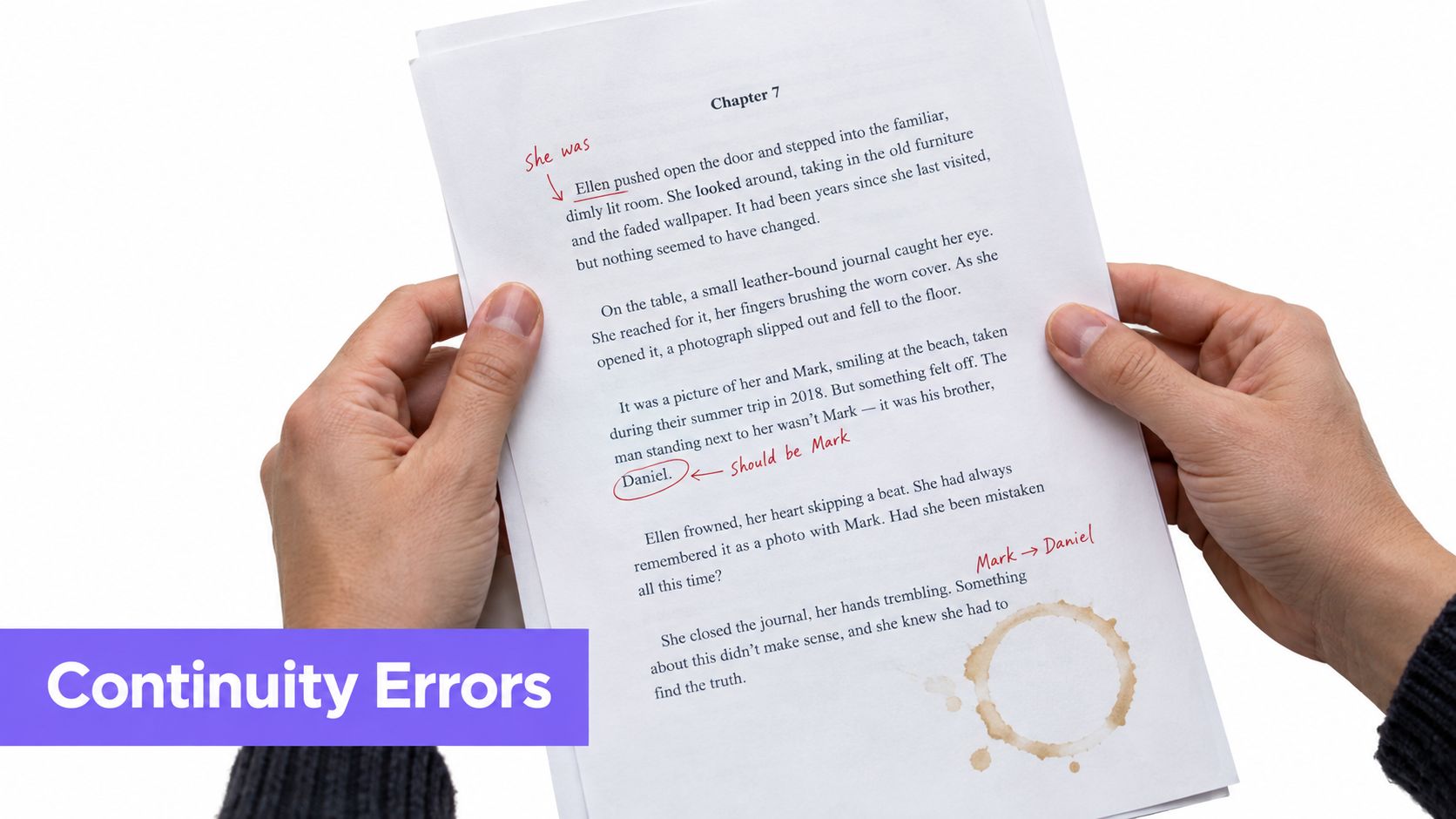
Revision is where continuity usually gets butchered. Move one scene, delete another, combine two supporting roles, and suddenly the book contains emotional and chronological claims that no longer match the actual draft. Multiple editing sources warn that structural edits break chronology around them, which is why continuity has to be checked again after rewrites in this revision continuity checklist.
The failures that keep showing up
A proper tracking system prevents a specific class of manuscript damage. It catches the girlfriend who forgives before the apology scene. It catches the detective who knows the witness lied before anybody exposed the lie. It catches the ally who acts loyal in a chapter that now falls after the betrayal.
For large casts and series work, you also need a running record of names, dates, objects, settings, and relationship changes as they first appear, with a clear distinction between intentional change and actual contradiction. That approach is central to keeping characters consistent across a manuscript or series. A scar can fade if the book establishes treatment. A hairstyle can change if somebody gets a haircut on the page. A broken alliance cannot magically become stable because you forgot to update a scene.
If you need a sharper definition of what counts as a genuine break, this overview of a continuity error is useful because it separates deliberate development from accidental contradiction.
Pretty systems versus useful systems
Pretty systems show you nodes and lines. Useful systems tell you the line changed from suspicion to dependence in chapter eleven and flipped to contempt in chapter seventeen. Pretty systems store trivia. Useful systems catch the contradiction before copyedits.
What Systematic Tracking Changes in Your Manuscript
Once relationship state is tracked systematically, revision stops feeling like you're juggling knives in the dark. You stop relying on memory and start checking evidence. A hostile ally stays hostile until the text earns the shift. A reveal lands in the right order. A cut scene doesn't leave emotional ghosts behind.
No system catches everything. But the manuscript gets calmer, cleaner, and a lot harder to accidentally break.
If your current method is a character sheet, a half-maintained spreadsheet, and hope, that's not a system. Novelium gives writers a way to track relationships, knowledge states, timeline logic, and continuity without pushing the manuscript out of their existing workflow. If you're tired of discovering broken character dynamics after the draft is already tangled, it's worth a look.