Privacy Best Practices for Novelists Keeping Drafts Safe
“Turn on encryption and read the privacy policy” is not a privacy strategy for an unpublished novel. An encrypted cloud service may still process your draft on someone else's infrastructure, retain diagnostic copies, expose metadata, or place plaintext in a sync folder you forgot existed. Local processing reduces transmission and third-party exposure, but it doesn't protect a laptop infected with malware or a crash dump full of chapter text.
The useful question is brutally specific: where does your manuscript go, who can access it, what gets copied, and how do you prove deletion? Those questions matter more than a reassuring badge or a polished security page. The following privacy best practices apply the same discipline used for sensitive business data to the working reality of complex fiction, from recurring characters and beta-reader comments to unpublished publishing plans.
Why Most Privacy Advice Fails Novelists
Most privacy checklists assume the asset is a password, payment record, or identity document. A novelist's asset is different. It may be an 80,000-word unpublished manuscript tied to a known author, identifiable beta readers, revision history, commercial deadlines, and private correspondence. Losing it is bad. Letting it leak through a support bundle or shared folder can be worse.
An encrypted database doesn't answer where the text is processed, indexed, cached, backed up, or exposed to administrators and third parties. It also doesn't answer whether the provider uses submitted material for model training. Those are separate questions, and vendors that collapse them into one “secure” label are asking you to do their thinking for them.
The practical test: “Private” is a claim. Treat it like one until you can verify the data flow.
Your draft can appear in imported files, local indexes, temporary folders, crash logs, analytics events, exported reports, beta-reader copies, and support attachments. An author who protects the main manuscript folder but ignores those side channels has protected the obvious copy and left the useful copies lying around.
Local-first software changes the exposure profile. It can keep manuscript text on your device and avoid sending it to a remote provider, but it doesn't eliminate endpoint risks, insecure backups, malware, lost hardware, or careless synchronization. The data protection for content creators guidance from Simple Unmark is useful background because it treats creator workflows as a distinct privacy problem rather than reducing everything to generic account security.
Ask every tool four questions before importing a draft. Where is the text processed? What gets cached and where? Who controls the encryption keys? How is deletion verified? If a vendor can't answer plainly, don't give it your manuscript.
Map Every Place Your Manuscript Actually Lives
Protection starts with an inventory, not a privacy policy. Trace the manuscript from import to deletion and record every destination, including the places nobody thinks to document.
Open the source file in Word, Scrivener, Google Docs, or plain text and follow the path. Record the local application directory, indexes, temporary files, backups, synchronization folders, exported reports, analytics, crash dumps, support tickets, and beta-reader copies. Then mark each location by sensitivity. Full manuscript text and identifiable comments belong at the highest tier. Aggregate operational data may belong lower, but only if it can't be used to reconstruct the work or identify the people attached to it.
A simple inventory is enough:
| Data flow | Destination | Sensitivity | Retention need | Access path |
|---|---|---|---|---|
| Manuscript import | Local analysis store | Highest | While project is active | Author account and device |
| Character and continuity index | Local database | High | While project is active | Application process |
| Crash report | Diagnostic directory | High if it contains text | Short and defined | Support or local administrator |
| Beta-reader export | Shared file or portal | High | Until feedback is resolved | Named collaborator |
| Backup archive | Encrypted backup storage | Highest | Defined project retention | Recovery account or key holder |
The quiet leaks usually sit in the last three rows. Temporary folders can retain recent chapters. Cloud-sync directories can duplicate a local draft onto another device. Unbounded logs can preserve document fragments long after the author believes a file has been removed.
Inventory rule: If you can't name the destination and access path, you haven't mapped the data.
Treat file organization as part of security, not housekeeping. A practical guide to digital file organization systems can help establish predictable locations, but your inventory must go further by recording retention and access. Run the exercise again whenever you add a plugin, change a sync provider, invite a collaborator, or enable diagnostics.
Local, Encrypted Cloud, or Hybrid
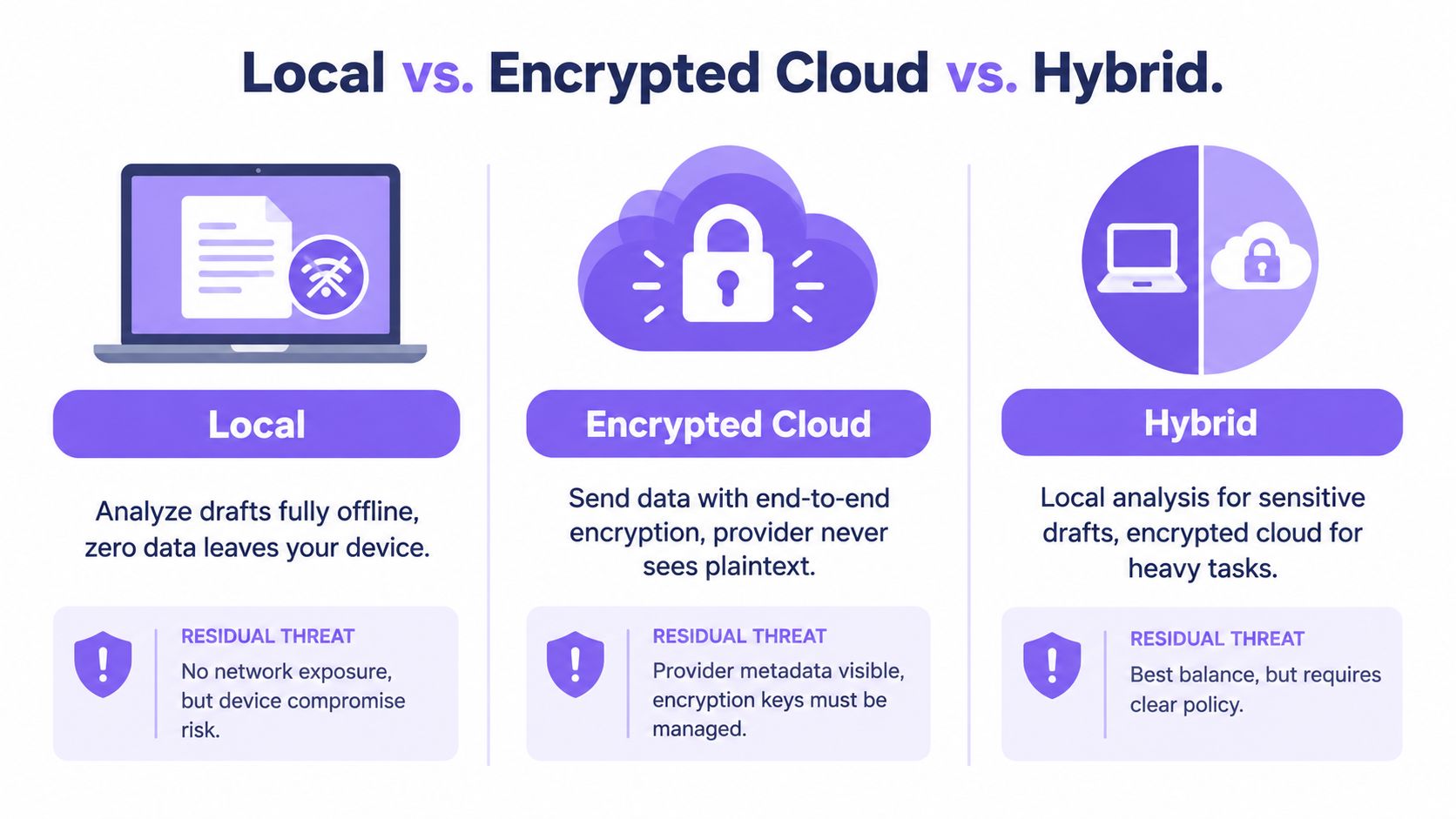
The choice between local-first, encrypted cloud, and hybrid processing depends on the event you're trying to survive.
Local-first keeps analysis on the writing device. That sharply reduces network transmission and provider exposure, which is valuable when the draft is commercially sensitive. A compromised account won't automatically expose a manuscript that never left the device. The trade-off is endpoint risk. Malware, a stolen laptop, plaintext temporary files, and an insecure sync habit can still defeat the design.
Encrypted cloud can provide convenient access across devices and centralised backups. It may protect stored and transmitted data, but you still need to establish who can access plaintext, who controls the keys, what metadata remains visible, and whether administrators or subprocessors can process the content. A subpoenaed provider, compromised account, or badly configured sharing permission creates a different exposure path from a lost laptop.
Hybrid is often the most workable model for a professional writer. Keep manuscript analysis and sensitive continuity data local, while sending only explicitly authorised operational information to a cloud service. Define the exception in writing. “The cloud is fine for some things” is not a policy.
| Event | Local-first response | Encrypted-cloud response | Hybrid response |
|---|---|---|---|
| Lost device | Depends on device encryption and remote access controls | Cloud copy may remain available | Local draft depends on device controls |
| Compromised account | Less useful if no draft is stored remotely | Potentially exposes accessible projects | Exposes only permitted cloud data |
| Provider compelled to disclose data | No provider-held manuscript if processing stays local | Provider exposure depends on keys and plaintext access | Limited to approved cloud material |
| Malicious beta reader | Sharing controls still matter | Shared copy can be downloaded or forwarded | Same collaboration risk, smaller analysis surface |
The comparison is more useful than a label such as “secure.” For a broader product comparison, see Novelium versus Notion for novelists, then verify the actual processing boundary rather than trusting the category name.
Key Management for People Who Hate Key Management
Encryption isn't a switch. It's a system for generating, storing, using, rotating, revoking, and destroying keys. The classic failure is encrypting the manuscript database while leaving the keys beside it. Steal the host or backup, and the encryption becomes decorative.

Use a documented operational standard. Classify manuscript and account data by sensitivity and retention period. Generate keys through an approved cryptographic module or managed vault, separate key-encryption keys from data-encryption keys, and restrict key operations through authenticated least-privilege access. Stored manuscript data should use authenticated encryption, while permitted synchronization and account traffic should use TLS. Hardware-backed or isolated storage is preferable where available.
NIST's Privacy Framework treats privacy as an enterprise risk across the complete data life cycle, from collection through disposal. That principle applies even to a novelist's private draft. Encryption protects storage and transmission, but governance determines who can decrypt, why they can do it, and when access ends.
Ask a vendor where keys live, whether one long-lived key is reused across users or artifacts, how access is logged, and how revocation is tested. A sound system has a documented cryptoperiod, tested backup restoration, and a process for retiring keys so expired backups can't be opened forever.
The key-management guidance from CISA is worth using as a vendor-interview checklist. You don't need to become a cryptographer. You do need to reject “encrypted” when nobody can explain the keys.
Collaboration Hygiene Without the Hand-Wringing
The weakest point in a manuscript workflow is often the person who receives a copy. An editor forwards an attachment, a beta reader shares a link, or a contractor inherits an account with access to every project. The cloud didn't make that mistake. Someone did.
Use named accounts and least-privilege permissions. Send an expiring link instead of a permanent one, watermark identifiable copies, and give each beta reader a distinct export so a leak can be traced without guessing. Editors and contractors should receive access to the project they're working on, not your master account.
Keep the beta-reader roster, comments, and export history under the same discipline as the manuscript. Those records can identify relationships, reveal plot information, and expose publishing plans even when the main draft stays protected.
Collaboration rule: Every shared copy should have an owner, a purpose, an expiry, and a revocation path.
Pseudonymisation helps, but don't mislabel it as anonymity. Replacing an author's name with an internal ID reduces direct exposure only if the lookup information stays separate and protected. If your system can reconnect the ID to the author, the data remains linkable. The EDPB guidance on pseudonymisation explains that distinction clearly.
Give collaborators a short written policy: don't forward files, don't upload them to another service, don't retain them past the agreed purpose, and report a mistaken share immediately. For decisions about tools that process manuscripts, the ethics of writing with AI discussion adds an important question, namely whether the service's data practices match the author's working boundaries.
Backup, Retention, and the Deletion Test
A backup is another copy of the manuscript, not a magical safe room. Define retention by category. Revision histories, character records, diagnostic reports, support attachments, crash logs, and full drafts don't all need the same lifespan.
The UK Information Commissioner's Office says identifiable data should be kept no longer than necessary for its purpose, reviewed periodically, and erased or anonymised when it's no longer needed. Offline storage still counts if the organisation holds and controls the information. Apply that logic to every service handling your work, including backups and exported reports.
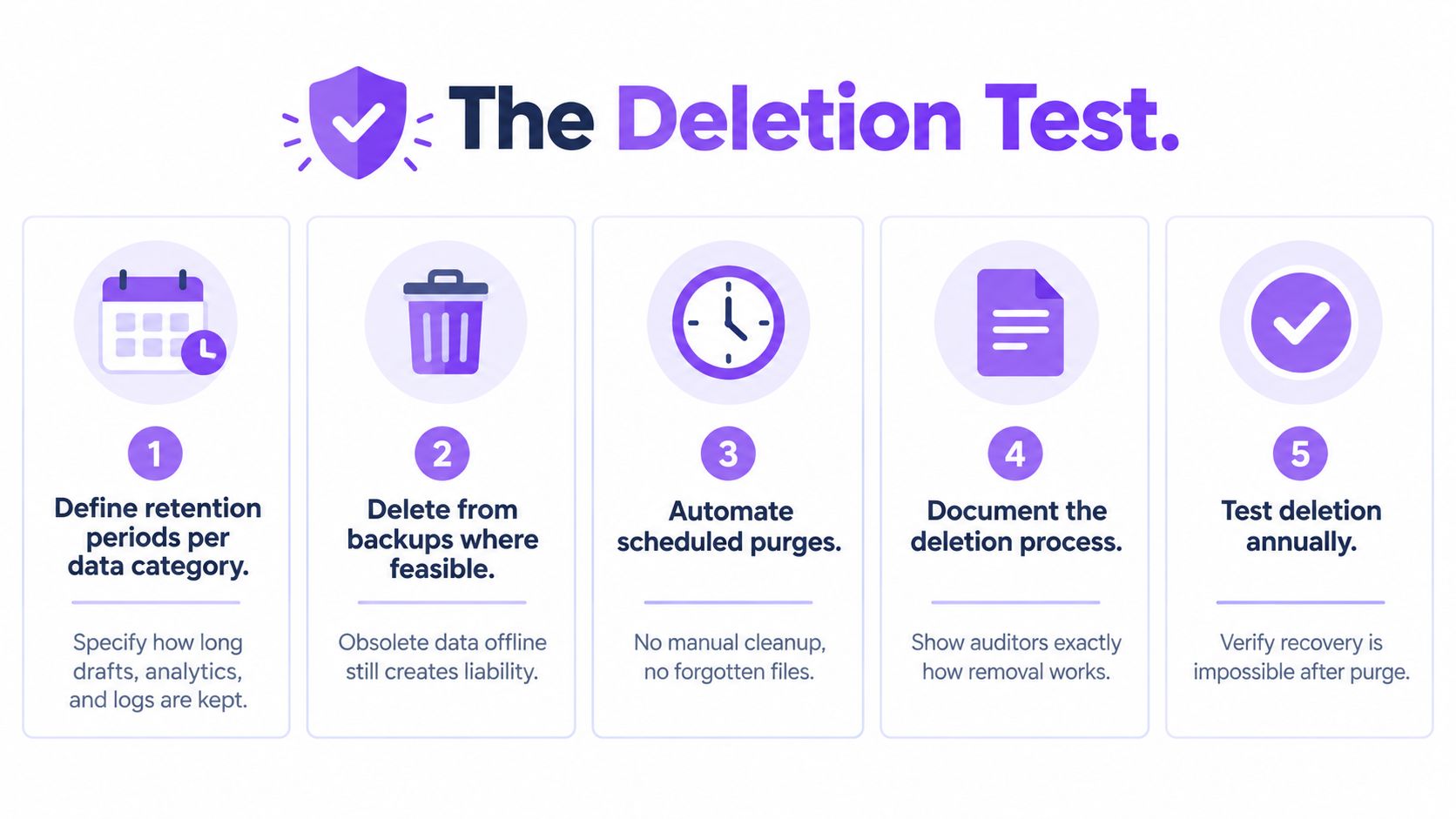
A deletion test should search logs, caches, indexes, temporary files, and exported reports for manuscript fragments after removal. Test restoration separately. A retired key shouldn't decrypt an expired backup, and a “deleted” project shouldn't reappear when an old device reconnects.
The ICO storage limitation guidance gives the right standard: document why data remains, review it, and remove it when the purpose ends. Ask vendors to prove what deletion means in active systems, caches, replicas, and backups.
A Short Checklist Before You Trust Any Tool
Run these questions against every manuscript service:
- Processing boundary: Does the full draft stay on your device, or does text leave it?
- Copy map: Which caches, indexes, crash reports, backups, and exports contain manuscript material?
- Key control: Who generates, stores, uses, rotates, and revokes the keys?
- Access trail: Can the service show who accessed sensitive files and why?
- Retention: Are revision histories, logs, support files, and backups governed by defined periods?
- Deletion proof: Can you test removal from primary storage, caches, indexes, and recoverable backups?
- Secondary use: Is your manuscript excluded from training, analytics, and unrelated product development?
- Collaboration: Can you issue named, limited, expiring access instead of sharing a master credential?
Novelium's privacy information describes a local-processing approach for manuscript analysis, encrypted storage, and deletion requests. Verify any such claim against your own threat model. A tool that surfaces continuity issues locally can reduce transmission risk, but you still need device encryption, controlled backups, secure collaboration, and deletion tests.
The standard: Choose the workflow you can inspect, test, and revoke. Marketing language doesn't protect a draft.
Novelium's Character Tracker and World Codex extract and track character details, knowledge states, relationships, events, and world information across manuscripts while supporting local manuscript analysis. Visit Novelium to check your drafts for continuity problems without treating your unpublished work as disposable training material.