Plot and Characters: The Consistency System
You've reached the late-middle of a complicated manuscript and found the familiar wreckage. Your protagonist remembers a conversation that happened before they learned the relevant fact. A secondary character turns up with an injury that was never caused. Someone crosses a city between scenes with no time to travel. The outline still looks elegant, the character questionnaire is full, and the book no longer agrees with itself.
That isn't a failure of imagination. It's a failure of state tracking.
The argument over whether a novel is character-driven or plot-driven is useful only up to a point. Both approaches collapse when the writer loses track of what a character knows, when that knowledge changes, where the character is, and what their body or relationships have endured. Plot and characters aren't competing engines. They're linked records of pressure, choice, consequence, and change.
Why Your Character Questionnaire Is Lying to You
The standard character questionnaire promises control. You fill in the childhood history, favorite food, greatest fear, physical description, and secret desire. Three months later, your protagonist knows something they shouldn't, carries a scar they never received, and lives two cities away from the location established in the opening chapters.
The questionnaire didn't fail because the answers were wrong. It failed because the answers were static.
A profile captures a character at the imaginary beginning of the novel. A manuscript records that character moving through time. Those are different jobs. The first document supports development, while the second protects continuity. Confusing them leaves you with a polished biography and no reliable account of what happened between chapters.
Editorial rule: If a character fact can change after page one, it belongs in a tracking system, not only in a profile.
The problem becomes obvious in a long manuscript. At 80,000 words, scenes are separated by hundreds of pages, multiple subplots, and a growing number of decisions. A character's emotional state after a betrayal isn't a permanent trait. Their knowledge after an intercepted message isn't part of their birth profile. Their relationship after a confrontation can't remain unchanged because an old spreadsheet says they're allies.
Static traits versus narrative states
A static document encourages authors to ask, “Who is this person?” A continuity system asks, “What is true about this person in this scene?”
That second question catches the failures that questionnaires miss:
- The detective has learned the suspect's identity, but the next chapter gives them a first-discovery reaction.
- The injured character is described climbing stairs normally before the recovery scene occurs.
- A former couple speaks with intimacy after an event that should have changed their relationship.
- A character acts on information that exists in the author's notes but never reached the character on the page.
Even the character's central false belief needs temporal handling. It may shape their decisions, but it also interacts with new evidence and changing behavior. A useful reference point is the glossary entry on the lie the character believes, particularly when that belief changes in force rather than disappearing neatly at a plot milestone.
The fix isn't another questionnaire. It's a record that updates whenever a scene changes a character's knowledge, condition, location, relationship, or arc position. Your characters aren't files you complete. They're moving systems you maintain.
The Mechanics of Motivation and Structure
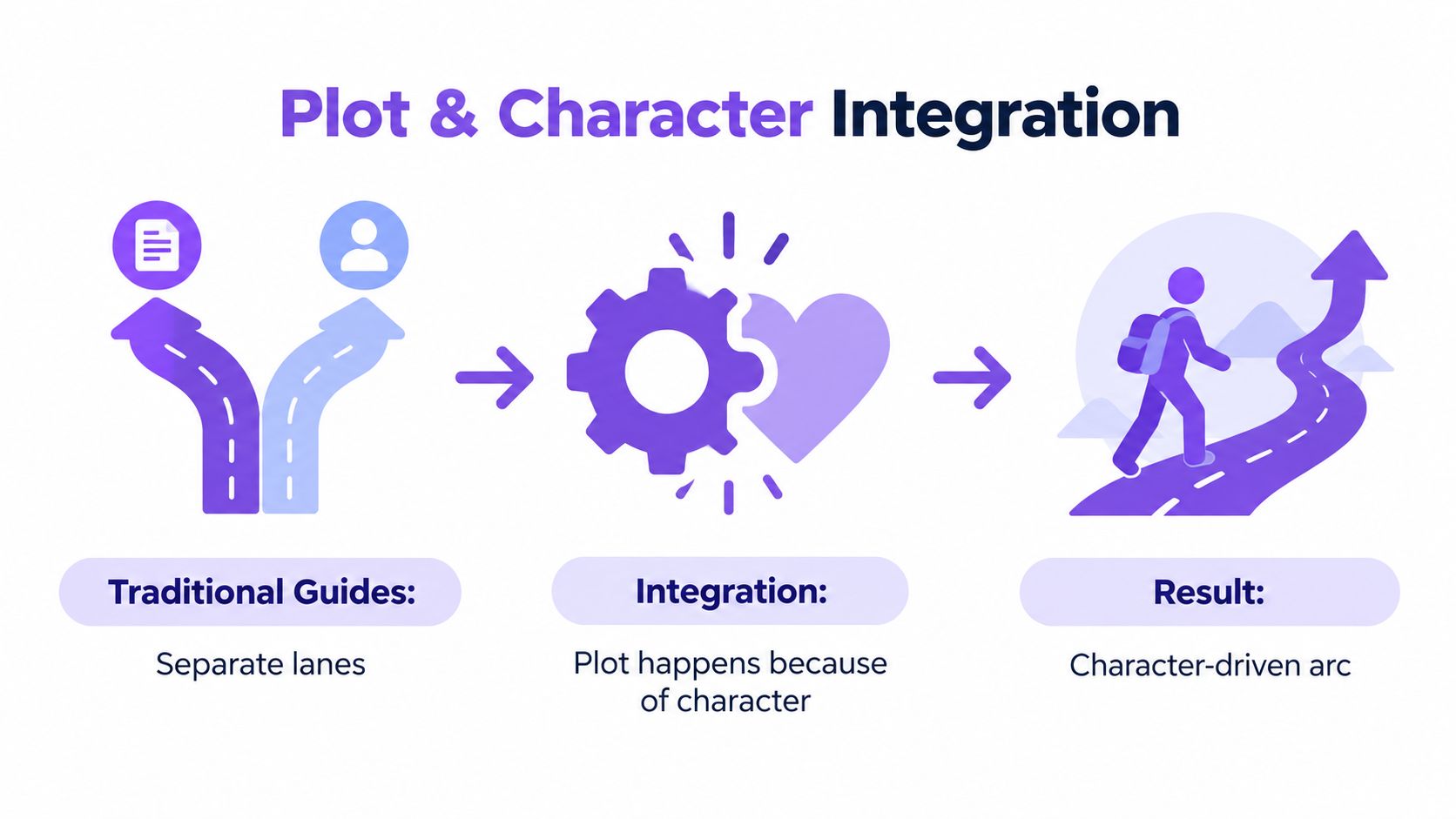
Plot and characters become inseparable the moment a character makes a consequential choice. The choice changes the external situation, and the changed situation applies new pressure. That pressure alters what the character wants, fears, knows, or is willing to do. Treating plot beats and character arcs as separate lanes produces the familiar manuscript in which events happen to the protagonist instead of because of them.
Formal narrative study has treated structure as more than a loose creative preference for centuries. Aristotle's Poetics, dated to about 335 BCE, is widely treated as the earliest surviving formal work on story structure, while Gustav Freytag's Die Technik des Dramas appeared in 1863 and shaped the five-part dramatic arc of exposition, rising action, climax, falling action, and denouement. Modern narrative theory also describes a recurring sequence of equilibrium, disruption, realization, restored order, and a new equilibrium, associated in scholarship with Todorov and Weinstein in 1969. These milestones are summarized in this narrative theory timeline.
The practical implication is simple. A plot point isn't merely an event on an outline. It's a new fact in a character's lived record.
The reader tracks more than action
Readers follow who did what, but they also track who knows what, which relationships remain intact, and whether a person appearing in the next scene is psychologically continuous with the person from the previous one. Academic work treats characters as core narrative existents alongside events and settings, and research discussed through this ERIC record on fictional character study connects character engagement with mental tracking of identity, relationships, and knowledge.
That's why the character-driven versus plot-driven distinction loses value during revision. A thriller fails when the investigator forgets evidence. A quiet family novel fails when a reconciliation doesn't alter later behavior. A nonlinear literary novel fails when the same character has incompatible knowledge in adjacent timelines.
Character motivation has to operate as a mechanism, not a label. The question isn't whether the protagonist is brave, guarded, ambitious, or grieving. The question is which known facts and current pressures make this particular action more plausible than the alternatives. Track that chain and structure begins to feel inevitable. Lose it, and the outline becomes decorative.
For practical terminology, the character motivation glossary is useful because motivation only matters structurally when it produces observable decisions and consequences.
From Profiles to Tracking Systems
A character profile tells you who someone is. A character tracking system tells you what remains true, what has changed, and when the change occurred.
That distinction matters most in a large cast. A development document can hold the material you need to invent a person. A continuity system must survive revision, reordered scenes, flashbacks, withheld information, and the introduction of details you didn't plan during drafting. The first supports discovery. The second prevents contradiction.
Track variables, not trivia
Most authors collect far too much material and monitor too little of what breaks. A favorite color rarely creates a continuity problem. Knowledge, injuries, ages, relationships, occupations, and locations do.
A workable system should record the facts that affect scene logic:
| Track closely | Track only when structurally relevant |
|---|---|
| Knowledge received in a specific scene | Favorite foods |
| Physical injuries and recovery | Decorative preferences |
| Age and elapsed time | Extensive childhood trivia |
| Relationship changes | Unused personality labels |
| Role, occupation, and access | Worldbuilding that never affects action |
A writer developing an unusual culture or speculative setting may still need extensive worldbuilding. The point is to separate interesting information from active constraints. If a cultural rule changes what a character can say, own, inherit, or do, it belongs in the continuity record. If it exists only because the author enjoyed designing it, keep it somewhere else.
A useful character creation guide from revid.ai can help with initial ideation, but ideation isn't continuity management. The character still needs a living record once the manuscript starts changing.
Rebuild the timeline before polishing scenes
Character tracking and timeline tracking can't be separated. A character's age, knowledge, injury, relationship, and location all depend on sequence. A continuity audit should cover every stated duration, every age, and every reference to how long ago an event happened. The timeline inconsistency guide recommends rebuilding chronology before editing scenes, then logging each scene with its date or relative day, start and end time, location, viewpoint, and elapsed duration.
That level of detail sounds tedious because it is. It's also far less tedious than discovering late in revision that an entire subplot depends on impossible timing. A character bible can hold the stable foundation, but the manuscript needs a change log layered over it.
The Failure of Manual Methods at Scale
Index cards, spreadsheets, and corkboards are excellent for externalizing thought. They're poor substitutes for a system that records cause and sequence across a long manuscript.
A manual method usually breaks in one of two ways. The author stops updating it because drafting is more urgent, or the document accumulates so many disconnected notes that checking it becomes slower than trusting memory. Both outcomes create the same risk: convenience begins deciding what is true.
Consider a few ordinary failures. A character refers to a book they never read because the author remembers researching it but never placed the reading scene on the page. A gun, letter, or key disappears from a room and then returns when the plot needs it. A character travels between locations in less time than the chronology allows. None of these errors requires a weak premise. They arise because the manuscript contains more active facts than the writer can reliably hold in working memory.
What manual tracking does well
Manual notes are valuable during discovery. Cards let you move scenes, compare parallel arcs, and see whether a subplot has vanished. Spreadsheets make it easy to sort characters by role, location, or relationship. A simple scene list can expose an empty middle faster than rereading prose.
The trouble starts when writers ask those tools to perform cross-manuscript verification. A spreadsheet doesn't automatically know that “the old injury” and “the broken wrist” refer to the same event. A corkboard won't flag a revelation that appears before its setup. A note-taking app stores contradictions alongside accurate facts without deciding which version belongs to which point in time.
Manual notes externalize memory. They don't replace editorial judgment, and they don't reliably enforce sequence.
An automated manuscript intelligence platform can compare extracted details across chapters, while the writer decides whether a flagged discrepancy is intentional. That division of labor works better than either extreme. The machine handles recall and cross-checking. The author handles meaning, voice, ambiguity, and the deliberate violation of expectation.
The Seven Essential Fields for Every Character
A professional tracker doesn't need every interesting detail about a person. It needs the minimum information required to preserve identity and continuity through scenes. The character continuity tracker guide identifies seven essential fields that keep a named character tied to identity, chronology, relationships, knowledge, and development.
Identity and body
Full name and nicknames prevent accidental identity drift, especially when a character is introduced under a title, family name, alias, or shortened form. Record every name the manuscript uses and the circumstances in which each one appears.
Physical description should capture stable identifiers and meaningful changes. Hair, clothing, scars, mobility, visible fatigue, and injuries matter when they affect recognition, action, or reader comprehension. Don't turn this into a fashion catalogue. Track what another character could notice and what the body can or can't do.
Age and how it changes connects the character to the timeline. For a single-period novel, age still matters in relation to backstory. For a multigenerational or nonlinear story, it becomes a basic continuity constraint.
Social position and information
Relationships need status, not just labels. “Sister,” “ex-partner,” or “employer” doesn't tell you whether the relationship is estranged, repaired, concealed, or newly renegotiated. Log the event that changes the relationship and the point at which each person knows about it.
Occupation or role controls access, authority, expertise, and plausible behavior. A character can change jobs, lose status, assume a false role, or work under conflicting identities. Those transitions belong in the record.
Key knowledge state is the field authors neglect most often. Record the fact, the scene in which the character receives it, and whether they believe, misunderstand, conceal, or forget it. Knowledge isn't merely a plot note. It determines whether a reaction is possible.
Arc status tracks the character's current position in their development. Don't reduce this to “before change” and “after change.” Note the decisions that demonstrate movement, the strategies they still use, and the behavior that contradicts their stated insight.
Keep the record scene-aware
Update these fields when a scene changes them. A character can have several valid descriptions across a manuscript, but only one valid state for a particular moment. That is the difference between continuity and a frozen profile.
Automated Coherence for Complex Narratives
The useful version of manuscript software doesn't try to replace revision. It reduces the amount of the book you must remember while revising.
A platform such as Novelium can extract characters from a manuscript, track traits, relationships, knowledge states, arcs, and events across chapters, and surface timeline conflicts, plot holes, and contradictions. Its workflow also includes visual timeline analysis, pacing analysis, and a beta reader dashboard, which puts structural review and reader feedback in the same working environment. Authors can import Word, Scrivener, Google Docs, or plain text, then run checks during drafting or after a complete draft.

The practical relief comes during the ugly revision pass. Instead of hunting manually for every mention of an injury, you can inspect where the detail appears and decide whether the character's physical state is coherent. Instead of rereading every chapter for a missing revelation, you can review the knowledge trail and repair the earliest contradiction. Instead of maintaining a separate document every time a recurring character reappears, you can work from an extracted record and verify the current state against the scene.
The tool doesn't decide that a contradiction is bad. A deliberate mystery may require a character to misremember, lie, or appear under an altered identity. The point is visibility. You can't make a confident artistic choice about a discrepancy you haven't found.
A complex novel still needs human judgment, but it shouldn't require human memory to function as a database. Track the facts that govern behavior, connect them to time and scene, and let the manuscript prove whether plot and characters are moving together.
Novelium's Character Tracker and World Codex automatically extract character details, relationships, knowledge states, events, and continuity issues across your manuscript. Visit Novelium to check complex drafts for timeline mistakes, character contradictions, plot holes, and object inconsistencies before they reach readers.