A Working Plan for Writing a Novel That Survives Draft Two
The popular advice is to outline the novel, follow the outline, and revise the prose afterward. That works until the manuscript starts making decisions of its own. A character learns something earlier than planned, a weapon changes hands off-page, a relationship advances without an on-page cause, and suddenly the outline is describing a book that no longer exists.
A useful plan for writing isn't a ceremonial document you complete before drafting. It's a living continuity system. It records what changed, who knows it, what each person carries, where everyone is, and which future events now depend on those facts. The outline is only the first draft of that system.
Why Most Novel Plans Collapse by Chapter Twelve
Most novel plans don't fail because the writer was lazy. They fail because the document was never designed to survive drafting. A chapter outline records intended events. The manuscript records actual events. Once those diverge, the writer usually keeps drafting from memory and leaves the outline untouched.
That becomes dangerous in an 80,000-word novel, where a small decision can remain dormant for chapters before it causes damage. The protagonist's injury affects how they travel. A missing key determines who can enter a room. A secret changes the meaning of a later conversation. If the plan tracks only plot beats, it loses the state changes that make those beats credible.
A controlled study of 111 English-language learners found that required self-timed planning increased the time writers spent preparing, but the planning condition itself didn't significantly improve final integrated-writing scores in the published study. The useful distinction is brutal and simple: planning behavior isn't planning effectiveness. More preparation time doesn't compensate for a plan that fails to capture actionable information.
The outline is not the manuscript
An outline can remain internally elegant while the draft becomes structurally inconsistent. That's the failure I see most often in manuscript analysis. The writer's original architecture was sound. The prose wandered, discovered a better motive, moved a reveal, or gave information to the wrong character. Nobody revised the record, so the outline became historical fiction.
Practical rule: If the manuscript changes a fact, the plan changes immediately. Otherwise you're maintaining two competing versions of the novel.
This is why a plan for writing a novel should behave more like a production model than a promise. It needs an explicit place for canon, uncertainty, deliberate deviations, and unresolved threads. “The detective suspects the mayor” is not enough. Record whether the detective has evidence, who supplied it, whether the mayor knows about the suspicion, and what the detective can feasibly do with that knowledge.
A rigid outline also confuses discovery with error. A scene that reveals a stronger motive isn't automatically a failure of planning. It becomes a failure when the writer accepts the new motive but doesn't propagate its consequences through the remaining scenes. Even workflows built to turn a script into an AI video need a stable source of truth for sequence and state. Novelists need one even more, because a prose manuscript hides continuity failures inside apparently natural conversations.
For practical terminology, keep a reference such as Novelium's glossary of pacing issues nearby, but don't mistake pacing labels for a plan. A label tells you where the reading experience drags. A living plan tells you why the scene exists and what it changes.
The planning research points in the same direction. A report summarized by the American Psychological Association described essays that scored approximately five points higher under an all-at-once composing approach than under a rigid step-by-step approach. The implication for fiction isn't that outlines are useless. It is that planning, drafting, and revision must remain in contact. The plan has to survive contact with the pages.
The Story Spine and the Scene Ledger
Build two artefacts, not one. The first is the story spine, a compact model of the novel's structural intent. The second is the scene ledger, a running record of what happens and what becomes true because it happens.
The spine should fit on a page without collapsing into vagueness. Record the premise, protagonist objective, opposing force, major turning points, climax, and ending. Don't use it to store every subplot or atmospheric detail. Its job is to answer one question: what must the novel accomplish at the level of dramatic movement?
A useful story spine framework can remain spare. If the ending changes, update the spine before writing the next major sequence. If a secondary character becomes the true opposing force, don't leave that fact buried in a chapter note. Structural intent belongs in the spine.
The ledger tracks state, not trivia
The scene ledger carries the information that static character profiles routinely miss. Each entry should include:
- Viewpoint and purpose: Who owns the scene, what they want now, and what prevents them from getting it.
- Causal result: What decision, loss, discovery, relationship change, or commitment exists at the end that didn't exist at the beginning.
- Knowledge state: What the viewpoint character and other present characters know on entry and exit.
- Time and place: The date or relative position, location, season, and relevant travel constraints.
- Objects and conditions: What characters carry, lose, break, hide, wear, or physically suffer.
- Open threads: Which promises enter the next scene, which payoffs become possible, and which questions remain unresolved.
Consider a scene in which Mara confronts her brother in a railway office. She enters knowing that the ledger was stolen. She leaves knowing that he sold it, carrying his brass key, with a bruised wrist and a new obligation to protect the clerk who witnessed the exchange. The next ledger entry should not merely say “Mara goes home.” It should record the key, the witness, the injury, the brother's betrayal, and the fact that Mara now knows the theft was deliberate.
That is the difference between a scene summary and a continuity record. The summary helps you remember the scene. The ledger protects every later scene that depends on it.
Keep the documents separate
A single giant planning file usually becomes unreadable. The spine gets diluted by research, while the scene notes omit the state details that matter later. Separate the documents, then connect them through scene identifiers and revision dates.
The spine tells you whether the novel is still heading toward the intended transformation. The ledger tells you whether the characters can plausibly reach the next turn from their current state. If the ledger contradicts the spine, don't automatically repair the ledger. Decide whether the manuscript discovered something better, then revise the spine and downstream entries.
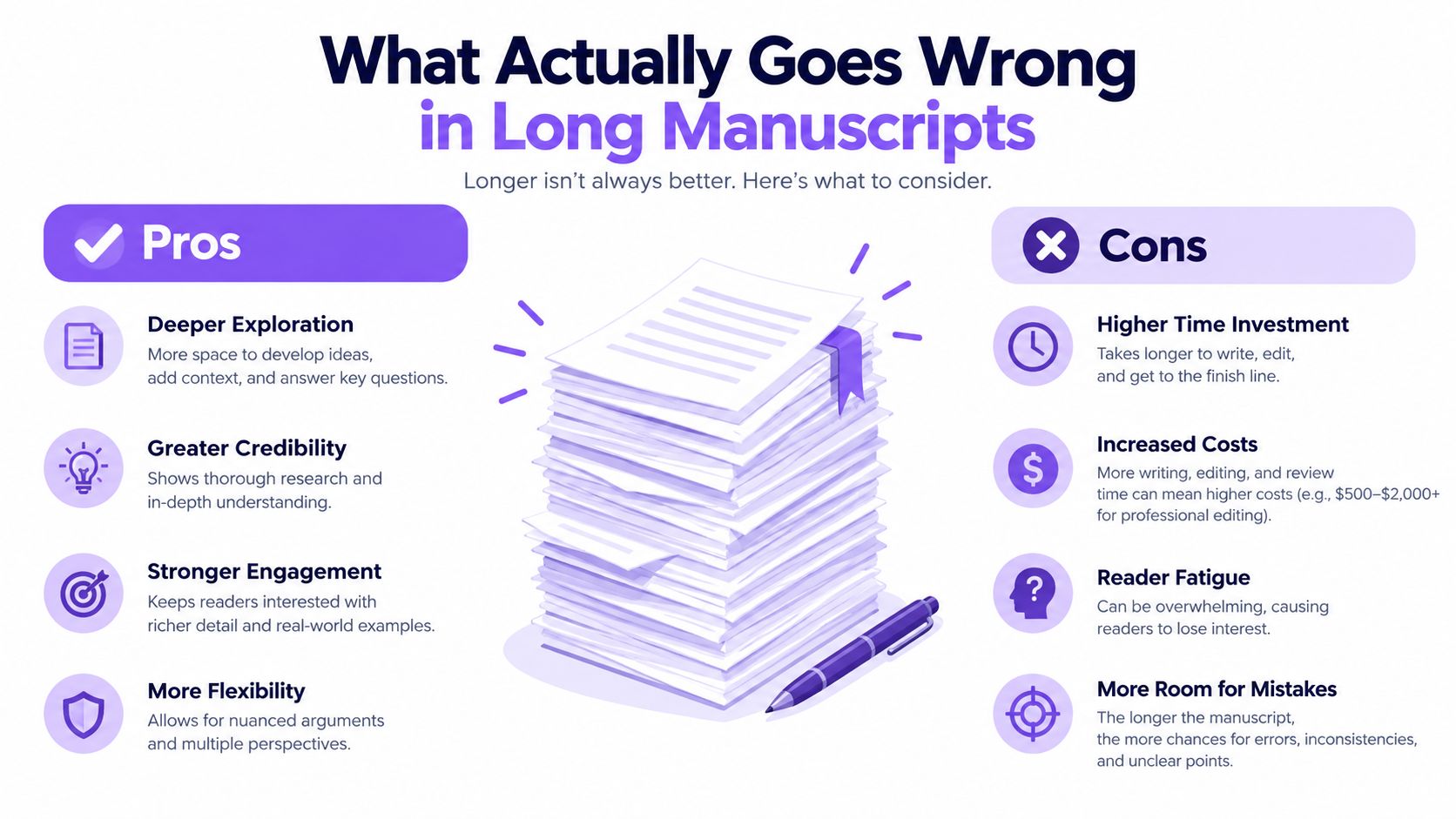
What Actually Goes Wrong in Long Manuscripts
Writers usually check visible attributes first. They search for the wrong eye colour, an inconsistent age, or a coat that changes from black to brown. Those errors are irritating, but they aren't the continuity failures that do the most damage.
The difficult errors concern access, possession, relationships, and sequence. A character acts on information they never received. Two people behave as though trust has been repaired even though no scene repaired it. A document appears in a room after the character left it elsewhere. A funeral happens in winter, then the next chapter treats the same event as a summer memory.
The most dangerous version is the knowledge-state slip. Character sheets may say that Lena is suspicious of the council, but they won't necessarily record when she learned about the forged letter, which version she believes, or whether anyone told her that the seal was counterfeit. A later accusation can sound perfectly natural while giving Lena information she hasn't earned.
Relationship states fail in the same way. “Allies” and “enemies” are useless labels if they don't preserve the cause and timing of change. Trust, hostility, intimacy, allegiance, and obligation move through scenes. If the plan doesn't record those transitions, the writer often treats a new emotional condition as if it appeared between chapters.
Why memory loses the mechanics
Research reviews place focused working memory at approximately four meaningful chunks, rather than the often-repeated seven-item rule in this review. A novel scene can require you to hold a character's location, injury, possessions, relationship status, knowledge state, and causal history at the same time. That exceeds what unaided attention can reliably preserve.
Chunking doesn't solve the problem if the bundle contains hidden variables. “The conspiracy” may stand for who knows about it, when they learned it, what evidence exists, and which version is believed. Remembering the label doesn't guarantee that you remember its mechanics. External tracking isn't administrative fussiness. It moves canonical information out of the attention buffer so you can verify it while drafting.
The practical categories are straightforward:
- Knowledge errors: Someone knows a fact before the manuscript gives them access to it.
- Relationship errors: Trust or hostility changes without an event that earns the change.
- Object errors: A weapon, letter, phone, key, or body disappears and reappears without a transfer.
- Timeline errors: Travel, recovery, day sequence, season, or age conflicts with an earlier anchor.
A static profile can describe a character's history. It can't reliably tell you what that character knows on page 247, what they're carrying after page 198, or why they now trust the person they threatened on page 121. That requires a changing ledger.
A Multi-Pass Schedule That Updates the Plan as You Write
A word-count schedule tells you how much text to produce. It doesn't tell you whether the story remains causally sound. Use checkpoints instead, with each pass answering a different question.
Pass one locks the spine
Before drafting, write the premise, protagonist objective, opposing force, turning points, climax, and ending. Keep this version deliberately lean. You're establishing the novel's load-bearing structure, not decorating it with every idea that might appear.
Then mark the scenes that must change the story's state. A scene qualifies when it alters a decision, information state, relationship, possession, physical condition, or future event. If removing it changes none of those, it's probably atmosphere, repetition, or material to consolidate.
Pass two builds the ledger
Create ledger entries for the opening sequence and continue updating them as scenes are drafted. Don't wait until the complete draft to record changes. At minimum, use checkpoints before chapter three, chapter eight, chapter fifteen, the midpoint, and the climax. These are inspection points, not magical structural laws. Use the same principle if your chaptering differs.
At each checkpoint, compare the intended spine with the actual manuscript. Record deviations explicitly:
Deviation record: The manuscript now treats the brother as a willing accomplice. Update his objective, Mara's knowledge, the key's significance, and every later scene that depends on his earlier innocence.
That entry prevents a deliberate discovery from masquerading as a contradiction. It also tells you what to repair. A deviation isn't complete until its consequences have been propagated through the ledger.
The writing-process evidence supports this recursive approach. One think-aloud study found that planning, formulation, and monitoring occupied approximately 90% of composing activity in the Cambridge study. The balance changes over drafting, with planning prominent early, formulation rising during production, and revision becoming more prominent later. Your schedule should reflect that movement instead of pretending drafting is a sealed phase.
For a practical overview of how to outline your novel, start with the spine, then keep revising the model as the scenes supply evidence.
Pass three audits the complete draft
After the first complete draft, separate structural correctness from stylistic refinement. Run the audits in an order that protects downstream work:
- Chronology: Test dates, travel, recovery, seasons, ages, and elapsed time.
- Knowledge: Check what each character knows at every major decision.
- Motivation: Confirm that choices follow the character's current information and emotional state.
- Setup and payoff: Trace major payoffs back to earlier setups.
- Prose: Polish sentences only after the scene's causal role survives inspection.
Record each defect with its severity, location, affected threads, and repair status. Fix the impossible timeline before adjusting a paragraph's rhythm. Correct the missing object before polishing the scene where the object is used. Otherwise you'll spend time improving prose that has to be dismantled.
The benchmark isn't obedience to the original outline. It's traceability. Every major payoff should point to a setup, and every scene should document a meaningful change.
Where Manuscript Intelligence Fits in the Loop
Manual tracking is the right place to begin because it forces editorial decisions. You decide which facts are canon, which are uncertain, and which deviations are intentional. A spreadsheet can handle an early project, but scale exposes its weakness. It records what you enter, not what the manuscript implies.
That is where manuscript intelligence belongs. Novelium automatically extracts and tracks character details, knowledge states, relationships, events, objects, and chronology across a draft. Its Character Tracker and World Codex provide structured records while timeline analysis surfaces impossible sequences and contradictions that are easy to miss during a linear reread. The writer still decides whether an inconsistency is an error or a deliberate reveal. The system closes the gap between the ledger and the prose.
This matters most when a manuscript has a large cast, recurring locations, multiple timelines, or a series continuity burden. A character can be dead in one chapter and active in another because of a flashback, or because the draft made a mistake. Analysis can flag the collision. It can't replace the editorial decision about which interpretation belongs in the book.
Privacy also belongs in the workflow decision. Novelium processes manuscripts locally on the writer's device, keeps stored work encrypted, and doesn't train on the manuscript. For authors who've already tried spreadsheets and questionnaires, the useful test is simple: can the system maintain a living model while the draft changes, without flattening the writer's voice or taking control of the story? That's the standard a plan for writing should meet.
If your outline is already drifting, stop adding notes to the old version and build a scene ledger from the manuscript you have on hand. Use Novelium to extract and track characters, relationships, knowledge states, objects, events, and timeline dependencies as you revise. Visit Novelium and put your current draft through a continuity check before draft two turns a small deviation into a structural repair job.