10 Kinds of Books and the Continuity Traps Each One Hides
A book doesn't have to belong to a single genre, even in a library catalog. The Library of Congress guidance for fiction allows classification by form, genre, character, setting, and topic. That's useful permission for novelists writing across categories. It's also a reminder that the label on the cover tells you very little about where the manuscript will break.
A historical fantasy can inherit the chronology problems of historical fiction, the rule dependencies of fantasy, and the knowledge-state problems of a mystery. Calling it romantasy doesn't make any of those disappear. The label matters less than the ledger, especially when you're carrying characters and consequences between books.
These kinds of books need different continuity checks, not different versions of the same character questionnaire. Before you choose the right writing approach, identify what changes between scenes and what must remain fixed. A beautifully documented childhood won't stop a character from acting on a secret they haven't learned.
1. Epic Fantasy
Epic fantasy's continuity problem isn't the existence of elaborate lore. It's the distance between a world rule and its consequences.
Robert Jordan's The Wheel of Time, George R.R. Martin's A Song of Ice and Fire, and Brandon Sanderson's Cosmere books offer different models of sprawling, interconnected storytelling. For your own series, the useful question isn't how much lore to document. It's which facts constrain the next scene.
Say a mage finishes a battle unable to cast again until she rests. A later siege scene needs her power, so you move it earlier during revision. Unless you track exhaustion by scene, you've given her an unexplained recovery.
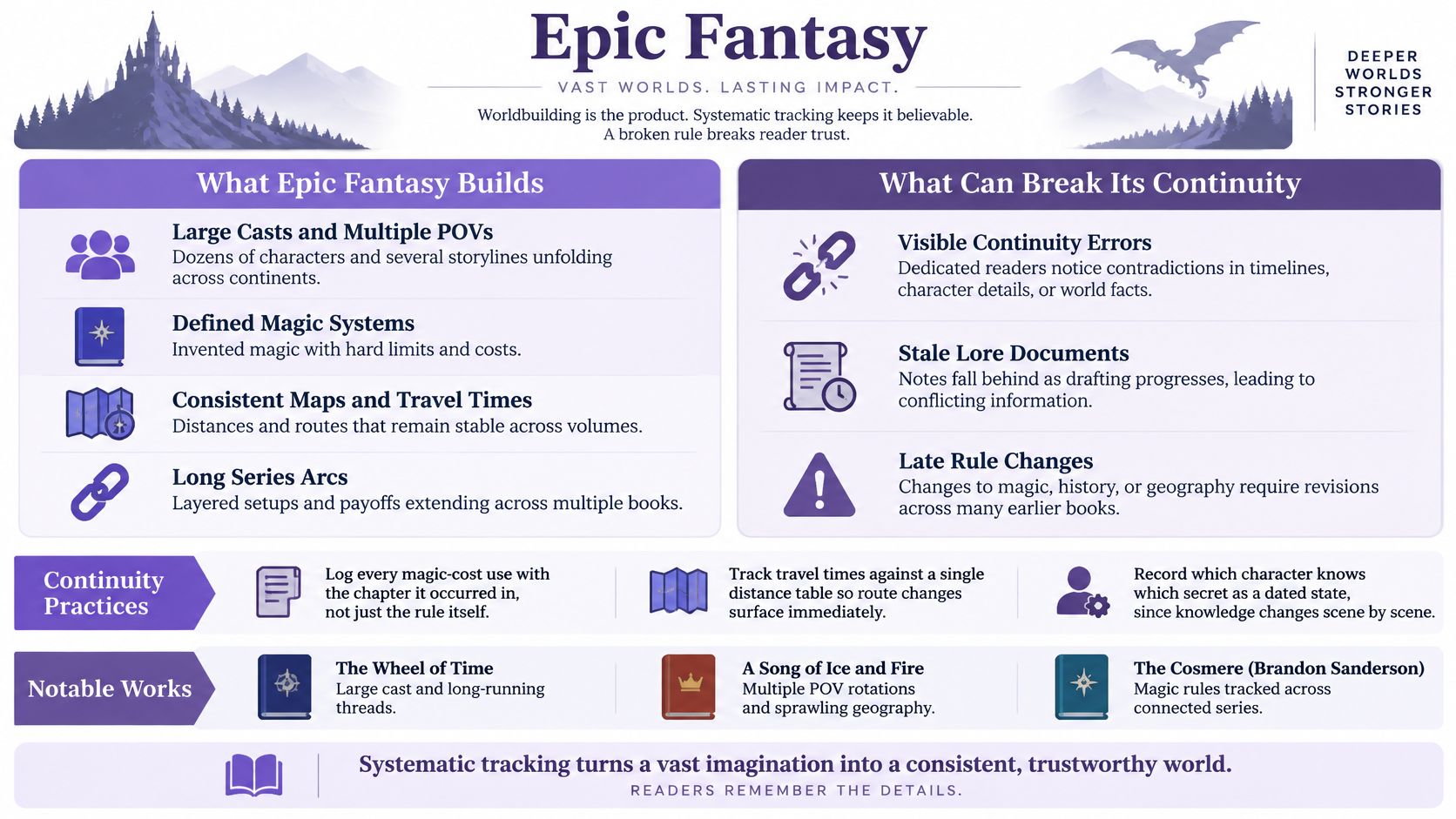
Record each use of magic, its cost, and the character's resulting condition. Keep travel durations against a shared distance reference, then record departures and arrivals against the manuscript timeline.
Knowledge needs the same treatment. The royal genealogy belongs in the world bible; the scene where the exiled heir learns it belongs in the continuity record. Confusing those documents produces characters who know everything their author knows.
2. Science Fiction
Your engineer solves the crisis by remotely disabling an implant. Fine. Why couldn't she do that during the kidnapping earlier in the book?
That question exposes operational continuity, the gap between an interesting technology and the actions it permits. Hard science fiction makes technical constraints especially visible, but space opera and social speculation need consistent limits too.
Frank Herbert's Dune, Isaac Asimov's Foundation series, and Ann Leckie's Ancillary Justice are useful reference points for different dependencies: ecology and power, historical sequence, and perception shaped by social rules.

Separate capability, access, and knowledge. A ship may possess a weapon its current crew can't operate, or a character may understand a technology without having permission to use it.
Maintain a master chronology for births, colony histories, crew changes, and elapsed travel time. When a new solution depends on an unestablished capability, flag it before polishing the scene. Either establish the capability and inspect its earlier consequences, or find another solution. A technical explanation added at the climax doesn't repair the missing dependency.
3. Crime and Mystery
The clue ledger isn't supplementary documentation. It's the mechanism of the mystery.
Agatha Christie's Poirot and Marple novels, Dorothy L. Sayers's Lord Peter Wimsey series, and Raymond Chandler's Philip Marlowe books offer distinct approaches to detection and recurring protagonists. In your manuscript, all require a defensible account of what happened and what people believe happened.
Say a witness identifies a missing bracelet before the detective has disclosed that anything was stolen. That can be an excellent clue. It can also be an accidental disclosure left behind when you moved an interview.
Practical rule: Track the event, the evidence, the interpretation, and who has access to each. Those aren't interchangeable facts.
Timestamp alibis against actual scenes, including travel between them. Keep false statements separate from established facts so the liar's version doesn't accidentally become your own reference.
Record unresolved red herrings too. If a suspicious phone call never receives an explanation, the reader can't distinguish deliberate ambiguity from a thread you dropped. In a detective series, preserve earlier deductions and personal disclosures, not just recurring cast descriptions.
4. Thriller
The meeting runs late. The protagonist crosses the city, clears security, catches a flight, and reaches the ambush before sunset. Each scene reads quickly. Together, they may be impossible.
Reading speed isn't elapsed story time. Lee Child's Jack Reacher novels, Gillian Flynn's Gone Girl, and Frederick Forsyth's The Day of the Jackal are useful comparison points for movement, information asymmetry, and tightly sequenced action.
For an action-heavy manuscript, build a clock that includes the unglamorous intervals: collecting equipment, waiting for transport, treating an injury. You don't need to narrate them all. You do need to leave room for them.
Keep the clock separate from the reveal order
In a psychological thriller, the sequence of disclosures may differ sharply from the sequence of events. Record both.
Say the reader sees a threatening message before the protagonist does. Her next decision must follow her knowledge, not the reader's anxiety. Log knowledge changes at scene exits, and preserve the source of each revelation. Otherwise, a revision can turn calculated concealment into a character inexplicably ignoring information.
5. Romance
A recurring couple can survive a changed hairstyle. A relationship can't survive an emotional argument built on information both partners already exchanged.
Relationship continuity is more than pairing status. Julia Quinn's Bridgerton series, Nora Roberts's family and town series, and Courtney Milan's linked historical romances provide useful models for interconnected casts whose histories extend beyond an individual courtship.
For an enemies-to-lovers manuscript, track the evidence behind each person's hostility. If one lead learns that the apparent betrayal was staged, later antagonism needs a new basis. Repeating the old accusation without acknowledging that discovery doesn't prolong tension. It erases development.

Maintain a relationship map at each book's opening, then log disclosures, reconciliations, engagements, and separations as dated changes. Dual viewpoints need separate records of what each lead knows and what each merely suspects.
Keep recurring descriptions and backstory references tied to their manuscript locations. A sibling's occupation, a dog's name, or an established wedding season becomes binding once published. Your private preference for a better detail doesn't revise the earlier book.
6. Historical Fiction
Historical fiction gives you an external chronology and an invented chronology. Neither excuses mistakes in the other.
Hilary Mantel's Wolf Hall, Ken Follett's The Pillars of the Earth, and Bernard Cornwell's Saxon Stories are useful reference points for fiction constrained by documented events, generational change, and invented lives within a historical period.
Say your courier witnesses a public event, then delivers its news before the journey could reasonably end. Verifying the event's date won't catch the problem. You also need the courier's route, departure, means of travel, and arrival.

Distinguish documented facts from fictional commitments
Mark historical anchors as fixed references and attach supporting material to them. Record invented births, marriages, deaths, and meetings separately, but align every scene against both records.
Flag period vocabulary and customs at their first appearance rather than scattering unresolved questions through prose. When you deliberately depart from the historical record, document that choice explicitly. Otherwise, a later revision may restore historical accuracy while breaking the alternate sequence you've already written.
7. Horror
The survivor's injured hand is useless while opening a door, then perfectly capable of gripping a weapon. That's not a supernatural mystery. It's an injury the draft forgot.
Horror needs physical state, supernatural state, and perceived state kept distinct. Stephen King's Salem's Lot, Shirley Jackson's The Haunting of Hill House, and Anne Rice's Vampire Chronicles offer very different reference points for community, uncertainty, and long-running supernatural histories.
Say salt appears to stop a creature. Record whether that is an established property, a character's theory, or a coincidence. Later failure can deepen the horror, but only if you know which claim you're overturning.
Uncertainty belongs in the reader's experience. It doesn't belong in the author's record of what the manuscript has established.
Track wounds, possession, contamination, deaths, and apparent deaths as changes with scene references. Separate confirmed outcomes from what surviving characters believe happened.
For sequels, carry forward consequences as well as survivors. A character who escaped the creature may retain an injury, a false belief, or knowledge they haven't shared. Resetting those conditions makes the previous book feel disposable.
8. Literary Fiction
An unreliable narrator still needs a reliable record behind the manuscript. Otherwise, you can't tell a meaningful contradiction from an accidental one.
Kazuo Ishiguro's The Remains of the Day, Toni Morrison's Beloved, and Virginia Woolf's Mrs Dalloway are useful reference points for memory, nonlinear sequence, interior time, and recurrence. The tracking task isn't to flatten those effects into a conventional plot outline.
Preserve the distinction between what happened and how it's told. Say a narrator recalls a farewell as affectionate, then later describes refusing an offered hand. Keep both passages, their exact wording, and the underlying event together. You can then judge the discrepancy as a choice rather than rediscover it during copyediting.
Index the details that carry meaning
Track recurring objects, phrases, gestures, and images with their locations. An inherited watch changing wrists may matter more than a minor journey taking an extra afternoon.
The BISAC Fiction hierarchy distinguishes Literary, Speculative, and other categories rather than treating fiction as an undifferentiated shelf. Those labels help position the work, but they don't determine its continuity requirements. Track the dependencies your particular structure creates, including intentional gaps and contradictions you need to preserve.
9. Young Adult
Young adult is an audience category, not a continuity shortcut. The BISAC Young Adult Fiction hierarchy includes distinct paths for romance, time travel, comics, and other narrative forms. A young adult fantasy therefore needs both its speculative rules and its developing cast tracked.
Suzanne Collins's The Hunger Games, Rick Riordan's Percy Jackson series, and Veronica Roth's Divergent trilogy are useful comparison points for protagonists whose circumstances change within shared systems.
The awkward failures can be mundane. Say a protagonist has a birthday during the summer, but the sequel places them in a school year incompatible with the established calendar. Correcting the age alone may leave friendships, exams, and family expectations misaligned.
Track milestones as events, not profile fields
Keep dated records of ages, school progression, permissions, family changes, and seasonal activities. Where driving or other regulated activities matter, verify the relevant jurisdiction rather than importing assumptions.
Before adding another volume, reconcile the series bible with the published manuscripts. Planned facts that never reached the page aren't canon; throwaway details that did reach the page still count. A growing character needs an evolving record, not a frozen introductory profile.
10. Urban Fantasy
Your vampire faction can control the city council. It still needs a plausible way to reach the meeting.
Urban fantasy puts real geography and supernatural permissions in the same scene. Jim Butcher's The Dresden Files, Ilona Andrews's Kate Daniels series, and Patricia Briggs's Mercy Thompson series provide useful reference points for recurring protagonists navigating layered supernatural societies.
Say a magically sealed district blocks a familiar shortcut. Later, you relocate a confrontation into that district but leave the protagonist's arrival unchanged. The map remains accurate, and the magic rule remains accurate. Their interaction is wrong.
Record faction changes alongside personal changes
Maintain alliances, leadership, territorial access, debts, and prohibitions at each book's opening. Update them when scenes change the political situation, not when you eventually revise the world bible.
Keep powers, injuries, possessions, and relationships in the protagonist's running record. Check real-world routes and transit details against supernatural restrictions rather than maintaining disconnected maps.
A faction chart that says two groups are enemies isn't enough. Record who knows about their secret truce, when it began, and whether the protagonist can safely act on it. Political knowledge is still character knowledge.
Where Each Kind of Book Breaks Continuity
| Item | Core Feature | Main Continuity Risk | Reader Expectation |
|---|---|---|---|
| Epic Fantasy | Large casts, defined magic systems, expansive worlds, and multi-book arcs | Contradictions in lore, travel times, character knowledge, or magic limits | Consistent world rules and satisfying long-term payoffs |
| Science Fiction | Speculative technologies, physical limits, long timelines, and invented institutions | Technical rules or timeline details drifting between scenes and books | A credible premise governed by consistent internal logic |
| Crime and Mystery | Fair-play clues, suspect knowledge, alibis, and recurring detectives | Conflicting timelines, alibis, or unresolved red herrings | A solvable puzzle with accurate clues and consistent character histories |
| Thriller | Compressed timelines, ticking clocks, multiple locations, and information gaps | Implausible logistics, shifting deadlines, or characters learning facts off-page | Fast pacing with believable timing and clear knowledge states |
| Romance | Interconnected relationships, dual POVs, and recurring character details | Relationship timelines or physical and biographical details drifting | Consistent relationship development and accurate recurring details |
| Historical Fiction | Invented stories set within documented chronology and period customs | Anachronisms or fictional events conflicting with real and established dates | Historical accuracy alongside a coherent fictional timeline |
| Horror | Consistent threat rules, character states, and atmospheric settings | Forgotten monster rules, injuries, deaths, or possessions | Sustained dread grounded in consistent rules and consequences |
| Literary Fiction | Recurring motifs, non-linear timelines, and unreliable narration | Lost echoes, unclear chronology, or accidental contradictions | Deliberate patterns and ambiguity that feel intentional |
| Young Adult | Coming-of-age arcs, aging protagonists, and recurring school or setting details | Inconsistent ages, grade progression, calendars, or series rules | Believable character growth and steady continuity across installments |
| Urban Fantasy | Modern city settings layered with supernatural rules and factions | Conflicting city details, faction politics, character states, or powers | A coherent blend of recognizable real-world details and magic |
Where the Record of Your Series Should Live
Across these kinds of books, the important distinction isn't between elaborate worldbuilding and realistic settings. It's between describing a character and tracking a character through change. A profile says a detective distrusts her partner; a tracking record says she discovered his deception, confronted him, accepted part of his explanation, and withheld the rest from her supervisor.
That's why most character profiles fail as continuity tools. They're development documents built to help you invent someone, not records of what that person knows, carries, believes, or can physically do at a particular scene. Favorite meals and childhood anecdotes can be useful, but they won't catch a confession delivered to someone who already heard it.
Keep the evidence attached: Every consequential state change needs a manuscript location. Without that reference, you're checking memory against another version of memory.
A spreadsheet can work if you maintain it rigorously. The problem isn't the cells; it's the manual synchronization between those cells and a changing manuscript. Across an 80,000-plus-word draft, moving a revelation or deleting a recovery scene can invalidate records you had every reason to trust yesterday.
Keep development notes, established manuscript facts, and unresolved decisions distinguishable. After revision, review the consequences of changed scenes rather than merely updating descriptions. For serialized publication, you can group serialized content on your site, but organizing installments for readers doesn't replace tracking dependencies between them.
Novelium's Character Tracker and World Codex automatically extract and track character details and world information across chapters and manuscripts. Its continuity tools track knowledge states, relationships, events, and timelines so you can inspect contradictions against the draft rather than maintain a separate account from memory. Processing happens locally on your device, keeping the manuscript private.
The author still decides whether a discrepancy is an error, a lie, or an intentional revision of the reader's understanding. The system's job is to make that decision visible. That's a better use of your attention than hunting for the passage where you last mentioned someone's damaged shoulder.
Novelium offers manuscript-based character tracking, a World Codex, and continuity analysis with local processing. Visit Novelium to check your current draft for the knowledge gaps, timeline slips, and forgotten consequences your genre label won't catch.