9 Ideas for Characters That Stay Consistent Across Books
Your character profile is already out of date. The popular advice to build a more detailed character sheet misses the problem: a static profile records what you intended at the beginning, not what someone knows, carries, or has survived by chapter forty. Adding a favorite breakfast won't fix that.
A reader catches the detective asking who owns the warehouse when she already interviewed its owner. You remember drafting the interview, but then moved it earlier during revision. Your profile still describes her as observant. Excellent. She's observant and apparently unable to retain a conversation.
The most useful ideas for characters create specific continuity pressures across 80,000-plus words and recurring casts. Each archetype in this list is a failure waiting for a tracking habit to prevent it, not a brainstorming decoration.
Novelium tracks character traits, knowledge states, relationships, and events as you write, flagging contradictions in real time so failures surface as they happen. The underlying distinction matters whether you use software or a spreadsheet: development documents describe possibilities; tracking records establish what has happened.
1. The Character Who Knows Too Much Too Soon
Give a court translator access to secrets nobody realizes she understands. It's a strong concept until she reacts to a conspiracy before hearing about it, or asks about a betrayal she's already translated.
Knowledge leakage happens in both directions. Authors let characters borrow information from another viewpoint, then forget information those characters possess. In multi-POV epic fantasy, the reader's knowledge is particularly easy to mistake for shared knowledge.

Record every consequential reveal against its chapter and scene, with the witnesses, recipients, and means of acquisition. Distinguish hearing an allegation from confirming it. Your translator can suspect the prince without knowing he signed the order.
For mystery investigators returning across books, preserve case knowledge between volumes rather than rebuilding their expertise from scratch.
Practical rule: Before approving a question in dialogue, check whether the speaker already has its answer.
Keep the textual reference attached. A note saying she eventually learns the truth isn't enough to audit the scene you're editing.
2. The Deceptive Account
An unreliable narrator needs a more reliable record than an honest one. Track the objective truth, the narrator's knowledge, their private interpretation, and the account they give each audience.
Agatha Christie's The Murder of Roger Ackroyd makes omission central to its narrator's account. Gillian Flynn's Gone Girl offers constructed accounts to examine, while Kazuo Ishiguro's The Remains of the Day is useful for thinking about self-protective interpretation. These aren't interchangeable forms of unreliability.
Record the audience, not just the lie
Say your witness gives the police a train alibi but tells her sister she stayed home. Record both versions beside her actual movements, including the evidence each version must accommodate. Her later reasoning can acknowledge the truth privately without accidentally treating her public account as fact.
Mark deliberate omissions explicitly. Otherwise, revision can turn carefully withheld information into an accidental contradiction.
For a compact reader-side exercise, try a mystery with optional hints and separate available evidence from inference.
Use the accompanying video as another prompt for examining what an account reveals and withholds.
3. The Serial Impostor
Your disgraced diplomat returns as a shipping agent, then poses as a distant cousin to enter the same household. The fun isn't the wardrobe. It's the accumulating claims that can expose her.
Patricia Highsmith's The Talented Mr. Ripley and its sequels offer an obvious reference point for identity management. Espionage thrillers add another useful model: the cover identity supported by a legend document.
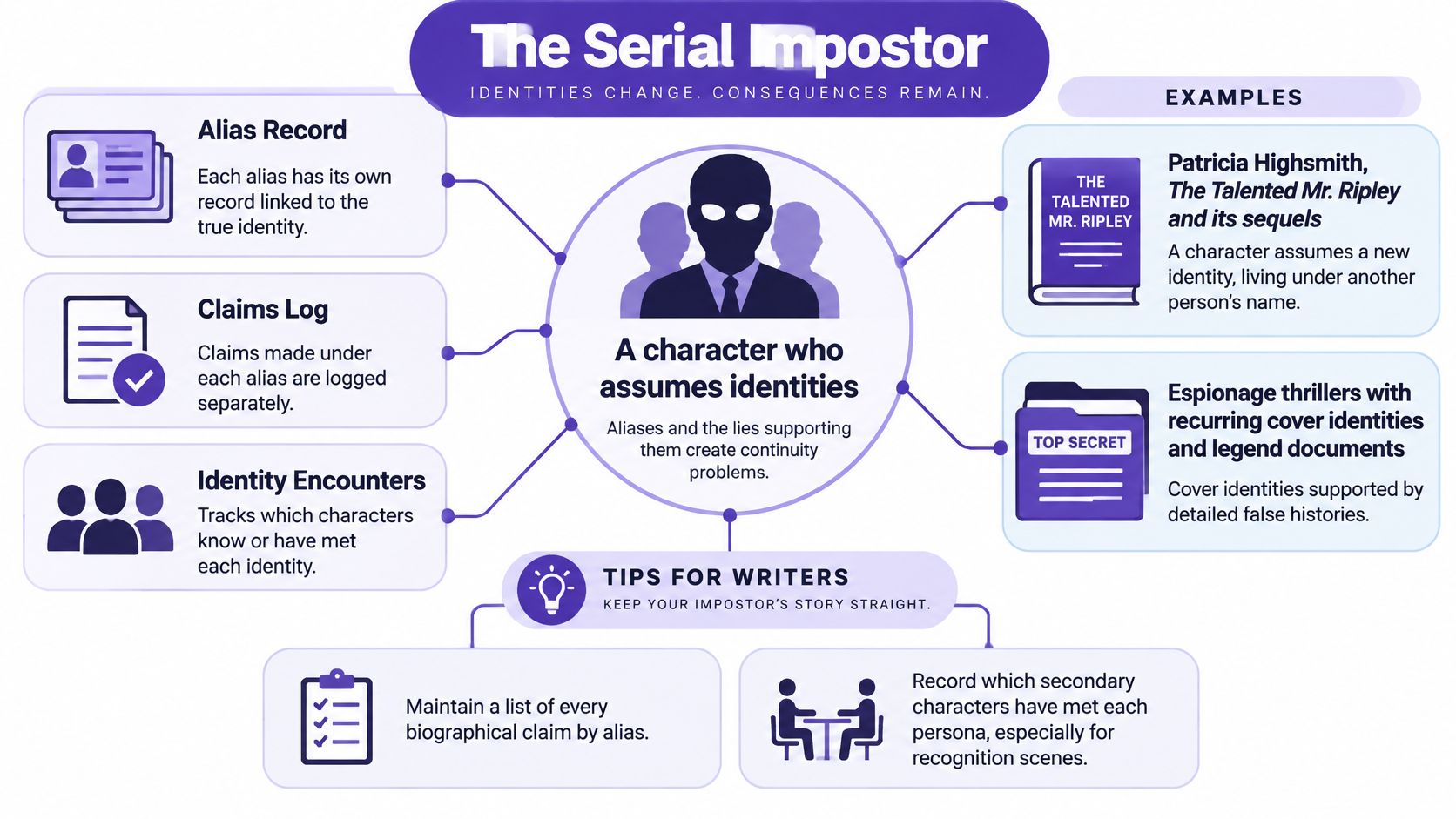
Give each alias a linked record under the character. Store the claimed birthplace, family, occupation, accent, credentials, and every biographical assertion made on the page. Don't overwrite the shipping agent's invented sister when the cousin acquires a different family.
The critical field is who encountered which persona. A recognition scene depends on that history, including whether someone heard a voice, saw a face, or only read correspondence.
Track recognition as uncertain when appropriate. A suspicious housekeeper shouldn't become fully informed merely because your notes connect the identities. Let her notice a repeated gesture without granting her the whole deception.
4. The Body That Keeps Score
A wounded surgeon who must keep operating generates better continuity problems than a profile marked physically resilient. Which movements hurt? What compensations does she make? What can she conceal from colleagues but not from a patient?
Diana Gabaldon's Outlander provides a useful reference for scars that remain part of a character's history across volumes. Medical thrillers demand the same discipline over shorter narrative intervals: an injury can't disappear because the next scene needs competent hands.
Preserve the change history
Enter the injury as an event, then track restrictions, treatment, recovery expectations, and later changes. Research the particular injury rather than assigning a convenient healing period. If recovery occurs off-page, record when the character regains the relevant function.
After a time jump, check the first physical description against the latest state. Hair length, scars, limps, prostheses, and habitual compensations all need chronological context.
Don't replace injured with recovered in the profile. You'll need the earlier state when revising an intervening scene, and a current-status field alone won't tell you what was possible then.
5. The Object With a Passport
The courier is loyal, resourceful, and carrying a sealed letter she's forbidden to open. None of those traits explains how her pursuer later quotes its contents.
Objects need records independent of their owners. In J.R.R. Tolkien's The Lord of the Rings, the One Ring's custody matters to the plot, not merely to inventory. A techno-thriller's stolen device deserves the same attention.

Give the letter its own entry, including holder, location, condition, contents, and access history. Record every transfer against a scene, including off-page handoffs. Possessing the envelope doesn't automatically mean knowing what's inside.
Say the courier gives it to a priest, then later produces it at the border. Either she retrieved it, substituted another letter, or you've got a continuity error.
An object's purpose isn't its location. Knowing why the key matters doesn't tell you whose pocket it's in.
Track copies separately. A photographed document can spread information while its original remains locked away, which changes the investigation without changing physical custody.
6. The Series Timeline Keeper
A recurring apprentice becomes a magistrate across your series. Between appearances, she ages, qualifies, changes allegiance, and acquires enemies. Reintroducing her from an old profile can erase the very history readers returned for.
Jim Butcher's The Dresden Files is a useful reference for recurring characters aging across volumes. Long-running fantasy and crime series require explicit carryover for relationships, injuries, skills, legal status, and deaths.
Start the next book from the previous ending
Anchor age to a birth date or birth year, then calculate it against dated events. A working timeline in fiction should distinguish story chronology from publication order, especially when prequels and overlapping narratives enter the mix.
Recalculate ages after books spanning more than a few months. If dates are intentionally approximate, preserve that uncertainty rather than inventing precision.
At each book's ending, save a state snapshot. Import the next manuscript against that existing series record instead of starting clean.
If the apprentice ends a volume estranged from her mentor, their next friendly exchange needs reconciliation, strategic performance, or another explanation. Familiarity isn't permission to reset the relationship.
7. The Shared-Knowledge Ensemble
At the planning meeting, the smuggler learns that the bridge is mined. The medic misses the meeting. Later, she refuses to cross because of the explosives.
That's not intuition unless you've established a basis for it. It's an information transfer the manuscript hasn't earned.
George R.R. Martin's A Song of Ice and Fire offers a familiar reference for rotating viewpoints with unequal access to events. In a multi-protagonist literary novel, the same issue appears when separated family members converge and suddenly share everyone's discoveries.
Audit boundary: The reader's accumulated knowledge belongs to nobody inside the story until someone acquires it.
For an ensemble cast, record attendance and later disclosure separately. The medic can learn about the bridge secondhand, but identify who tells her, when, and how much they reveal.
Audit each viewpoint independently before reading the manuscript as a whole. Otherwise, your familiarity with the complete plot makes missing handoffs harder to notice.
Group messages and communal meals aren't automatic fixes. Establish who received the message or remained at the table, particularly when someone's absence matters later.
8. The Character Who Remembers Differently
Memory loss doesn't excuse continuity errors. It introduces another state to track.
An amnesiac archivist who recovers the location of a hidden ledger still may not remember who helped conceal it. Treating recovery as a general switch gives her information the scene never restored.
Kate Atkinson's Life After Life, with Ursula's recurring lives and recollections, offers a useful reference for narratives where experience and remembered experience don't align neatly. Amnesia thrillers require similarly careful distinctions as recall returns.
Keep separate versions of the past
Maintain the objective event history separately from each character's recollections. Tag remembered details as accurate, incomplete, distorted, or disputed, and record every recovery with a scene reference.
For repeated timelines, identify which iteration produced an experience and whether anything carries forward. A feeling of dread isn't the same as remembering the ambush location.
The author's memory isn't a safe substitute for textual evidence, either. Before approving a recovered conversation, locate the scene or establish that the recollection deliberately introduces previously unseen history. Don't accidentally validate a conversation that existed only in your abandoned outline.
9. The Voice That Shifts With Circumstance
A diplomat speaks clipped institutional English at work and expansive, teasing Spanish with her siblings. That variation is characterization, not inconsistency. The problem starts when she uses family intimacy with a hostile official for no discernible reason.
Irvine Welsh's Trainspotting offers a reference for distinctive Scots speech across a cast. Multilingual fiction adds context-sensitive choices about language, fluency, audience, and what another speaker can understand.
Track the conditions of speech
Keep a compact record of signature constructions, forms of address, vocabulary limits, and register changes. A useful character voice record explains when a habit appears, not just that it exists.
Your diplomat might drop contractions during interrogation, avoid professional jargon with her father, or revert to a childhood nickname under stress. Connect changes to circumstances rather than enforcing identical dialogue everywhere.
Record only markers readers will notice. Cataloguing every sentence produces maintenance work without helping revision.
When a speech pattern changes permanently, log the cause and its first appearance. Promotion, migration, intimacy, and deliberate impersonation can all justify shifts. An unexplained change between drafting sessions can't, however good the individual line sounds.
How each character idea stresses continuity and what to track
| Item | Primary Tracking Need | Best Suited For | Failure It Prevents |
|---|---|---|---|
| The Character Who Knows Too Much Too Soon | Scene-by-scene character knowledge and reveals | Large casts, multi-POV fantasy, mystery series | Characters asking about facts they already know |
| The Deceptive Account | Truth, knowledge, statements, lies, and omissions | Unreliable narrators, mysteries, conflicting alibis | Lies or omissions contradicting facts, evidence, or timelines |
| The Serial Impostor | Aliases, false claims, and who encountered each identity | Espionage thrillers and stories with recurring impostors | Alias details drifting or identities being recognized inconsistently |
| The Body That Keeps Score | Time-stamped injuries, recovery, and physical changes | Stories with lasting injuries or evolving appearances | Injuries, scars, or other physical details disappearing between scenes |
| The Object With a Passport | Object custody, condition, contents, and transfers | Plots driven by important objects passed between characters | Characters using objects they no longer possess |
| The Series Timeline Keeper | Character histories, ages, and end-of-book states | Long-running series with recurring casts | Cross-book contradictions, impossible sequences, or reset character states |
| The Shared-Knowledge Ensemble | Who witnessed events and what each viewpoint knows | Ensemble stories with multiple POV characters | Characters referencing events or conversations they never learned about |
| The Character Who Remembers Differently | Objective events and each character's recollections | Amnesia stories and repeated-timeline narratives | Memories conflicting with what happened or what the character could recall |
| The Voice That Shifts With Circumstance | Character speech patterns and their causes of change | Distinctive dialects, multilingual casts, evolving voices | Unexplained shifts in a character's dialogue style |
Build the Tracking System Before Your Cast Outgrows Your Memory
Stop treating character documents as finished products. They're running records, and they need to change whenever a scene alters what someone knows, possesses, believes, or can physically do. A beautifully formatted biography that never updates is still an obsolete document.
Development notes and tracking systems serve different purposes. Speculative motives, possible histories, and discarded alternatives belong in the development space. Established facts, scene references, and state changes belong in the tracking record, with unresolved contradictions clearly marked. Blur that line and a rejected backstory starts behaving like canon twenty chapters later.
Start with the manuscript's weakest point
Pick the two concepts above that most closely match your current manuscript. Set up a knowledge log for consequential disclosures and a state snapshot for the book in progress. Audit one viewpoint or one series timeline this week, using the draft as evidence rather than your recollection of it.
For each entry, retain the supporting scene and distinguish confirmed fact from inference. When you move a revelation, check the dialogue and decisions that depend on it. When you delete a confrontation, remove its supposed consequences unless another scene now supports them. Revision is where continuity breaks, because the text changes faster than anyone's memory of it.
Studio Liddell on creative project tracking covers the broader creative-workflow side, but a fiction record needs a specific discipline: separate what you intended from what the manuscript establishes.
Novelium automatically tracks character traits, knowledge states, relationships, and events across your chapters, so the record updates as your draft changes. You still decide whether a contradiction is an error, a lie, or intentional uncertainty.
The goal is to preserve the conditions under which surprises make sense. Let characters betray each other, change their minds, and conceal the truth. Just keep a record of who was there.
Novelium tracks character details, knowledge states, relationships, and events across your draft, alongside the objects and timelines those characters depend on. Visit Novelium to check your manuscript's continuity without building another static character sheet you'll have to maintain by hand.