How to Self Publish a Novel in 2026 Without Burning Out
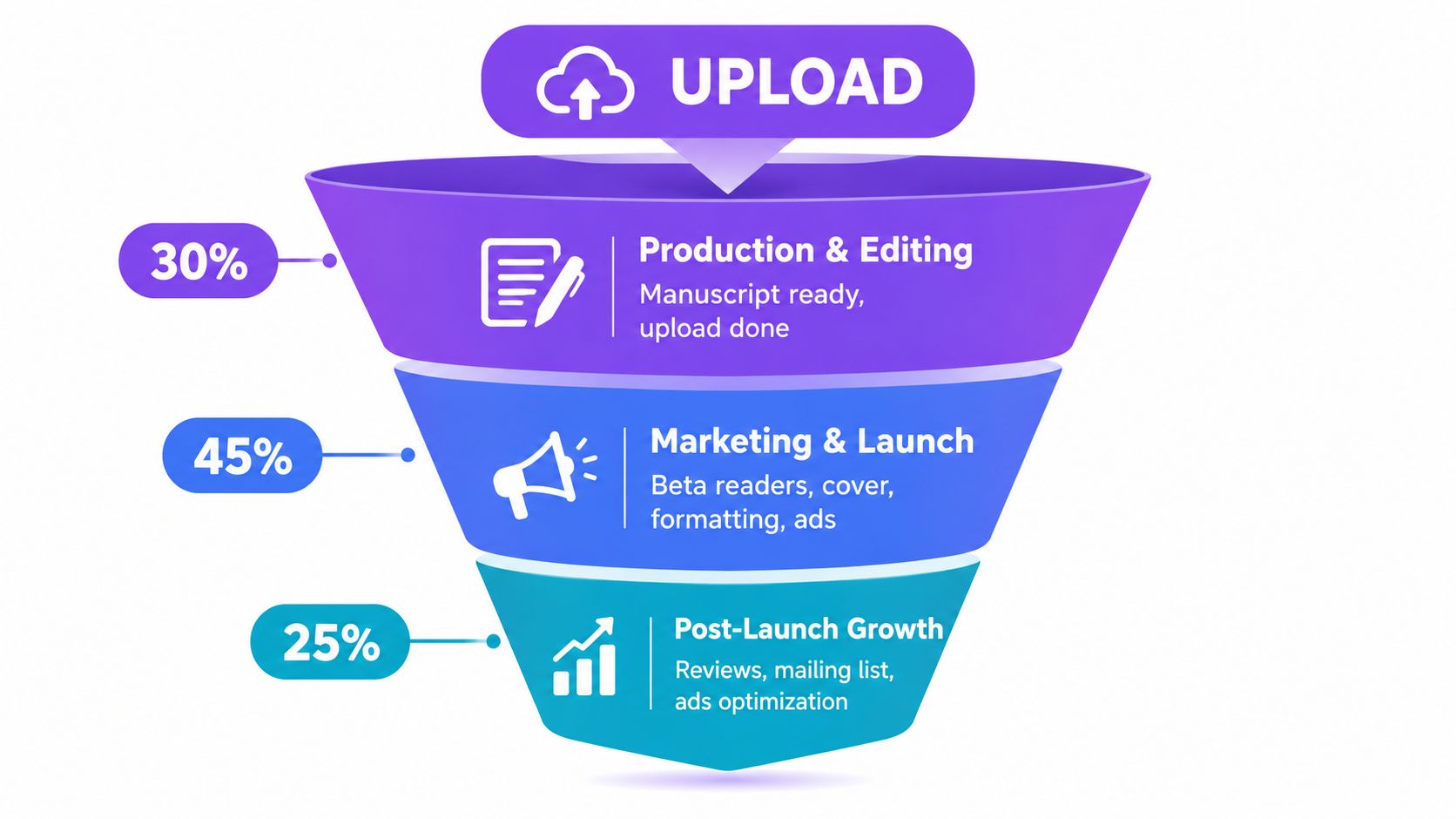
Most advice about how to self publish still treats the job like a retailer form. Finish the manuscript, export the files, upload to Amazon, done. That's beginner thinking, and it burns people out because it points all their effort at the easiest part of the process.
The upload is clerical. The business is everything around it.
That matters more now because self-publishing isn't some scrappy side lane anymore. One industry summary puts the global self-publishing market at $2.16 billion in 2025, up from $1.85 billion in 2024, with a projected 16.7% compound annual growth rate through 2033 to about $6.16 billion (BestWriting's market summary). If you're still treating this like a file-delivery task, you're operating with a hobby mindset inside a scale market.
Amazon deserves credit for making this commercially accessible. Its self-publishing platform launched in November 2007 as the Digital Text Platform on the same day as the first Kindle, and KDP Select followed in December 2011 with promo tools tied to 90-day Kindle exclusivity (Automateed's KDP history summary). That shift made digital-first publishing normal. It also trained authors to mistake platform access for business ownership.
Stop Treating Self-Publishing Like an Upload and Start Treating It Like a Business
Most debut authors overestimate the importance of getting the files live and underestimate the risk of platform dependence. That's backward. Retailers are channels, not your company.
Recent industry coverage on indie author trends says 30% of authors are already selling direct while another 30% plan to do so (Joanna Penn's 2026 indie trends roundup). Pay attention to that. Serious authors are moving toward reader ownership because they've learned the hard way what happens when one retailer controls discovery, pricing pressure, and access to your audience.
The three assets that actually compound
If you've published a few novels, you've already seen the pattern. The assets that pay you again are boring on launch week and priceless two years later.
- Your reader email list matters more than a temporary retailer bump.
- Your backlist does more revenue work than your launch post.
- Your control over pricing gives you options when a series stalls or a promo underperforms.
Everything else is support infrastructure.
Practical rule: If a task doesn't grow one of those three assets, question why you're doing it.
A clean upload receipt is not momentum. A system that brings readers back for book two is momentum. That's the difference between self-publishing a novel and building an author business.
The operational view most guides skip
Here's the blunt version. When authors ask how to self publish, they're usually asking the wrong question. They ask where to click. They should ask who owns the customer relationship after the sale, who controls pricing, and which formats deserve budget first.
That shift changes every decision after the draft is finished. You stop obsessing over retailer dashboards and start building an operation: cleaner manuscripts, smarter distribution, simple pricing logic, launch sequencing, legal setup, and post-launch maintenance that feeds the next release instead of dying after week one.
Preparing a Manuscript That Survives Beta Readers and Continuity Checks
Writers with complex novels rarely fail because they can't write scenes. They fail because revision becomes circular. They keep polishing sentences in a manuscript that still has structural drag, broken chronology, and continuity leaks.
We've seen the same pattern over and over in long fiction. Static notes don't protect a live manuscript. Character sheets are great for trivia. They do almost nothing when a recurring side character knows information too early, a week compresses into two days, or a weapon disappears between chapters.
Run the edit in one direction
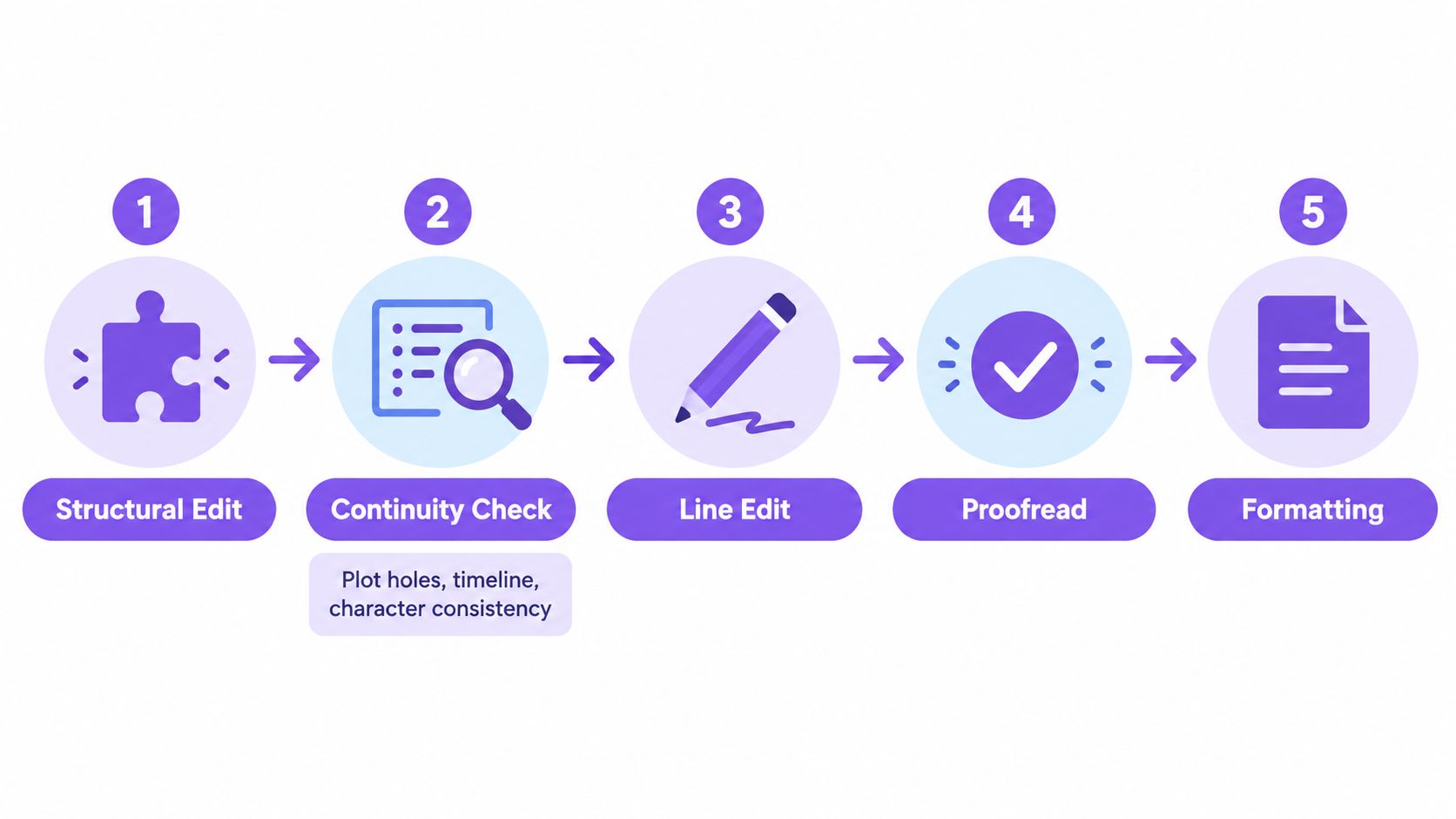
Use a one-way pass. Structural first. Continuity second. Line work third. Proof last. Formatting only after the manuscript stops moving.
If you line edit before checking continuity, you'll end up polishing scenes that later need surgery. That's wasted effort, and on an 80,000-word-plus novel it adds up fast.
A workable order looks like this:
- Structural edit for pacing, scene order, missing turns, dead subplots, and weak chapter exits.
- Continuity check for timeline, knowledge state, recurring object placement, age drift, travel logic, and POV consistency.
- Line edit for clarity, rhythm, repetition, and sentence drag.
- Proofread after changes are locked.
- Format only when the text is stable.
For a practical revision workflow, Novelium's guide on self-editing your novel is worth reading alongside your usual edit process.
What beta readers usually miss
Beta readers catch boredom and confusion. They do not reliably catch continuity. That's not a criticism. It's just not how people read.
They'll tell you a chapter drags. They often won't notice that the detective learned the suspect's surname in chapter twelve even though no one told her until chapter fourteen. They may not register that the heroine's eye color changes, or that the knife used in the kitchen scene somehow reappears in the car three chapters later.
The more books you write, the less your problem is imagination and the more it's state management.
That's why you need separate functions for different readers. Developmental beta readers should see the manuscript while big changes are still possible. ARC readers should get the near-final version, where their job is less about story architecture and more about confusing phrasing, typo catches, and launch readiness.
Use tools that expose drift
For objective passes, run the manuscript through ProWritingAid or AutoCrit. Not because software can replace judgment. It can't. Use it because repetition, sentence clutter, and style habits become invisible when you've read the book too many times.
For timeline views, Scrivener's corkboard or Plottr gives you the aerial perspective most manuscripts need. For continuity tracking across large casts and long manuscripts, Novelium can track characters, events, knowledge states, and timeline conflicts across chapters without turning your process into spreadsheet maintenance.
For handling beta copies, use a private shared Google Doc, a controlled folder, or a managed beta pool. Don't spray manuscripts into random inboxes and then pretend version control will sort itself out.
Before formatting, do one export sanity pass:
- Clean styles so chapter heads and scene breaks are consistent
- Remove double spaces because they always survive longer than they should
- Flatten font weirdness from copy-paste imports
- Check front and back matter so links, sample chapters, and mailing-list pages aren't missing
That's the version you publish. Not the one that merely feels finished.
Choosing Where to Sell KDP IngramSpark Aggregators or Direct
Distribution decisions expose whether you think like a novelist or like a publisher. Novelists ask where the file should go. Publishers ask which channel fits the format, the audience, and the long-term business.
Amazon KDP is the obvious starting point for ebooks. That's not controversial. The argument starts when people treat KDP as the whole strategy.
What each channel is actually for
Use channels for their strengths, not because the internet told you to "be everywhere."
| Channel | Best For | Royalty Range | Reader Ownership |
|---|---|---|---|
| KDP | Kindle reach and Amazon-native ebook sales | 70% or 35% for ebooks depending on price band and conditions | Low |
| IngramSpark | Print distribution to bookstores and libraries | Varies by setup and wholesale terms | Low |
| Draft2Digital or Smashwords | Low-friction wide ebook distribution | Varies by retailer and aggregator share | Low |
| Direct sales | Selling from your own storefront or campaign pages | Higher margin per sale qualitatively | High |
If you need a quick refresher on Amazon's platform terms, Novelium's glossary entry for Kindle Direct Publishing is a clean summary.
My default recommendation for a debut novelist
For a 2026 debut fiction release, I'd start with KDP for ebook and paperback, plus a direct-sales layer you control. Then I'd decide whether wide distribution deserves attention based on genre, release cadence, and your tolerance for operational drag.
If you're ebook-only, skip IngramSpark. That's dead weight. IngramSpark matters when print distribution is part of the plan. If you don't have a print strategy, don't add another dashboard just to feel professional.
If you want broad ebook distribution without managing multiple retailer accounts, use an aggregator like Draft2Digital or Smashwords. That's the convenience play. It's not the ownership play.
KDP is a channel. Direct sales are an asset.
The exclusivity tradeoff you shouldn't romanticize
Amazon's exclusivity offer still tempts authors because Kindle Unlimited can produce visibility and page-read income. The catch is control. KDP Select asks for 90-day Kindle exclusivity, which means you're making a distribution bet every quarter.
That's not automatically wrong. For some genre fiction, Select works. But don't confuse a tactical exclusivity test with a career strategy.
The direct-to-reader angle matters more now because authors are actively moving there through Shopify, Kickstarter, and live or in-person sales, as noted in the earlier industry trends link. Direct sales won't replace retailer reach for most debut authors on day one. They will, however, start building the customer relationship retailers never hand back to you.
My short version is simple. Start where readers already buy. Build where you own the relationship. Don't invert that.
Pricing Royalties and Format Mix That Actually Pay Back
Most pricing advice is sentimental. Ignore it. Price is not a statement about your worth. It's a lever.
The only pricing facts that deserve permanent space in your head are Amazon's ebook royalty tiers. Current guides report 70% for qualifying KDP ebooks and 35% otherwise, with the 70% tier applying at $2.99 to $12.99 when the other conditions are met (Inkfluence AI's 2026 KDP royalty explainer). That's the frame you price inside.
What the royalty split means in practice
If your novel sits inside the qualifying band, you get the better tier. Step outside it and your per-sale economics drop hard. That's why random bargain pricing can be expensive in ways newer authors don't notice until after launch.
| Format | List Price | Platform | Per-Unit Royalty | Notes |
|---|---|---|---|---|
| Ebook | $2.99 to $12.99 qualifying range | KDP | 70% tier, subject to conditions and delivery fees | Best default band for most indie fiction |
| Ebook | Outside qualifying band | KDP | 35% tier | Use deliberately, not by accident |
| Paperback | Varies | KDP or IngramSpark | Varies with print cost and channel terms | Model this before approving proof |
| Audiobook | Varies | ACX, Audible, or wide audio distributors | Varies by exclusivity and distributor setup | Only add when the audience justifies the spend |
I won't pretend there is one perfect fiction price. There isn't. There is a price that fits your genre, your series structure, and your launch objective.
Format sequencing beats format sprawl
A lot of authors light money on fire by trying to launch every format at once. Don't.
Recent coverage points to audiobook expansion, premium physical formats, and mainstream production assistance in indie workflows as growing trends (Write Light Group's 2026 self-publishing trends roundup). That's useful context, but trend growth doesn't mean every debut novelist should fund every format immediately.
Start with ebook and paperback. Those are your core discovery and conversion formats. Add audio later if the book proves demand, your series has legs, or your audience strongly prefers listening. Skip expensive premium experiments until the plain version sells.
Don't build a format stack to impress other authors. Build one that survives contact with your cash flow.
A launch discount can help if you use it as a short-term traffic move. Then return to your real catalog price. Cheap forever is not strategy. It's often just fear wearing a marketing hat.
Running a Launch That Builds a Reader List You Own
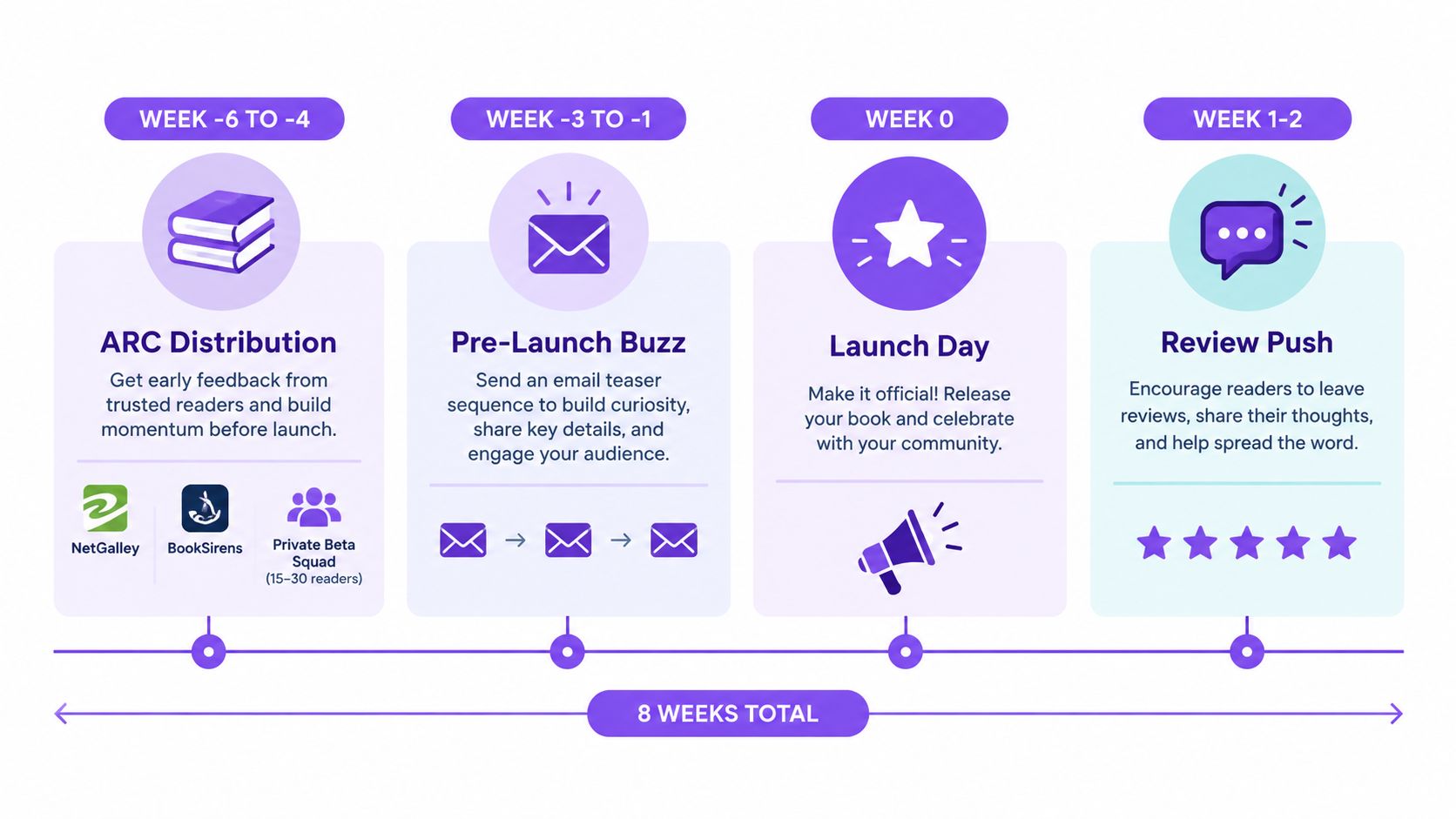
Launches fail when authors treat them like a checklist. A strong launch is a sequence. Timing matters more than enthusiasm.
The sale itself belongs to the retailer. The next conversation has to belong to you. That's the standard every launch decision should answer to.
Start with ARC distribution
Get advance copies out before launch, not after. Use NetGalley, BookSirens, or your own private review team. The method matters less than control and follow-through.
Your ARC group should know exactly what you're asking for: finish the book, report obvious errors, and post a review during launch week if they liked it. Don't dump a file into the void and hope goodwill solves the rest.
A mailing-list explainer like Novelium's mailing list glossary is useful if your reader funnel is still loose.
Add traffic only after the page can convert
Don't buy attention for a weak product page. Fix the description, categories, metadata, and retailer sample first.
Then layer on promotion:
- Amazon ads work best when your cover and blurb already signal genre correctly.
- BookBub cost-per-click ads make more sense once reviews exist and the page has social proof.
- Newsletter swaps through BookFunnel or StoryOrigin still work when the subgenre match is tight.
- Your own email sequence should push readers to one clear action, not seven.
Your launch isn't a demand-generation miracle. It's a conversion test on packaging, timing, and audience fit.
Price to direct traffic, not to apologize
A temporary promo price can help move volume and reduce risk for new readers. Fine. Use it with a deadline and a reason. Then move back to your intended price.
What matters more than the exact discount is where the reader goes next. Every book should point readers toward something you own: a bonus scene delivery page, a reader magnet signup, a direct storefront, a Substack, or a private community. GroupMe can work for some genres. BookFunnel landing pages work well when you want clean delivery without extra technical friction.
If your launch creates sales but captures no contact path, you rented attention and called it growth.
ISBNs Barcodes Copyright and Tax Setup Before Your First Sale
This is the part everyone delays because it isn't fun. Do it anyway. Sloppy admin causes expensive messes later, especially once you've got multiple formats and multiple channels.
ISBNs and barcodes aren't decorative
If you're publishing into the U.S. market, treat Bowker as the formal source. Bowker identifies itself as the official source for ISBNs in the United States through ISBN.org. That's the identifier step. Not a graphic design choice. Not a thing to "sort out later."
For print books, a barcode isn't just a random black rectangle either. Bowker states that a barcode is the graphical representation of a book's ISBN and, in the United States, price information, and its barcode service requires both an ISBN and retail or list price data through Bowker's barcode guidance. If you're selling a U.S. print edition, handle it correctly from the start.
Copyright and paperwork still involve real-world steps
A lot of authors assume copyright registration is just an online form. It isn't that simple. The U.S. Copyright Office says authors must send physical deposit copies to the Library of Congress at 101 Independence Avenue SE in Washington, DC under its deposit requirements (U.S. Copyright Office mandatory deposit page). Plan for paperwork and delivery, not just screen clicks.
If legal admin isn't your strength, it's sensible to hire virtual legal assistants to organize filings, rights paperwork, and compliance tasks before they become launch-week clutter. That's not glamorous help. It's useful help.
Tax setup before money starts arriving
Handle your tax identity before the first platform payout forces the issue. Complete retailer tax interviews early. Keep publisher records organized by format and platform. If you're selling direct through your own storefront, don't assume retailer rules cover you. They usually don't.
The principle is simple. If a task affects rights, identifiers, payment records, or compliance, do it before launch. Administrative debt compounds faster than most authors expect.
Post-Launch Maintenance and the First 90 Days That Decide Everything
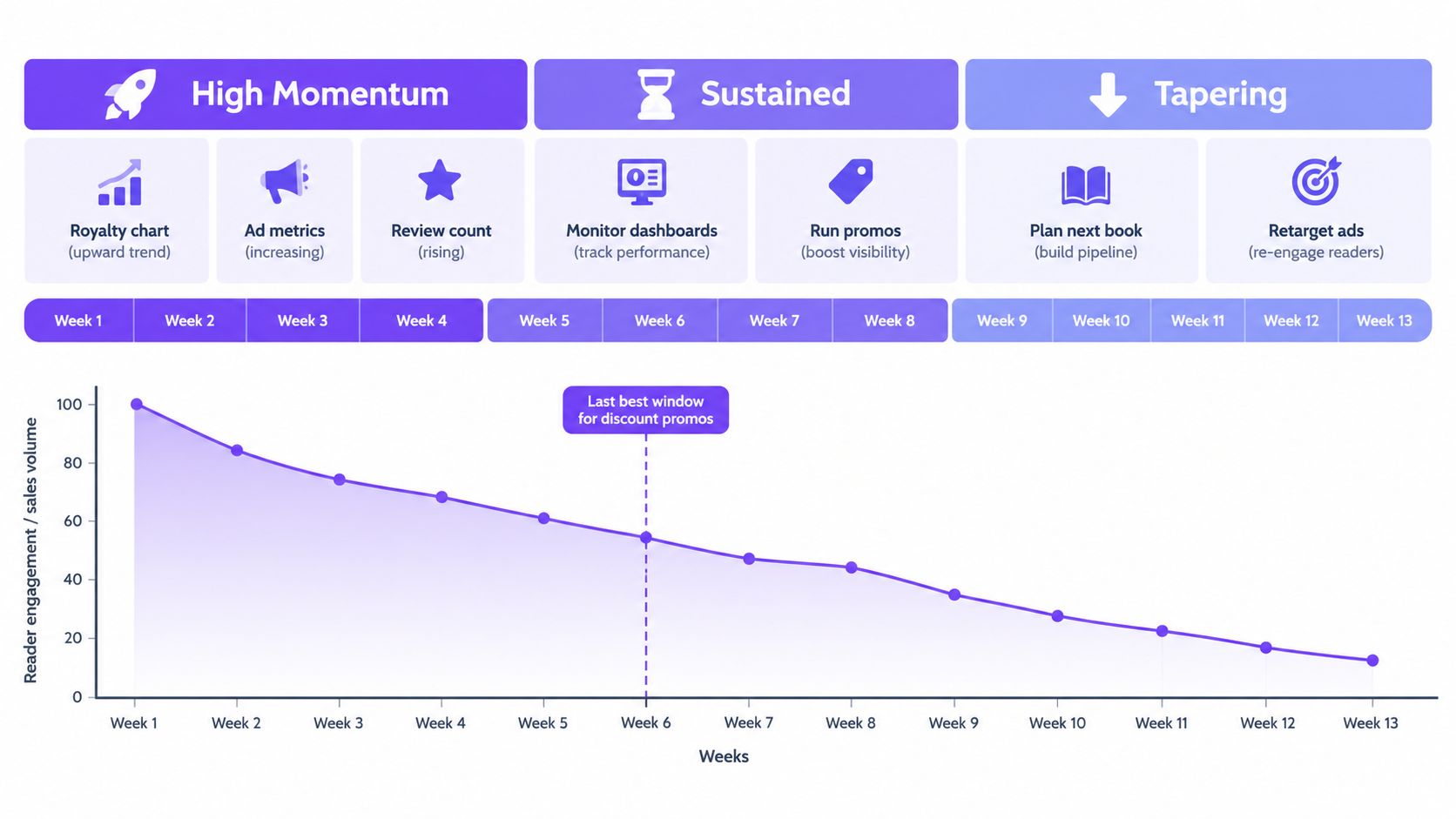
Most debut authors waste the first 90 days watching rank swings and refreshing dashboards. That's retailer thinking. Smart indie authors use this window to build a direct-to-reader business while attention still exists.
Platform dependence is the risk too many authors miss. If all your post-launch energy goes into feeding Amazon ads and chasing store algorithms, you do not have a publishing business. You have a rented sales channel. In 2026, that is a fragile way to build a career.
What to monitor each week
Track signals that lead to decisions.
I watch four every week:
- Ad efficiency. If an ad set spends and fails to produce enough revenue, read-through, or list signups, cut it fast.
- Read-through to book two. Series authors make their money here, not from bragging about one book's launch spike.
- List growth. If sales climb but your email list stays flat, readers are buying from a store and disappearing.
- Organic versus paid sales split. If paid traffic carries the whole book, your positioning, product page, or audience match is off.
Do not collect metrics for sport. Attach an action to each one. Keep, cut, revise, or redirect.
Maintenance work that matters
Refresh ad creative before performance decays. Update metadata when a keyword set underperforms for long enough to prove the point. Tighten your back matter if readers are not clicking into your list, bonus content, or next book.
Then do the work that pays back longer than a launch week push. Email new subscribers. Deliver the promised magnet fast. Ask for reviews after readers have had time to finish, not the day after download. Watch early complaints for patterns. If several readers stumble over the same promise, cover, category, or opening chapters, fix the mismatch.
Start the next book now.
A backlist grows careers. One title with no follow-up does not. The author who uses these 90 days to strengthen the reader pipeline and move the next manuscript forward will beat the author who treats launch rank like a personality trait.
The outcome you're after
Your goal is not getting a file live on a retailer dashboard. Your goal is building a repeatable system that turns attention into owned audience, owned audience into future sales, and each book into demand for the next one.
That system includes a clean manuscript, smart distribution, pricing that protects margin, a reader list you own, and post-launch habits that reduce reliance on any single platform. Get that right and every release gets easier. Ignore it and you keep paying stores to introduce you to readers you never get to keep.
If you're publishing complex fiction, continuity errors and timeline drift will sabotage both the manuscript and the launch process long before ads or pricing can help. Novelium gives novelists a way to track character details, knowledge states, timeline logic, and manuscript consistency before the book goes out to beta readers, ARC teams, and retailers.