How to Respond to Criticism as a Fiction Author
99% of all criticism is noise you should delete without reading, and the skill is building a filter fast enough to spot the 1% that matters. Respond well by separating factual problems from reader reactions and personal preference, then answer only what deserves your time.
You're probably looking at a review, an editorial letter, or a beta-reader document with comments scattered through a manuscript you've already revised three times. One note says the timeline is impossible. Another says the protagonist feels cold. A third demands that you change the ending because the reader wanted a different book. They sit together in the same inbox, wearing the same visual weight, even though they're not remotely the same kind of information.
That's the trap. Criticism is a data stream, not a verdict on your worth as an author. Your job isn't to absorb it all, perform gratitude, or defend every sentence. Your job is to identify which signals reveal a defect in the book, which reveal a reader's experience, and which are merely somebody trying to make your novel obey their preferences.
The Brutal Math of Novel Feedback
Most writers enter publishing believing feedback is a direct line to improvement. It isn't. A beta reader, an agent, an editor, and a reviewer may all comment on the same scene while operating under entirely different incentives, expectations, and levels of responsibility.
The useful question isn't “Is this person right?” It's “What kind of information is this?” A complaint about a character knowing something before learning it is a continuity signal. A complaint that the character should be nicer is usually a preference signal. A complaint that the book is boring is evidence of an experience, not proof of a specific technical failure.
That distinction is professional hygiene. The feedback glossary is useful precisely because writers need language for separating response types instead of flattening every comment into “good note” or “bad note.”
Your readers aren't one audience
Early readers often help you discover where the manuscript loses clarity. Editors test structure, market fit, and execution against a professional brief. Reviewers react publicly to the finished artifact. Random commenters may only be broadcasting taste.
Treating all of them as equal authorities creates two predictable failures. You either revise the book into a committee project, or you stop listening altogether because the signal is buried under noise. Neither is a serious revision method.
Practical rule: Never make a change while still emotionally fused to the comment that suggested it.
Collect criticism first. Sort it later. A harsh note can be correct, and a warm note can be useless. The tone tells you how the message feels. It doesn't tell you what the message contains.
Why Some Criticism Works and Other Criticism Destroys
A reader says, “I stopped trusting the detective when she forgave him.” Another says, “You need to make the detective tougher.” Both comments concern the same character, but they deliver different kinds of information. Research summarized by the American Psychological Association on constructive criticism distinguishes evaluative feedback about completed work from directive feedback about how someone should perform a future task. Evaluative feedback reports an observed result. Directive feedback moves straight to a prescribed solution.
That distinction determines how much usable data reaches your revision process. The first comment ties a reaction to a specific moment in the manuscript. You can test the scene, the setup, the character's motivation, and the intended effect. The second skips diagnosis and proposes a personality transplant. Accepting it without examination can pull the novel toward someone else's preferences.
A good critique, as defined in our critique glossary, can still be severe. Severity does not make feedback useless, and politeness does not make it accurate. Useful criticism identifies an observable effect, points toward the relevant passage, and leaves room to determine whether the cause is a scene problem, a setup problem, or an intentional effect that the reader merely dislikes.
Fairness changes what people can hear
Criticism also carries information about the exchange itself. Research on interpersonal fairness in feedback exchanges found that criticism delivered with greater fairness produced more favorable judgments and greater acceptance of the feedback. For authors, the practical point is simple: people process content more accurately when the exchange does not attack their standing.
A reviewer who calls you incompetent may still have noticed a real pacing problem. The insult contributes no diagnostic value, so remove it from the data stream. Ask what claim remains after hostility, exaggeration, and personal judgment are deleted.
“I felt lost in chapter nine” is data. “Only an idiot would write chapter nine this way” is packaging.
Record the usable claim beside the relevant scene. Then test it against the manuscript and other responses. You do not need to reward bad packaging with a public argument, and you do not need to discard valid information because its delivery was poor. Triage protects both the book and the conditions required to revise it.
Triage Before Response
Before drafting a reply, route the criticism into a category. Don't let a comment move directly from somebody else's mouth into your revision plan or your nervous system.
Use three buckets. Factual errors include impossible dates, contradictory eye colors, a weapon appearing without being acquired, or a character referring to information they haven't learned. Subjective reactions include boredom, discomfort, dislike, confusion, or a sense that a relationship lacks chemistry. Noise includes attacks on your intelligence, demands that you write a different genre, and vague declarations that your voice is terrible.
The categories don't determine whether you respond. They determine what kind of response is possible.
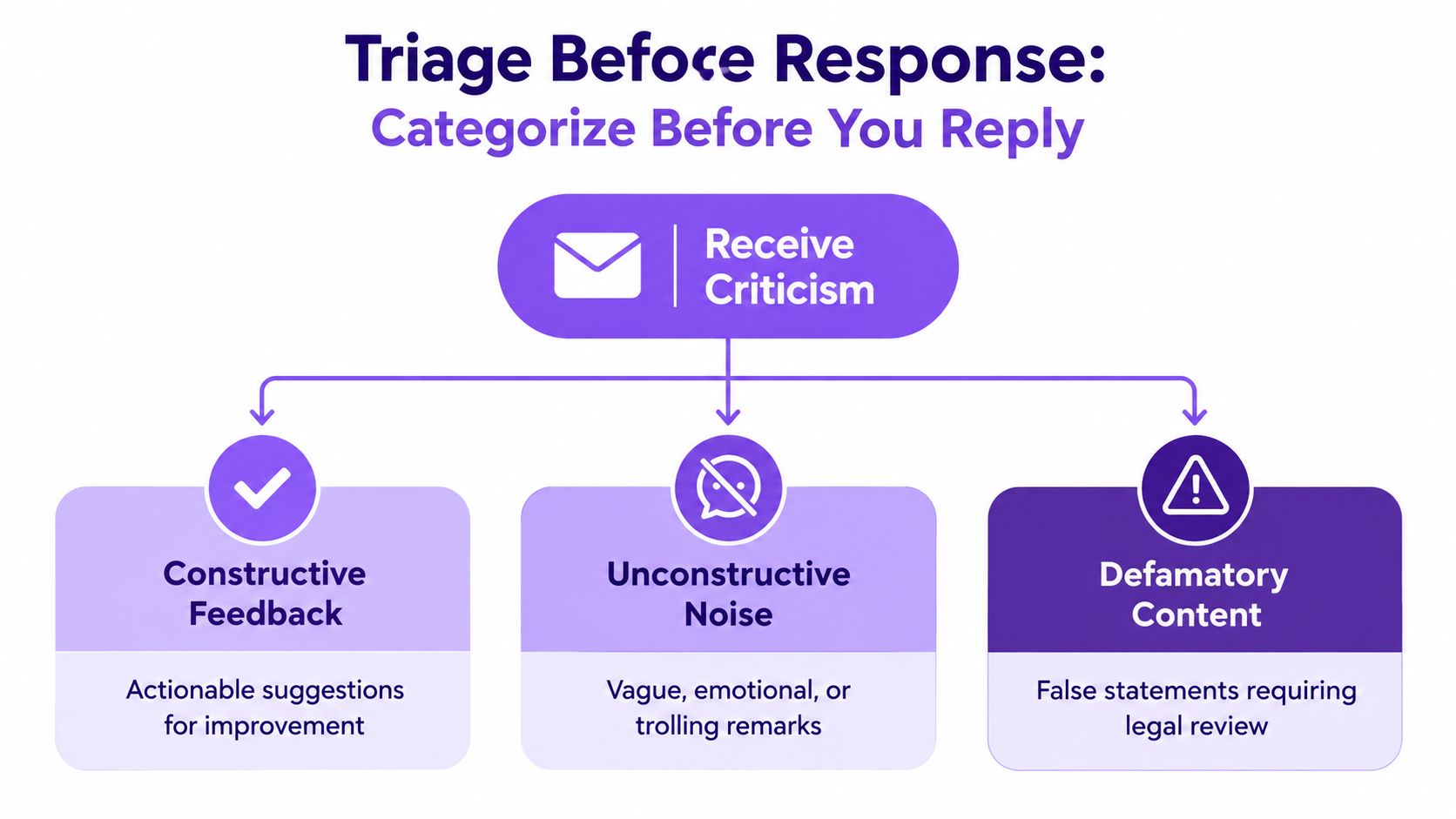
Route the information, not the emotion
For a factual error, verify the manuscript. Search the relevant chapters, check your timeline, and inspect the character's knowledge state. If the contradiction exists, fix it or explain why the reader's interpretation is wrong.
For a subjective reaction, look for recurrence. One reader feeling bored may reflect taste or a single mismatch. Several independent readers flagging the same scene gives you a stronger pattern, especially if they identify the same point of confusion. The fresh-eyes technique helps here because it keeps you from relying only on readers who already understand your intentions.
Noise needs a different action: archive, mute, or delete. Don't turn a personal attack into a workshop exercise. You can learn from criticism without accepting the critic's framing, motives, or demand for access to you.
A useful response sheet has four columns: claim, evidence, action, reply. The claim records what was said. Evidence records the passage or reader reaction. Action records fix, monitor, clarify, or reject. Reply records whether anyone needs an answer at all. That last column matters. Many criticisms deserve processing and never deserve a message.
The Defensive Tactics You Must Avoid
Complaint-handling research identified six defensive tactics in responses to criticism: redirecting, evading, psychologising, invalidating, closing the episode, and individualising concerns. The study published through PubMed Central reports that avoiding tactics appeared in 33% of responses, delegitimising tactics in 18%, and limiting tactics in 61%. Redirecting occurred in 19% of responses and showed a strong association with criticism.
Authors use the same moves, usually with better vocabulary. Redirecting sounds like, “You didn't understand the genre.” Evading sounds like, “The actual problem is how readers consume books now.” Psychologising sounds like, “You only disliked the heroine because she reminds you of someone.” Invalidating says the reaction is stupid. Closing says, “Well, the book is finished.” Individualising turns a work-level concern into a critic-level defect.
Watch the moment you change the subject
The common thread is refusal to process the actual signal. If someone says the third-act reveal contradicts an earlier fact, explaining your childhood, your intentions, or the critic's politics doesn't answer the claim. It changes the subject while pretending to engage.
The clean alternative is narrow and boring. Restate the concern. Check the text. Say what you found. Then state the action, if any.
Response discipline: If your draft reply contains more information about the critic than about the criticism, stop writing.
Publicly, keep the boundary firm. “Thanks for reading. I'm not discussing individual reviews, but I've noted the concern” is enough. Privately, investigate whether the review exposed a real continuity break. Professionalism doesn't require public availability, and privacy doesn't require self-deception.
Scripts for Different Sources
A beta reader who spent days with your manuscript gets a specific acknowledgment. A stranger posting a hostile review gets almost nothing. The response protocol should match the relationship, not the intensity of your feelings.
For a beta reader, write: “Thanks for flagging the scene in chapter fourteen. I'm checking whether the confusion comes from the reveal order or from the character's motivation. Please tell me where you first lost track, but don't rewrite the scene for me yet.” That extracts a location and protects your revision authority.
For an editor, write: “I see the structural concern about the middle section. I'll review the three linked chapters and return with a proposed revision scope. I'm not committing to removing the subplot until I've tested whether compression solves the pacing issue.” That is cooperative without agreeing to an undefined rewrite.
For a public reviewer, write: “Thanks for reading and sharing your reaction.” Then stop. You don't need to litigate a stranger's taste in the comments, and you certainly don't need to explain every deliberate choice to an audience that didn't ask for a director's commentary.
Different sources produce different evidence
The most valuable beta note often arrives as a messy emotional report. “I hated this chapter” may conceal a precise problem with withheld information, an implausible decision, or a relationship that hasn't earned its turning point. Ask where the response changed, not whether the reader can design the solution.
An editor's note deserves a more formal exchange because the work has a professional scope. Ask which outcome the proposed change serves, what material it displaces, and whether the request concerns a defect or a market position. Those are separate decisions.
A public review is not a private editorial conference. For broader practical guidance on keeping criticism responses measured and bounded, this criticism response advice offers a useful reference point. Adapt scripts to the source, and don't confuse courtesy with ongoing access.
How to Decide What to Change
Responding to criticism doesn't mean agreeing with it. It means showing that you processed it accurately.
The Science guidance on constructive criticism recommends focusing on the substance of the work rather than personal attacks, thanking people for engaging, and deciding which issues are worth addressing. That final decision belongs to the author. A reader can identify an effect without having authority over the cure.
Use three tests. Does the criticism identify a factual break? Does it recur across independent readers or appear in a high-value editorial context? Does fixing it strengthen the book's intended experience rather than merely making it more agreeable?
Revision is a negotiation with the manuscript
A factual continuity problem usually earns correction. A reaction that exposes a repeated comprehension failure deserves investigation. A request to make the villain less disturbing may deserve rejection if disturbance is the point.
The hard cases mix valid substance with bad rhetoric. Separate them. A reader who says, “This romance is ridiculous because your protagonist is an idiot” may have identified a missing emotional bridge. Remove the insult, test the bridge, and decide whether the scene needs work.
The same principle applies to character tracking. In a long manuscript, a reader's “she would never do that” may indicate a motivation problem, but it may also expose a state contradiction. Check what the character knows, what they promised, what injuries they carry, and what changed between scenes. Revision should follow the evidence, not the loudest phrasing.
A practical record distinguishes accepted, rejected, and deferred notes. Rejection isn't failure. Write one sentence explaining why the change conflicts with the book's voice, logic, genre promise, or ending. Deferral is useful when you need to read the full manuscript before judging a local complaint.
Novelium's Character Tracker and World Codex automatically extract and track character details across manuscripts, including traits, knowledge states, relationships, events, and world information. That kind of systematic record helps you test whether criticism points to a real contradiction instead of relying on memory across a long series.
The goal isn't to become impervious. It's to become precise. Accept the correction that repairs the book, preserve the choice that defines it, and refuse the demand that turns your novel into somebody else's draft.
Use Novelium to track character knowledge, relationships, timelines, and continuity while you investigate criticism across a complex manuscript. Import your draft, connect feedback to the relevant chapters, and let the system show you which complaints reveal genuine inconsistencies before you revise.