7 Historical Fantasy Book Series That Test Your Continuity
Read the best historical fantasy book series for atmosphere, the usual advice goes. Study the clothes, the food, the court etiquette. Fine, but none of that saves a scene where a spy knows a secret nobody told her.
Most recommendation lists celebrate world texture and ignore the bookkeeping that makes it hold. For a working novelist, the more useful question is what each series requires its author to track: future knowledge, military authority, unstable allegiances, or the changing status of an artwork.
These are continuity stress tests, not a ranking of prose or romance. Some belong squarely in historical fantasy; others use invented worlds with recognizable historical foundations. Read them for the structures your own series needs, whether you're managing time travel, a court conspiracy, or a war whose participants keep changing sides. The failure scenarios below are diagnostic examples, not allegations that these authors got their records wrong.
1. Outlander
Diana Gabaldon's Outlander makes Claire's knowledge a permanent continuity hazard. A nurse displaced into Scotland's past doesn't merely bring medical skills. She brings expectations about politics, survival, and what happens next, none of which automatically belongs to the people around her.
The split chronology makes that information gap visible.
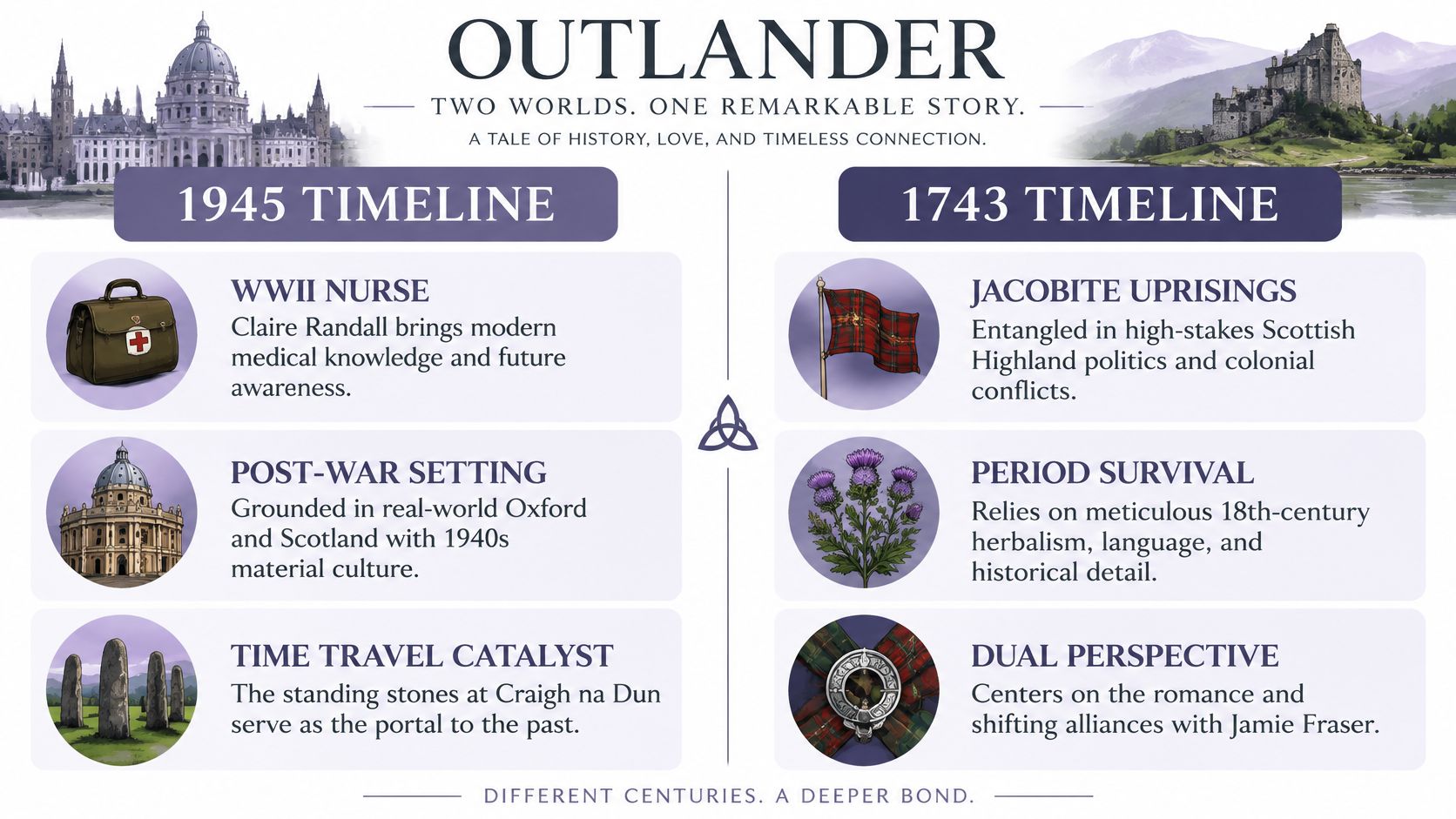
For authors working within historical fiction, the useful distinction is knowing a treatment versus being able to perform it. Claire's expertise doesn't guarantee access to equipment, ingredients, cooperation, or a patient who believes her. Record those separately, or competence becomes a convenient permission slip.
Track the disclosure, not just the fact
Say your displaced physician warns an ally about an approaching political disaster. Later, another character acts on that warning despite never receiving it. The chronology can be flawless while the scene still cheats.
Give each consequential fact an origin, a recipient, a disclosure scene, and a confidence level. Track whether Jamie believes Claire, not merely whether she's told him something; disbelief changes decisions just as surely as ignorance does.
Study this series for asymmetric knowledge across a long relationship. Its demanding historical texture is valuable, but the structural lesson is sharper: author knowledge, protagonist knowledge, and shared knowledge aren't interchangeable.
2. Temeraire
A dragon beside a warship looks spectacular. For the novelist, it also means feeding, transport, command, and diplomatic status.

Naomi Novik's Temeraire puts Laurence and his dragon inside the Napoleonic conflict, making fantastic creatures participants in military institutions rather than decorative weapons. That's the productive difficulty of alternate-history worldbuilding: an invention changes who can exercise power, not just how a battle looks.
For a comparable manuscript, maintain separate records for an officer's rank, posting, legal status, and actual command. A disgraced officer may retain expertise without retaining authority. If your next council scene lets everyone obey him as before, you've erased the consequences of the previous volume.
Command test: Record who can issue an order, who must obey it, and what happens if they refuse.
Dragon records need the same precision. Training, physical capacity, trust, and political commitments shouldn't collapse into a general description of loyalty. A dragon can trust a handler while rejecting the institution that employs him.
Use the accompanying video as a companion to the series, then return to the practical question of authority.
Study this series for institutional consequences. The trade-off is administrative complexity: every reassignment can affect travel, access, relationships, and the next military decision.
3. Kushiel's Legacy
A spy's character profile can be perfectly accurate and almost useless. Knowing that Phèdre nó Delaunay is perceptive won't tell you whether a particular courtier knows she has discovered his betrayal.
Jacqueline Carey's Kushiel's Legacy combines espionage, sexuality, religion, and political obligation in Terre d'Ange. Its value for a series novelist lies in the distinction between declared allegiance, private loyalty, and constrained behavior. Those states can contradict each other without the characterization being inconsistent.
Give secrets their own records
Suppose a courtier publicly supports a noble house while privately helping its opponent. Your record needs the public position, the concealed commitment, the people who suspect it, and the evidence they possess. A general label such as untrustworthy tells you none of that.
Track secrets as facts with audiences, not as notes buried under the protagonist's biography. Mark a suspicion differently from confirmation, and distinguish an accurate deduction from a lie that happens to produce the same behavior.
A religious mark or obligation also needs an operative rule, not merely a glossary definition. If it changes what a character can promise or endure, record the consequence at the scene where it matters.
Study Carey for information asymmetry in political relationships. The price of intricate intrigue is maintaining several incompatible versions of events without accidentally giving everyone the narrator's understanding.
4. The Sarantine Mosaic
An artwork can need more continuity tracking than a supporting character. In Guy Gavriel Kay's The Sarantine Mosaic, Crispin's commission connects artistic work to patronage, religion, and imperial power.
The workshop image captures the physical side of that problem: making art requires access, materials, labor, and time.

For your own history-building, separate the empire's established conditions from the changes your plot introduces. A study of David Gemmell's historical fantasy identifies a related approach: retain recognizable historical foundations while using fantastic elements to reinterpret conflicts and gaps.
Treat the commission as a changing object
Say an artist loses a patron's protection midway through a commission. Can he still enter the building? Who pays his assistants? Who has seen the disputed imagery? Unless the manuscript answers those questions consistently, the political reversal has no material effect.
Record the artwork's design, completion state, authorized viewers, funding, and vulnerability to alteration. Align workshop scenes with court events on the same timeline, because a commission can't respond to a political change before the artist hears about it.
Study Kay for material projects entangled with power. Invented names provide flexibility, but they don't remove the need to track offices, patronage, religious authority, and debts.
5. The Poppy War Trilogy
Rin's power isn't a stable character trait. In R. F. Kuang's The Poppy War trilogy, supernatural capability belongs alongside bodily condition, psychological strain, dependency, and military usefulness.
The series draws on Chinese history through an invented setting. Read it for how personal deterioration and factional warfare complicate each other, rather than treating its historical foundations as interchangeable scenery.
A power record that says only powerful tells you nothing about whether the character can survive using it today.
For a comparable war narrative, log the capability available in a scene, its immediate cost, and the impairment carried into the next scene. If a commander can unleash devastation after the previous chapter established incapacitation, you need a recovery mechanism, not a more emphatic description of determination.
Keep the army separate from its reputation
A faction's name doesn't establish its current strength. Record commanders, subordinate units, location, supply condition, and the orders each group has received.
Suppose an alliance changes while troops are already marching. The political agreement and the battlefield response cannot occur simultaneously unless communication makes that possible. Track the messenger, delay, and uncertainty.
Study this trilogy for escalation with consequences. The hard part isn't making each confrontation bigger. It's preserving the damage, depleted resources, and compromised loyalties that prevent later confrontations from resetting to the same starting position.
6. The Glamourist Histories
An invitation can alter a plot as decisively as a military order. Mary Robinette Kowal's The Glamourist Histories places magical practice within Regency social expectations, where skill, reputation, marriage, and access don't operate independently.
The distinction matters even when the visual language of magic suggests private power.
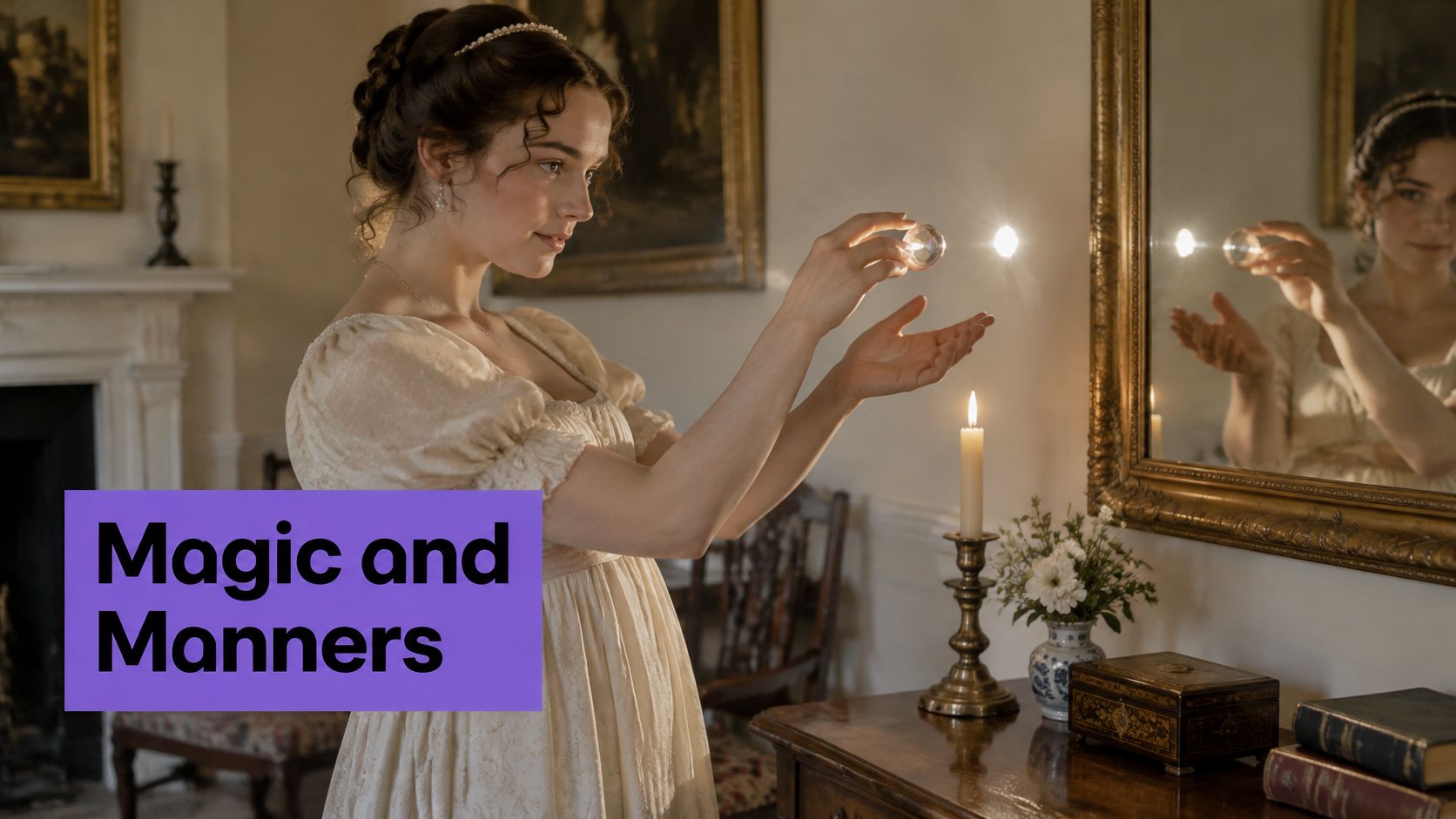
Jane's changing capabilities require a training history. Her social position requires something else: a record of who has witnessed those capabilities, how they interpreted them, and whose judgment carries consequences.
Reputation needs an audience
Don't assign a character a universal state called disgraced. Disgraced among whom? A family might conceal an incident while a rival circulates it and a prospective patron remains unaware.
Say your glamourist performs something socially compromising at a private gathering. Record the attendees, servants or observers with access, subsequent disclosures, and resulting invitations or exclusions. Gossip needs a route through the manuscript.
Social continuity: A private reconciliation doesn't repair a public reputation unless someone makes the repair public.
Study this series when manners and magic impose overlapping restrictions. The trade-off is that seemingly small scenes carry substantial state changes. A dinner, lesson, or introduction may change access to a patron as decisively as a formal appointment, and your records need to preserve that change.
7. A Discovery of Witches and the All Souls Trilogy
Who possesses the manuscript? That question is separate from who has read it, who understands it, and who knows it exists.
Deborah Harkness's All Souls trilogy follows Diana Bishop and Matthew Clairmont through a story involving scholarship, supernatural communities, and travel into the past. Its central document makes archival research an active plot mechanism rather than background decoration.
Track custody and interpretation separately
In a comparable manuscript hunt, give the document a custody history, physical condition, access restrictions, and contents record. Then attach character-specific interpretations. Someone can possess the right evidence and reach the wrong conclusion without creating a continuity error.
Time travel adds another distinction: calendar position versus personal sequence. A character may encounter someone in the past after already knowing their later self. The scene must preserve which meetings each participant remembers.
Suppose a recurring figure recognizes a phrase introduced during a later encounter in their own life. That's an information leak unless the story establishes another route. Track each appearance against both the shared chronology and the character's lived order.
Study Harkness for object history intertwined with personal history. The difficulty isn't merely dating events correctly. It's preventing relationships, discoveries, and interpretations from arriving before the experiences that produced them.
How the seven series stack up as continuity stress tests
| Item | Setting | Core Publication Span | Main Continuity Risk | Best For |
|---|---|---|---|---|
| Outlander | Georgian-era Scotland and later settings, linked to 1945 by time travel | 1991–2021; nine main novels | Tracking decades of events, family ties, historical detail, and characters' knowledge of the future | Readers who enjoy expansive historical romance and time travel |
| Temeraire | Napoleonic-era alternate history with dragons in global warfare | 2006–2016; nine novels | Keeping military ranks, dragon development, and international alliances consistent | Readers who enjoy military fantasy and alternate history |
| Kushiel's Legacy | Alternate Renaissance Europe with elaborate court and religious systems | 2001–2003; original trilogy | Tracking shifting allegiances, secrets, and noble-house relationships | Readers who enjoy intricate court intrigue and morally complex characters |
| The Sarantine Mosaic | Byzantine-inspired empire with invented religion and politics | 1998–2000; two novels | Aligning parallel storylines and political changes across the duology | Readers who want a focused historical fantasy with themes of art and power |
| The Poppy War Trilogy | Alternate China shaped by modern Chinese wars and history | 2018–2020; trilogy | Maintaining consistency in evolving magic costs, factions, and invented geography | Readers prepared for intense military fantasy and difficult historical themes |
| The Glamourist Histories | Regency England, where glamour is a learned art shaped by social rules | 2010 onward; series end not specified | Tracking social standing, relationships, and characters' magical skills | Readers who enjoy Regency manners, romance, and restrained magic |
| A Discovery of Witches and the All Souls Trilogy | Contemporary settings and Elizabethan England, connected by time travel | 2011–2014; trilogy | Tracking characters' knowledge across eras and the manuscript's custody and contents | Readers who enjoy research-driven fantasy, romance, and historical time travel |
Building the Tracking Layer Before the Series Outgrows Your Memory
Each series presents a workload that memory alone would struggle to support: disclosures, commissions, commands, training, injuries, and documents changing hands. That doesn't establish which tools these authors used. It establishes what your own system must preserve if you're attempting comparable complexity.
Character development documents and character tracking systems do different jobs. A development document explains why someone fears betrayal. A tracking system records that they learned about a betrayal during the escape, confronted the wrong suspect afterward, and still haven't discovered who supplied the false evidence.
Static profiles fail when writers expect them to perform that second job. A spreadsheet can work, but only if its entries retain scene references, changes, and dependencies. Overwriting an allegiance with its latest value destroys the earlier state you need when revising an earlier chapter.
Start with the thread most likely to break in your current series: a secret, an alliance, a time jump, or an object with disputed ownership. Record its state before each relevant scene, what changes during the scene, and which later passages depend on that change. Use practical strategies for critical reading to test what the text establishes rather than what you remember intending.
Novelium's Character Tracker and World Codex provide a systematic alternative: character and world details are extracted from the manuscript, while the codex stores lore, settings, and rules. The record can grow with the draft rather than depending on a separate documentation session you keep postponing.
Don't begin by cataloguing every embroidered cuff. Begin with the fact that would invalidate your next major scene if the wrong person knew it. That's the tracking layer worth building before another volume makes the dependencies harder to untangle.
Novelium automatically tracks characters, knowledge states, relationships, and timeline events from your manuscript, with local processing that keeps your draft on your device. Visit Novelium and start with the secret, alliance, or time jump your historical fantasy series can least afford to contradict.