Format for Writing a Play Templates and Submission Guide
You've opened a play script that looks as if it was assembled by three different people. The title page uses one font, the dialogue another, scene headings drift between the left margin and the center, and page numbers vanish whenever the act changes. The writing may be strong, but the document tells the reader that rehearsal will be harder than it needs to be.
That's the issue with the format for writing a play. Formatting isn't decoration applied after the creative work. It's the operating system shared by playwrights, directors, actors, stage managers, literary managers, and publishers. The right format lets them find information quickly, estimate the practical demands of a script, and mark changes without fighting the page. The wrong one creates friction before anyone has reached the first meaningful exchange.
Why Play Format Matters Before Anyone Reads Your Dialogue
A reader opens a play script needing immediate orientation. Who speaks? Where are they? Has the scene begun, shifted location, entered memory, or been interrupted? If those answers are buried in prose or obscured by inconsistent typography, attention goes to decoding the page rather than judging the writing.
That first page also signals whether the script can function as a working document. Directors look for entrances, exits, changes of place, and scene rhythm. Stage managers need pages they can annotate during rehearsal. Actors scan character cues and dialogue blocks under pressure. Literary staff assess how the piece may operate in performance, not how it reads as literature.
Practical rule: A professional script should make the next action obvious without making the reader search for it.
Formatting gives the team a usable estimate of scale. Monospaced type keeps line lengths predictable, while act and scene divisions reveal changes in theatrical structure. Pagination cannot time a performance or replace a reading, but it gives collaborators a stable document for discussing pace, cuts, and practical demands.
There isn't one universal template
Playwriting and submission guides generally share a family of conventions: 8.5 by 11 inch paper, 12-point Courier or another readable 12-point font, one-inch margins on the top, bottom, and right, and a wider left margin for binding. The Dramatists Guild script-format guidance also reflects familiar practices such as single spacing, all-caps character names, act and scene starts, and pagination.
The destination determines which details deserve adjustment. For a contest, use a clean, compact page that lets a reader move quickly through the script. For a staged reading, preserve more room for annotations and page handling. For production, a broader left margin may be appropriate when pages will be punched, assembled, and marked repeatedly. A publisher may impose its own house style, so a template copied from another institution can make an otherwise careful submission look inattentive.
The history of these conventions also matters. Script Magazine's history of formatting describes screenplay formatting as developing from playwriting practice, carrying forward setting, character descriptions, stage directions, cues, and act structures. Those elements remain familiar because they address practical theatrical needs. Formatting is a destination-based decision system, not a single template applied unchanged to every reader.
Core Page Architecture Every Play Script Shares
Build the script in a master document with stable page geometry. The destination may require changes, but the base file should prioritize readable text, predictable page turns, and enough room for the work it must support.
Set the page before styling the words
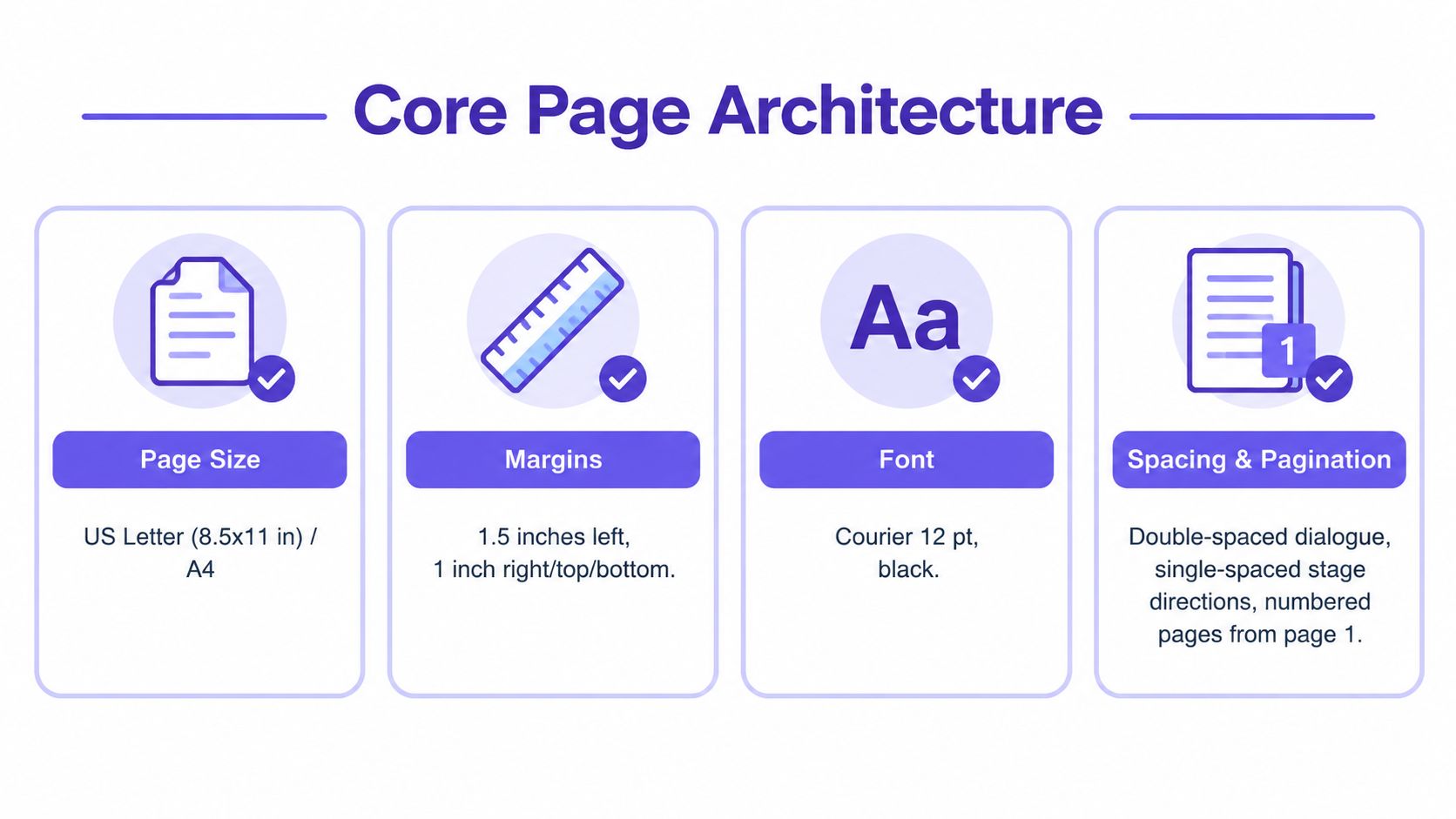
Use US Letter paper, 8.5 by 11 inches, for the standard English-language submission environment. Set the top, bottom, and right margins to one inch, with a 1.5-inch left margin for the common submission convention. Production copies may need a much wider left margin, about four inches, for binding and rehearsal notes, as shown in the Cary Playwrights Forum formatting guide.
Set 12-point Courier unless the recipient specifies another readable 12-point font. Its monospaced characters keep line length predictable, helping readers judge the script's practical scale. A proportional font can look polished, but a rehearsal manuscript needs consistency more than visual elegance.
Keep most text single-spaced, with clear separation between elements. The visual guide below summarizes the core layout.
Let the page breathe
Dialogue should be easy to track, while stage directions should separate from speech through indentation, line breaks, or tab stops. Keep the right margin ragged rather than fully justified. The Otterbein play script guidelines also use all-caps character names, functional stage directions, and page numbers in the upper-right area.
Treat pagination as a destination decision. A contest reader benefits from a compact page that moves quickly. A staged reading needs more usable space for annotations and page handling. A production script may need the wider binding margin. Some guides begin numbering on page two, while others start with the first page of dialogue. Follow the recipient's rule, and do not reset numbering at an act break unless requested.
Set up the file in this order:
- Create the master page: Set paper size, margins, font, paragraph spacing, headers, and page numbers before importing the script.
- Define element styles: Create separate styles for title text, act headings, scene headings, character cues, dialogue, parentheticals, and stage directions.
- Test a representative scene: Check long speeches, brief exchanges, stage directions, and a page turn. A template that handles only ordinary dialogue is unfinished.
- Export a locked copy: Open the PDF on another device and inspect page breaks, missing headers, orphaned headings, and accidental blank pages.
Anatomy of a Standard Play Script From Title Page to End Mark
A readable script has a hierarchy the eye recognizes immediately. The title page announces the work without crowding it. The opening pages identify the cast and establish the play's structural vocabulary. The body then repeats a controlled pattern of cues, speech, action, and transitions.
Place the title, playwright's name, and contact information on the title page according to the destination's requirements. Don't turn the page into a poster. A theatrical script benefits from restraint because the reader needs to identify the work and move into it without navigating ornamental material.
A character list, or dramatis personae, follows when the submission expects one. Keep names consistent with the cues used in the script. If a character appears as MARA in the dialogue blocks, don't identify that speaker as MARIA in the cast list unless the distinction is deliberate and explained.

Structural signals do real work
Act headings and scene headings should be visually unmistakable. Use centered, capitalized headings such as ACT I or SCENE 1, and begin acts or major scene divisions on a new page when the destination expects that treatment. Don't mix centered headings, flush-left headings, decorative separators, and unexplained numbering in the same document.
A standard exchange looks something like this:
Correct
MARA
I didn't leave the door open.
ELI
You did. I watched you.
(The lights shift toward the hallway.)
Distracting
Mara: I didn't leave the door open.
Eli: You did. I watched you.
The lights shift toward the hallway and the whole house seems to breathe with the ancient memory of every argument that has taken place there.
The second version may contain a vivid sentence, but it collapses speaker identification, dialogue formatting, and direction into one undifferentiated block. A stage manager can't mark it efficiently, and an actor has to determine whether the final line is playable action, atmosphere, or authorial commentary.
For a concise reference to terms such as front matter, use the Novelium glossary entry on front matter. The vocabulary matters because different readers use these labels when requesting revisions or discussing a submission.
Close the document clearly
Stage directions should identify meaningful theatrical events, including entrances, exits, lighting changes, sound, and the end of a scene. Finish the play with an explicit closing direction and an end marker. The Otterbein guidance recommends a clear close, such as lights fading to black, because pages can be reordered or marked heavily during rehearsal.
The video below offers a useful visual comparison of script conventions. It isn't a substitute for the recipient's playwriting guidelines, but it can help you see how hierarchy changes the reader's pace.
How One Act Radio and Minimalist Plays Adjust the Standard
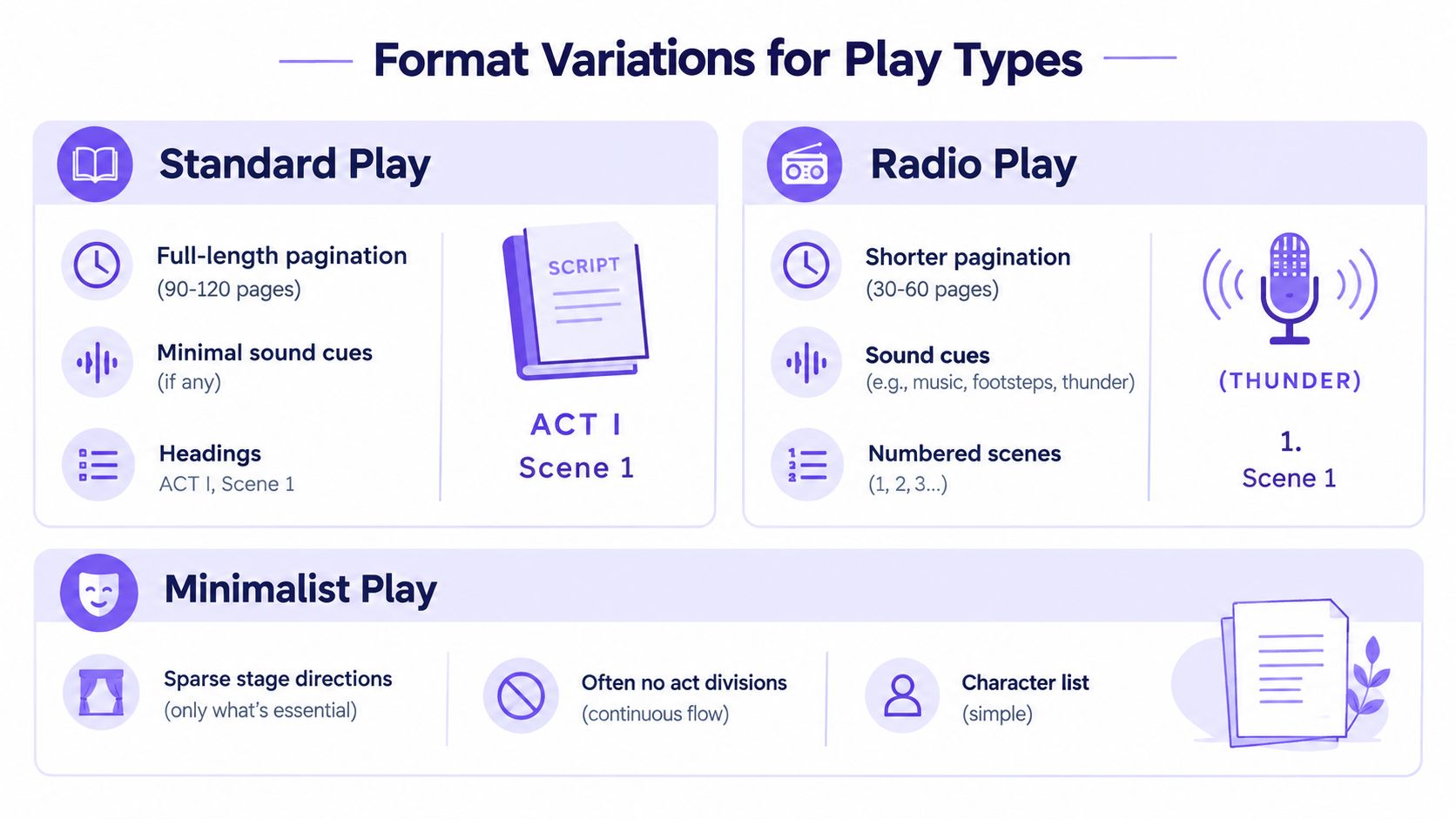
The base architecture stays recognizable, but the form determines which signals deserve more emphasis. A one-act play doesn't need the same act machinery as a full-length work. A radio play replaces visible movement with sound and vocal identity. A minimalist play may remove most scenic instruction while making every remaining direction consequential.
One-act and full-length work
A full-length play generally benefits from clearly marked acts and scenes because those divisions help readers discuss structure and help production teams locate rehearsal material. An act heading should be easy to find, usually centered and set apart, with scene headings following a consistent pattern.
A one-act can be leaner. If it has no internal scene changes, don't manufacture elaborate divisions to make the script resemble a longer play. Mark the opening situation clearly, track entrances and exits, and use a final direction that tells the room the play has ended. The format should reveal the play's shape instead of pretending it has a shape borrowed from another form.
Radio and minimalist scripts
Radio scripts need sound cues that are as legible as dialogue. Identify effects consistently, keep them distinct from spoken text, and establish who is speaking when voices could be confused. A cue such as (THUNDER) or SFX: DOOR SLAMS should be used according to the receiving organization's convention, not scattered interchangeably through the manuscript.
Minimalist work needs the opposite discipline from an overdirected script. Sparse directions can carry more weight, so each one should describe an event the performers or technical team can use. Don't replace a playable instruction with a paragraph of literary atmosphere.
The following infographic captures useful contrasts, but treat its page-length examples as illustrative rather than universal. Different destinations set different expectations.
A helpful comparison is available in Solo AI's video script tips, especially for thinking about how cues and spoken material need to remain visually distinct across performance formats. The transfer from screen to stage isn't exact, but the underlying principle holds: the reader must know what is heard, what is seen, and who controls the next beat.
Radio has no visible entrance, so a voice cue may need more precision. Minimalist theatre has no elaborate scenic apparatus to carry transitions, so a light, sound, or movement direction may become the hinge of an entire scene. Format the form you've written.
Dialogue Character Cues and Stage Directions That Stay Readable in Rehearsal
The character cue is the reader's handrail. Set the speaker's name in all caps, keep it consistent throughout, and place it clearly above the dialogue. Don't change from MARA to MARIA because the longer name feels more formal in one scene. That small variation creates unnecessary uncertainty for actors, stage managers, and anyone using document search.
Dialogue should read as a block, not as a paragraph disguised as a novel. Keep speech visually separate from directions, and use parentheticals only when the delivery needs clarification that the line itself cannot provide.
Directions should be playable
A useful direction tells a collaborator what happens. An unhelpful direction tells them how to feel about what happens.
Less useful
(She moves with the terrible, almost imperceptible exhaustion of someone who has spent her entire life refusing to admit that the room has become a mausoleum.)
More useful
(She sits. She doesn't look at him.)
The second version leaves room for the actor and director while still establishing behavior. It also survives annotation. A stage manager can mark a pause, adjustment, or traffic note without having to wade through prose.
Place stage directions on their own line or at a clear tab stop. Keep emotional cues short, and don't use parentheticals to micromanage every syllable. If the performance depends on a specific action, write that action. If the line already communicates the intention, let the actor work.
Handle interruptions and simultaneous speech plainly
For overlapping dialogue, use a convention the production team can recognize immediately. You can identify simultaneous speech in a stage direction, split the dialogue into clearly marked blocks, or follow a house style for overlapping lines. The worst option is to stack voices in a way that resembles a formatting accident.
An exchange can remain clean even when the action is fast:
JONAH
Wait.
RHEA
No, listen.
(They speak over each other.)
JONAH
I found the key.
RHEA
The house is empty.
The Novelium glossary entry on stage business is useful when you need precise language for movement, gesture, and practical action. Keep those terms functional. A direction belongs in the script because the room needs it, not because the page has space for another beautiful sentence.
Submission Ready Formatting for Theatres Contests and Publishers
A contest reader, reading committee, or rehearsal room needs a different kind of page. Set the destination first, then build an export from one protected master file. Editing the only copy for each submission invites drifting margins, broken pagination, and revisions that exist in one file but not another.
Contests and general submissions
Start with the recipient's published rules. If none exist, use a conservative shared format: readable 12-point type, consistent character cues, clear act and scene headings, sensible margins, and stable page numbers. The goal is quick orientation, not visual personality.
A contest may require a 1.5-inch left margin and one-inch margins elsewhere. A theatre preparing a reading may need more binding or annotation space. Check whether the title page must be anonymous, whether the file must be PDF, and how the file should be named. The Dramatists Guild complete formatting guidelines show why formatting choices depend on purpose and publisher. No font or margin rule applies to every destination.
Staged readings and production
A staged reading script must be easy to hold, mark, and follow at speed. Give entrances, exits, sound, lighting, and scene changes clear visual treatment. Preserve space at the binding edge when the receiving theatre requests it, and test page turns against moments that need uninterrupted attention.
A production submission is closer to a rehearsal document than a competition manuscript. Remove decorative headers, author commentary, and dense direction that obscures playable information. If the theatre requests a production draft, follow its pagination and revision conventions. Changing the appearance of a competition file is not enough.
A clean master file is an asset. Manually altered submission copies create continuity problems.
A practical export workflow
| Destination | Preserve | Adjust only when requested |
|---|---|---|
| Contest | Clear hierarchy, readable dialogue, consistent pagination | Margins, title-page anonymity, file naming |
| Staged reading | Binding space, playable directions, visible cues | Page layout for annotation and rehearsal handling |
| Publisher | House font, front matter, act and scene treatment | Typography, headers, pagination, submission metadata |
| Production | Stable page identity and clear technical cues | Wider binding area, revision marks, production pagination |
Name each version for its destination and revision. Avoid labels such as “final,” which reveal nothing when another export exists. Before sending a PDF, inspect page turns, act openings, scene headings, character cues, and the final end mark. Confirm that fonts are embedded and that no comment, tracked change, or draft note remains.
The submission guidelines glossary gives useful terminology for requirements that vary among contests, theatres, and publishers. Its example settings are a prompt to verify the recipient's instructions, not a universal template.
Why Static Character Profiles Fail in Long Plays and Series
A polished script can still contain continuity failures that formatting will never catch. The character cue may be perfect while the character who speaks has forgotten information they learned two scenes earlier, appears after an exit that never happened, or uses an object they lost in the previous act.
Ordinary character profiles break down. A questionnaire records a character's background, preferences, physical description, and dramatic history at one moment. It doesn't track knowledge state, changing relationships, injuries, possessions, promises, or the consequences of scene-level decisions.
For a short draft, memory may be enough. In a long manuscript, a recurring ensemble play, or a series with a large cast, it isn't. The document evolves, but the profile remains frozen unless the writer manually audits every affected scene.
Development documents are not tracking systems
A development document answers, “Who is this person?” A tracking system answers, “What does this person know, believe, possess, and owe at this exact point in the manuscript?”
That distinction prevents errors such as:
- Knowledge-state slips: A character reacts to a revelation before anyone has told them.
- Relationship reversals: Two characters behave as if a confrontation never happened.
- Object inconsistencies: A key, letter, weapon, or phone changes hands without an on-page transfer.
- Impossible appearances: A character returns to a scene after leaving, or appears in two locations without a transition.
- Physical continuity failures: An injury, disguise, costume change, or limitation disappears because the profile lists the trait but doesn't track its current state.
The useful record is scene-specific. After each scene, the system should update what changed, then make those changes visible when later passages contradict them. A character can begin the play unaware of a secret and end it informed. A static profile records the secret. Tracking records the moment the character learns it.
Scale changes the standard
Writers managing 80,000-plus-word manuscripts, recurring casts, or interconnected projects already know the cost of manual checking. Spreadsheets help, but they still depend on disciplined updates and can separate facts from the passages that establish them. The more versions you create for readings, submissions, and revisions, the easier it becomes for a continuity note to fall out of sync.
Novelium's Character Tracker and World Codex automatically extract and track character details across manuscripts, including traits, knowledge states, relationships, events, and objects. That kind of system complements a well-formatted script because it checks the manuscript's internal state rather than merely its page appearance.
Quick Reference Checklists Templates and Cross Referenced Glossary
Before sending a play, inspect the file as a production document. A strong script can still fail the first-glance test when its hierarchy shifts between pages, or when the version does not match the recipient's workflow.
Final formatting check
- Destination: Confirm the theatre, contest, agent, or publisher's current requirements. A contest may prioritize anonymity and submission consistency, while a staged reading may need room for annotations and easy page handling.
- Page architecture: Verify paper size, margins, font, spacing, and header placement. Change these settings for the destination, not by habit.
- Title page: Check the title, author name, contact details, and anonymity rules.
- Character list: Match every listed name to the character cues in the script.
- Act and scene headings: Use one capitalization, alignment, numbering, and page-break convention.
- Dialogue: Keep speaker names consistent and visually distinct from spoken text.
- Stage directions: Remove literary padding and retain playable, necessary action.
- Pagination: Check the starting-page rule and confirm that no act break resets the count.
- End marker: Close the final scene with an explicit direction and clear end notation.
- Export: Open the PDF separately. Inspect page turns, blank pages, clipped text, and missing elements.
A production draft may need practical annotation space. A contest file may require stricter anonymity and a clean, compact presentation. A publisher may specify different margins, headers, or pagination. Treat the format as a destination-based decision, then keep every other choice stable.
Keep the reference material close
Use the Dramatists Guild formatting guidance for broad conventions. Use the Cary Playwrights Forum guide for binding and annotation needs, and the Otterbein guidelines for cues, directions, pagination, and endings, as noted earlier. These references describe workable systems, not a single mandatory template. Compare them with the destination's instructions and choose one coherent approach.
Keep a master template with named styles, rather than a file patched with manual spaces and tabs. When a theatre requests different margins or pagination, duplicate the master, apply the requested change, and export a clearly labeled version. This preserves the script's visual consistency while keeping revisions traceable.
A good format cannot repair a weak play. It can prevent a strong one from looking careless and give the people staging, assessing, and revising it a document they can trust.
If you manage a large cast, recurring characters, or revisions across multiple play versions, Novelium can track character details, relationships, knowledge states, events, and world information across a manuscript. Use it alongside a stable formatting template to catch continuity failures that page layout cannot reveal.