10 Classic Christmas Stories Every Writer Should Revisit
The most adapted Christmas story in modern screen culture isn't a recent bestseller. It's Charles Dickens's A Christmas Carol, a compact novella whose structure has supported hundreds of adaptations and retellings, with estimates ranging from well over 100 filmed versions to roughly 272 total adaptations, and some rankings placing the total above 400 film and television adaptations according to Radboud Recharge's adaptation analysis. That kind of endurance isn't just cultural luck. It signals a narrative machine with unusually reliable parts.
For novelists, classic christmas stories are useful because they expose what breaks in ambitious manuscripts. Characters forget information they learned three chapters earlier. Emotional reversals arrive before the evidence that would justify them. A magical system changes rules whenever the plot needs a rescue. A recurring character behaves like a different person because the author tracked traits, not state.
The stories below work as technical blueprints for character knowledge tracking, timeline control, emotional continuity, and world logic. They're worth revisiting before a complex revision, especially if you're managing a large cast, a nonlinear structure, or a series where every new installment inherits old facts. If you're developing illustrated or younger-reader projects, Marquis Book Printing's children's book options also show how much narrative weight visual formats can carry.
1. A Christmas Carol by Charles Dickens
Dickens published A Christmas Carol on 19 December 1843, with an initial print run of 6,000 copies priced at five shillings. The printing sold out by Christmas Eve, and the book had reached 13 editions by the end of 1844, according to the historical account collected by Wikipedia. That rapid commercial response reflects the novella's structural economy. Dickens gives each scene a clear task and wastes little narrative motion.
Transformation under pressure
Scrooge begins inside a rigid emotional and ideological system. His misanthropy governs his finances, speech, relationships, and interpretation of other people. The ghosts work because each encounter presents evidence that his existing explanations cannot absorb.
The Ghost of Christmas Past reveals the history beneath his current behavior. The Ghost of Christmas Present makes consequences visible, including the human cost of treating poverty as an abstraction. The future vision removes his ability to separate reputation, death, and social memory from his own conduct. Scrooge's knowledge state advances in one direction. Dickens does not let him absorb a revelation, revert without cause, and rediscover the same lesson later.
That distinction separates a character arc from a character-tracking problem. An arc describes the intended transformation. Tracking records what the character has learned, what he continues to deny, and which belief no longer survives the evidence. Dickens makes each ghost sequence build on the previous one, rather than presenting three interchangeable moral lectures.
Practical rule: If a reversal depends on new information, record the information before you record the emotion. The emotion has to follow the evidence.
Why the structure stays clean
The supernatural time mechanism lets Dickens move through Scrooge's past, present, and possible future without the logistical complications of ordinary linear travel. The mechanism also keeps the protagonist inside an escalating sequence. He can resist the visions, but he cannot leave the narrative problem behind.
Modern versions such as Scrooged preserve the three-ghost framework while changing the social context. That adaptability helps explain why the story functions as a recurring catalog asset rather than a one-off seasonal narrative. Study the final act closely. Dickens accelerates the emotional beats after the evidence has done its work, allowing the transformation to land before sentiment becomes excessive.
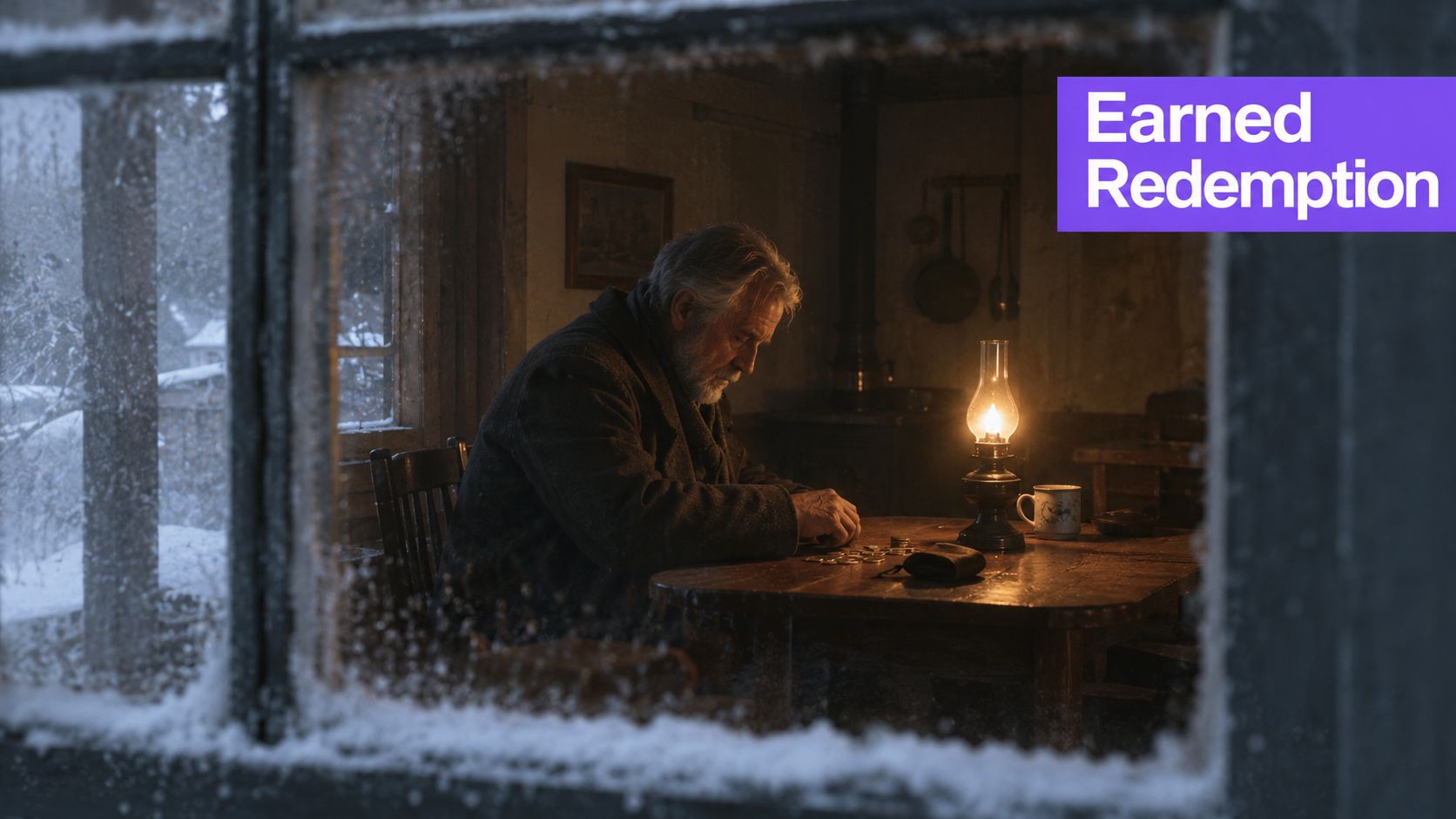
For a long manuscript, record every major revelation as a permanent change in the character's available interpretation. The character arc glossary offers a useful definition, but your working document should also show which facts the character knows and what they can no longer consider true.
2. The Gift of the Magi by O. Henry
O. Henry's “The Gift of the Magi” looks simple because the machinery is concealed. Its power comes from synchronized ignorance. Della doesn't know what Jim has sacrificed, Jim doesn't know what Della has sacrificed, and the reader discovers each fact at the moment the characters do.
That arrangement is brutally difficult to execute in a longer manuscript. The writer has to maintain separate knowledge states for both characters and for the audience. A scene can't accidentally leak Jim's action through an observation Della would understand. Della's behavior must remain legible as love rather than suspiciously evasive. The final irony only works because both characters make rational choices from incomplete information.
Timing creates the tragedy
Neither character fails because of a broken motivation. They each pursue the gift that seems most meaningful under the circumstances. The problem comes from timing. Their sacrifices collide with the purchases they've made, producing an outcome that's materially inconvenient but emotionally exact.
That's a valuable model for dual-perspective fiction. Writers often try to manufacture surprise by making characters behave strangely. O. Henry does the opposite. He makes their behavior consistent and lets the reader understand the consequences before the characters can.
The irony belongs to the sequence of knowledge, not to a sudden change in personality.
The domestic setting also carries economic information without a lecture. The apartment, hair, watch, and gifts establish scarcity through objects. Physical details do the work of exposition because each detail has both descriptive and narrative value.
Why expansion usually weakens it
Attempts to stretch this story into longer forms often dilute the impact by adding plot that the structure doesn't need. The story's compression isn't an absence of craft. It's the craft. Every scene moves toward the paired discovery.
For your own dual reveal, map Della's equivalent and Jim's equivalent separately. Note what each person knows, suspects, misreads, and chooses not to ask. Then draft the discoveries without allowing one character's knowledge to contaminate the other's viewpoint. That kind of control is central to the short story craft glossary, particularly when the ending depends on a narrow window of reader awareness.

The consistency failure to watch for is simple. If one character seems to know too much, the irony collapses. If both characters seem too oblivious, the ending feels engineered. The story survives because the knowledge gaps are precise.
3. The Nutcracker and the Mouse King by E.T.A. Hoffmann
Hoffmann's The Nutcracker and the Mouse King is more psychologically unstable than the familiar ballet suggests. Clara's Christmas night may be a dream, a supernatural event, or an experience that makes the distinction irrelevant. Hoffmann doesn't resolve the question, but he does maintain strict consistency inside Clara's perception.
That's the distinction professional writers need when building an unreliable framework. External reality can remain uncertain. Internal response cannot. Clara's fear, wonder, memory, and accumulating understanding follow a coherent progression even when the reader can't verify the battle or the transformation.
Ambiguity needs accounting
The story shifts through narrative frames, including an opening shaped by Clara's godfather, Clara's own perspective, and uncertainty around the narration of the battle. Those shifts could easily disorient a reader. Hoffmann controls them by anchoring each passage in a distinct mode of perception.
Track plot events separately from emotional events. If the Nutcracker's reality remains questionable, Clara's response to seeing him still needs a stable cause. If she forgets something, the omission must create ambiguity rather than repair a continuity problem.
Modern adaptations often make the fantasy straightforward. Tchaikovsky's ballet, first performed in 1892, became more famous than Hoffmann's original, but the simplified version loses much of the source text's psychological unease. That change demonstrates a broader adaptation lesson. Clarifying a mystery can improve accessibility while reducing the exact tension that made the original distinctive.
Ambiguity is not permission to contradict yourself. It's a promise that the reader will receive consistent evidence without a final guarantee.
Hoffmann introduces the magical through Clara's perception instead of announcing a new reality system. For writers working with dream logic, fractured memory, or layered realities, record what the viewpoint character sees, what she remembers, and what she can't verify. The gaps should remain intentional across scenes.
4. Christmas Stories by Louisa May Alcott
Louisa May Alcott's Christmas stories offer a less flashy but more demanding problem, recurring characters across episodes that need to work independently. The stories associated with the March family preserve emotional continuity even when readers encounter them outside publication order or without the full context of Little Women.
Alcott's periodical experience shows in the construction. Each episode establishes its own immediate emotional situation, then adds another layer to the reader's understanding of familiar characters. The characters don't remain static to protect recognition. They respond to recurring pressures with variations shaped by prior experience.
Recurring characters are not frozen characters
For a series writer, the key distinction is between what remains emotionally stable and what changes. Jo's responsiveness to conflict may remain recognizable, while the conflict itself, her age, responsibilities, and relationships alter the available response. A profile that lists “impulsive” or “independent” won't tell you whether she has already learned the cost of acting impulsively in this particular timeline.
Alcott's approach also avoids the dreaded continuity dump. A reference to an earlier event can function whether or not the reader remembers that event, because the reference carries present emotional meaning rather than merely proving that the author remembers the backstory.
The Christmas setting acts as a stable baseline. It gives different stories a shared emotional vocabulary, so changes in family circumstances become visible without repetitive explanation. That's especially useful in interconnected collections, where the season can provide structural unity while the plots remain separate.
Track response patterns, not adjectives
Create a record of recurring characters that distinguishes:
- Emotional constants: the pressure points and loyalties that keep the character recognizable.
- Earned changes: responses altered by events already experienced in the series.
- Reader-facing references: past events that can be mentioned without assuming perfect recall.
- Point-of-view limits: what each family member believes happened, especially when perspectives differ.
The same principle applies to contemporary interconnected fiction. A character's consistency comes from the relationship between past experience and present choice, not from repeating a handful of traits. Alcott's episodic model gives series writers a durable way to let characters evolve without making every installment dependent on a complete reading order.
5. The Lion, the Witch and the Wardrobe by C.S. Lewis
C.S. Lewis's The Lion, the Witch and the Wardrobe makes imaginary geography feel usable without turning the novel into a gazetteer. The children discover Narnia through encounters, danger, and partial explanations. Their knowledge grows at different speeds, and the narrative uses those differences to create tension.
The time relationship between Narnia and the children's world creates a second tracking problem. The children experience an extended sequence in Narnia, then return to a world where far less time has passed. Lewis doesn't reduce the effect to a technical explanation. He lets the discrepancy remain part of the story's strangeness.
Information asymmetry drives the ensemble
Peter, Susan, Edmund, and Lucy don't receive the same information at the same moment. Lucy's early knowledge makes her look unreliable to the others. Edmund's knowledge is compromised by his bargain with the Witch. Peter and Susan must make judgments based on testimony they can't yet confirm.
For a manuscript with multiple protagonists, that means one shared “Narnia facts” sheet isn't enough. Each character needs a separate knowledge ledger. The setting may have one geography and one history, but the cast has different maps of it.
A world bible records what is true. A character tracker records who has earned the right to act on that truth.
Lewis also keeps the Witch present through consequences and expectation before she becomes a direct scene participant. Her influence shapes the children's choices even when she isn't physically there. That's a useful way to maintain antagonist pressure without making every chapter repeat the antagonist's presence.
Map the world privately, then track when each child learns the relevant geography, politics, and history. The fantasy glossary helps define the genre framework, but essential continuity work happens scene by scene.
6. Yes, Virginia, There Is a Santa Claus by Francis Pharcellus Church
Francis Pharcellus Church's editorial response to Virginia's question about Santa Claus solves a problem many speculative novels mishandle. It validates doubt without destroying the world the reader wants to inhabit.
Church doesn't insist that skepticism is foolish. He changes the frame around the word “real.” Santa can exist through faith, imagination, generosity, and love without requiring the argument to rest on ordinary physical evidence. The piece remains persuasive because its definition of reality stays stable once established.
Reframing without cheating
For writers working with metaphorical worlds, spiritual systems, or deliberately uncertain supernatural elements, the sequence matters. Church begins with the individual child's uncertainty, expands toward a broader principle about childhood, and arrives at an emotional and metaphysical claim. The movement feels earned because each step answers the question raised by the previous one.
This technique also protects the reader from narrative gaslighting. The text doesn't say, “You saw the contradiction, but it wasn't a contradiction.” It says that the contradiction came from an overly narrow definition of existence.
Tone carries much of the authority. Church's certainty matches the editorial form and the emotional purpose. If the voice wavered at the central point, the framework would collapse. Writers often track plot facts while ignoring tonal reliability, then wonder why a world feels inconsistent even when its rules technically hold.
A useful test for uncertain worlds
Write down the competing definitions in your manuscript. What does “real” mean to the skeptic, the believer, the narrator, and the institution defending the supernatural? If those definitions shift from scene to scene, the ambiguity will read as indecision.
Church's piece remains a compact lesson in argumentative architecture. It doesn't prove Santa in the ordinary sense. It builds a coherent system in which the emotional truth can stand without pretending that every question has the same kind of answer.
7. The Chrono-Synclastic Infundibulum Christmas Story from Slaughterhouse-Five by Kurt Vonnegut
Kurt Vonnegut's Slaughterhouse-Five isn't strictly a Christmas story, but its Christmas material belongs in any serious discussion of nonlinear narrative. Billy Pilgrim experiences time out of sequence, yet Vonnegut keeps his knowledge tied to the particular point in time Billy is inhabiting.
That distinction prevents the novel's structure from becoming a continuity free-for-all. Billy may know something from a future experience when the narrative places him there, but he doesn't casually use that knowledge to rewrite his responses in another timeline position. The reader can be disoriented by chronology without being forced to doubt whether the author knows the chronology.
Separate timeline from character state
Nonlinear writers often keep one timeline document and assume it solves everything. It doesn't. Timeline order answers when an event occurs. Character state answers what the character knows, believes, fears, and remembers at that moment. Those systems interact, but they aren't interchangeable.
The recurring Christmas scenes function as emotional anchors. They give the reader recognizable points inside the time-hopping structure, so the novel can move wildly while preserving orientation. Billy's voice also remains stable across timeline instances. His tonal consistency does more structural work than a series of explanatory transitions would.
Vonnegut's method is particularly valuable for large manuscripts because nonlinear errors often masquerade as characterization errors. A protagonist appears inconsistent when the underlying issue is that the draft has merged two versions of the protagonist's knowledge.
Track the scene's chronological position and the character's narrative position as separate fields. Never let one stand in for the other.
Influential nonlinear works such as Cloud Atlas and Everything Everywhere All at Once demonstrate how far audiences will follow fractured chronology when the internal rules remain legible. The more ambitious the structure, the less tolerance you have for accidental memory.
8. A Christmas Memory by Truman Capote
Truman Capote's “A Christmas Memory” carries its emotional force through accumulation rather than conventional plot escalation. The story follows a child and an elderly cousin preparing for Christmas, with sensory details gradually revealing the cousin's declining health and fragile circumstances.
The cousin's character doesn't transform into a wiser, more resigned version of herself. She remains creative, generous, and full of wonder while her physical capabilities narrow. That's a difficult form of continuity because the narrative changes the conditions around the character without changing her essential nature.
Decline without personality drift
Capote establishes aging through physical detail rather than blunt explanation. The reader notices what the cousin can do, how she moves, and what requires more effort. Each detail matters because it belongs to a cumulative pattern. If one scene suddenly gave her abilities the previous scenes had removed, the ending would feel manufactured.
The narrator also doesn't understand everything the cousin understands. That knowledge gap creates tenderness and grief without requiring an adult explanation of mortality. The child's partial comprehension remains consistent, so the reader can perceive the stakes without forcing the viewpoint to become prematurely advanced.
For writers handling illness, aging, grief, or deteriorating circumstances, the tracking target isn't just medical fact. It's the relationship between physical capacity, self-perception, and behavior. A character can lose strength without losing generosity. A character can understand mortality without becoming emotionally tidy.
Let sensory continuity carry meaning
Capote's textures, tastes, scents, and handmade preparations establish the emotional atmosphere. They also create recurring anchors that make the story feel remembered rather than merely narrated. Track those anchors as part of the character's lived world, not as decorative description.
A conventional plot engine isn't required when the emotional engine is precise. The consistency failure to avoid is not “the character has no arc.” It's the opposite. Don't force an artificial arc onto a character whose meaning comes from remaining recognizably herself as circumstances change.
9. The Polar Express by Chris Van Allsburg
Chris Van Allsburg's The Polar Express creates a world that ignores ordinary geography and time while remaining remarkably consistent inside its own rules. The train's route, behavior, visual identity, and relationship to the child's memory form a coherent system even when the journey seems impossible.
The ending keeps the dream question open, but it doesn't treat all interpretations as equally unsupported. The story plants evidence for the journey's reality while preserving room for skepticism. That balance is harder than choosing pure magic or pure explanation.
Impossible worlds still need rules
Van Allsburg's train behaves like a particular kind of impossible object. It doesn't change its identity to solve each obstacle. Its appearance and conduct remain stable across the journey, and the repeated visual details give the reader anchors when the setting stops obeying ordinary logic.
For a secondary world, write the rules the reader won't see. Decide how travel works, what the impossible object can and can't do, which memories persist, and what evidence remains after the event. You don't need to explain every rule on the page. You do need to avoid changing them accidentally.
The ensemble is lightly individualized because the journey and the train carry more structural weight than deep psychological differentiation. That isn't a shortcut every novel can use, but it's an intentional allocation of narrative attention. If your manuscript has a large cast, decide which characters require detailed state tracking and which function primarily as witnesses, guides, or pressure points.
The film adaptation made the ending more explicit, changing the ambiguity that gives the book much of its power. That's a useful warning for adaptation-minded writers. Clarification can solve one audience problem while creating a thematic one.
10. The Night Circus by Erin Morgenstern
Erin Morgenstern's The Night Circus is the most directly applicable model here for novelists managing a large cast, nonlinear chronology, and controlled information asymmetry. The narrative moves among past and present sections, with dates and scene placement shaping what the reader knows about the competition.
Celia and Marco remain separated for much of the novel, yet their emotional development stays synchronized enough to feel causally related rather than authorially coordinated. That requires more than a plot outline. Each character needs a record of what has happened, what has been inferred, and what remains unknown.
Knowledge matrices prevent elegant disasters
The circus contains characters who know about the competition, characters who understand only fragments of its rules, and visitors who experience its effects without access to the central explanation. Morgenstern keeps those knowledge levels distinct. Secondary characters don't suddenly behave like insiders because the plot needs them to understand a mechanism they've never encountered.
Track three sequences independently:
- Chronological order: when the event occurs in the world.
- Narrative order: when the reader encounters the event.
- Knowledge order: when each character learns or infers its significance.
Those sequences produce different effects. A scene can appear early in the book, occur late in the characters' lives, and reveal a fact to the reader before a central character understands it. Collapse the sequences into one document and you'll eventually give someone impossible information.
The most dangerous continuity error is often elegant. It reads smoothly because the prose is good, but the character has learned something two chapters before the scene where they actually discover it.
Morgenstern's atmosphere also depends on consistency. The circus feels coherent because its recurring sensory and social patterns survive the nonlinear structure. The narrative consistency infographic is a useful visual prompt for separating strengths in a magical system from the points most likely to fail under revision.
For a further example of how stories can be discussed across formats, watch the accompanying narrative analysis video.
Comparison of 10 Classic Christmas Stories
| Title | 🔄 Implementation Complexity | ⚡ Resource Requirements | ⭐ Expected Outcomes | 📊 Ideal Use Cases | 💡 Key Advantages |
|---|---|---|---|---|---|
| A Christmas Carol (Charles Dickens) | Moderate, controlled temporal jumps and single‑POV tracking | Moderate, scene/timeline tracking + motif mapping | ⭐⭐⭐⭐, convincing, earned transformation | Redemption arcs, tight novellas that hinge on knowledge shifts | 💡 Links evidence to emotional beats; motifs enforce consistency |
| The Gift of the Magi (O. Henry) | High, synchronized dual reveals require exact info control | Low–Moderate, short form but demands precise scene timing | ⭐⭐⭐⭐, powerful ironic payoff when executed correctly | Parallel/double‑perspective reveals, concise short stories | 💡 Align reader and character discovery; map each character's knowledge |
| The Nutcracker and the Mouse King (E.T.A. Hoffmann) | High, shifting frames and sustained unreliability | High, track subjective vs. external events and multiple narrators | ⭐⭐⭐, strong ambiguous atmosphere, less definitive closure | Ambiguous reality, unreliable narration, dream‑logic tales | 💡 Maintain subjective consistency; introduce magic via perception |
| Christmas Stories (Louisa M. Alcott) | Moderate, episodic serialization with recurring characters | Moderate, ongoing character core tracking across standalones | ⭐⭐⭐⭐, reliable emotional continuity across episodes | Serialized fiction, interconnected short stories, character series | 💡 Separate emotional cores from plot details; enable backward compatibility |
| The Lion, the Witch and the Wardrobe (C.S. Lewis) | High, ensemble cast + implied time discrepancies | High, geography/timeline and per‑character knowledge tracking | ⭐⭐⭐⭐, immersive worldbuilding and clear discovery arcs | Children's fantasy, secondary worlds with time/knowledge gaps | 💡 Reveal world via encounters; keep per‑character knowledge documented |
| Yes, Virginia... (Francis P. Church) | Low, linear persuasive structure addressing doubt | Low, tonal control and logical reframing, minimal plot work | ⭐⭐⭐, effective for persuasion and tonal credibility | Addressing reader skepticism, defining metaphysical terms | 💡 Validate doubt first, then reframe terms; tone builds trust |
| Chrono‑Synclastic Infundibulum (Vonnegut / Slaughterhouse‑Five) | Very High, non‑linear time‑hopping with multiple knowledge states | Very High, rigorous tracking of character state across timelines | ⭐⭐⭐⭐, philosophically coherent if consistency is strict | Nonlinear narratives, fragmented timelines with recurring anchors | 💡 Use recurring scenes as orientation; track voice per timeline instance |
| A Christmas Memory (Truman Capote) | Low–Moderate, minimal plot, heavy sensory consistency | Low, scene‑by‑scene sensory and physical capability tracking | ⭐⭐⭐⭐, high emotional resonance from subtle consistency | Character vignettes, portrayals of aging, mood‑driven stories | 💡 Accumulate sensory details to show change; imply rather than state |
| The Polar Express (Chris Van Allsburg) | Moderate, magical world with strict internal rules | Moderate, rule document + visual repetition (illustrations) | ⭐⭐⭐⭐, believable impossible world when internally consistent | Picture books, visual worldbuilding, ambiguous reality tales | 💡 Define internal rules off‑page; reinforce with repeated visuals |
| The Night Circus (Erin Morgenstern) | Very High, non‑linear timeline, large cast, knowledge asymmetry | Very High, knowledge matrix, timeline and scene sequencing required | ⭐⭐⭐⭐, strong atmosphere and complex narrative cohesion | Adult literary fantasy, multi‑timeline ensemble narratives | 💡 Build a knowledge matrix per scene; let atmosphere support mechanics |
Next Steps for Your Manuscript
These classic christmas stories don't agree about tone, genre, realism, or narrative scale. A Christmas Carol uses supernatural constraint to force a belief system forward. “The Gift of the Magi” builds its ending from synchronized ignorance. The Nutcracker and the Mouse King preserves internal consistency inside unresolved reality. Alcott handles recurring characters across episodes, Lewis separates world facts from individual knowledge, and Vonnegut separates chronology from character state.
The common thread is not “good characterization” in the broad classroom sense. It's state management. Each story knows what a character has experienced, what the character can infer, what the reader has been shown, and which facts must remain true even after the manuscript changes shape.
That's where most character profiles fail. They're static documents containing age, appearance, personality traits, history, and perhaps a few favorite foods. Useful for initial development, they become nearly useless once the draft grows complicated. They don't record that Mara learned the killer's identity in chapter twelve, that she still believes her brother is innocent in chapter eighteen, or that she can't logically ask a question in chapter twenty-four because she already received the answer.
A character development document describes who someone is supposed to become. A character tracking system records what has happened to that person on the page. The first supports invention. The second protects continuity during revision, especially when you move scenes, split viewpoints, alter chronology, or add a subplot that changes the information available to half the cast.
Audit your draft by tracking knowledge, not just events. For every major scene, record who is present, what each person knows, what each person believes, what they're hiding, and which objects or relationships have changed. Then compare those records against the actual prose. You'll find failures that a conventional outline won't catch, such as a deceased character appearing in a later memory with the wrong age, a character using a nickname before learning it, a relationship reverting after a reconciliation, or an object moving between locations without anyone carrying it.
Timeline tracking needs the same discipline. A Monday-to-Tuesday slip can be obvious, but subtler errors matter more. A character may spend a night recovering in one chapter, attend an early meeting in the next, and still be described as having traveled overnight from another location. The manuscript can sound plausible sentence by sentence while the sequence remains impossible.
Novelium is built for this scale of problem. Its Character Tracker and World Codex automatically extract character details across a manuscript, then track traits, knowledge states, relationships, events, objects, and timeline changes as the draft evolves. It can surface plot holes, character contradictions, impossible sequences, and information inconsistencies while preserving the writer's control over the story.
The platform also builds a visual timeline and provides scene-level pacing analysis, which matters when your revision fixes continuity but accidentally creates a long dead zone or an overcompressed climax. You can import Word, Scrivener, Google Docs, and plain text, then run live checks or batch analyses after a draft. The manuscript stays private through local processing and encrypted storage, with no training on your work.
That privacy matters for professional writers. You're not handing an unfinished novel to a public critique system and hoping the terms are friendly. You're using a continuity layer designed around the practical failures that appear in long manuscripts, series, and large casts.
The same logic applies when you prepare a finished book for another format, including converting written books to audio. A continuity error that feels minor in print can become glaring when a narrator gives it a voice, especially if a name, timeline, relationship, or physical detail changes between chapters.
Use these stories as pressure tests. Choose one technique, map it against your manuscript, and look for the point where your character's knowledge, emotional state, or physical world stops matching the page. That's the work that turns an impressive draft into a dependable one.
Novelium tracks the details these stories handle so well, including character knowledge, relationships, objects, events, and timelines, while flagging contradictions as your manuscript changes. Visit Novelium to audit your next complex draft with a private continuity system built for fiction writers.