Character Speech Patterns That Make Fiction Voices Distinct
You're midway through a long manuscript, and the problem appears in a scene that should be easy. Your surgeon explains a risk in clipped, clinical phrases. Your retired diplomat responds with elaborate qualifications. Your younger smuggler interrupts both of them. Then you remove the dialogue tags and discover that all three sound like you on a tired afternoon.
That drift rarely happens because the writer lacks imagination. It happens because character speech patterns are continuity data, and most character documents don't store continuity data. A profile may tell you that someone is proud, anxious, educated, or funny. It usually doesn't tell you what that person knew before chapter twenty, how pressure changes their syntax, which questions they avoid, or whether their favorite verbal habits have started appearing in somebody else's mouth.
Short fiction can survive intuition. An 80,000-word novel, a series, or a cast that keeps expanding needs a tracking system. The useful question isn't only, “How do I make this voice distinctive?” It's also, “What observable choices define this voice, and do those choices remain true as the manuscript changes?”
Introduction Why Voices Blur by Chapter Twenty
A character can arrive fully formed. In chapter one, you hear the precise rhythm, the unusual metaphor, the dry refusal to answer a direct question. By chapter twenty, deadlines, plot mechanics, revisions, and competing points of view have sanded those edges down. The character still has the same biography in the notes, but the dialogue has migrated toward the author's default cadence.
The failure gets worse when characters share scenes. One person asks short questions, another answers indirectly, and a third speaks in polished paragraphs. During revision, you tighten everyone's lines for clarity. You remove repetitions. You standardize punctuation. You make the interruptions less messy. The manuscript improves locally while the voices become interchangeable globally.
Practical rule: If a voice only works when you remember the character's backstory, it isn't being carried by the dialogue strongly enough.
The fix isn't another personality questionnaire. It's a record of what the character does with language, scene by scene. Track sentence length, question behavior, contractions, register, recurring speech bundles, interruptions, silence, and the knowledge available at that moment. Those markers reveal voice drift earlier than a general read-through does.
The rest is practical. Define the voice as an idiolect, identify the features that carry characterization, build distinct patterns without turning anyone into a catchphrase machine, then track those patterns as the draft evolves. That's how you stop treating voice as a burst of inspiration and start managing it like the long-form continuity problem it is.
What Character Speech Patterns Actually Are
A character can be witty, guarded, or formal in your notes and still sound like everyone else by chapter twenty. Character speech patterns solve that problem by turning voice into something you can observe and track. Linguistics calls an individual's language variety an idiolect, a concept Bernard Bloch used in 1948 to describe “the totality of the possible utterances of one speaker at one time.” The historical definition appears in research on computational approaches to character speech.
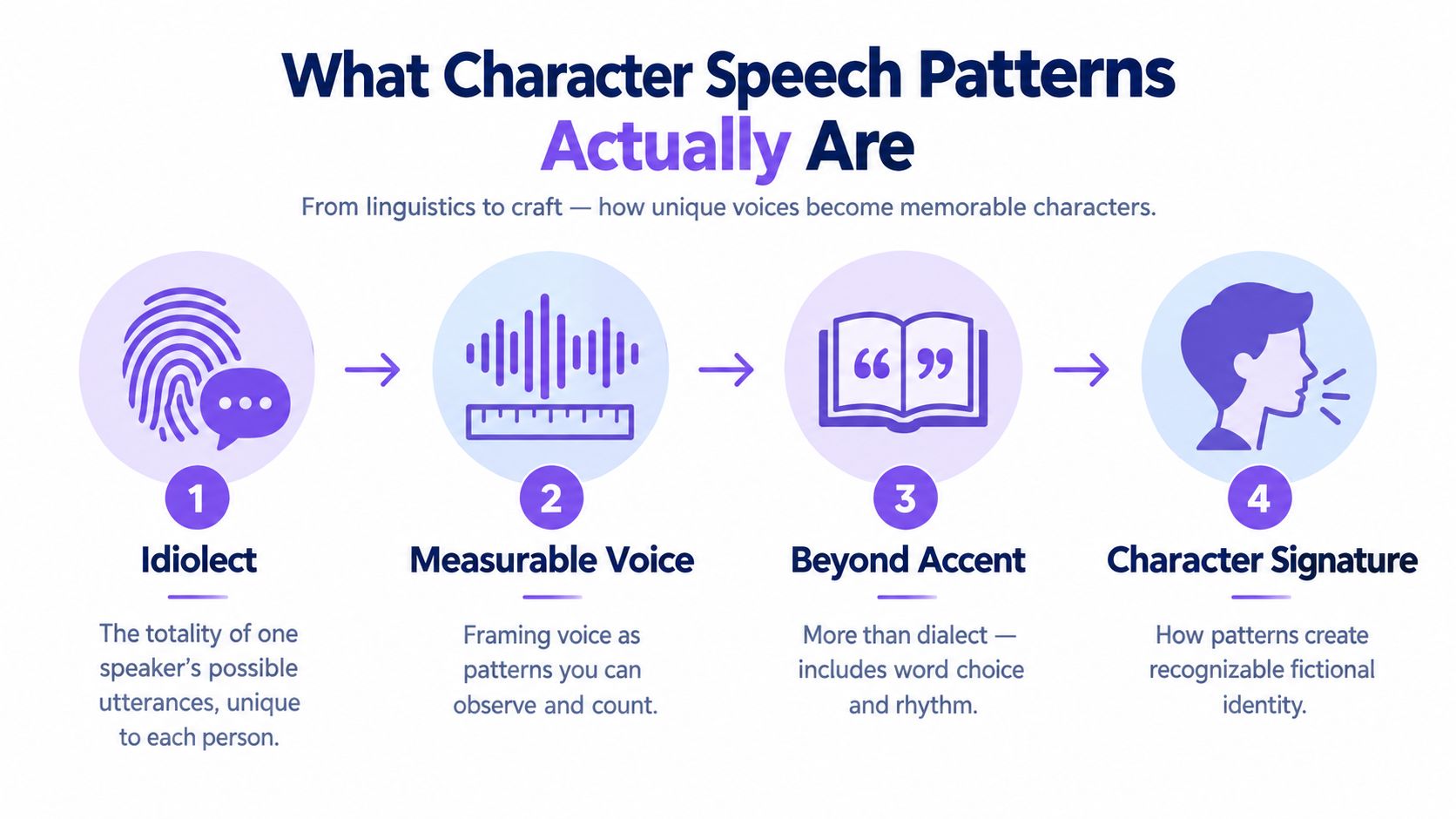
A fictional idiolect does not reproduce real speech word for word. It creates a repeatable set of choices readers can recognize: syntax, vocabulary, rhythm, pronouns, punctuation, register, and interaction habits. One character qualifies every statement. Another answers in fragments. A third uses formal vocabulary but interrupts constantly, showing that control matters more than courtesy.
Those choices can be measured. Computational literary research examines who speaks, how often, and which linguistic markers separate speakers. The Project Dialogism Novel Corpus contains 35,978 annotated quotations across 22 full-length novels, as described in the character-speech research. For a novelist, the practical implication is simple: voice can be audited instead of judged only by instinct.
A practical writing voice framework helps define voice at the craft level. Character speech needs a narrower record of repeated behavior under pressure. “Witty and guarded” is a label. “Answers direct questions, uses contractions with intimates, and builds longer sentences when cornered” is a tracking rule you can test across scenes.
The glossary definition of idiolect offers a concise reference. In practice, a character speech pattern is a recurring linguistic and conversational signature. Track its markers, and voice drift becomes a continuity problem you can catch before an entire manuscript starts speaking in the author's default cadence.
How Speech Patterns Function in Fiction
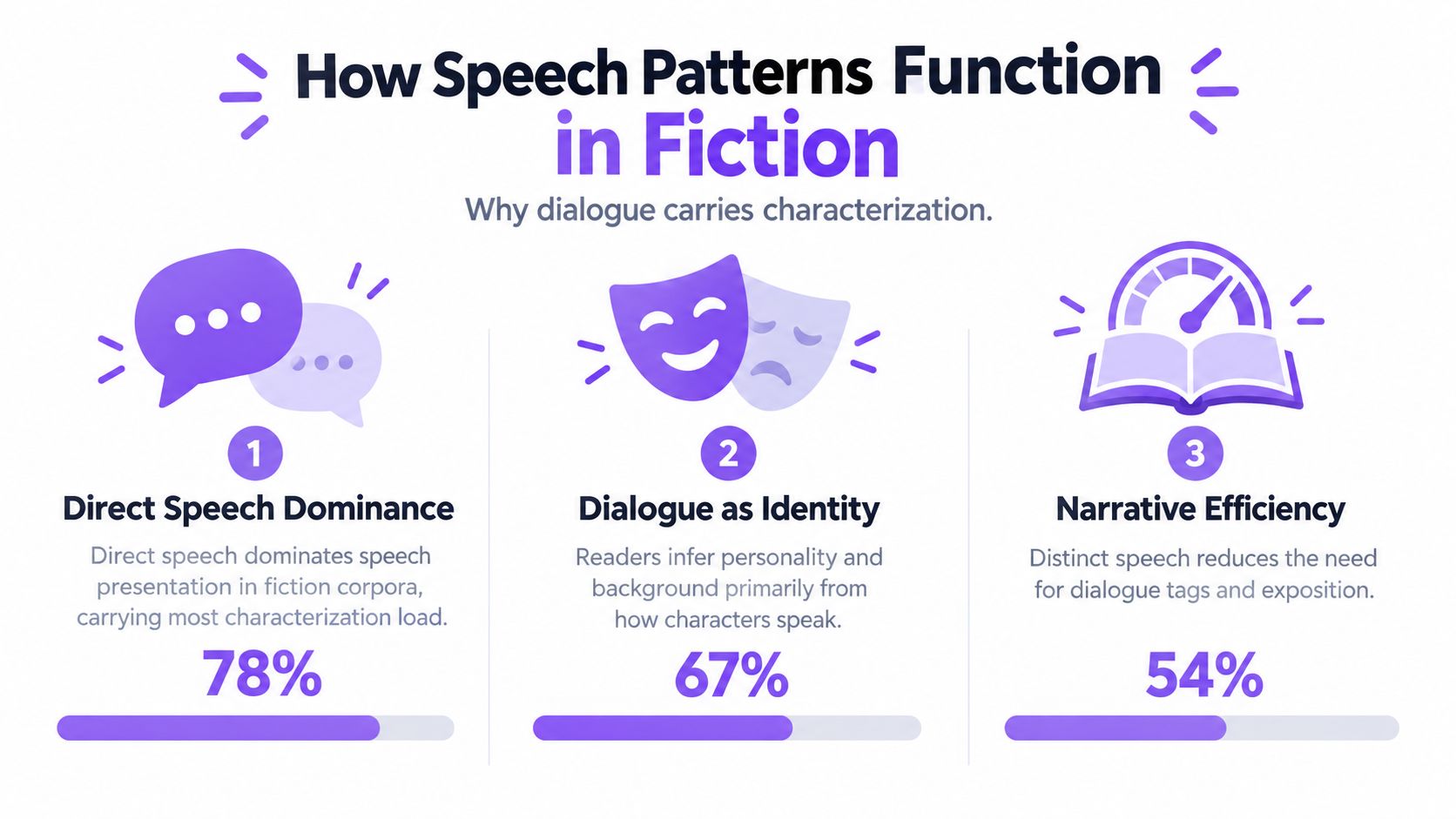
By chapter twenty, a voice can drift without announcing the failure. A guarded character starts explaining. A terse character begins delivering polished paragraphs. The manuscript still reads smoothly, yet several people now sound like the same narrator. Speech patterns function as a tracking system, because direct dialogue gives readers repeated evidence of who a character is.
One study of English fiction found that direct speech accounted for 74% of all instances of speech presentation, while free indirect speech accounted for 3%. In a smaller extract from the same corpus work, direct speech represented 49% of speech presentation, according to research on representing speech and thought in fiction. Quoted language therefore carries a large share of characterization. Readers register who issues commands, who explains their reasoning aloud, who reaches for “I,” who avoids naming themselves, and who uses punctuation like a set of brakes.
The markers readers actually register
Sentence length gives you one measurable marker. Research on Austen's novels reported that most characters used average sentence lengths between 11 and 17 words, while Mr. Collins averaged 29 words per sentence, making him a pronounced outlier. Lady Catherine de Bourgh used the pronoun “I” more frequently than any other character, while Mr. Collins used “she” more frequently than any other character across Austen's fiction. The findings appear in the same study of speech and thought presentation.
Readers rarely count those features consciously. They absorb the pattern and infer status, self-regard, intimacy, anxiety, competence, and social positioning. A character who qualifies every statement creates a different pressure from one who makes declarations, even when both use ordinary vocabulary.
The practical test is simple. Replace “witty and guarded” with markers you can search: sentence length, pronoun preference, recurring speech bundles, interruptions, or the point where replies become longer. Static character sheets miss drift because they describe intention. A text-level record shows what the character does.
The Building Blocks That Make Voices Distinct
Accent is the fastest tool writers reach for and one of the easiest to overuse. Literary dialect can represent regional, social, nonstandard, or individual speech, with spelling variation and apostrophes acting as visible signals of identity in American fiction, as discussed in research on literary dialect. Used carefully, those cues establish background. Used on every line, they turn reading into transcription.
A catchphrase has the same weakness. It announces identity instead of generating it. Once a phrase repeats often enough, the reader stops hearing the character and starts seeing the author's label stuck to the character's forehead.
Speech bundles do more durable work. Corpus research on nineteenth-century English novels found that recurring lexical sequences can range from ordinary spoken-language bundles to highly individualized patterns tied to one character. Fictional speech also uses more involvement and interaction features than narrative prose, while narrative prose leans more informational, as shown in research on speech bundles in the nineteenth-century English novel.

That gives you a better design target. Choose a small group of interacting markers rather than one theatrical gimmick.
| Surface choice | What it can reveal |
|---|---|
| Sentence shape | Patience, control, education, panic |
| Pronoun preference | Self-focus, deflection, group loyalty |
| Recurring bundles | Relationship habits and worldview |
| Punctuation and rhythm | Hesitation, certainty, interruption |
| Register shifts | Audience awareness and social calculation |
The strongest voices sit on a continuum. They contain ordinary conversational material, but the arrangement becomes recognizably personal. Writers evaluating performance or synthetic character voices can also find a useful comparison in this discussion of voice actor versus AI for characters, particularly when separating surface sound from the underlying verbal design.
How to Create and Test Distinct Speech Patterns Without Caricature
Build the voice in layers, then attack it in revision. Start by drafting a neutral exchange between two characters with different stakes. Strip out names and dialogue tags. If you can't identify the speakers from their turns, don't add more accent. Change the underlying behavior.
Test the pattern, not the costume
Run a contrastive line test. Give both characters the same proposition, such as a request for help or a denial of blame. Let one answer with compressed certainty and the other with qualification, procedural detail, or a counterquestion. The content stays constant, so the difference has to come from speech pattern.
Then perform a rhythm-stripping pass. Remove favorite metaphors, dialect spelling, and obvious verbal signatures. Keep syntax, turn length, question behavior, and level of directness. If the character disappears, the voice was leaning on decoration instead of structure.
Use interruptions as meaning, not furniture. Fictional dialogue can be analyzed as opening and responding moves, with responses functioning as support or confrontation. That framework, described in analysis of fictional dialogue, gives you a practical way to see who initiates, who cooperates, and who refuses the offered direction of a conversation.
Let pressure alter the voice selectively
Hesitations, pauses, interruptions, and repairs should appear for emotional or relational reasons, not because realistic speech contains them. Research on fictional dialogue notes that dysfluencies are used sparingly, usually for specific effects, while turn-taking, silence, and nonverbal cues carry structural meaning, as discussed in discourse analysis of turn-taking.
Read the scene aloud after the clean-up pass. Listen for whether each character has a different pace, not whether every line sounds artificially quirky. Speech tags and surrounding beats also contribute information about rhythm, action, silences, and non-fluencies, according to research on dialogue tags and fictional speech.
If a dialect cue makes a character harder to read, reduce it. The glossary entry on dialect in fiction is a useful reminder that dialect is one component of characterization, not a substitute for a complete voice.
Tracking Speech Patterns Across a Long Manuscript
A character development document explains who someone is and how they change. A character tracking system records what changed, when it changed, who knows about it, and whether the change appears in the prose at the right point.
That distinction prevents familiar failures. A character learns a secret in chapter twelve but refers to it in chapter nine. A cautious speaker suddenly uses the antagonist's preferred technical term before hearing it. Two siblings begin with different rhythms, then converge after an intensive revision because the writer has edited both toward the same clean, efficient dialogue.
Track each character's active markers by scene. Record sentence shape, register, question behavior, contractions, recurring bundles, and pressure responses alongside knowledge state, relationship changes, and significant events. A static character bible can store the baseline. It can't, by itself, show how that baseline evolves through the manuscript.
A lightweight manual method works: keep a scene-indexed voice log, paste representative lines, and mark any deliberate shift. Review neighboring scenes rather than rereading the entire draft whenever a voice feels wrong. Automation becomes useful when the manuscript is too large for reliable memory, especially when it can extract character details, compare scenes, and flag contradictions without replacing editorial judgment.
Keeping Every Voice Consistent From Draft to Series
A voice can survive one revision and still drift by the next book. Treat consistency as tracking: compare sentence length, contractions, question habits, and recurring speech bundles across scenes, then record deliberate changes when knowledge, relationships, pressure, or status shifts.
Run one concrete continuity check before final edits. For each major speaker, compare the last three scenes and flag any bundle that has migrated to another character. Review the surrounding context before changing the line. A shift may be intentional, but an unplanned shared phrase usually signals voice drift.
Novelium's Character Tracker and World Codex extract character details, linguistic patterns, and knowledge states across manuscripts. They help surface drift and contradictions while keeping drafts local and private. Visit Novelium to extend voice audits beyond static character sheets.