Character Relationship Chart Maker: Map Large Casts
The usual advice is to map your cast before you draft. Fine, but a chart made on day one is wrong by chapter ten unless you maintain it. Allies defect, witnesses lie about who they know, and a relationship label that was accurate during outlining can contradict the manuscript by the midpoint.
The problem isn't insufficient character development. It's confusing development documents with tracking systems. A profile describes the person you intended to write. A tracking system records what that person knows, believes, possesses, and conceals at a particular scene. Favorite drinks and childhood anecdotes won't prevent a detective from recognizing a suspect before their introduction.
A useful character relationship chart maker must do more than draw attractive connections. It should help you distinguish public allegiance from private hostility, record when trust changes, and preserve the evidence behind those changes.
A relationship line without a story position describes the whole book badly and individual scenes even worse.
These tools range from quick standalone diagram makers to manuscript-aware platforms. The deciding question isn't how many colors you can assign. It's whether you can recover the relationship state you need without reconstructing it from memory.
1. Novelium
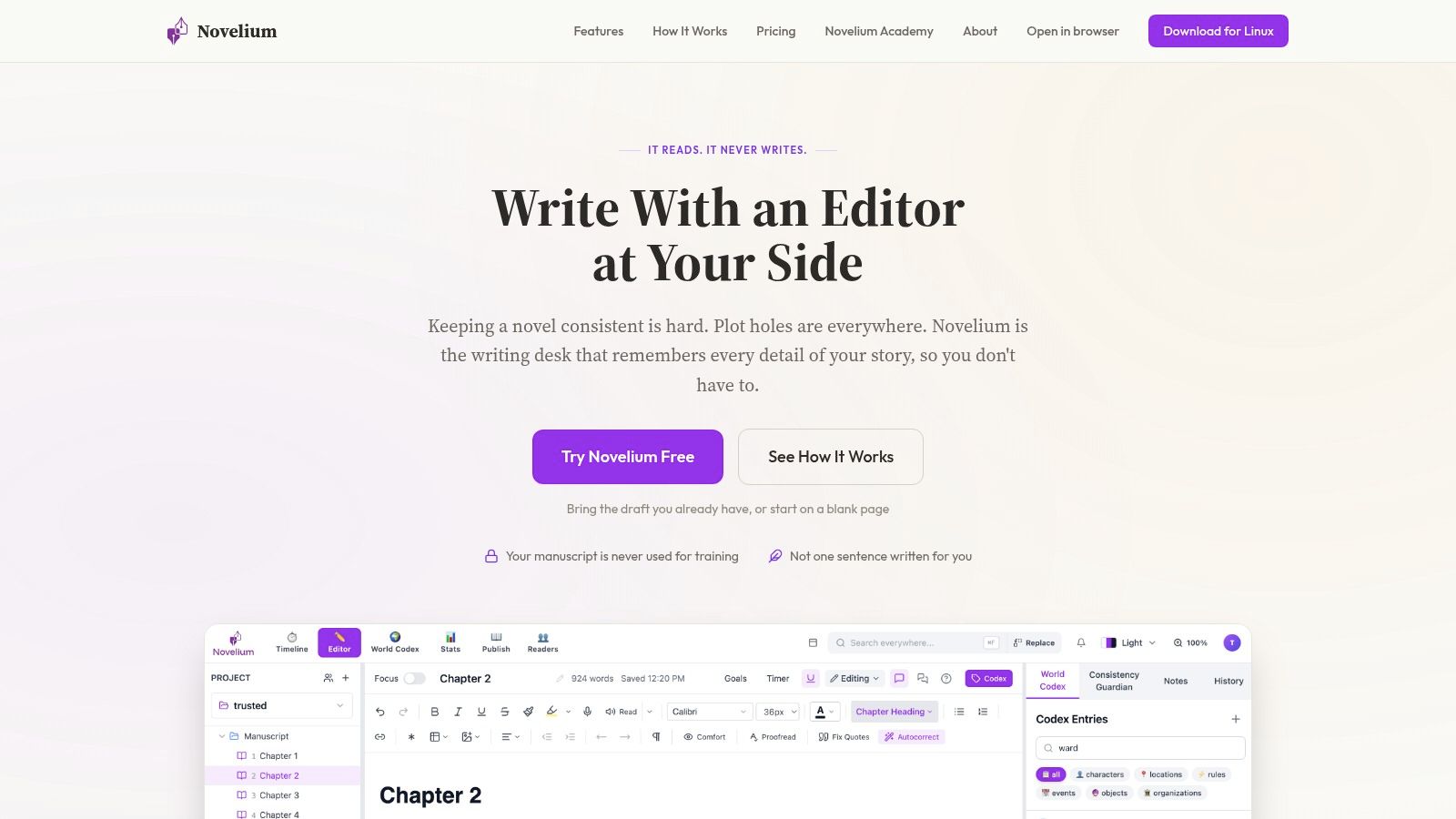
Novelium is the manuscript-first choice, rather than a separate canvas you must keep synchronized. Bring in your manuscript, outline, character sheets, and notes. Our approach is to use the draft as the continuity reference, not ask you to maintain another version of the book beside it.
That distinction matters after revision. Say you move a confession later but leave an earlier confrontation untouched. The relationship still looks plausible on a diagram, yet the confrontation now depends on information the viewpoint character hasn't received.
Where manuscript-aware tracking matters
The hard part of automated character mapping happens before anyone draws a line. A computational-linguistics study of relationship extraction found that resolving pronouns before generating maps increased the percentage of correct relationships. Names, titles, nicknames, and pronouns must resolve to the right person, or the resulting chart can attach an action to the wrong character.
That's the standard to apply to manuscript analysis: can you validate the interpretation against the text? An apparent contradiction can be deliberate deception, an unreliable account, or a genuine mistake. Authors still make that decision.
Novelium processes drafts locally and doesn't use manuscripts for training. It's the stronger fit when your problem is continuity across a changing manuscript, not producing a standalone cast illustration. The trade-off is scope: a manuscript-analysis workspace is more than you need for a diagram destined for a pitch packet.
2. RelationCanvas
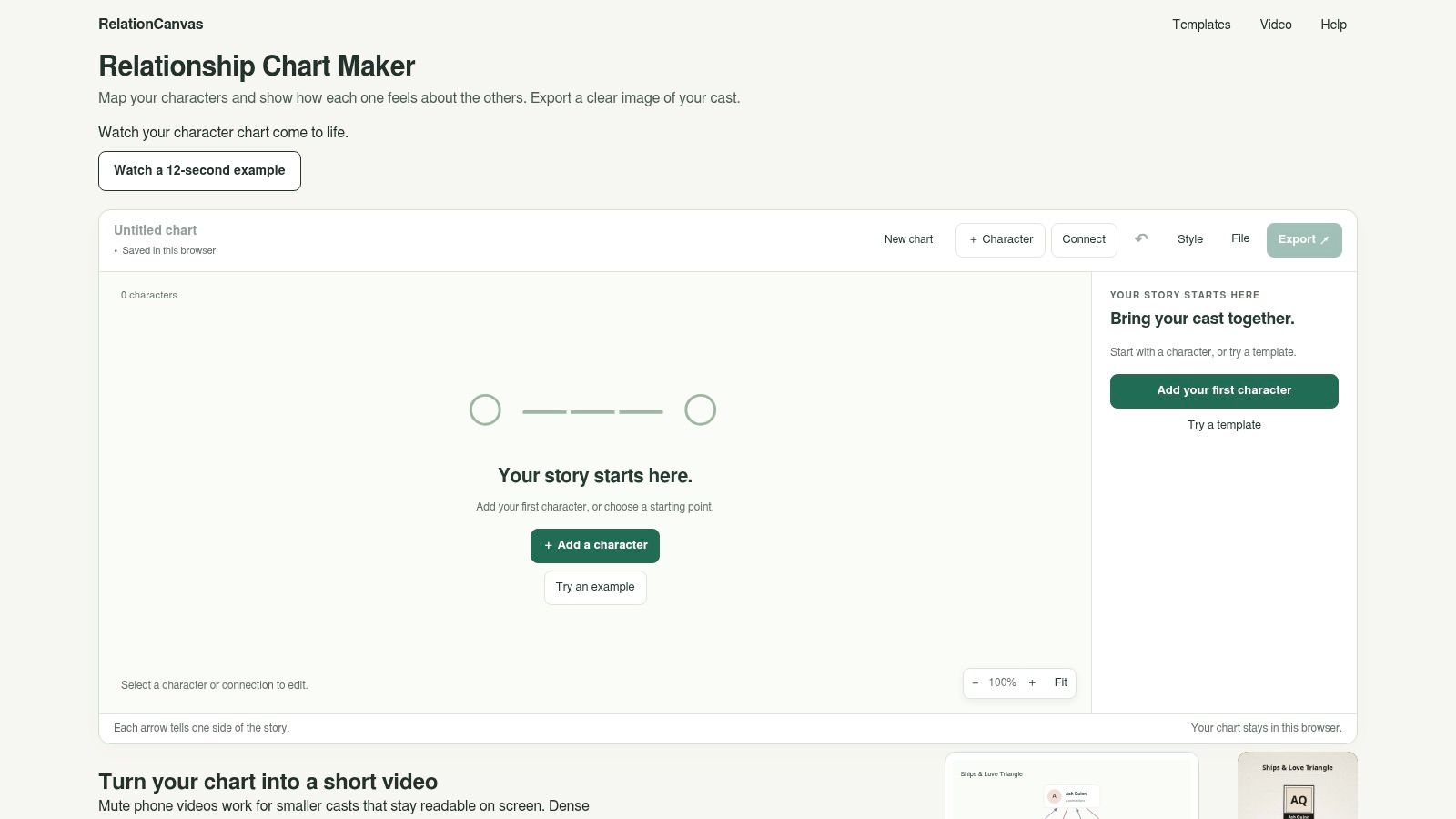
Open RelationCanvas when you need a diagram, not another writing environment. It runs in the browser without registration, supports labeled directional connections, and offers free, watermark-free PNG and SVG exports.
SVG export is the practical attraction. A scalable chart is useful for a series reference document, presentation, or collaborator handoff. You can arrange the cast around the relationship question you're investigating rather than a rigid family hierarchy.
A portable picture, not a portable database
Charts stay in the current browser on the current device. Export your work deliberately, and don't treat browser storage as your only backup. Moving computers or clearing browser data can interrupt access.
RelationCanvas doesn't provide a full character bible or manuscript-planning workspace. That keeps the experience focused, but relationship history remains your responsibility. Preserve separate states around major reversals and name them by the relevant scene or event.
I'd choose it for a clean cast overview or editorial conversation. I wouldn't use the finished image as proof that a complicated information chain still works after revision. The export tells you what you drew, not whether the manuscript still supports it.
3. characterchart
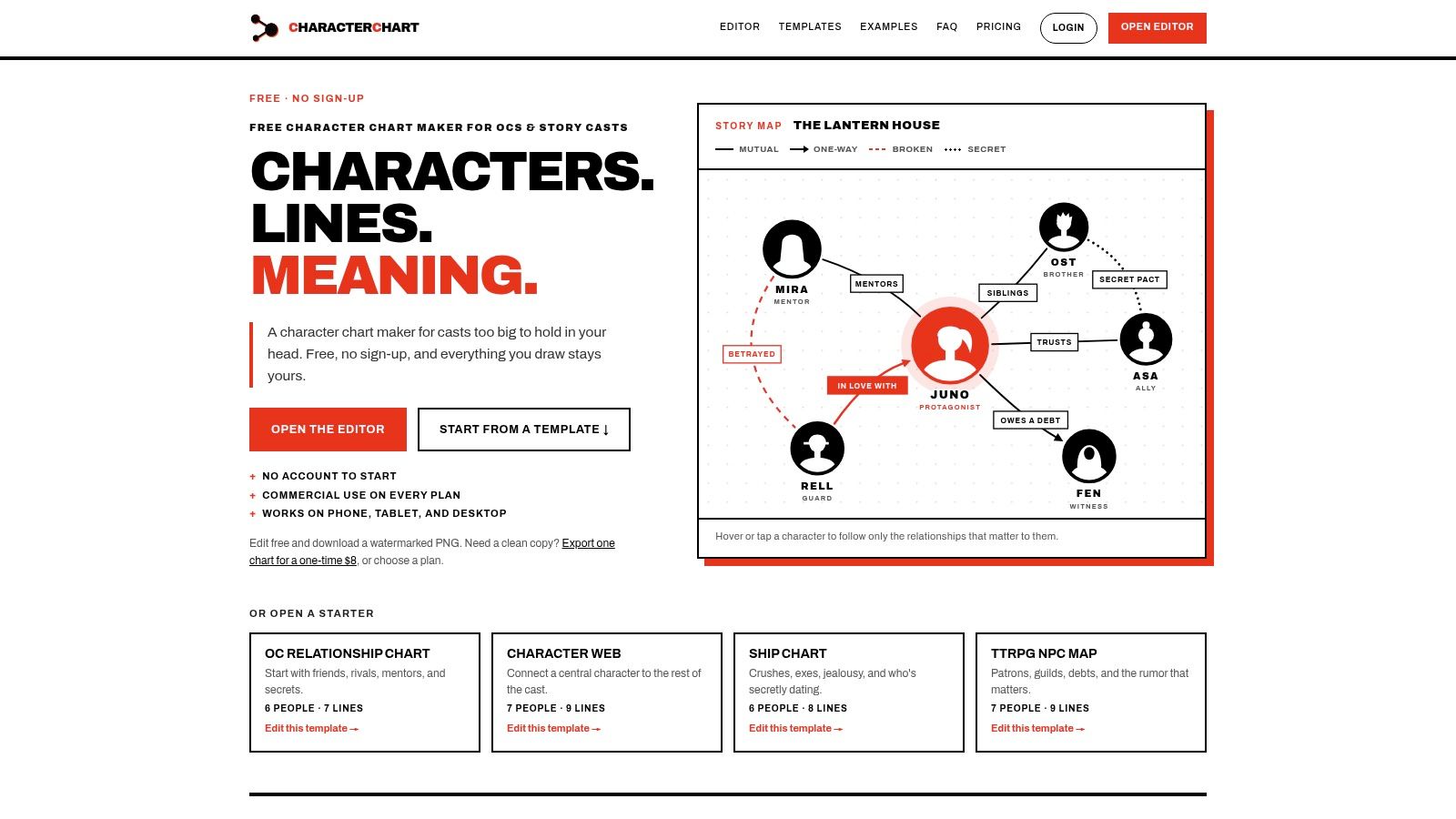
A mystery cast and a fantasy faction network don't need identical starting layouts. characterchart supplies templates for those uses, alongside romance charts, character webs, and campaign casts. You can begin editing without an account, then use an account for saved charts and share links.
Its advanced mode adds portraits, roles, tags, notes, styling, a searchable outline, and automatic layouts. The searchable outline matters more than decorative portraits once finding the right character becomes slower than editing their relationships.
Detail still needs a time reference
A chart can complement a character bible, but it shouldn't become an unstructured substitute. Keep enduring history separate from scene-dependent information. A character's parentage and their current belief about that parentage are different records.
Free PNG exports carry a watermark, while clean exports have paid options, including a one-time purchase. Text and Group tools also require a paid plan.
The trade-off is straightforward: characterchart offers more cast-specific organization than a bare canvas, but more fields don't automatically create continuity tracking. Record the source scene and effective story position in your notes, or an elaborate chart can become just as stale as a simple one.
4. RelationMap
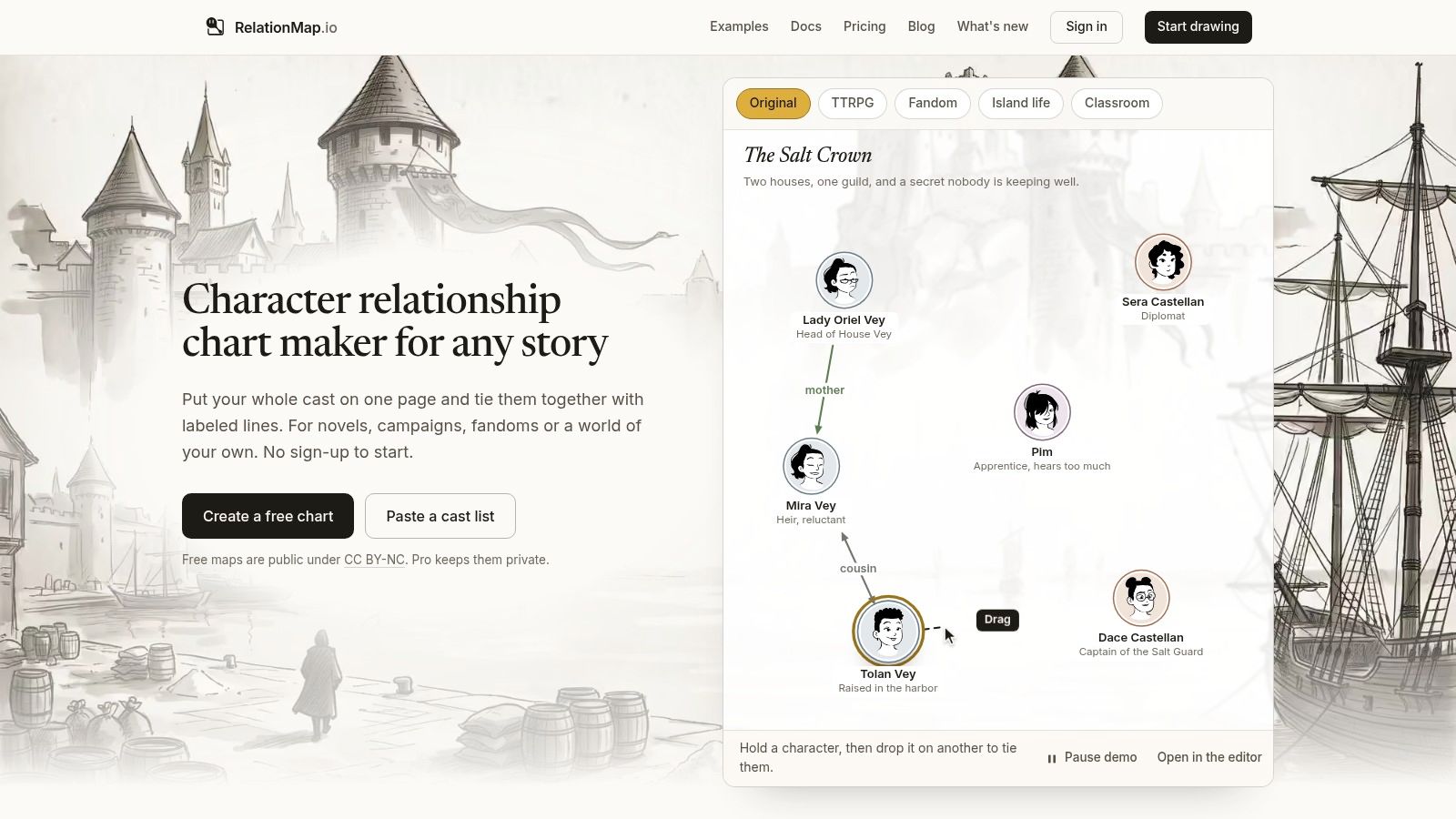
Read the visibility rules before entering your unpublished cast. RelationMap makes free cloud-saved maps public under a non-commercial Creative Commons license. Private maps require a paid plan.
That's a consequential trade-off for a tool that supports text-based cast entry, visual editing, sharing, embedding, and exports including PNG, JPG, PDF, and JSON. Text editing is useful when changing names or reorganizing a substantial cast would otherwise mean repeated clicking.
Privacy rule: A cast map can reveal the murderer, concealed parentage, and the political settlement at the end. Treat it as manuscript material.
RelationMap's text-to-diagram workflow suits writers who prefer structured entry over constant dragging. It doesn't remove the need to review generated relationships or preserve earlier states.
For an enemies-to-lovers arc, the endpoint label is particularly unhelpful. Record the difference between performed hostility, actual distrust, private attraction, and the scene where each changes. Otherwise you've summarized the trope while losing the information needed to check the scenes.
Choose RelationMap for flexible editing and distribution. For confidential work, settle the private-map requirement before uploading anything.
5. Soukanzu
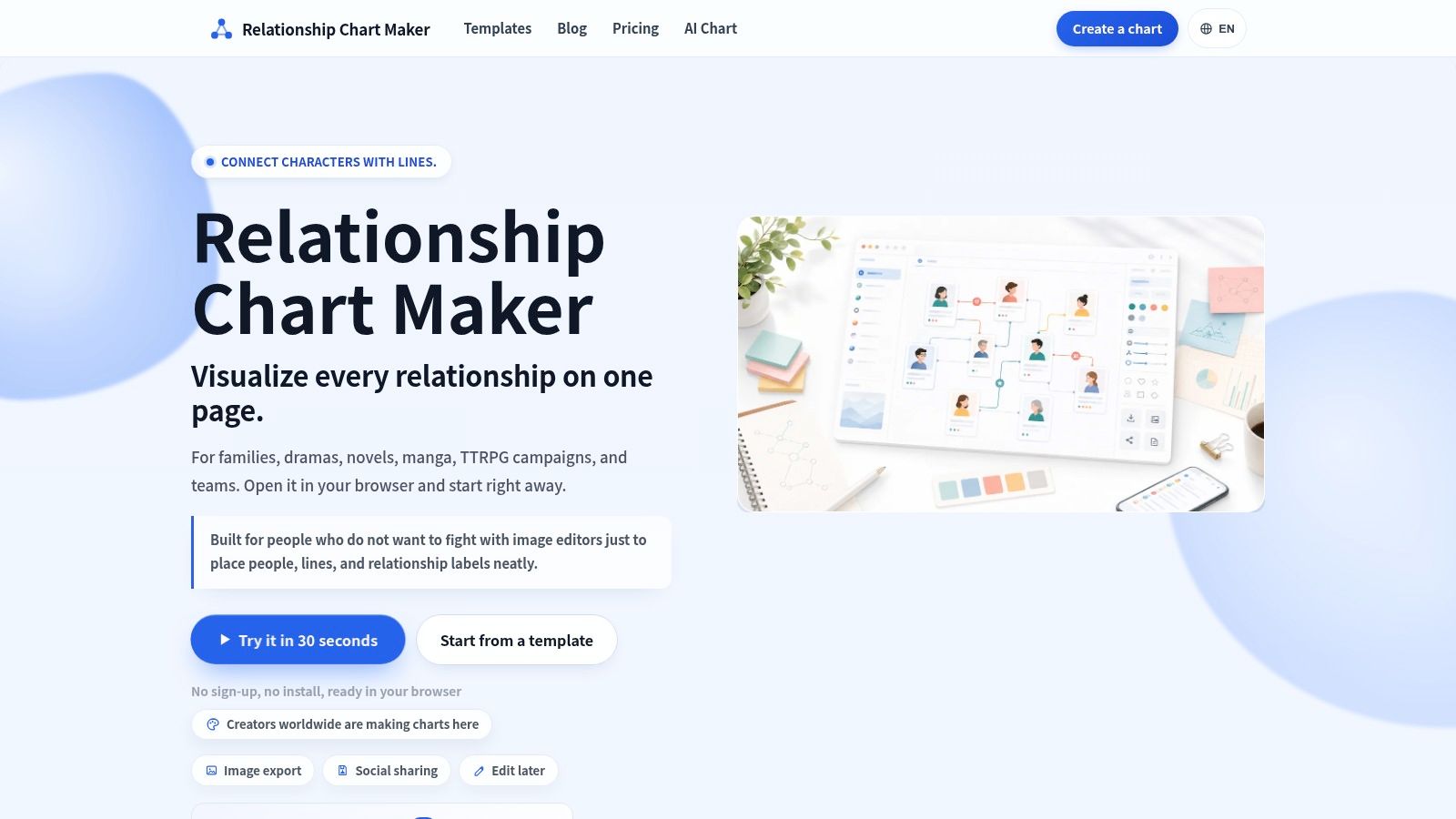
Soukanzu favors a quick start: browser-based editing, drag-and-drop characters, labeled connections, images, colors, and templates. It runs on phones and tablets, useful for reviewing a compact cast away from your main writing setup.
Check the cast limit before committing. The pricing page gates free charts to a small cast, with Premium supporting larger ones, and the character-chart product page lists Premium at $4.99 monthly or $19.99 for lifetime access.
Convenient doesn't mean self-maintaining
Browser autosave is convenient until you change devices or clear browser data. Save exports deliberately, especially before reorganizing a chart. Premium adds export options beyond the free watermarked PNG.
Soukanzu suits a compact relationship sketch, family subset, or focused subplot review. It's weaker as the sole record for an ensemble novel, because every relationship state is yours to maintain. A chart that was accurate at chapter one says nothing about chapter forty.
Keep sensitive plot text out of its generated-chart function unless you're comfortable with the external processing involved. Starting without an account isn't the same as keeping every operation on your device. Evaluate storage and text processing separately.
6. Campfire Writing
A relationship chart becomes more useful when the surrounding reference material lives nearby. Campfire Writing puts relationship mapping within a modular writing and worldbuilding suite, alongside character profiles and other planning tools.
That makes it a better fit than a standalone diagram maker when you need to move between a family connection, a character's history, and the wider setting. Its Relationships module accommodates personal networks and family trees.
Don't mistake profile depth for state tracking
The danger is building beautifully detailed profiles that still can't answer a scene-level question. A practical relationship-mapping method distinguishes each character's internal feelings from their outward behavior toward the other. That separation is more useful for continuity than another paragraph of biography.
Say a captain protects a subordinate publicly while privately suspecting treason. A shared label such as trusted allies erases the distinction that makes the dialogue work.
Campfire offers a free starting point and paid module or plan options. Match access to the modules you need rather than assuming every planning feature comes together. Choose it for connected planning material, while maintaining explicit records of when relationship facts become true.
7. LoomArras
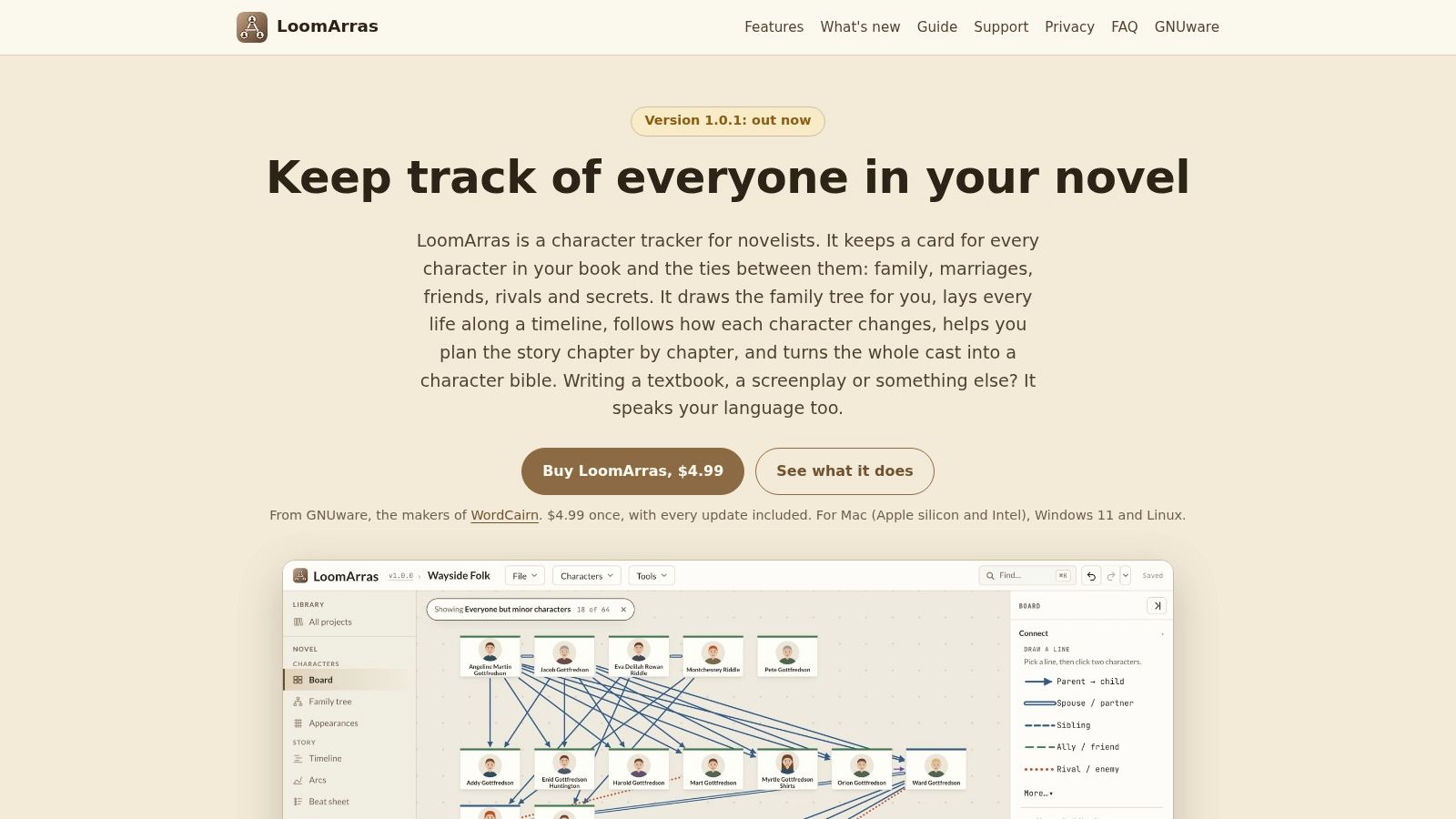
LoomArras takes changing relationships seriously. Its visual board connects character cards, while timeline and story-so-far views show characters' lives and connections at different points. LoomArras also derives family trees from recorded family relationships and includes character-appearance views.
That combination suits family sagas better than a timeless web. Kinship may remain fixed while marriages, inheritance expectations, household membership, and knowledge of ancestry change.
Better suited to a working desktop reference
LoomArras is downloadable desktop software rather than an instant browser canvas. The developer describes optional reading of local chapter files and says content isn't sent elsewhere. That's a meaningful distinction for writers who want manuscript material to stay on their machine.
Its temporal approach also matches the questions raised by a long-form narrative-tracking framework, which treats character retention and relationship persistence as chapter-aware measures. A connection appearing somewhere in the book isn't enough to establish its state everywhere.
The limitation is adoption risk: independent feedback is limited, and a broader tracking application takes more commitment than a disposable diagram. Test it with a complicated family branch and a major reversal before moving your entire series reference into it.
8. World Anvil
World Anvil is the stronger candidate when personal relationships sit inside a much larger political structure. Character and organization records, family trees, diplomacy webs, linked articles, timelines, and maps let you connect people to the institutions around them.
A courtier can be related to a claimant, employed by a rival house, and publicly loyal to the crown. Those aren't interchangeable connections. World Anvil's broader setting structure gives you room to record the distinction.
World history and character knowledge are separate
The setup cost is real. You're building a linked reference environment, not merely dropping names onto a canvas, and privacy controls depend on tier. Compare that workflow with a World Anvil alternative if your immediate problem is manuscript consistency rather than maintaining a setting wiki.
The discipline is separating objective setting facts from character beliefs. An article can correctly identify the secret heir without establishing who has discovered that identity in the current scene.
A complete world encyclopedia can still give you the wrong answer about what a viewpoint character knows.
Choose World Anvil for institutional relationships and extensive shared worlds. Don't assume a well-linked article network automatically preserves scene-specific knowledge or the order in which characters acquire it.
9. Storymapper
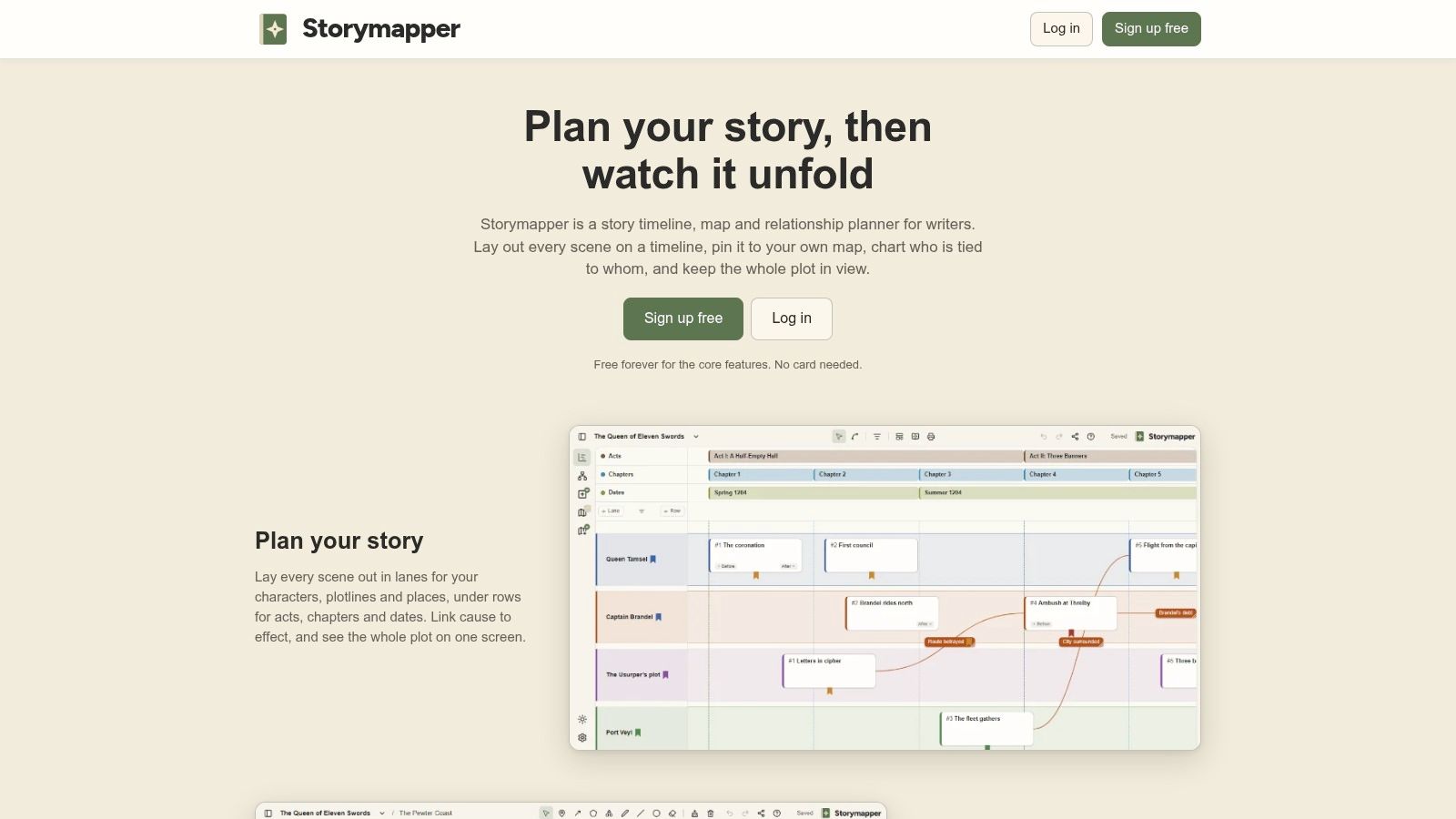
A commander can't respond to a betrayal before the messenger arrives. Storymapper brings a relationship chart together with timeline and map views, making it relevant when chronology and geography constrain relationships.
Its relationship tools cover families, chains of command, and changing alliances. The appeal is the ability to plan people and events across related views rather than maintain an isolated cast poster.
Check the transition, not just the endpoints
For a military or political novel, test a sequence involving an order, a journey, and a change of allegiance. You need to know when the order was issued, where its recipient was, and whether the alliance had already changed.
A visual character-dynamics design study identified visual overload and difficulty interpreting exact values from graphical encodings. The practical lesson is to insist on explicit labels and manageable views, not just a larger canvas.
Storymapper is more story-specific than generic diagramming software, but its public access and pricing details need checking before adoption. Independent user feedback is limited, too. Judge it by whether your test sequence remains legible across its views, not by how attractive the initial network looks.
10. Kakiniwa
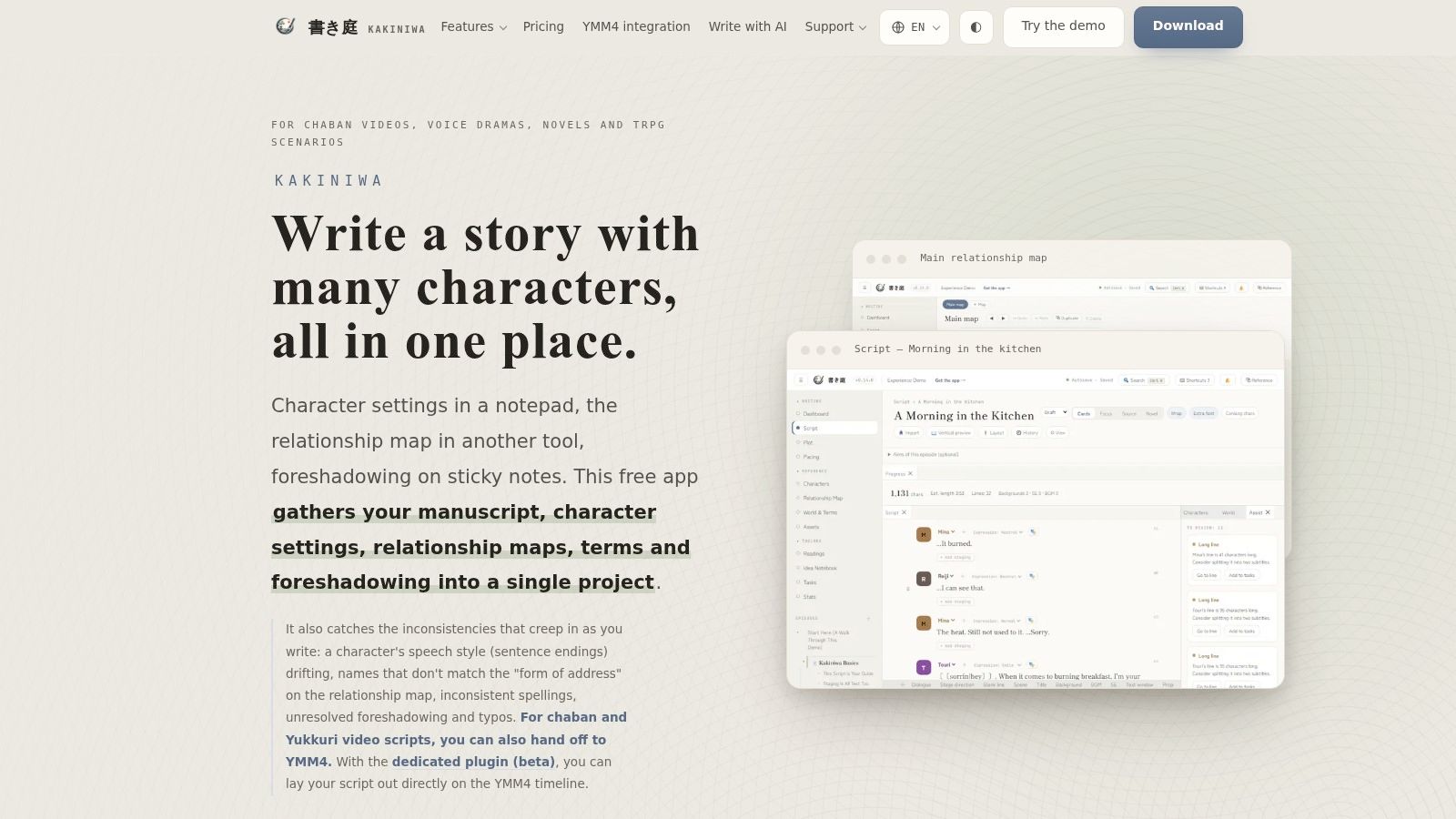
Kakiniwa combines manuscript drafting, character and world notes, relationship maps, terminology, and foreshadowing within a project. Its English site describes a free public beta with desktop versions and offline use.
This is an integrated-workspace proposition rather than a chart-export utility. It also describes checks for speech-style drift, inconsistent names, and unresolved foreshadowing, which makes it relevant to writers whose continuity problems extend beyond relationships.
Integration isn't a reason to skip testing
Public-beta software requires a different decision from an established reference workflow. Test imports, saving, recovery, and the usefulness of its checks before moving an active production manuscript.
For relationship notes, prioritize fields that affect scenes. A relationship-chart template guide recommends recording public status, private truth, power balance, hidden information, source scenes, and consequences. Those details explain why a conversation can be consistent even when the characters describe their bond differently.
Choose Kakiniwa if you want drafting and references together and accept a less-established application. If you only need a printable diagram, the broader workspace adds unnecessary migration work. If you need continuity checking, test the specific failure you care about rather than treating every check as equivalent.
Character relationship chart makers at a glance
A chart maker is only as good as its answer at chapter forty. That is the filter this table applies. All ten tools below will draw a relationship diagram; the column that separates them is what happens to that diagram once the story moves. Static charts are not worthless, but they capture intent at a moment, not a state you can rely on later.
| Tool | Best for | What happens to the chart as the story moves |
|---|---|---|
| Novelium (recommended) | Manuscript continuity and series planning | Tracks characters, timelines and plot threads, and flags conflicts as you type |
| RelationCanvas | Quick, standalone character relationship charts | Static; no time-based changes noted |
| characterchart | Template-based charts with detailed cast information | Static; no time-based changes noted |
| RelationMap | Relationship maps with visual and text editing | Static; no time-based changes noted |
| Soukanzu | Quick, mobile-friendly character charts | Static; no time-based changes noted |
| Campfire Writing | Relationship mapping within a broader planning workspace | Maps connections; time-based changes not specified |
| LoomArras | Large casts, family sagas, changing connections | Shows how relationships stand at different story points |
| World Anvil | Relationships linked to detailed worldbuilding records | Family trees and diplomacy webs; change over time not specified |
| Storymapper | Planning that combines relationships, timelines and maps | Supports relationships that change as a story progresses |
| Kakiniwa | Drafting and organizing story references in one app | Relationship maps; time-based changes not specified |
Three entries claim anything about change over time, and only Novelium ties that claim to the manuscript itself. Its Character Dashboard extracts characters from the draft and tracks what each one knows at every moment, so a betrayal or a concealed identity can be checked against the scene where it lands. LoomArras shows how relationships stand at different story points, and Storymapper supports maps that shift as a story progresses. Campfire Writing, World Anvil and Kakiniwa draw connections without stating how those maps age. RelationCanvas, characterchart, RelationMap and Soukanzu are static by design.
Cost is the least revealing column, which is why it is gone. Where the tool pages state numbers, the picture is narrow: Soukanzu's free charts cap at four people, with Premium above that; characterchart charges for unwatermarked exports; Campfire sells plans and modules; LoomArras is a one-time purchase with updates included; RelationMap puts private cloud maps behind Pro; Novelium starts free and scales to Pro and Publishing plans as projects grow. Compare free tiers first and invoices second.
Privacy splits the field along a similar line. RelationCanvas keeps charts in the current browser on the current device, and LoomArras says manuscript reading is optional and local, with content not sent anywhere. Kakiniwa describes offline use. Soukanzu autosaves in the browser but sends text for AI chart generation to an AI service. RelationMap's free cloud maps are public under a non-commercial Creative Commons license, which makes a spoiler-heavy map a spoiler. Novelium reads the draft locally, encrypts stored manuscripts and does not train on them.
I would not build a series bible on a chart that cannot say who knows what in chapter twelve. Drawing is the easy half.
Pick the Tool That Tracks, Not the One That Draws
Quick diagram makers have a legitimate job. RelationCanvas and Soukanzu produce a focused visual; characterchart adds cast-specific organization; RelationMap supports flexible editing and sharing. None has to become your entire writing environment to justify a place in your process.
For a long manuscript or a series cast, though, the decisive question is whether you can recover the right state at the right scene. Test a betrayal, a concealed identity, and a revision that moves a revelation. Can the tool separate what happened from what each participant believes happened?
Make the manuscript the reference
Novelium's Character Dashboard extracts characters from the text and tracks physical descriptions, personality traits, backstory, and arcs. It shows what information each character has at every moment of the story, so you can inspect scene-by-scene knowledge without rebuilding the chart by hand. Characters, world details, and timeline entries get tracked automatically with no manual data entry, and the Story Bible holds rich character histories you can reference mid-draft. Timeline conflicts, character inconsistencies, and continuity problems appear in the sidebar as you type.
That gap separates intended characterization from the actual draft. A revised disclosure should change your reading of the scenes around it. It should not just add another annotation to a chart that is already crowded.
The same test applies to any software holding records. When you compare client management tools, the question is whether they preserve current state or a polished view of stale information. For fiction, stale information means a character acting on a secret they have not learned yet.
Keep the diagram if it helps you think. Stop asking it to do the work of a tracking system. Choose the tool that lets you inspect the state behind a scene, then test it against your current draft rather than a tidy demonstration cast.
Novelium tracks characters, knowledge states, relationships, and timelines from your manuscript, so your continuity reference changes with the draft. Bring your current manuscript to Novelium and check a complicated revelation or relationship reversal before your next revision pass.