A Book Written in First Person: Why POV Matters
First person is a control problem, not a shortcut. The reader may stay inside one voice, but that voice can carry restricted knowledge, unstable memory, embedded documents, temporal distance, or direct address. Each choice creates failure points that become harder to police across an 80,000-word manuscript. The strongest book written in first person examples use those limits deliberately rather than treating intimacy as an automatic virtue. The books below work as models for distinct first-person effects, and for the continuity burden each effect creates. A character-development document describes backstory, temperament, and motivation. A character-tracking system records what that character has witnessed, learned, believed, forgotten, and done as scenes change. That distinction is central to serious revision. Tools such as Novelium's Character Tracker and World Codex, alongside resources like this Codex guide for creators, address the moving data rather than leaving it trapped in a static profile.
1. Unreliable Narrator
An unreliable first-person narrator doesn't merely surprise the reader at the end. Their distortion operates from page one, through omissions, self-deception, selective memory, prejudice, or outright lies. The voice can sound persuasive while the surrounding evidence refuses to cooperate.
Gillian Flynn's Gone Girl uses dual unreliable narrators to destabilize certainty. Kazuo Ishiguro's Never Let Me Go lets Kathy gradually expose how much she has understood, or perhaps refused to understand, all along. Agatha Christie's And Then There Were None withholds the narrator's true position in the events. These books don't make unreliability a decorative twist. They build the reader's interpretation around a controlled gap between what the narrator says and what the manuscript supports.
That gap is where long-form continuity becomes severe. Track direct observation separately from inference, hearsay, and belief. A narrator who sees a bloodstained coat can describe the coat. They can't state who wore it unless they learned that elsewhere. If they establish a memory as certain early in the book, a later contradiction needs to arise from a designed flaw in memory, not an authorial oversight.

What to track
Record every factual claim the narrator makes, then classify it as witnessed, inferred, reported, remembered, or invented. Establish their biases early enough that readers can detect the pattern without needing a late explanation. Concrete sensory details help because physical observations are easier to audit than interpretations.
A reliable narrative voice glossary won't solve the problem by itself. Your manuscript needs a knowledge ledger. Novelium's Character Tracker can surface the more damaging contradiction, such as a narrator recognizing a face they've never encountered, remembering a conversation that occurred outside their access, or treating a previously unknown fact as established history.
Practical rule: Unreliability should change the reader's interpretation, not the author's underlying facts.
2. Stream of Consciousness
Stream of consciousness looks loose on the page and is anything but loose underneath. The form captures associations, interruptions, contradictions, sensory triggers, and half-formed thoughts as they arrive. It gives the reader unusual proximity to a mind, but proximity exposes the pattern of that mind.
James Joyce's Ulysses defines the technique at its most expansive. Virginia Woolf's Mrs. Dalloway maintains coherence while moving through interior associations, and Sylvia Plath's The Bell Jar uses mental flow to reveal a deteriorating state. Their narrators don't produce random verbal weather. Objects, memories, anxieties, and recurring perceptions create a recognisable system.
For a long manuscript, track the narrator's mental habits as carefully as external events. Does a hospital corridor repeatedly trigger childhood images? Does a particular person interrupt every hopeful thought? Does anxiety narrow perception toward exits, clocks, or bodily sensations? Those patterns create continuity in prose that may otherwise appear fragmented.

Thought has architecture
The distinction between stream of consciousness and a more controlled interior monologue matters in revision. A stream can contain jagged syntax, but readers still need recurring anchors that tell them where the consciousness is moving. Vary sentence length and fragment density. Pure turbulence across every scene quickly becomes noise, and noise conceals both deliberate pattern and accidental repetition.
Track emotional registers too. An anxious narrator associates differently from a dissociative or manic narrator. If the mental state changes, mark when and why. Otherwise, the voice will appear to recover or deteriorate according to scene convenience rather than character experience.
A brief visual reference can help when mapping those recurring anchors.
3. Epistolary Elements Within First-Person Narration
Letters, emails, diary entries, reports, and notes give a first-person novel a second layer of evidence. The narrator tells the story, then places an artifact in the reader's hands. That artifact may expose another voice, contradict the narrator, or show the narrator's earlier self before later knowledge altered the account.
Dracula uses letters and diaries to construct a first-person record across multiple characters. The Screwtape Letters turns correspondence into the primary dramatic engine within its framing concept. Leigh Bardugo's Ninth House embeds research documents and notes within first-person sections, allowing the manuscript to widen its evidentiary field without abandoning the central voice.
Documents feel factual in a way narration often doesn't, which makes their contradictions conspicuous. A letter dated before an alleged discovery can't casually contain knowledge acquired later. An email from a secondary character shouldn't reveal information the narrator claims to have encountered for the first time unless the timing or provenance explains it.
Provenance is part of the plot
Track when the narrator obtained each document, whether they're quoting it from memory, reading the original, summarising it, or showing it to the reader as a physical object. Record what the document reveals and what the narrator claims to know at that point. Gaps can create excellent tension, but only when the gap is intentional.
Give each document a distinct voice. A diary entry shouldn't sound like the polished retrospective narration unless that similarity tells us something about the writer. Dates, locations, authorship, and access belong in the manuscript's continuity system, not in a loose notes file that stops evolving after the draft's opening chapters.
4. Retrospective Narration With Structural Time Shifts
Retrospective first person gives you two narrators at once. The experiencing self moves through events without later knowledge. The narrating self looks back with information, regret, judgment, or a motive for telling the story. Past tense alone doesn't create this structure. The separation between then and now does.
Nick Carraway in The Great Gatsby narrates from a future position shaped by disillusionment. The Kite Runner uses retrospective narration to connect past trauma with present understanding. Laurie Halse Anderson's Speak reveals hidden knowledge gradually through the narrator's retrospective processing. In each case, the reader tracks not only what happened, but when the narrator understood what happened.
Keep the two knowledge states separate. “I didn't know this then” and “I won't tell you this yet” are different operations. The first belongs to temporal structure. The second belongs to narrative withholding. Confusing them produces a narrator who appears to know everything and nothing whenever the plot needs a particular delay.
Build a two-track chronology
Record the narrator's emotional state during the original events and during the act of narration. The older self may be ashamed, defensive, fascinated, or still mistaken. Mark the scenes in which present understanding changes. If the narrator discovers the truth in the middle of the story, later reflections must account for that change without retroactively giving the earlier self impossible awareness.
The reason for telling the story also matters. A narrator writing confession, testimony, memoir, self-justification, or elegy will select details differently. That motive shapes emphasis, omission, and tone, so it belongs in the tracking record alongside dates and events.
5. Free Indirect Discourse and Thought Attribution
Free indirect discourse blurs narrator and character without announcing the handoff with “he thought” or “she wondered.” In first person, the effect is especially volatile because the narrator's consciousness already controls the grammatical centre. A phrase can sound like the narrator's interpretation, an echo of another character's language, or an intrusion into a mind the narrator can't access.
Kazuo Ishiguro uses this ambiguity in The Remains of the Day, where Stevens's language carries both his formal self-presentation and the pressures he refuses to name. Sally Rooney's Normal People moves through intimate perspective across its alternating sections. Toni Morrison's Beloved blends voices and perspectives with fluid force, but that fluidity remains anchored in a carefully managed consciousness.
The danger is not ambiguity itself. The danger is unmarked access. A first-person narrator can interpret a lover's silence, repeat their words, or infer their fear. They can't report the lover's private thought as fact unless the novel has established a special mechanism for that access.
Protect the boundary
Decide whether the narrator's apparent access reflects empathy, close observation, remembered conversation, or a deliberate stylistic breach. Track which characters they understand well and which remain opaque. Their interpretation should not become universal omniscience by accident.
The principles of deep point of view are useful here, but a glossary won't replace scene-level tracking. Mark every shift in thought attribution. If a character's inner language begins appearing in the narrator's prose, keep that pattern consistent enough for readers to recognise it as technique rather than continuity failure.
“Interpreting someone's thoughts isn't the same as knowing them.”
That distinction gives you tension. The narrator may be perceptive and still wrong. Their confidence should not erase the boundary between evidence and access.
6. Fragmented or Non-Linear First-Person Narrative
A fragmented first-person novel asks the narrator to assemble meaning from pieces. The fragments may surface through trauma, investigation, memory, documents, or a deliberately disrupted chronology. The structure can feel immediate because it follows consciousness rather than calendar order, but every fragment still has to fit the underlying reality.
Julio Cortázar's Hopscotch makes reordering part of the reading experience. Jennifer Egan's A Visit from the Goon Squad uses non-linear movement and fragmented perspective. Irvine Welsh's Trainspotting pushes fragmented first-person narration through multiple voices. Their disruptions aren't random. Recurring images, voices, objects, and emotional pressures give readers handles.
Maintain two timelines
Keep the actual chronology in a separate map from the order in which the manuscript presents scenes. Record the narrator's age, location, physical condition, relationships, and knowledge at each point. A later fragment can reinterpret an earlier event, but it can't alter the weather, injury, travel sequence, or object position unless the contradiction is part of the narrator's unreliability.
Trauma may justify fractured recall, but it doesn't excuse arbitrary assembly. The reader needs a reason to trust that the fragments will form a coherent whole. Repeated anchors help. So do consistent transitions, even when those transitions are sensory rather than explicit.
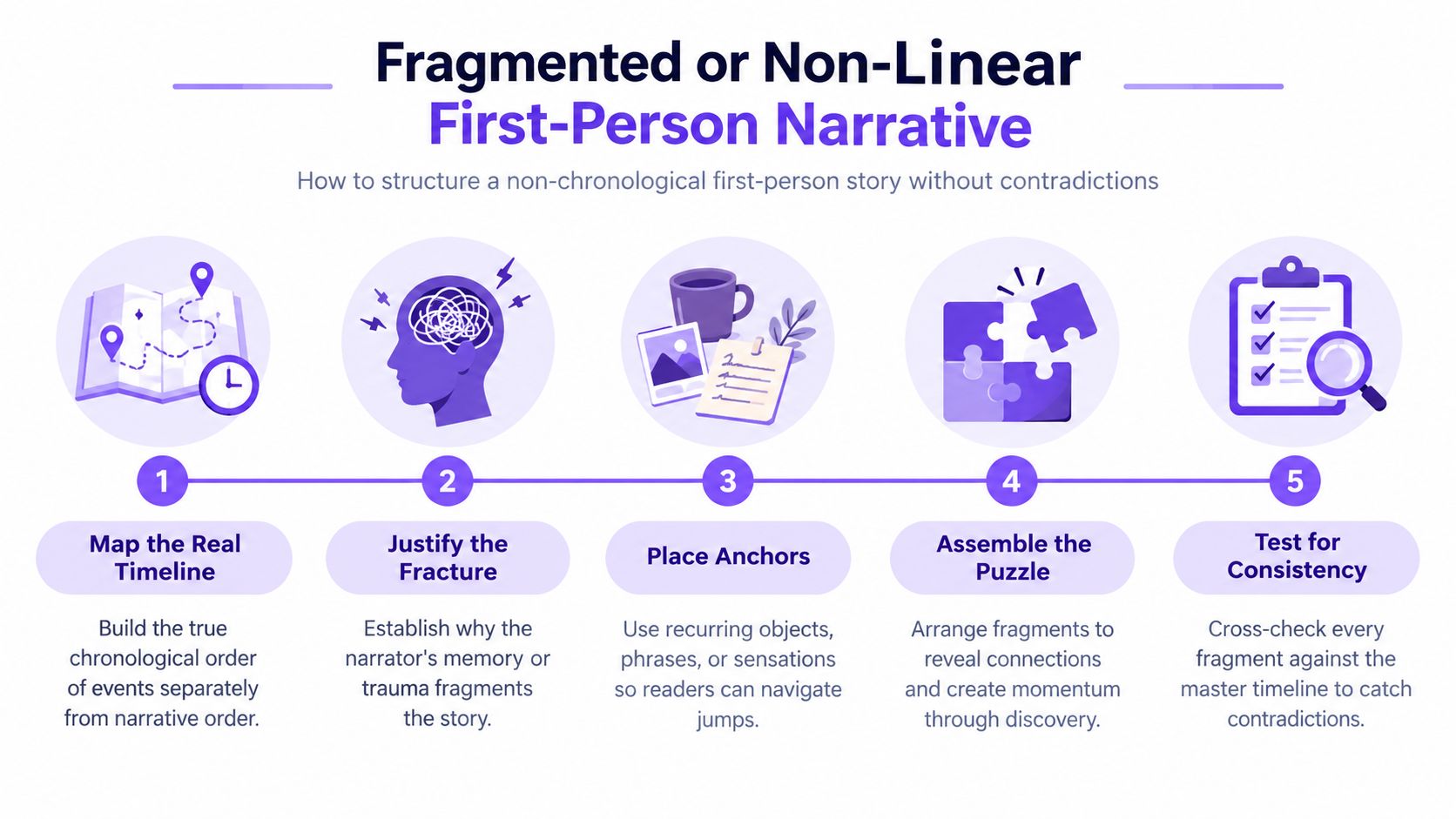
Audit each fragment twice. Read it in publication order for reader orientation, then in chronological order for factual continuity. A reveal should become clearer when reassembled. It shouldn't expose a missing cause, an impossible encounter, or a narrator who knows the ending before acquiring the necessary information.
7. Intimate Address and Second-Person Slip
Some first-person narrators speak to the reader directly, using “you” to create complicity, accusation, confession, or shared recognition. Holden Caulfield's direct address in The Catcher in the Rye helps make his voice feel conversational and defensive. Italo Calvino's If on a winter's night a traveler builds its structure around second-person address. Claudia Rankine's Citizen uses “you” to implicate the reader in experiences shaped by systemic racism.
The technique changes the relationship between narrator and audience. “You know how it is” assumes common ground. “You would have done the same” asks for judgment while attempting to control it. Those assumptions are not harmless flourishes. They establish what the narrator believes the reader knows, accepts, or will forgive.
Make the address a system
Introduce direct address as a voice signature, not a late gimmick. Track when the narrator speaks to the reader and what emotional pressure triggers it. Philosophical or confessional moments usually carry more weight than casual second-person slips scattered through ordinary action.
The narrator's assumptions must remain stable enough to feel intentional. They can change as the character becomes more honest, but the change needs a cause. A narrator who alternates between treating the reader as a confidant and pretending the reader doesn't exist will sound inconsistently drafted unless that fracture is the point.
Direct address also affects reliability. A narrator claiming “you understand” is making an authority move. The reader may accept the invitation, resist it, or notice that the narrator is using intimacy to avoid accountability. Track those claims as carefully as any factual statement.
7-Point Comparison of First-Person Narrative Techniques
| Technique | 🔄 Implementation complexity | ⚡ Resource requirements | 📊 Expected outcomes | 💡 Ideal use cases | ⭐ Key advantages |
|---|---|---|---|---|---|
| Unreliable Narrator | High, must track narrator knowledge vs. reality | High, continuity logs, tracking tools, many revision passes | Creates sustained tension and re-read value; risk of reader feeling cheated if inconsistent | Psychological thrillers, mystery, character-driven novels | Destabilizes trust; voice becomes central storytelling device |
| Stream of Consciousness | Very high, sustain associative patterns and voice consistency | High, intense editing, anchors, careful pacing | Deep immersion and intimacy; can exhaust readers if overused | Literary/experimental fiction, portraying altered mental states | Unparalleled interior access; justifies nonlinear thought leaps |
| Epistolary Elements within First Person | Medium-high, align documents with timeline and narrator access | Medium, document formatting, timeline cross-checks | Adds layered perspectives and perceived factuality; may complicate timeline | Hybrid narratives, multi-voice stories, revealing backstory | Brings other voices in without leaving first person; boosts realism |
| Retrospective Narration with Time Shifts | Medium-high, manage narrating-self vs. experiencing-self consistently | Medium, map knowledge states across timeframes, editorial shaping | Enables irony and reflection; sustains suspense if handled well | Memoir-style, coming-of-age, stories relying on hindsight | Allows reflection while preserving narrative tension and control |
| Free Indirect Discourse & Thought Attribution | High, precise POV boundaries and documented intimacy required | Medium, voice markers, relationship mapping, careful revision | Creates psychological closeness and subtle ambiguity; risk of confusion | Close-relationship dramas, deep-POV character studies | Expands access to others' interiority without breaking first person |
| Fragmented / Non-Linear First Person | Very high, overlay chronological timeline vs. narrative fragments | High, timeline maps, anchors, intensive consistency checks | Engages readers as puzzle solvers; reflects trauma/memory; can frustrate | Trauma narratives, experimental structures, mystery puzzles | Structural revelation and reader participation; conceals info via order |
| Intimate Address & Second-Person Slip | Medium, sustain rhetorical stance and consistent assumptions | Low–Medium, voice calibration, clarity on reader assumptions | Produces immediacy and complicity; can alienate if manipulative | Confessional pieces, political/lyrical works, voices courting reader complicity | Creates immediate connection and rhetorical power through direct address |
Choose the Constraint You Can Control
First-person effects aren't the same thing as first-person fashion. Choose the structure because it creates the reader relationship your novel needs, then name the continuity data that structure will require. An unreliable narrator needs witnessed events, acquired knowledge, inferences, and omissions. A retrospective narrator needs separate timeline positions and separate awareness states. An epistolary structure needs document dates, authorship, provenance, and access. Fragmentation needs both chronological order and presentation order. Direct address needs stable assumptions about the reader.
A profile that says a character is guarded, observant, traumatised, or funny won't protect an 80,000-word manuscript. Those facts may help with development, but they don't tell you whether the character has already learned the antagonist's name, whether they witnessed the argument in chapter six, or whether a supposedly private memory has appeared in dialogue before its reveal.
Character development documents describe who a character is becoming. Character-tracking systems record what changes scene by scene. The second system has to evolve with every draft and revision because revisions alter knowledge, relationships, object locations, event order, and the narrator's available evidence.
Audit the first-person technique you're borrowing against your own manuscript. Mark every moment of witness, inference, memory, document access, thought attribution, and direct address. Then use Novelium's Character Tracker and World Codex to surface contradictions across chapters before they become revision archaeology. Novelium is designed for manuscript continuity, including character knowledge, relationships, events, timelines, and inconsistencies that a conventional profile won't catch.
Novelium's Character Tracker and World Codex automatically extract and track character details, knowledge states, relationships, events, and world information across your manuscript. Visit Novelium to check your first-person draft for timeline errors, impossible knowledge, and continuity contradictions before they spread through the next revision.