Writing Story Outline That Survives a Full Draft
Most outlining advice assumes the outline's job ends when drafting begins. That's the part I'd throw out. A premise and a sequence of beats can help you start, but they won't protect an 80,000-word manuscript from timeline slips, knowledge violations, missing objects, or promises that vanish for thirty chapters.
A working outline has to do more than summarize plot. It needs to record the changing state of the story, scene by scene, so you can verify what each character knows, where everyone is, what they're carrying, what has happened to them, and which tensions remain unresolved. That approach reflects the long-standing use of outlines to manage chronology, pacing, character development, scenes, and timelines in long-form fiction, as documented in historical fiction outlining guidance.
Most Outlines Die Before They Help
Most writers treat the outline as a pre-draft chore. They sketch the premise, arrange the major beats, perhaps color-code a few chapters, then abandon the document when the story mutates. By the time the manuscript reaches the quiet middle, the outline has become a museum piece describing a book that no longer exists.
That failure isn't proof that outlining is useless. It proves the document was built for the wrong job. A plot summary tells you what happens in broad terms. It doesn't tell you whether Mara has already learned about the forged letter, whether the revolver is still in the desk, or whether the character arriving at dawn has had enough time to travel there.
The outline as a living ledger
Treat the outline as a state-tracking system. At every scene boundary, record the facts that can affect continuity: physical position, time, knowledge, emotional pressure, possessions, injuries, relationships, and open questions. The prose dramatizes those changes. The outline verifies them.
This is especially important in books with recurring casts, parallel timelines, multiple points of view, or delayed revelations. A character profile may say that Daniel is a former surgeon. A tracking record says that Daniel knows about the fracture because he examined it in scene twelve, but doesn't know who caused it because that information never reached him.
Practical rule: If a fact can change between scenes, it belongs in the working outline.
Formal writing guidance treats outlining as a planning step that sorts information, establishes a clear storyline, and keeps paragraphs and progression understandable for the audience. Those same principles apply to fiction, but a novel requires one extra layer. The outline must preserve not only order, but state. Communication guidance from UNECE supports the broader value of structure, chronology, and audience clarity.
A useful outline catches the contradiction before the reader does. That's why it survives the draft.
Building the Outline in Layers
Don't try to produce the final scene document in one heroic sitting. Expand the story in layers, solving larger structural problems before you spend time naming every doorway and cup of coffee.
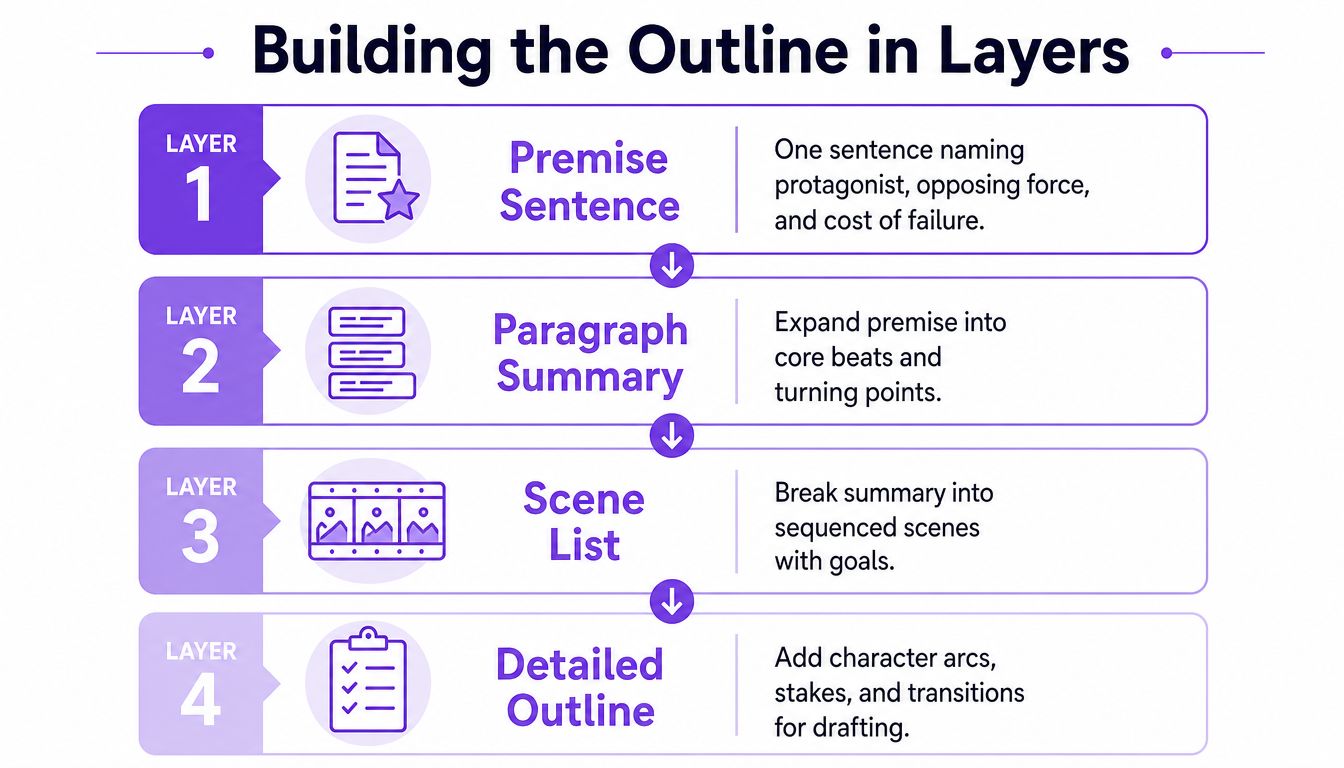
Start with a one-sentence premise. Name the protagonist, the opposing force, and the cost of failure. If the sentence can't identify those pressures, it isn't a premise yet. It's atmosphere.
Expand that sentence into a paragraph covering setup, escalation, midpoint reversal, and resolution. Then expand each sentence of that paragraph into its own paragraph. You're moving from the idea's spine to the major movements that will carry the book. This layered process follows the Snowflake-style expansion sequence, which moves from a sentence to a paragraph, then broader development, character work, and scene planning.
Don't stop at the act sketch
The common stopping point is the act-level summary. It's useful for discussing the book, but it's too vague for drafting. Push each major paragraph into scenes, and give every scene a distinct purpose, pressure, and consequence.
A scene list should show the sequence, not merely the ingredients. A practical chapter entry often works well at 100 to 300 words, enough to capture purpose, point of view, key events, emotional movement, and the ending without turning the outline into finished prose, as described in this chapter-outline guidance.
Your detailed outline can live in a spreadsheet, Scrivener, index cards, or a plain document. The format matters less than whether every scene becomes a row you can revise. Writers who want a broad introduction to premise generation before committing to a structure can also use this starryai AI story guide as a brainstorming resource.
The outline is now an artifact you can interrogate for months. That's the point.
Scene Entries That Actually Link
A scene entry doesn't need to become a miniature chapter. It needs to expose the causal machinery. The most useful version has five fields.
| Field | Purpose |
|---|---|
| Viewpoint character | Establishes whose perception and knowledge govern the scene |
| Location and time | Fixes physical position, date, hour, and elapsed time |
| Scene goal | Defines what the viewpoint character is trying to achieve now |
| Conflict or obstacle | Names the person, fact, condition, or doubt blocking that goal |
| Exit state | Records what changes in knowledge, ownership, emotion, belief, or circumstance |
The viewpoint field prevents accidental access to information the character couldn't perceive. Location and time prevent impossible travel and contradictory geography. The goal keeps the scene from becoming decorative. The obstacle gives the scene resistance instead of vague unease.
The exit state does the essential work. If Lena enters the archive looking for a birth record and leaves with proof that the record was altered, the next scene shouldn't begin as if she's still searching for the document. It should begin under pressure created by that discovery. Someone must respond to it, hide it, challenge it, or act before Lena can use it.
Build pressure forward
One source reduces a scene outline to viewpoint, goal, conflict, turning point, and outcome, with the outcome creating the pressure, choice, or information that launches the next scene. That cause-and-effect principle is more useful than a page of atmospheric notes. You can see a related distinction between scene movement and aftermath in Novelium's scene and sequel glossary.
Read the scene list without opening the manuscript. You should be able to follow pressure as it compounds. If the entries read like disconnected events, the outline has recorded sequence but not causality.
Where Manuscripts Quietly Break
Drafts rarely collapse at the climax. The visible failure usually starts earlier, in the middle, where small continuity errors pass unnoticed because each individual scene still sounds plausible.
Consider a simple calendar break. A chapter is labeled Monday. The following scene opens on Tuesday morning, but a character refers to an event from that Tuesday as though it happened earlier the same day. The prose may not announce the error. The outline will, if it records date and hour rather than relying on chapter labels.
The missing field is obvious in retrospect: a timestamp for every scene. Without it, the writer can't calculate elapsed time, and the manuscript invents a day.
A knowledge violation is more damaging because it makes a character appear clairvoyant. A side character apologizes for information they were never shown receiving. The writer remembers the revelation because they created it, then unconsciously gives that knowledge to everyone in the cast.
What the outline failed to record
The scene entry needed a knowledge-at-start field. It should have stated what the side character knew before entering, what they learned during the scene, and what remained withheld. Without that record, revision depends on memory, and memory is unreliable across a long draft.
These aren't merely typos. They're failures of state tracking. A character can have the correct name, age, history, and personality profile while still behaving inconsistently because the profile never records what changed between scenes.
A character profile describes who someone is. A tracking system records what has happened to them.
Good entries act as tripwires. They expose the Monday-to-Tuesday slip, the unexplained apology, the missing knife, the injury that disappears, and the relationship that jumps from suspicion to intimacy without an intervening change.
Turning the Outline Into a Continuity Check
A working outline earns its place after drafting begins. Use it as a verification tool, running each chapter against the relevant scene entries instead of rereading the manuscript and waiting for contradictions to surface.
Check four axes. Timeline records the day, hour, sequence, travel, and elapsed time. Knowledge confirms that each character acts only on information available to them. Physical state tracks injuries, locations, clothing, possessions, and object positions. Relationships records shifts in trust, allegiance, resentment, obligation, and emotional debt.
| Axis | What You Verify | Source Field in Scene Entry |
|---|---|---|
| Timeline | Date, hour, travel, elapsed time | Location and time |
| Knowledge | What each character knows at scene start and exit | Viewpoint and knowledge notes |
| Physical state | Injuries, possessions, position, clothing, object location | Exit state |
| Relationships | Changes in trust, allegiance, conflict, or obligation | Exit state and conflict |
Place the relevant scene entries beside the draft chapter. Compare the previous scene's exit state with the current scene's opening condition, then compare the current exit with the next scene's pressure. Keep style out of this pass. The question is whether the manuscript still obeys its recorded facts.
Make the pass mechanical
A targeted continuity pass beats a general reread. Continuity guidance recommends checking elapsed time, timeline, character knowledge, physical state, and relationships, as covered in Novelium's consistency check glossary. Maintain concrete records for names, traits, geography, objects, and plot facts in a story bible or notes. The continuity revision checklist describes this focused approach in practical terms.
For a long manuscript, search the draft against those records. Search every mention of the heirloom, each reference to the injury, and every scene involving the hidden room. Confirm when the object changed hands and when the character learned the truth. Memory will not protect the draft from errors you introduced several chapters earlier.
Dedicated manuscript tools can support this work. Novelium automatically extracts and tracks character details across manuscripts, including traits, knowledge states, relationships, events, and continuity conditions. It suits writers who need systematic tracking rather than another static questionnaire.
Update the outline whenever a draft scene changes direction. Revise its exit state, the pressure entering the next scene, and any affected timeline, knowledge, physical, or relationship record. The outline then remains a living control document, testing the manuscript chapter by chapter instead of becoming abandoned planning material.
How Much Outlining Is Enough
The mistake isn't under-outlining or over-outlining. It's treating the outline as a fixed deliverable that must be completed before writing and never touched again.
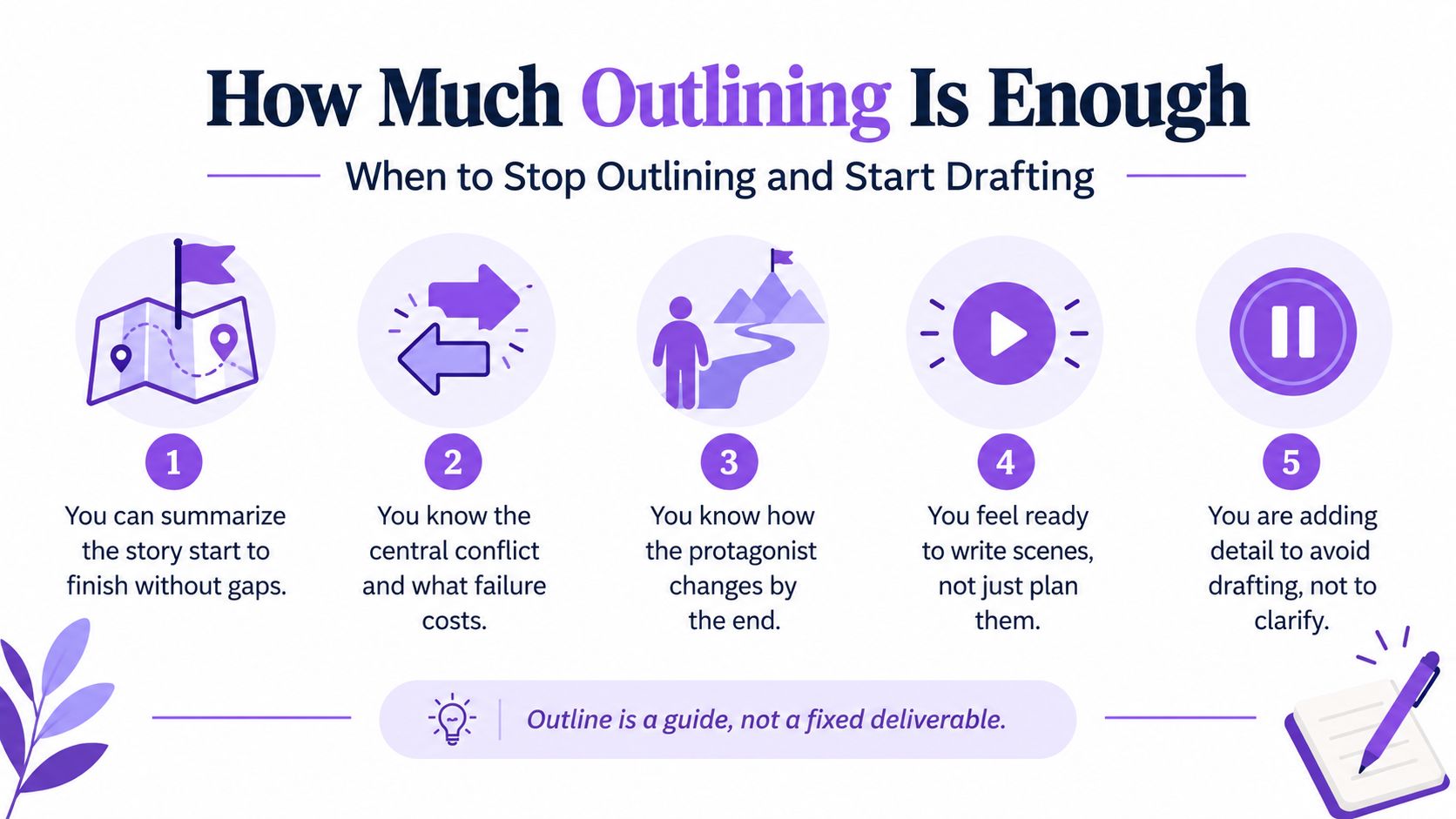
Start drafting when every planned scene has an outcome, a next-scene pressure, a timestamp, and a clear knowledge state for each relevant point-of-view character. You should also be able to trace the pressure feeding the inciting incident, midpoint reversal, and climax. If the scene list still contains blank transitions, you're not preserving discovery. You're postponing structural decisions.
Stop expanding when additional detail only restates what you already know. A four-stage progression from premise to paragraph, expanded synopsis, and scene planning gives you a useful model for solving structure in layers, as described in Novelium's novel outlining workflow. The practical threshold is reached when the outline can prevent contradictions without dictating every sentence.
Keep revising the ledger
When a draft scene changes direction, update its entry immediately. Change the exit state, adjust the pressure entering the next scene, revise the timeline, and run the four-axis check again. A flexible outline protects discovery because it records the consequences of discovery.
Writers often describe themselves as plotters or pantsers, but the useful distinction is whether the manuscript's changing facts remain visible. That debate is more productive when framed as a workflow choice rather than an identity, as discussed in this comparison of plotters and pantsers.
An outline that survives a full draft doesn't predict every surprise. It preserves the chain of consequences after the surprise arrives. Build that document, update it as the story changes, and stop asking a static character profile to perform a tracking system's job.
Novelium's Character Tracker and World Codex automatically extract and track character details, knowledge states, relationships, objects, and events across your manuscript. Visit Novelium to check whether your draft's continuity can survive the next chapter before your readers find the break.