What Is Pacing in a Story: A Guide for Novelists
The most popular advice about pacing is also the least useful: make the story faster. That instruction sends experienced writers into sentence surgery, where they cut description, shorten paragraphs, and remove every quiet beat, only to discover that the manuscript now feels breathless rather than compelling.
So, what is pacing in a story? It isn't the speed of events. It's the rate at which a narrative seems to unfold, shaped by the delivery of events, revelations, questions, reflection, and emotional consequence. A chapter can cover years in a paragraph, or minutes across many pages. Neither choice is automatically fast or slow. The core question is whether the relationship between story time and narrative time creates the reader experience you intended.
That distinction becomes more important as a manuscript grows. In an 80,000-word novel, a pacing problem often hides inside continuity problems, misplaced knowledge, repetitive scenes, or chapter endings that don't create forward pull. Writers managing series casts and interlocking timelines need more than a vague sense that a section “drags.” They need a way to see what the narrative is doing.
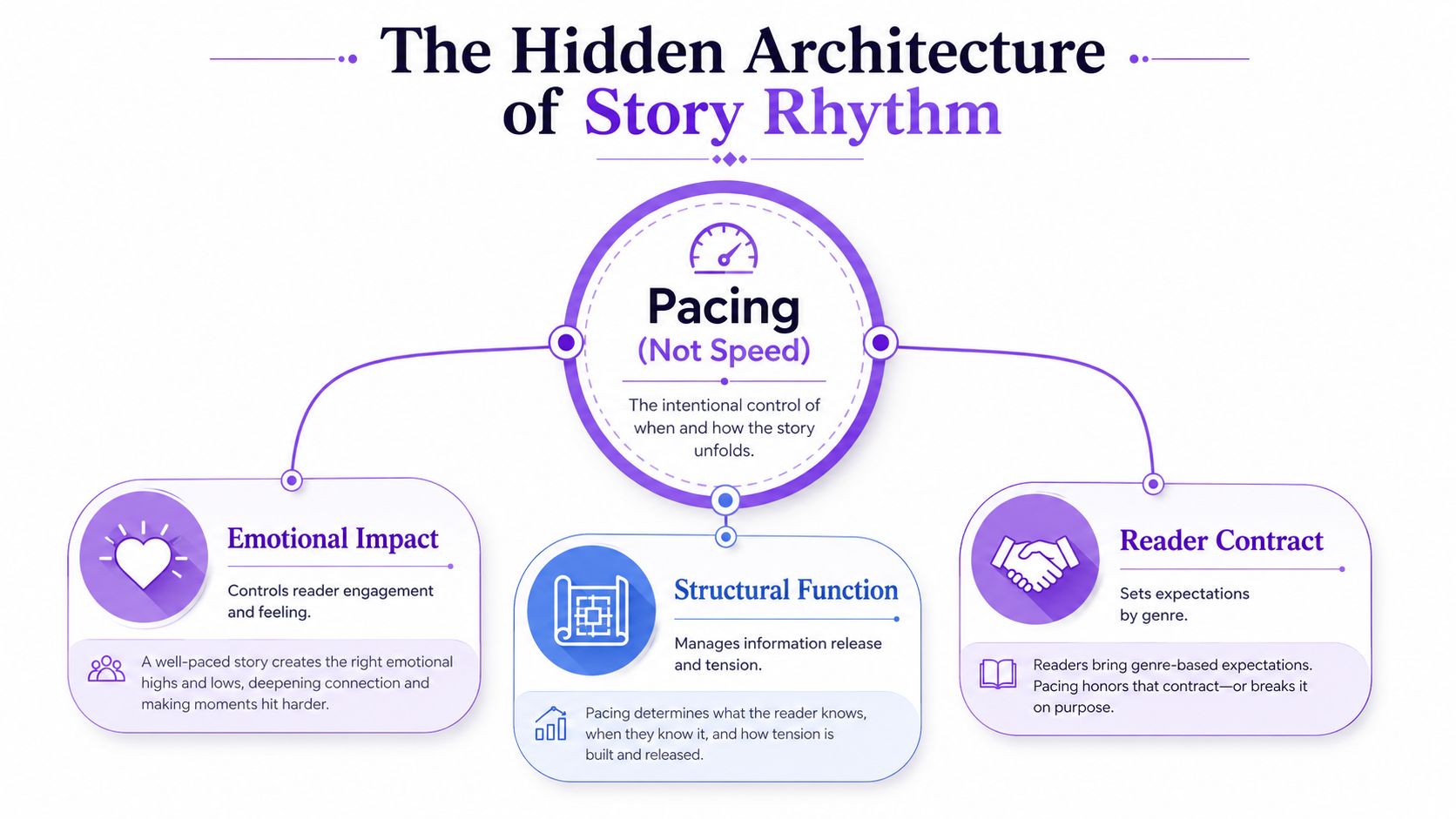
The Hidden Architecture of Story Rhythm
Pacing is not a synonym for speed. It's a structural relationship between story time and narrative time, and it governs how readers spend attention. A chapter covering ten years in summary may feel dense because it delivers important emotional change, while a chapter covering ten minutes in scene may feel sluggish because the characters circle information the reader already understands.
Modern narratology gives this relationship useful names. Gérard Genette's framework distinguishes four tempo effects, scene, summary, pause, and ellipsis. Scene occurs when narrated time and story time feel roughly equal. Summary compresses a longer span, pause stops story time while narration continues, and ellipsis skips a period altogether. This framework is discussed in the scholarly account of pacing and narrative tempo at Princeton's narrative studies repository.
Attention is the real material
The practical consequence is sharp. Pacing controls how long readers remain inside an event, how quickly they receive usable information, and how much space they have to interpret an emotional beat. Fast prose doesn't guarantee momentum. Momentum comes from meaningful change, unanswered questions, and a controlled release of information.
A scene can contain fighting, travel, and urgent dialogue yet read slowly if nothing changes in the reader's understanding. Conversely, exposition can feel propulsive when every paragraph answers one question while creating another. That's why line-level trimming often fails. The problem lives in the arrangement of narrative modes, not merely in sentence length.
Editorial rule: Diagnose the time relationship before you edit the wording.
In manuscript analysis, character tracking matters. If a character suddenly acts on information they haven't learned, the scene may feel confusing rather than fast. If a revelation arrives before the emotional groundwork exists, the chapter can feel rushed even when its prose is measured. A working definition of rhythm in prose helps separate sentence music from the larger movement of the narrative.
Understanding Scene Versus Summary Tempo
Scene and summary are not opposing quality levels. They're different tools for controlling narrative distance. Scene lets the reader experience an interval moment by moment. Summary compresses duration, often to move the story across travel, routine, historical change, or repeated activity without spending pages on material that doesn't deserve close attention.
The other two tempo effects complete the system. Pause expands narration while story time stops, as in reflection, description, or analysis. Ellipsis removes story time from the page, allowing the narrative to jump over an interval and resume when something relevant has changed. Long novels need all four because no reader wants every commute, meal, recovery period, or ordinary conversation dramatized in full.
Gingrich's quantitative method measures narrative speed by comparing the amount of story time covered with the pages required to narrate it. The scholarly discussion gives Proust's Combray as an example, where about ten years of story time are represented across 140 pages in the academic review of Gingrich's work. The point isn't that Proust provides a target ratio. It's that a single novel can move through radically different temporal densities without losing coherence.
Where long manuscripts break
Most pacing failures in complex drafts happen at the transitions. A writer begins a climactic confrontation in scene, then switches into summary to explain what the protagonist realizes. The event technically continues, but the reader loses the moment of discovery. The reverse creates a different problem: an author dramatizes every small movement during a transition that should have carried the reader quickly toward the next consequential scene.
Track the mode at the scene level. Mark whether each unit is primarily scene, summary, pause, or ellipsis, then compare that mode with the scene's function. A reveal usually needs enough scene-time for the reader to register its implications. A period of investigation may benefit from summary, provided the summary includes changed knowledge, escalating risk, or a consequential result.
This is also why a scene and sequel distinction helps at scale. The scene delivers action and consequence. The sequel processes the result and prepares the next decision. Confusing the two produces chapters that either sprint past emotional consequences or linger in reflection after the story has already moved on.
The Metrics of Reader Experience
A chapter that feels slow usually leaves measurable traces. Track how much narrative time each passage covers, how many words the draft spends on it, and whether the reader receives new information, emotional change, or a changed choice. These measures expose pacing problems more reliably than a general impression of “speed.”
Use compression as a diagnostic. Rewrite the same act in 10 words versus 100 words. The short version isolates the event's causal skeleton. The longer version shows where emotional texture, sensory detail, and explanation enter. Compare the two versions, then decide which moments require dramatization, which can remain in summary, and which add no change at all. Vary sentence length around the decisive action, using tighter rhythm to build pressure and more space for the beat that needs to register, as described in its pacing guidance.
Measure the reading experience
A read-aloud pass gives the draft a second diagnostic. Time a chapter, calculate its minutes per page, and compare that result with the chapter's intended emotional function. Fast chapters may read at under one minute per page, while contemplative chapters may approach 1.5 minutes per page. Treat those figures as warning lights, not laws.
If a pursuit takes longer to read than the reflective chapter beside it, inspect long explanations, repeated reactions, and conflict that pauses while characters process obvious information. If a grief scene uses the same clipped rhythm as an escape, the event may remain clear while its emotional weight disappears.
At manuscript scale, add two tracking columns: narrative time covered and reader time spent. A chapter covering three months in summary may be functioning well, while a paragraph that spends a page on one unchanged observation may be consuming attention without advancing either the timeline or a character's state.
| Intended effect | Watch for | Likely adjustment |
|---|---|---|
| Urgency | Dense explanation and delayed action | Compress setup and sharpen sentence rhythm |
| Revelation | Summary where discovery should land | Return the decisive beat to scene |
| Reflection | Repeated thoughts without changed understanding | Keep it only if it alters a choice |
| Transition | Detailed logistics with no consequence | Use summary or ellipsis |
Metrics support judgment; they do not replace it. They show where to inspect before beta readers describe a chapter as “weird” without identifying why.
Pacing Across Genre and Structure
Genre establishes a reader contract, but it doesn't dictate one permanent speed. Thriller readers generally expect rapid escalation and strong chapter pull. Romance can tolerate more elastic movement when the narrative is building intimacy. Immersive speculative fiction often needs slower passages to establish rules, culture, and physical reality.
The mistake is treating those expectations as sentence-level commands. “Use short sentences” can make a tender scene sound panicked. “Cut every slow scene” can remove the breathing room that makes a thriller's next escalation hurt. Pacing has to match both genre and emotional beat.

Calibrate rather than flatten
Map intensity across scenes, not just chapters. Give each scene a qualitative label such as low, moderate, high, or peak intensity, then check the sequence for unwanted flatness. A novel made entirely of peak scenes exhausts the reader. A novel that spends too long at moderate intensity feels polite when it should feel dangerous.
Sentence length supports that design but doesn't create it alone. Short sentences can increase immediacy during pursuit or confrontation. Longer syntax can carry reflection, layered perception, or complicated explanation. The decisive question is whether the sentence rhythm supports the information flow.
A quiet scene earns its place when it changes what the reader understands, wants, fears, or expects.
Chapter endings deserve their own pass. Endings don't need explosions. They need forward pull, which can come from a new question, a changed relationship, an impossible choice, or information that makes the previous scene mean something different. This is the part generic speed advice misses. Pacing depends on what the reader carries into the next chapter.
The same principle applies when you study a broader five-act structure. Structural labels matter only when they help you judge the pressure and release of the actual reading experience.
For a concise explanation of how plot movement and reader momentum interact, these story pacing techniques offer a useful companion resource. Use them as diagnostic prompts, not as a substitute for the manuscript's particular rhythm.
Act-by-Act Pacing Strategies
A macro audit catches problems that scene editing can't. A widely used three-act model places Act 1 at roughly the first 25%, Act 2 across the middle 50%, and Act 3 in the final 25% of the story in this overview of story structure. Within that shape, the inciting incident ends the setup, the midpoint introduces a reversal or revelation that changes direction, and the climax compresses the final stretch into the highest-tension sequence.
Treat those proportions as a map, not a mechanical template. The useful question is what each act is doing to the reader's expectations. Act 1 should create a trajectory rather than merely display the world. Act 2 needs variation, because sustained escalation without recovery becomes noise. Act 3 should narrow options and increase consequence until the climax feels unavoidable.
Audit the middle
The second act is where long manuscripts commonly lose pressure. Chapters may contain attractive scenes, substantial character work, and excellent prose, yet fail to alter the story's direction. Read each chapter as a discrete event and write down what changed by its end. If the answer is “the reader learned more about the same problem,” the chapter may need a sharper consequence or a more consequential exit.
Track both scene movement and summary movement. Summary can bridge months of investigation or relationship change, but it should not conceal a missing turning point. Scene can dramatize confrontation, but it shouldn't repeatedly stage the same argument with different furniture.
Genre changes the acceptable pattern. A thriller may require frequent reversals and cliffhanger pressure. A romance may slow around emotional recognition, then accelerate when commitment becomes risky. A speculative novel may spend more time in immersive explanation, but the explanation still needs to affect choices and future possibilities.
Audit question: Does this chapter move the story forward, or does it only prove that the story is still happening?
That distinction protects quiet writing from needless cutting while exposing narrative circling. Pacing isn't a demand for constant action. It's a demand for purposeful movement.
Tools for Pacing Analysis and Refinement
Manual pacing analysis works until the manuscript becomes large enough to defeat memory. In a complex novel, you're tracking scene mode, timeline, character knowledge, relationships, recurring objects, and chapter exits at the same time. A spreadsheet may record facts, but it rarely shows how those facts interact with narrative rhythm.
The most useful system separates character development documentation from character tracking. A development document describes who a character is, what shaped them, and how you expect them to change. A tracking system records what they know, believe, possess, conceal, and can physically do at each point in the manuscript. The second system evolves as the draft evolves.
Track state, not trivia
A profile that says a detective is observant won't prevent a continuity error. A tracking record can flag that the detective identifies a suspect before receiving the photograph, that a character uses a broken wrist normally in a later chapter, or that someone refers to a conversation they never witnessed. These aren't cosmetic mistakes. They disrupt the reader's causal understanding, which makes pacing feel unstable.
The same method applies to time. Record when an event occurs, what follows it, and which characters have access to the resulting information. A Monday-to-Tuesday slip, an impossible journey, or a deceased character reappearing can force readers to stop and repair the story in their heads. Once that happens, momentum has been spent on continuity repair instead of anticipation.

Novelium is one option for this workflow. Its Character Tracker and World Codex extract and track details across a manuscript, including character traits, knowledge states, relationships, events, and timeline information. Its pacing analysis presents scene-by-scene rhythm, while local processing, encrypted storage, and no training on your work address privacy concerns for writers working with unpublished drafts.
The overlooked pacing question is not only how quickly events happen. It's whether scene-time and story-time are aligned with the intended effect, and whether chapter endings create forward pull, a distinction emphasized in this discussion of pacing in fiction. Run that check after structural revisions, not only at the final copyedit. Profiles should change when scenes change, because the manuscript's current state is the only version readers will experience.
Novelium's Character Tracker and World Codex help you monitor character knowledge, relationships, timeline events, and continuity across complex manuscripts, while its pacing analyzer exposes scene-level drags and rushed passages. Visit Novelium to inspect your draft's narrative rhythm before continuity errors and stalled chapters reach your readers.