What is developmental editing: A Pro-Writer Guide to Elevate Your Novel
You’ve finished the manuscript. You know the story, you know the craft, but the term developmental editing still feels... fuzzy. What is it, really, for a novelist who isn't a beginner?
Think of it as the architectural stress test for your novel's foundation. It’s where you and an expert partner examine the core components—the plot, the character arcs, the pacing, the very soul of the story—long before you start polishing a single sentence.
What Is Developmental Editing, Anyway?
Let’s be clear about what this isn't: it’s not a souped-up beta read or a nit-picky line edit. For a career novelist, a developmental editor is like an engineer reviewing the blueprints of your novel, making sure the whole structure can actually support the weight of the story you're trying to build.
This is the single most important step in the entire editorial process. It’s a diagnostic tool that gets right to the heart of your story, identifying potentially fatal flaws before they can cost you an agent, a book deal, or a launch that falls flat. We're talking about the big stuff: a sagging second act, a climax that feels unearned, or a protagonist whose motivations just don't add up across 100,000 words.
Where Does It Fit in the Editorial Hierarchy?
The editing journey has a natural order, moving from the 10,000-foot view down to the microscopic details. Developmental editing always comes first. It’s the foundational work that makes everything else possible.
This flowchart shows exactly where it sits in the production workflow, starting with the big-picture blueprint and ending with the final, polished book.
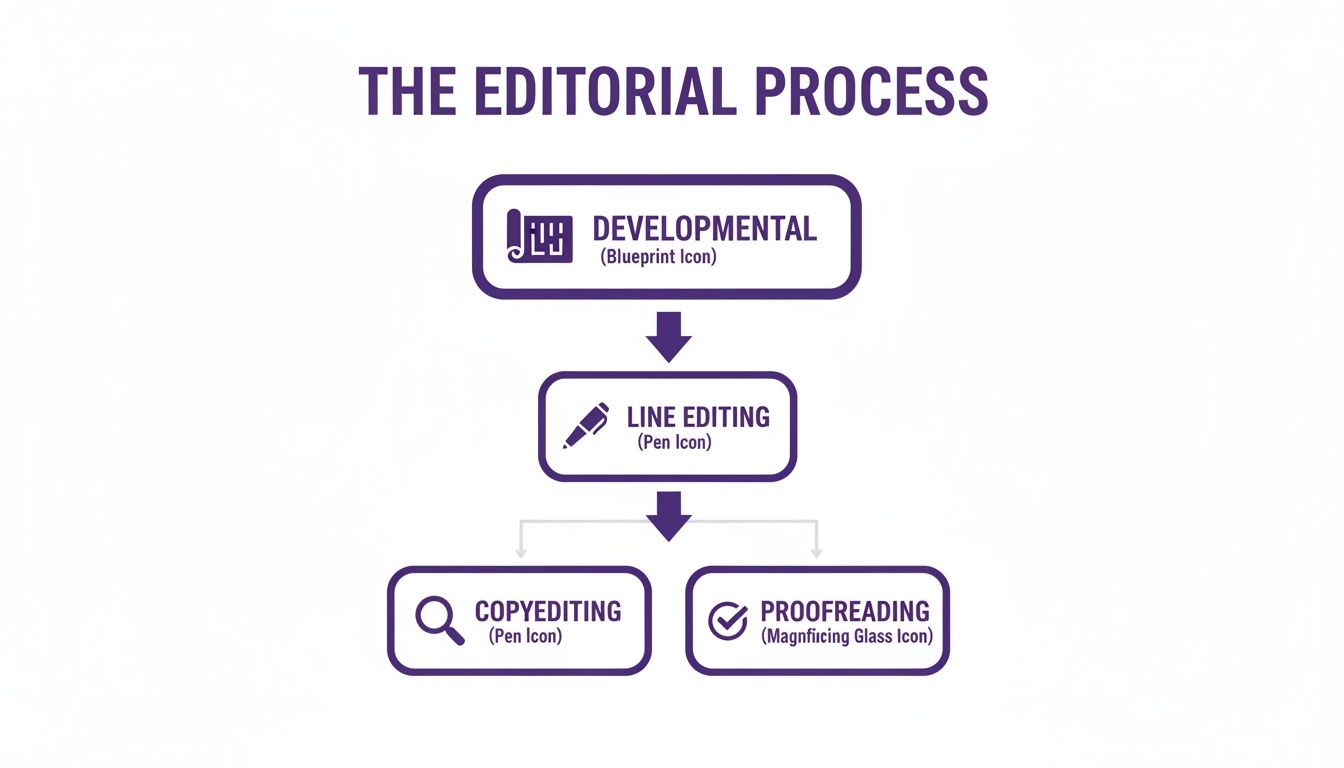
Each stage builds on the one before it. Trying to line edit a manuscript before the developmental work is done is like arguing over paint swatches while the foundation of the house is still cracked. It just doesn't make sense.
From Blueprint to Polish
To really grasp what a developmental editor does, you have to separate their job from the other, more granular types of editing. Most writers are familiar with copyediting and proofreading, which are all about correctness at the sentence level. Developmental editing is a whole different beast—it operates at the macro level of story mechanics.
Here’s a quick breakdown to show how the focus shifts from the big picture to the tiny details.
The Editorial Process From Blueprint to Polish
| Editing Type | Core Focus | Central Questions It Answers |
|---|---|---|
| Developmental Editing | Structure and Story (The Blueprint) | Does the plot hold together? Is the character arc satisfying? Are the stakes meaningful? Is the pacing effective? |
| Line Editing | Prose and Style (The Interior Design) | Is every sentence impactful? Does the author's voice resonate? Is the tone consistent? |
| Copyediting | Grammar and Mechanics (The Inspection) | Are there grammatical mistakes? Is punctuation correct? Are there continuity errors in details? |
| Proofreading | Final Polish (The Final Walkthrough) | Are there any typos or formatting errors before publication? |
This distinction is everything. A developmental editor isn't going to fix your commas. They are going to tell you that the entire third act falls flat because your antagonist's motivation is a mystery wrapped in an enigma.
This is about high-level, story-level problem-solving, not sentence-level perfection. The goal is a structurally sound, emotionally resonant narrative that’s ready for the next stages of refinement.
Why a Developmental Edit Carries the Highest Price Tag
Let's get straight to it: sticker shock is real. When an author gets their first quote for a developmental edit, seeing a number in the thousands can be a gut punch. This isn't some arbitrary price gouging. It’s a direct reflection of the analytical weight, the intellectual heavy lifting, and the sheer time involved in deconstructing an entire narrative universe.
A copyeditor works with a defined set of rules. A line editor refines the prose you've already written. But a developmental editor has to hold your entire story—its past, present, and all its potential futures—in their head at once. They're stress-testing the very logic of your world.
The Cost of Cognitive Labor
Think about the mental load here. The editor reads your book once, purely as a reader, just to get a feel for the story and experience it as intended. Then they read it all over again, but this time it's slow, methodical work, involving extensive notes and mapping the story's architecture.
This second pass means tracking every character's knowledge and state of mind, charting the plot's chain of cause-and-effect, and weighing the pacing of every single scene. They aren't just reading words on a page; they're reverse-engineering your entire creative process to find the hairline fractures in the foundation.
A developmental edit isn't about marking up your manuscript. It's about delivering a strategic blueprint for revision. The price reflects the weeks of deep analytical work required to create that roadmap, not just the hours spent reading.
After all that deep reading comes the synthesis. The editor then spends days, sometimes a full week or more, just distilling thousands of individual data points into a coherent, actionable editorial letter. That letter is the product you’re paying for.
The Financial Reality
The numbers back this up. The Editorial Freelancers Association (EFA) places typical hourly rates for this work between $50-$70, with per-word rates landing around $0.03-$0.06. It easily makes developmental editing the most expensive stage.
Data from Reedsy's freelance marketplace shows that 20% of developmental edit projects top $1,500. For longer, more complex manuscripts over 150,000 words, these costs frequently climb past $2,000—about double what you’d expect for a standard 75,000-word novel. You can dig into more insights about freelance editor rates from Publishing Perspectives, who have analyzed these trends in depth.
The Opportunity Cost of Skipping It
The upfront cost is significant, no question. But the opportunity cost of skipping this stage can be staggering. In the world of traditional publishing, agents and acquiring editors have zero appetite for "project" books that need a massive structural overhaul. A manuscript with a fundamental plot hole or a flat character arc is an easy pass. You really only get one shot.
For indie authors, the stakes are just as high, if not higher. You are the publisher. A story with deep, unresolved structural problems is exactly what fuels the one-star reviews that can kill a book's sales momentum right out of the gate. No amount of pristine grammar can save a story that just doesn't work.
A developmental edit isn't an expense. It's a direct investment in your novel’s market viability. It’s the professional due diligence required to ensure your story has the structural integrity to succeed, whether success is a publishing contract or a dedicated readership that eagerly awaits your next book. You’re not just paying for corrections; you’re paying for architectural assurance.
What a Developmental Editor Actually Delivers
If you’re picturing your manuscript returned to you, bleeding with red ink on every page, you're thinking of a copyeditor. That’s a different beast entirely. A developmental editor’s main deliverable isn't about correcting commas; it’s the editorial letter.
Think of this letter as a strategic roadmap for your revision. It's a multi-page, high-level diagnosis of your story’s structural health, the kind of feedback that changes the bones of your book, not just its clothes.
This letter is the end result of an intense, analytical read-through. The editor isn't just a reader; they're a narrative architect, deconstructing your story to see if the foundation can actually hold the weight you've put on it. What you get back is their expert opinion on what’s working, what's broken, and—most crucially—why.
The Anatomy of an Editorial Letter
A good editorial letter connects the dots. It won’t just point out a problem; it will show you how a seemingly small character choice in Act One creates a domino effect that makes your climax feel flat and unearned. The focus is always on the story's engine, not the paint job.
You won't find notes like, "This sentence is awkward." Instead, you'll get actionable, cause-and-effect analysis.
- Plot and Structure Diagnosis: This is the 30,000-foot view. Is the narrative arc sound? Does the inciting incident kick things off properly? They’ll flag a sagging second act where the tension just evaporates, or a climax that feels emotionally hollow because the setup was weak.
- Pacing and Tension Analysis: This is all about momentum. An editor will pinpoint the scenes or whole sections that are killing your story’s pace. Maybe it’s a poorly placed info-dump right when the action should be ramping up, or a string of low-stakes chapters that lets the reader's attention drift just before a huge twist.
- Character Arc and Consistency: Here, the editor digs into the emotional and logical journey of your characters. They'll find the contradictions, like a hero whose core motivation in chapter two is completely forgotten by chapter twenty, making their big decisions feel random and unbelievable.
A great editor isn’t there to rewrite your book for you. They’re the architect pointing out that a load-bearing wall is in the wrong place, giving you the blueprint to fix it yourself while keeping your voice intact.
Concrete Examples of Developmental Feedback
Let's make this real. A beta reader might tell you, "I got bored in the middle." That's a symptom. A developmental editor gives you the diagnosis.
A developmental editor will say, "The middle section sags because the antagonist disappears for 75 pages, which removes the central conflict's pressure. The protagonist is left reacting to minor subplots, lowering the stakes and killing the narrative drive."
See the difference? One tells you something is wrong. The other tells you how to fix it. The diagnosis points straight to the solution: you need to reintroduce the antagonist's influence—directly or indirectly—to keep the pressure on.
Here are a couple more examples of what you should expect:
Instead of: "The ending felt rushed."
You get: "The final confrontation lacks emotional weight because the hero acquired the key information needed to defeat the villain off-screen two chapters ago, rather than through a climactic struggle. This robs the reader of a hard-won victory."
Instead of: "I don't understand why she did that."
You get: "The protagonist’s choice to betray her mentor in Chapter 15 contradicts her established character trait of unwavering loyalty. We need a scene before this moment that seriously challenges this loyalty, providing the groundwork for this pivotal—and currently unearned—character turn."
This is the deep, structural insight you’re paying for. It's not about catching typos; it’s about identifying missed opportunities and logical flaws in your story's DNA. The goal is to hand you a clear, actionable plan to transform your draft from finished to unforgettable.
How to Prepare Your Manuscript for a Deeper Edit
Sending a messy first draft to a developmental editor is like asking an architect to evaluate a building from a coffee-stained blueprint. They'll spend half their time—and your budget—flagging basic continuity errors and timeline snags instead of tackling the deep narrative mechanics that actually matter.
Think of it as clearing out the "narrative static." This is your job. You have to hunt down the characters who know things they haven't learned yet, the timelines that don't add up, and the objects that appear and vanish between scenes. A professional-level consistency pass isn't optional; it's essential.

Cleaning up these foundational issues first elevates the entire conversation with your editor. You move past fixing simple mistakes and into strengthening your story's emotional core.
The Classic Character Profile Is a Trap
We all know the classic character profile. You’ve probably filled out dozens of them—eye color, favorite food, childhood trauma. But for a professional author, this is a trap. These are static documents. They capture a character at a single point in time and fail spectacularly at tracking what matters most in a complex narrative: their state.
We've analyzed countless manuscripts where the core problem wasn't a weak character concept, but a failure to track their evolution. A character's knowledge, emotional state, and physical condition have to change based on what happens scene-by-scene. A static profile can't tell you if your protagonist still remembers that vital clue from Chapter 3 when they reach the climax in Chapter 30.
This is the critical difference between a "character development" document and a true character tracking system. Development is backstory. Tracking is the live, moment-to-moment record of a character's journey through the manuscript. For a professional novelist, especially one writing a series, the latter is non-negotiable.
What You Should Actually Be Tracking
So, forget listing your character’s favorite color. Instead, focus on the dynamic data points that actually cause continuity breaks when they go unchecked. These are the details that, when wrong, shatter a reader's immersion.
Your pre-edit audit should focus on three main areas:
- Knowledge State: What does this character know, and when did they learn it? A character can't act on information they don't have. We constantly see characters referencing events they weren't present for—a simple but fatal consistency error.
- Physical State and Inventory: What injuries are they nursing? Are they still carrying the sword they picked up three scenes ago, or did it just vanish? Tracking these physical details prevents miraculous recoveries and disappearing objects.
- Timeline and Location: Where is the character, and what day is it? This seems basic, but timeline snags are rampant. A character can't be in two cities at once, and events have to follow a logical sequence.
By focusing your prep work on these dynamic elements, you clear the board of fundamental errors. This allows your editor to dedicate their expensive time to the high-value feedback you're actually paying for. It’s a crucial step, and you can explore more about what makes a great story with effective novel writing software.
The goal of a pre-edit pass is to solve the objective problems so your editor can focus on the subjective ones. They should be wrestling with your thematic resonance, not your broken timeline.
This level of preparation is fast becoming the industry standard. Why? Because a growing market of savvy authors understands its value. The global book editing market is projected to hit a $500 million valuation by 2025, largely because self-published authors know that this deep, professional polish is what separates a breakout hit from a book that vanishes into obscurity.
When you deliver a clean, consistent manuscript, you aren't just making your editor's job easier. You're ensuring your financial investment yields the deepest possible narrative insights.
Using Manuscript Intelligence to Sharpen Your Draft
This is where the human element hits its limit. A developmental editor is a master of story analysis—they can dissect theme, voice, and emotional resonance like nobody’s business. But even the sharpest mind is fallible when tracking thousands of tiny details across a 120,000-word manuscript.
Expecting your editor to catch every timeline snag or character inconsistency is like asking a master architect to personally inspect every single nail in a skyscraper. It’s not just impossible; it’s a massive waste of their talent.
Thankfully, we now have technology that gives us a crucial advantage by automating the meticulous consistency audit that has to happen before any serious developmental edit can begin. It’s about offloading the grunt work of objective error-checking from a human brain to a system built for that exact purpose.
The Automated Pre-Editor
Think of manuscript intelligence as your own private pre-editor. Tools like Novelium essentially read your manuscript to systematically flag the exact continuity errors, plot holes, and timeline mistakes that a human editor would otherwise spend hours—billable hours—hunting down. It’s a force multiplier for your own preparation.
This isn't about story advice or creative feedback. It’s a raw data analysis of your narrative's internal logic. It answers the objective questions so your editor can focus on the much harder subjective ones.
- Who knows what, and when? It tracks character knowledge scene-by-scene, flagging those moments where a character mysteriously acts on information they haven’t actually received yet.
- Does the timeline hold up? It maps out your story’s timeline, catching impossible sequences like a character traveling between cities faster than physics allows or a week that somehow has two Tuesdays.
- Is the pacing intentional? It can spot pacing imbalances, showing you exactly where a long string of slow, introspective chapters might be killing the story’s momentum right before a major plot point.
When you process your manuscript with this kind of tool first, you completely change the nature of the conversation with your editor.
The goal is to elevate the feedback you receive. Instead of your editor writing, "You forgot this character died in Act One," they can focus their energy on, "Let's refine the thematic parallels between the protagonist's and antagonist's journeys."
From Fixing Errors to Refining Artistry
This level of preparation fundamentally shifts the value you get from a developmental edit. When you hand over a manuscript that is already internally consistent, you free up your editor’s cognitive bandwidth to engage with the story on a much, much deeper level.
They can move beyond fact-checking your world and start stress-testing its soul. Their analysis becomes less about what’s broken and more about what could be brilliant. This is how you get the highest possible return on your investment.
This systematic approach is the difference between a reactive cleanup and a proactive refinement. It’s about using technology to handle the tedious, error-prone task of manual tracking—a process we explain in more detail in our overview of how Novelium's manuscript intelligence works.
Why Spreadsheets and Wikis Ultimately Fail
Look, you’ve probably tried to manage this yourself. The character spreadsheet, the worldbuilding wiki, the color-coded binder—these are the analog tools of a dedicated writer. The problem is they are static, disconnected from the manuscript itself, and demand constant manual updates.
Every time you revise a chapter, your external documentation becomes obsolete. You’ve just created a second, error-prone job for yourself: manuscript writer and continuity bookkeeper. At scale, this system always breaks down. We’ve seen it happen in hundreds of projects.
Automated manuscript analysis solves this by integrating directly with your text. The system reads what is actually on the page, creating a single source of truth that updates with every single revision. It’s not a separate document you have to maintain; it’s a live diagnostic of the story itself. This ensures your prep work is always accurate and allows you to enter the developmental editing phase with confidence, ready for a high-level strategic discussion about making your story unforgettable.
Finding the Right Editor for Your Project
Not every developmental editor is the right fit. An editor who built their career on cozy mysteries is going to miss the specific beats and nuances of your hard science fiction epic. Finding the right editorial partner is a matchmaking process—and it’s one you need to take seriously.

The goal here isn't just to find someone who will make your manuscript different. You need someone whose expertise aligns with your genre and whose feedback style actually empowers you to make it better. That means looking past a slick website and digging into their real-world experience and approach.
Vetting Your Potential Partner
Before you even think about signing a contract, you have to do your homework. Start by looking for professionals through reputable organizations and really sizing up their specific background.
Your vetting process should include these non-negotiables:
- Genre Specialization: Check their portfolio or client list. Have they worked on books like yours? An editor for quiet literary fiction brings a completely different lens than one who specializes in fast-paced commercial thrillers.
- A Sample Edit: This is a deal-breaker. Any serious professional will offer to edit a small piece of your manuscript, sometimes for a small fee. This is your single best tool for figuring out if it's a good fit. Does their feedback resonate? Do they "get" the story you're trying to tell?
- A Clear Contract: Never, ever move forward without a written agreement. It should spell out the deliverables (e.g., a 10-12 page editorial letter), the timeline, the cost, and the payment schedule. Vagueness is a massive red flag.
When Are You Actually Ready?
Let’s be brutally honest for a second. Your manuscript is ready for a developmental edit when you have pushed it as far as your own craft can possibly take it. You need a complete draft. You have to have already fixed the foundational consistency problems you can find on your own.
You’re ready when you’re staring down high-level, strategic questions about whether the story is truly working on an emotional and structural level.
A developmental edit is a professional service for authors preparing a product for the market. It is not a remedy for a messy early draft or a substitute for finishing the book.
Hiring an editor before this point is a guaranteed waste of money. They’ll just spend their time (and your cash) pointing out issues you could have fixed yourself, instead of giving you the deep, architectural insights you’re paying them for.
The Professional Landscape
Understanding an editor's career path can also give you some useful context. Many freelancers build their reputations over years, often gaining experience through platforms like the Editorial Freelancers Association. A typical trajectory involves working with a mix of self-publishers and authors shooting for traditional publication, and eventually handling complex series with a full suite of edits.
While terminology varies—Editors Canada, for instance, often uses the term 'structural editing'—the core function remains the same. The goal is to get trade books ready for a competitive market where publishers expect manuscripts to be nearly ready to go. You can get more insights into the career of a developmental editor here.
Ultimately, finding the right editor is about finding a strategic partner. They are the first professional set of eyes on your work, and their feedback can shape the entire future of your novel. Choose wisely.
Common Questions About Developmental Editing
Even if you’ve been at this for a while, developmental editing can feel like a bit of a black box. You know it’s a critical step, but what exactly happens can be murky. Let’s clear up some of the most common questions we hear from authors navigating this stage.
How Is Developmental Editing Different From a Manuscript Critique?
This is a big one. While both give you that crucial big-picture feedback, a manuscript critique is mostly a diagnostic report. It tells you what’s working and what isn’t, a lot like the editorial letter we talked about earlier. It’s great at flagging the major issues with your plot, characters, or pacing.
A full developmental edit, on the other hand, is usually a much more intensive, collaborative process. It can involve several back-and-forths and a real partnership in figuring out how to fix the problems a critique identifies.
Think of it this way: a critique tells you the foundation is cracked. A developmental edit helps you draw the new blueprint to fix it.
Can I Use Beta Readers Instead of a Developmental Editor?
Beta readers are invaluable. Seriously. They’re your first gut check on the reader’s emotional journey—where they got bored, where they were confused, and what parts made them pump their fists. Their feedback is pure gold.
But they are not a substitute for a professional editor.
Beta readers are great at spotting the symptoms. They’ll say, “I just didn’t connect with this character,” or, “The middle dragged for me.” A developmental editor diagnoses the underlying disease. They’ll explain, “The character’s motivation is inconsistent in the second act, which makes their final choice feel unearned.”
Use beta feedback to understand the what. Hire an editor to understand the why and get a road map for the how. (This is part of a much larger conversation about tools and collaboration in writing, including the ethics of writing with technology).
Beta readers are your audience. A developmental editor is your structural engineer. You need both, but they serve completely different functions.
When Is the Right Time for a Developmental Edit?
Timing is everything, and getting this wrong is an expensive mistake. The sweet spot for a developmental edit is after you have a complete draft that you’ve taken as far as you possibly can on your own. It absolutely has to happen before you even think about line editing or copyediting.
Sending an editor a half-finished manuscript or a messy first draft is like asking an architect to approve the finishes on a half-built house. It’s a waste of your money and their time. Any big structural change your editor suggests will completely undo any sentence-level polish you’ve already paid for.
So, finish the story. Hunt down all the continuity errors you can find. Then, and only then, call in the expert.
The cleaner and more consistent your manuscript is, the more your editor can focus on the high-level story mechanics you're actually paying them to fix. Novelium automates that tedious consistency check, flagging plot holes, timeline tangles, and character contradictions so you can fix them before your manuscript ever hits your editor’s desk. Prepare a smarter draft and get a deeper edit—try Novelium for free.