The Synopsis Isn’t a Sales Pitch. It’s a Structural X-Ray.
Let’s get one thing straight: a book synopsis is not a marketing tool. It’s not a blurb. It’s not an attempt to lure an agent into a story with clever misdirection. Think of it less like a movie trailer and more like a diagnostic X-ray for a literary agent. Its only purpose is to prove your manuscript is structurally sound by revealing its entire narrative skeleton—spoilers and all.
Your Synopsis Is a Blueprint, Not a Billboard

To put it bluntly, the only job of a synopsis is to prove your book works. It’s an architectural blueprint, not a billboard, and you’re writing it for an industry professional who’s evaluating your competence as a storyteller. This is not the place for cute turns of phrase or manufactured mystery.
This document has to lay it all bare: the complete plot, the full character arc, and the definitive ending. It’s how an agent can see if your story’s foundation is solid before they commit to reading 80,000 words. Based on all the manuscripts we've analyzed here at Novelium, the most common—and most fatal—mistake a writer can make is treating their synopsis like a sales pitch.
The Cost of Misunderstanding Its Purpose
Writers who hide spoilers, manufacture mystery, or lean on vague, enticing language are sending up a huge red flag. They're signaling to agents that they don’t understand the submission process. Even worse, it suggests they might not have a coherent story structure to begin with.
That approach almost guarantees a rejection.
An agent doesn’t have time to be teased. They need to see the entire cause-and-effect chain of your plot, from the inciting incident to the final resolution, laid out cleanly. They are looking for proof of concept—proof that you, the author, are a professional story architect who can deliver a satisfying narrative from beginning to end. It's a core distinction that separates serious authors from aspiring ones, and it gets to the heart of how different writers approach their craft. For more on that, you can check out our breakdown of plotters vs. pantsers and their different takes on story structure.
A synopsis that conceals the ending is like a blueprint that omits the foundation. It’s not mysterious; it’s incomplete and signals a critical lack of professional understanding.
At the end of the day, this document isn’t about selling the idea of your book. It’s about demonstrating its successful execution. A spoiler-filled synopsis that clearly articulates your protagonist's journey, their critical choices, and the logical consequences is your most powerful tool. It shows you respect an agent's time and have mastered the craft of storytelling.
Synopsis vs. Blurb vs. Outline: What’s the Difference, Anyway?
Mixing up a synopsis, a blurb, and an outline is one of the fastest ways to get your manuscript tossed aside. It’s a rookie mistake, and a costly one. This isn't just about getting the terms right; each of these documents has a very specific, non-negotiable job in the publishing world.
Think of them as different tools in your writer’s toolkit. You wouldn't use a sledgehammer to hang a picture frame, and you don't send an agent a blurb when they've asked for a synopsis. Let's make sure you’re using the right tool for the job.
The Blurb: Your Book's Movie Trailer
The blurb is pure marketing. It’s that punchy, seductive text you find on the back of a paperback or on an Amazon book page. Its one and only job is to hook a potential reader and make them desperate to know what happens next.
A great blurb is all about asking questions, not giving answers. It teases the core conflict, hints at the high stakes, and under no circumstances does it ever, ever spoil the ending. Its tone is emotional, punchy, and built for curiosity. It’s the movie trailer for your novel; it shows the car chase and the dramatic kiss but cuts away before you find out who lives or dies.
The Outline: Your Private Blueprint
Your outline is the messy, beautiful chaos that lives on your computer and in your head. It’s for your eyes only. This is your private architectural plan, and it can be anything from a sprawling mind map to a 50-page scene-by-scene breakdown or just a few bullet points scribbled on a napkin.
The audience is you, the author. Its purpose is to be the scaffolding you build your story on—the place where you track subplots, nail down timelines, and flesh out character arcs. It can be full of half-baked ideas and notes-to-self. Sending this to an agent is like showing a potential homebuyer the exposed wiring and un-sanded drywall. Don't do it.
The blurb sells the promise of a story. The outline organizes the process of a story. The synopsis proves the integrity of a story.
The Synopsis: The Professional Proof of Concept
And that brings us to the synopsis. This is the complete, spoiler-filled report you write for an industry gatekeeper—an agent or an editor. Its job is to prove that your story actually works. It demonstrates that your narrative is structurally sound from the inciting incident all the way to the final, satisfying conclusion.
This means you must reveal every major plot twist, the climax, and how everything gets resolved. The tone is professional and objective, written in third-person, present tense. You’re not trying to create suspense here; you’re showcasing your competence as a storyteller.
Synopsis vs. Blurb vs. Outline: A Functional Comparison
To really drive the point home, let's break down how these three crucial documents function in the real world. Each has a specific audience, a core purpose, and a completely different set of rules. Internalizing this is fundamental to navigating the submission process professionally.
| Document Type | Primary Audience | Core Purpose | Tone & Style | Spoiler Policy |
|---|---|---|---|---|
| Blurb | Potential Readers | To sell the book by creating intrigue and curiosity. | Punchy, emotional, marketing-focused. Hooks the reader. | No Spoilers Allowed. The goal is to tease, not tell. |
| Outline | The Author (You) | To structure the narrative, track plot points, and organize ideas. | Functional, informal, and as messy or detailed as you need. | All Spoilers. This is your private map; it contains everything. |
| Synopsis | Agents & Editors | To prove the story is well-structured and commercially viable. | Professional, objective, third-person present tense. Clear and concise. | All Spoilers Required. Must reveal the entire plot, including the ending. |
Mastering these distinctions shows an agent you understand the business of publishing. It’s a sign of professionalism that makes them take your submission seriously right from the start.
The Anatomy of a High-Impact Synopsis
A great synopsis isn't just a laundry list of what happens in your book. That's a surefire way to get a rejection. Instead, think of it as an argument. You’re making a case to an agent that your story works—that it’s more than a few cool scenes strung together.
You're proving that your protagonist's journey is not only emotionally powerful but also completely inevitable, driven by a tight chain of cause and effect.
This infographic shows where the synopsis fits in the grand scheme of things.
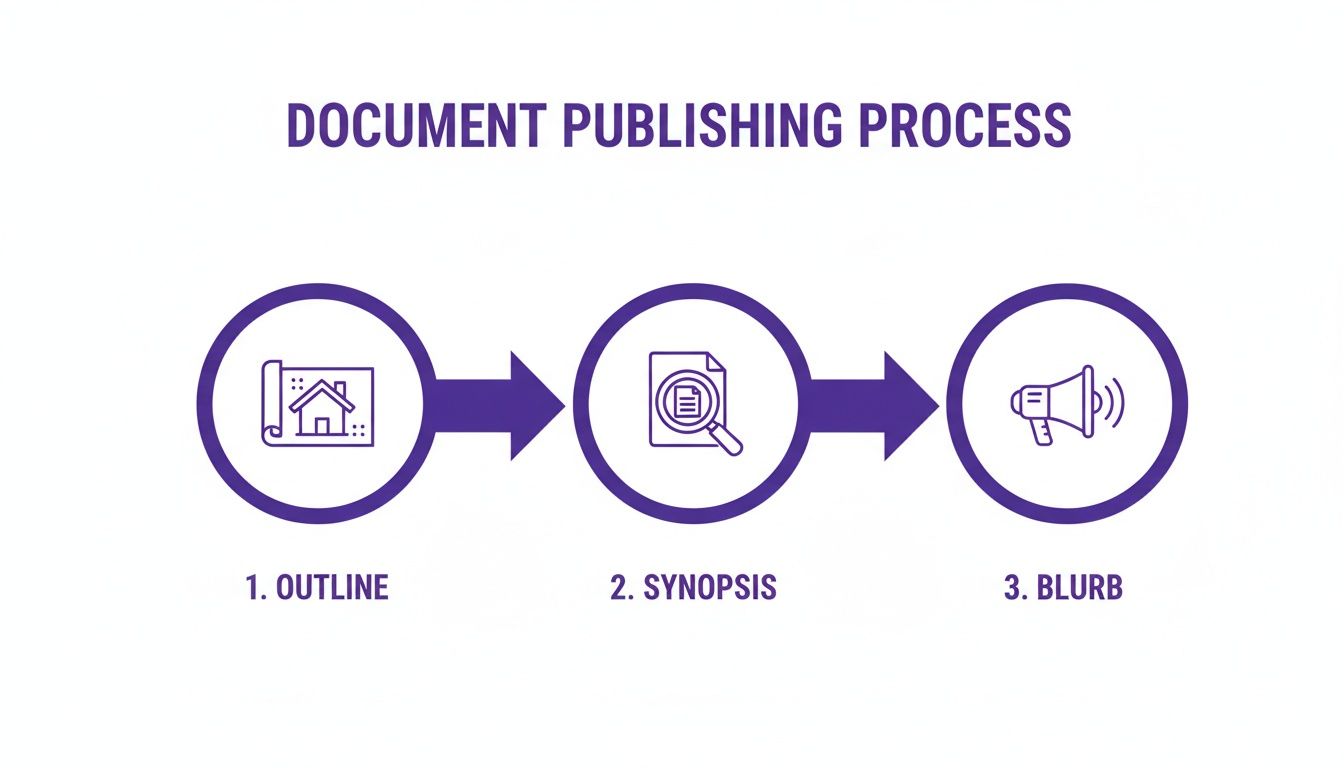
You start with the outline, which is just for you. Then you write the synopsis, translating your private blueprint into a technical proof for industry gatekeepers. Finally, you distill all that into a public-facing blurb to hook readers. The synopsis is that crucial bridge in the middle.
The Core Narrative Chain
To grab an agent's attention, your synopsis has to show a clear chain of causation. It’s not about "this happened, then this happened." It's about "this happened, which forced this to happen."
Every knockout synopsis is built on five essential pillars that create this narrative engine.
The Protagonist’s Starting Point: Who is your main character before the story kicks off? You need to establish their core misbelief or dysfunctional status quo. This is the "before" picture against which we'll measure their entire transformation.
The Inciting Incident: This is the moment their world shatters. It isn't just a random event; it's the specific catalyst that yanks them out of their comfort zone and onto a path they can't escape. It creates a problem so big they absolutely cannot ignore it.
Escalating Choices and Consequences: This is the meat of your synopsis. Walk the agent through the major decisions your protagonist makes to solve their problem. The key is showing how each choice leads to a direct consequence, which then forces an even tougher choice. This proves your plot has real momentum.
The Climax: This is where the protagonist confronts the central conflict head-on. It's the moment their old way of thinking is proven completely wrong, forcing them to make one final, agonizing choice that demonstrates their growth.
The Resolution and New Normal: Show the immediate aftermath. How has your protagonist fundamentally changed? This "new normal" cannot just appear out of nowhere; it must be the direct, earned result of the journey they just survived.
The secret is connecting these five points with relentless cause and effect. Every plot point must feel like a direct reaction to the one before it. Frame it like this: "This happened, forcing the character to do that, which led directly to this new disaster."
This isn’t just a fill-in-the-blanks template; it's the language of story architecture. Nailing it shows an agent you know how to build a novel that stands up on its own. It's tough to keep all these threads straight, which is where good novel writing software can be a lifesaver, helping you map out your plot points so that narrative chain is unbreakable.
And the synopsis isn't some new-fangled publishing hurdle; it's a historical powerhouse. The concept dates back to summaries on ancient scrolls for Roman libraries around 100 AD. By the 1850s, with the rise of mass printing, they became standard. Today, in a global books market valued at $143.34 billion in 2023, the synopsis is an absolutely critical tool for agents to filter the signal from the noise.
Common Synopsis Mistakes That Scream "Amateur"

Agents see the same mistakes again and again. They're the literary equivalent of a neon sign flashing "Newbie Here!" And trust me, these aren't minor slip-ups; they show a fundamental misunderstanding of what a synopsis is even for.
The absolute biggest offender? Getting lost in the weeds of your own worldbuilding. An agent doesn't need a deep dive into the thousand-year history of your magical kingdom, at least not yet. They need to know why your protagonist makes the choices they do.
When your synopsis reads more like a lore dump than a story summary, it sends a clear signal: the narrative engine is weak. The agent will assume your plot is just a scenic tour of your cool world, not a propulsive, character-driven story that can hook a reader.
The Character-Related Red Flags
Beyond the worldbuilding obsession, a whole host of character-centric mistakes pop up. The most common is the dreaded passive protagonist. If your main character is just a pinball, getting bounced around—rescued, kidnapped, or told what to do—it's a fatal flaw. Agents want to see a character who makes active, difficult choices that actually push the plot forward.
Another rookie move is packing the synopsis with a bloated cast. No one can keep track of five side characters in a 500-word summary. You have to be ruthless. Mention other characters only by their direct function to the hero, like "her traitorous mentor" or "the estranged brother she must rescue." If a character isn't a load-bearing wall for the main plot, they don't belong in the blueprint.
A synopsis is a diagnostic tool for narrative competence. Vague clichés, a passive protagonist, or a focus on worldbuilding are symptoms of a story that lacks a coherent, propulsive core.
Vague Language and Hidden Endings
Finally, writers love to sabotage themselves with fuzzy, evasive language. Phrases like "a journey of self-discovery" or "secrets will be revealed" are completely meaningless. They tell the agent nothing about the actual mechanics of your plot. Be specific. Instead of "she faces her deepest fears," write "she confronts the man who left her for dead." See the difference?
But the ultimate sin is hiding the ending. An agent isn't a reader you need to surprise; they're an investor trying to evaluate an asset. Withholding the resolution is like a startup founder refusing to show their business model. It doesn’t create intrigue; it creates doubt.
This isn’t a new problem. In the cutthroat world of publishing, your synopsis distills a 100,000-word epic into a hook that proves your story holds water. Back in 1890, publishers like Harper's received 10,000 manuscripts a year, rejecting 95% based on synopsis flaws alone. Now, with up to 1,000,000 new titles released annually, its role is even more critical. You can learn more about how competitive the publishing landscape has become.
Avoiding these common mistakes is your first and most important step toward getting a professional read.
Annotated Synopsis Examples for Professionals
Theory is cheap. Let's move on from abstract advice and get our hands dirty with some practical analysis. Below are two synopsis examples, one for a thriller and one for a more character-driven story. I’ve annotated them to show you not just what happens, but why certain choices in phrasing and structure are so effective when you're trying to hook an agent.
Think of this as less of a template and more of a workshop. We're going to break down how to demonstrate cause-and-effect, lock in character motivation, and nail your genre's voice—all while ruthlessly covering the entire plot. It’s all about seeing the architecture of a great synopsis in action, so yours can get the serious read it deserves.
Example 1: High-Stakes Thriller
Synopsis: The Cobalt Sanction
[Annotation: Establishes the protagonist, their core skill, and the status quo in one tight sentence.] Disgraced CIA cryptographer ELIZA VANCE, now a paranoid recluse after a mission went sideways, spends her days consulting for corporations, trusting algorithms more than people. [Annotation: Here is the inciting incident. It's personal and directly challenges her reclusive nature.] Her self-imposed exile shatters when a coded message arrives from her former mentor, DANVERS—a man who died on that final, disastrous mission.
[Annotation: Clear stakes and motivation. She is forced to act.] The message is a key, unlocking a hidden file that proves Danvers was framed as a double agent by a shadowy cabal within the Agency known as Cobalt. The file also implicates Eliza, making her a target. [Annotation: This is the first major choice, escalating the conflict from a personal mystery to a public threat.] Forced to run, Eliza’s only hope is to decrypt the rest of Danvers’ files, which are scattered on dead drops across Europe.
[Annotation: Introduces the antagonist and their direct opposition to the hero's goal.] Cobalt dispatches its top assassin, a ruthless operative known only as JAEGER, to retrieve the files and eliminate Eliza. A tense cat-and-mouse game ensues, with Eliza using her wits to solve Danvers’ cryptic clues, always staying one step ahead. [Annotation: The midpoint—a significant plot turn that raises the stakes exponentially.] In Berlin, she discovers the truth: Cobalt isn’t just covering up a past crime; they’re planning to assassinate a head of state at an upcoming G8 summit.
[Annotation: The climax is a direct confrontation of the central conflict.] With Jaeger closing in, Eliza uses the final file not to expose Cobalt but to feed them disinformation, luring their entire team into a trap at the summit. In the final confrontation, she uses Jaeger’s own protocols against him, leading to his capture. [Annotation: The resolution shows her transformation. She is no longer a recluse.] Eliza clears her name and Danvers’, but turns down an offer to rejoin the CIA. Instead, she establishes an independent watchdog group, using her skills to hold the intelligence community accountable, finally trusting her own judgment over any system.
Example 2: Character-Driven Literary Fiction
Synopsis: The Salt-Stained Letters
[Annotation: Instantly establishes character, setting, and internal conflict.] Forty-year-old archivist LEO QUINN has built a life out of preserving other people's pasts to avoid his own. He lives in his ancestral home on the coast of Maine, a house filled with the ghosts of a family fractured by the disappearance of his older sister, CLARA, two decades prior. [Annotation: The inciting incident is a discovery that forces him to engage with his past.] While cataloging a new collection, he discovers a hidden compartment in an old sea chest containing a stack of unsent letters written by Clara.
[Annotation: The letters drive the plot and define the central goal.] The letters reveal Clara’s secret romance with a visiting artist, and her plan to run away with him—not to escape her family, but to protect them from their tyrannical father. Leo’s mission becomes clear: find the artist, understand Clara’s final days, and unearth the truth his family has buried. [Annotation: This introduces the primary obstacle—not a villain, but an emotional and psychological barrier.] His investigation forces him to confront his estranged mother, a woman who has never spoken Clara’s name, and his father, whose dementia is slowly erasing the memories Leo desperately needs.
This whole process of boiling a novel down to its bones has been a publishing gatekeeper for a century. Synopses really became crucial during the U.S. publishing boom of the 1920s.
Industry logs from that era show that over 80% of the 50,000 yearly queries to the Book-of-the-Month Club were tossed based on the synopsis alone. It was simply the fastest way to spot a story that didn't hold water. You can find more fascinating stats about the evolution of the book market.
While these examples give you a solid framework, the most powerful tool is one that understands your story as deeply as you do. These days, authors are exploring how technology can lend a hand. It's worth looking into the role of AI writing software for novelists and how it can help you keep all those narrative threads straight.
Burning Questions from Writers Who’ve Been Around the Block
Even after you’ve written a few, the synopsis can feel like this weird, unnatural document. It’s not exactly creative writing, but it still needs a narrative pulse. It’s a summary, sure, but it has to move like a freight train.
It’s just… a strange beast. Here are some of the finer points that tend to trip up even seasoned authors.
What Do I Do with All My Subplots and Secondary Characters?
You cut them. Mercilessly.
Well, mostly. A synopsis is an exercise in brutal focus. If a subplot or a beloved secondary character can be removed without the main plot completely imploding, they don’t belong in the synopsis. Think of your story as a building; an agent needs to see the load-bearing walls, not the fancy crown molding.
For example, your protagonist's sarcastic best friend might deliver the best one-liners in the book. But unless they betray the hero at a crucial moment or reveal they were the secret villain all along, they're just color. Leave them out. The synopsis is about structure, not decoration.
If you absolutely have to mention another character, define them purely by their role in the protagonist’s journey. Something like, "the double-crossing mentor who kicks off the main conflict" or "the estranged brother whose rescue drives the entire second act." This keeps the spotlight right where it belongs: on your protagonist and their central struggle.
Is There a Perfect Length? And Does It Change?
The unbreakable, cardinal rule is one single-spaced page. This usually shakes out to around 500 words.
Some agents or specific submission guidelines might ask for two pages, but unless you see that instruction in black and white, you stick to one. Always.
Think of the one-page limit as part of the test. It’s not just about summarizing; it's about proving you have complete command of your own story. Can you distill an 80,000-word manuscript into its most vital, compelling components? Anyone can ramble on for 1,000 words hitting every minor plot beat. A tight, focused, one-page synopsis shows an agent you know what truly matters in your novel. It screams confidence.
Should I Write the Synopsis Before or After the Book?
The only correct answer is both.
First, write a "working" synopsis before you even start Chapter 1. This one is just for you. It’s a diagnostic tool, a way to kick the tires on your core concept and see if the plot actually holds together. It will be a mess. It will have holes. That's the whole point. It lets you spot fatal structural flaws before you’re 50,000 words deep in a dead-end draft.
Then, you write the "submission" synopsis after the manuscript is polished and truly finished. Your story will change in a thousand ways during the writing and editing process. Characters will surprise you, themes will deepen, and plot twists will emerge that you never saw coming. Sending an agent that initial, pre-writing synopsis is a surefire way to submit a document that no longer accurately represents the book you actually wrote.
How Much of My "Voice" Should I Put In?
The synopsis has two non-negotiable rules: third-person and present tense. This holds true even if your novel is written in first-person past. The voice needs to be professional and direct, but "professional" isn't a synonym for "boring and robotic."
The key is to let the tone subtly reflect your book's genre. A synopsis for a gritty psychological thriller can use short, sharp, declarative sentences that feel tense. One for a romantic comedy can have a knowing, slightly witty edge. Let your word choice and sentence rhythm echo the feel of your manuscript.
Just don't overdo it. Avoid getting chatty, asking rhetorical questions, or dropping in flowery, novelistic prose. The goal is clinical precision, but lightly dusted with a genre-appropriate flavor.
A synopsis is all about proving your story’s structural integrity. But actually maintaining that integrity across a 100,000-word manuscript is where things get messy. Novelium is a manuscript intelligence platform that acts as your structural editor, automatically flagging inconsistencies in your plot, timeline, and characters. It ensures your final draft is every bit as solid as your synopsis promises. Stop hunting for continuity errors and let our tool be your second set of eyes. Check your manuscript's coherence at https://novelium.so.