What Is a Continuity Test for Fiction Writers
A continuity test for fiction is a structured check that story events, character states, and world details remain consistent from scene to scene. It verifies whether each new passage fits what the manuscript has already established in story time, not just whether the prose reads smoothly.
You probably know the moment: a beta reader flags a contradiction in chapter seven, and you've read that scene a dozen times without seeing it. The character who acts on a secret they haven't learned yet, the missing day on a cross-country journey, the object that changes hands without moving. These aren't failures of craft or attention. They're state-tracking failures, and linear rereading is a poor way to catch them once scenes have been written out of order or revised independently.
The Continuity Problem Most Writers Discover Too Late
A continuity test checks whether every reference, state, and event in a scene fits what the story has established so far. The key phrase is so far. The manuscript has a chronology, even when the chapters don't follow it, and every character and important object has a state that changes as events unfold.
That makes continuity verification a mechanical problem, not a talent test. A smooth read can tell you where the prose drags. It can't reliably keep track of what each character knows, when a message arrived, or which version of a setting detail was established three hundred pages earlier. A continuity error in fiction is often small in isolation. The damage comes when readers start doubting whether the story's details can be trusted.
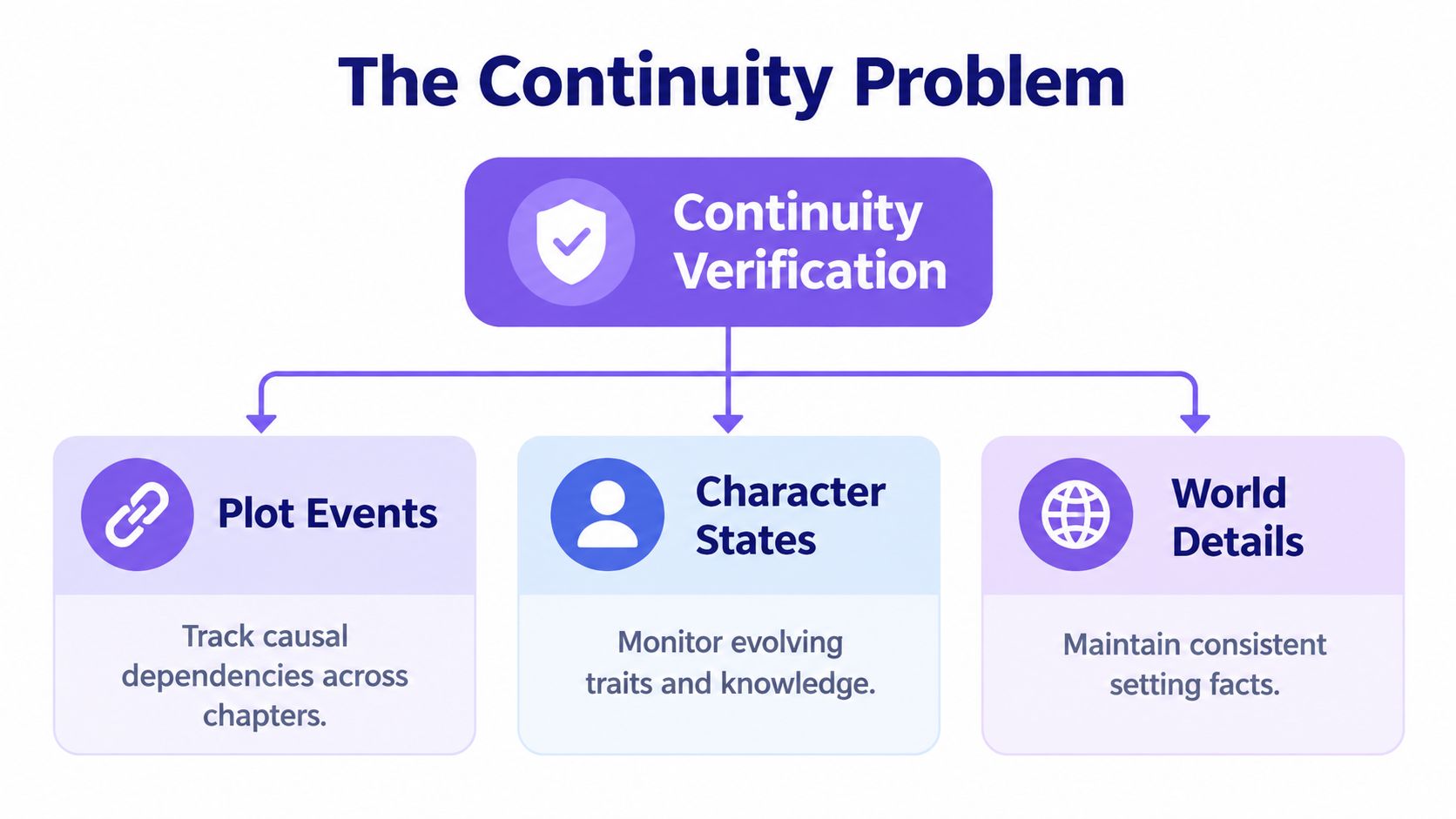
A useful test doesn't ask whether a scene feels right. It compares the scene against the manuscript's record of events and states. That record needs to answer practical questions: What has happened? When did it happen? Who knows about it? What changed, and what stayed the same?
| Category | What Gets Verified | Common Failure |
|---|---|---|
| Plot events | Whether a scene's events depend on earlier events that have actually happened | A character acts on a plan before the scene that creates it |
| Character states | What characters know, where they are, and what physical details apply at that point | A character uses information they haven't learned |
| World details | Whether locations, objects, and established setting facts remain consistent | A key object appears in a new place without a transfer |
Treat the test as verification, not proofreading. Rereading is still useful, but it isn't a system for comparing every scene against every relevant fact in a long manuscript.
The Three Kinds of Consistency That Break
Continuity isn't one kind of error. It's at least three related checks, and each needs a different method.
Plot continuity follows causal dependencies. If a character gets access to a locked room because another character gives them a key, the handoff has to happen before the entrance. This isn't a question of whether the scene is exciting. It's whether the action has a valid cause in the story.
Timeline continuity checks dates, durations, travel, and scene order in story time. Chapter order can't stand in for chronology, especially in a book with flashbacks or parallel plotlines. Record events by day, week, or month, then compare every time reference against that timeline. The test is whether all stated intervals can coexist, not whether chapters appear in a plausible sequence, as this guide to timeline continuity emphasizes.
Character and object continuity tracks changing states: knowledge, physical condition, location, and possession. A character can't use a secret they haven't learned. A sword left in a bedroom can't be on someone's hip later unless the story accounts for the transfer. A character's eye color or scar location shouldn't drift unless there's a deliberate, explained change.
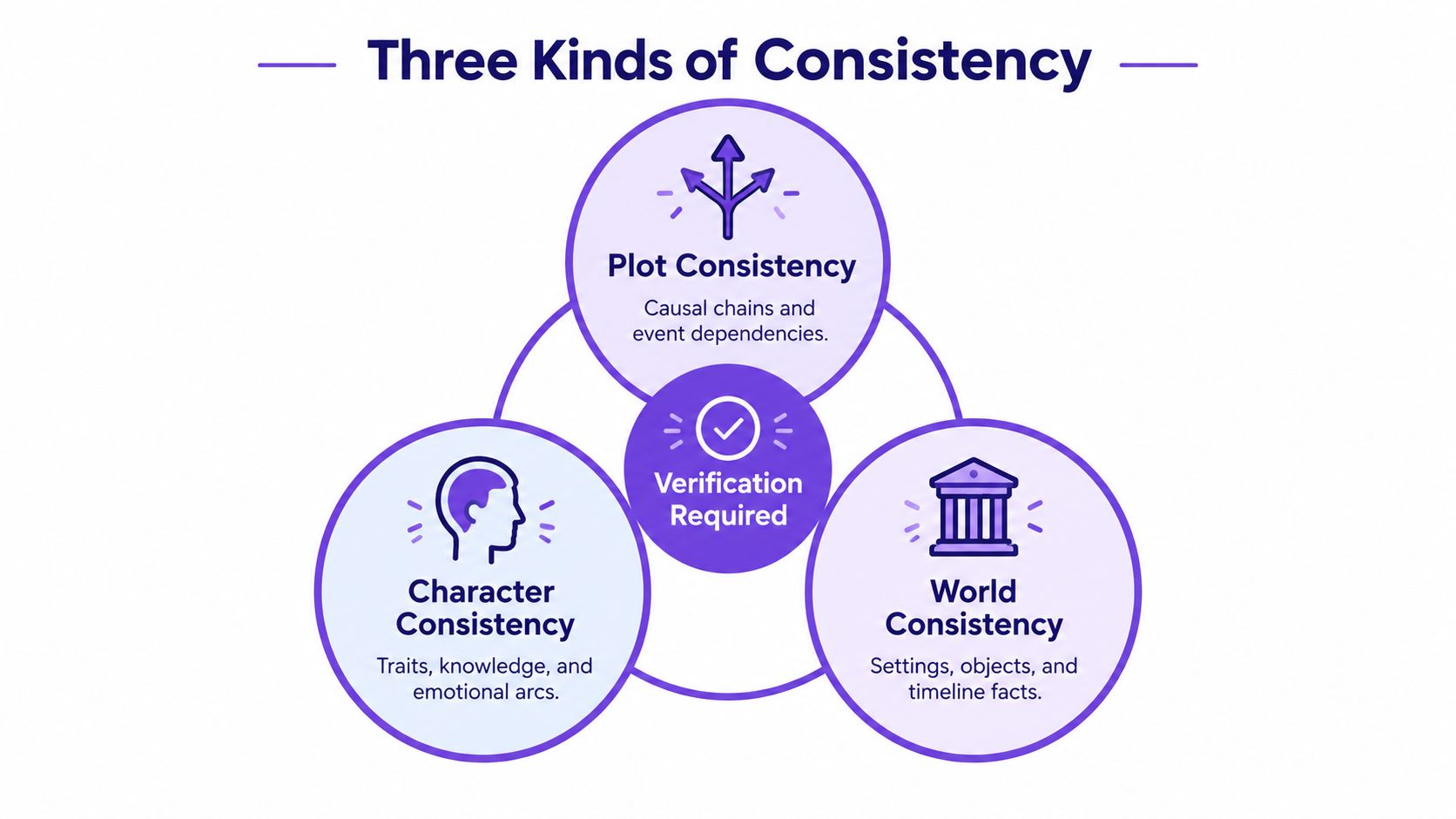
These categories overlap, but a fuzzy search can't verify all of them. Searching for a character's name may help locate scenes; it won't establish whether the character had the right information at that point or whether the event that supplied it had already occurred.
Film production offers a useful mechanical comparison. Continuity supervisors track state across separately shot units, checking details such as eyelines, costume condition, props, and the time shown on a clock. A report on film continuity says roughly 90 percent of on-screen errors occur when shooting resumes after a break in production (account of continuity errors in filmmaking). The lesson for novelists isn't to imitate a film set. It's to recognize that separately created scenes need an explicit record of what's true between them. For stories that reorder events, a timeline error is a state conflict, not merely a date typo.
Why Profiles and Questionnaires Cannot Do This Job
A character profile tells you who someone is. A continuity system tells you who they are now in this scene, what they know now, and what has changed since their last appearance. Those are different jobs, and a well-written questionnaire doesn't do the second one for you.
Most profiles are snapshots. They might record a character's appearance, history, and habits, but they don't track when a character learned the password, injured a hand, changed their hair, or handed over a letter. A novel is a sequence of changing states. Static documents describe; they don't verify.
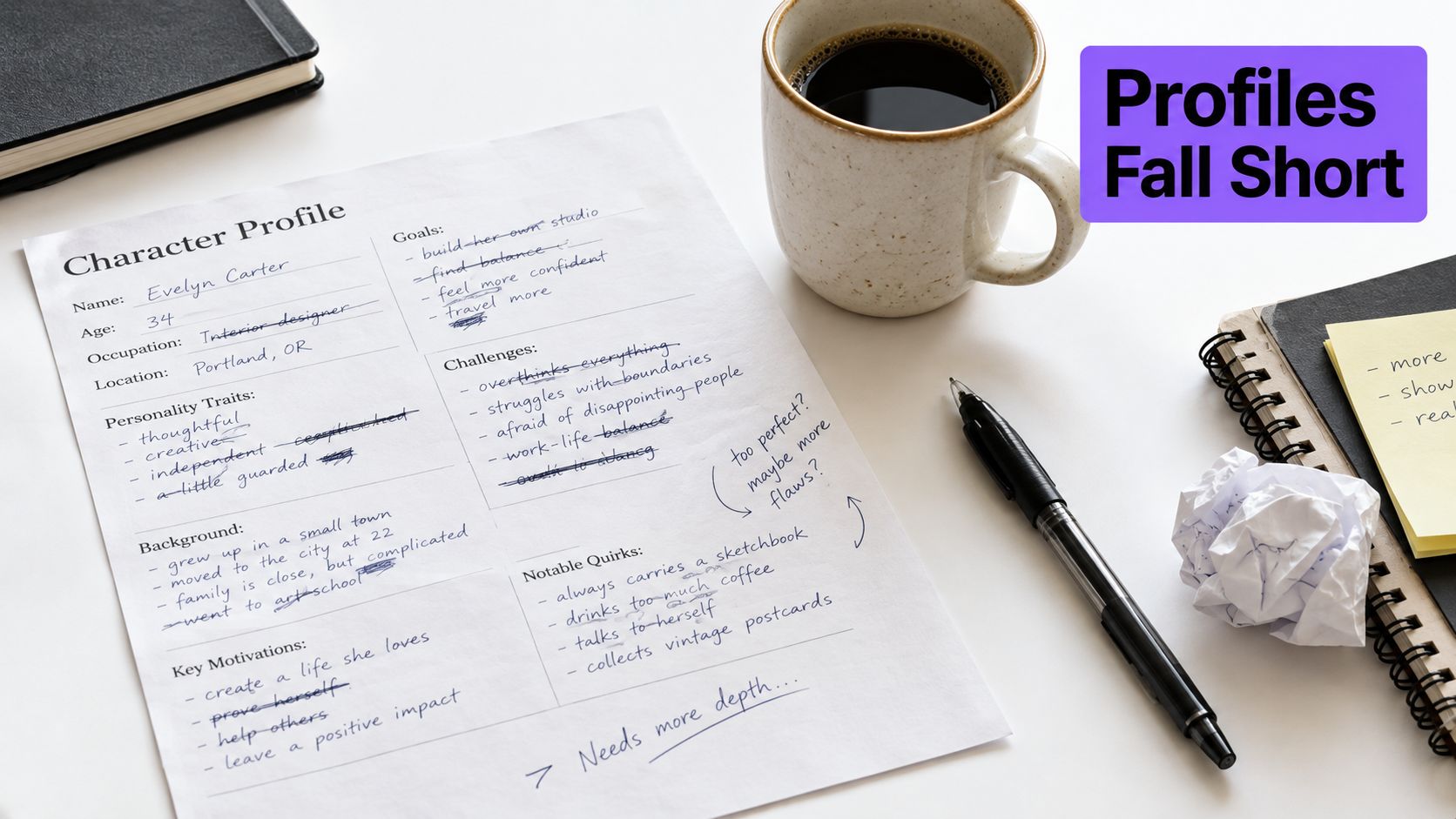
That's why the standard advice to “make a character bible” often disappoints writers working on long manuscripts or series. A character bible is valuable for organizing established information. It still won't tell you whether chapter fourteen contradicts the last valid state recorded in chapter nine. If the document needs you to remember every new detail and manually update each relevant entry, it's another thing that can go stale.
The distinction is simple: a development document helps you design a character or world; a tracking system follows what the manuscript establishes. The second needs to attach facts to scenes and story dates, update when new details appear, and flag a conflict against the latest valid state. Otherwise, you're maintaining a static reference beside a moving book and hoping your memory does the reconciliation.
The detail worth tracking isn't every entertaining fact in your worldbuilding notes. Prioritize facts that can contradict a later scene: knowledge, location, relationships, injuries, physical traits, possessions, rules, and events. A character's favorite childhood snack may be delightful. If it never affects a scene or gets referenced again, it doesn't need the same verification effort as the secret that drives the final act.
Failure Modes That Show Up in Real Drafts
A reader doesn't need to know the term “knowledge state” to feel the error. They only need to notice that Mara reacts to a confession before anyone has told her. Perhaps the confession appears in an earlier chapter on the page, but later in story time. Mara's reaction belongs after the confession, not before it. A continuity pass compares each scene with the established chronology and each character's knowledge, rather than trusting chapter order (overview of continuity in fiction)).
Travel creates another familiar trap. A character leaves one city on Monday, arrives somewhere else on Tuesday, and later calls the trip four days long. Maybe one date is wrong. Maybe the later line is. Either way, the manuscript needs one timeline that makes the stated intervals and dependencies possible.
Objects are worse than writers expect because they disappear from attention once a scene ends. A sword is left in the bedroom, then appears on the character's hip several chapters later. A photograph is burned, then becomes evidence. The reader may not stop to diagram the problem, but the unexplained change still makes the story feel less solid.
Physical details have a similar effect. Brown eyes in an early scene and green eyes later won't sink a plot, but recurring contradictions make readers wonder what else they've been asked to overlook. A scar moving from one side of the face to the other is easy to fix if a tracking record connects the detail to its scenes. It's much harder to catch by rereading a sprawling draft with no record to compare against.
These are not evidence that you've lost control of the book. They're the predictable cost of managing many interdependent facts in your head. Fix the contradictions that change causality, chronology, knowledge, or a meaningful physical state. Don't waste revision time policing harmless variations in wording that don't alter what's true.
Running the Test Manually vs Letting a Tool Do It
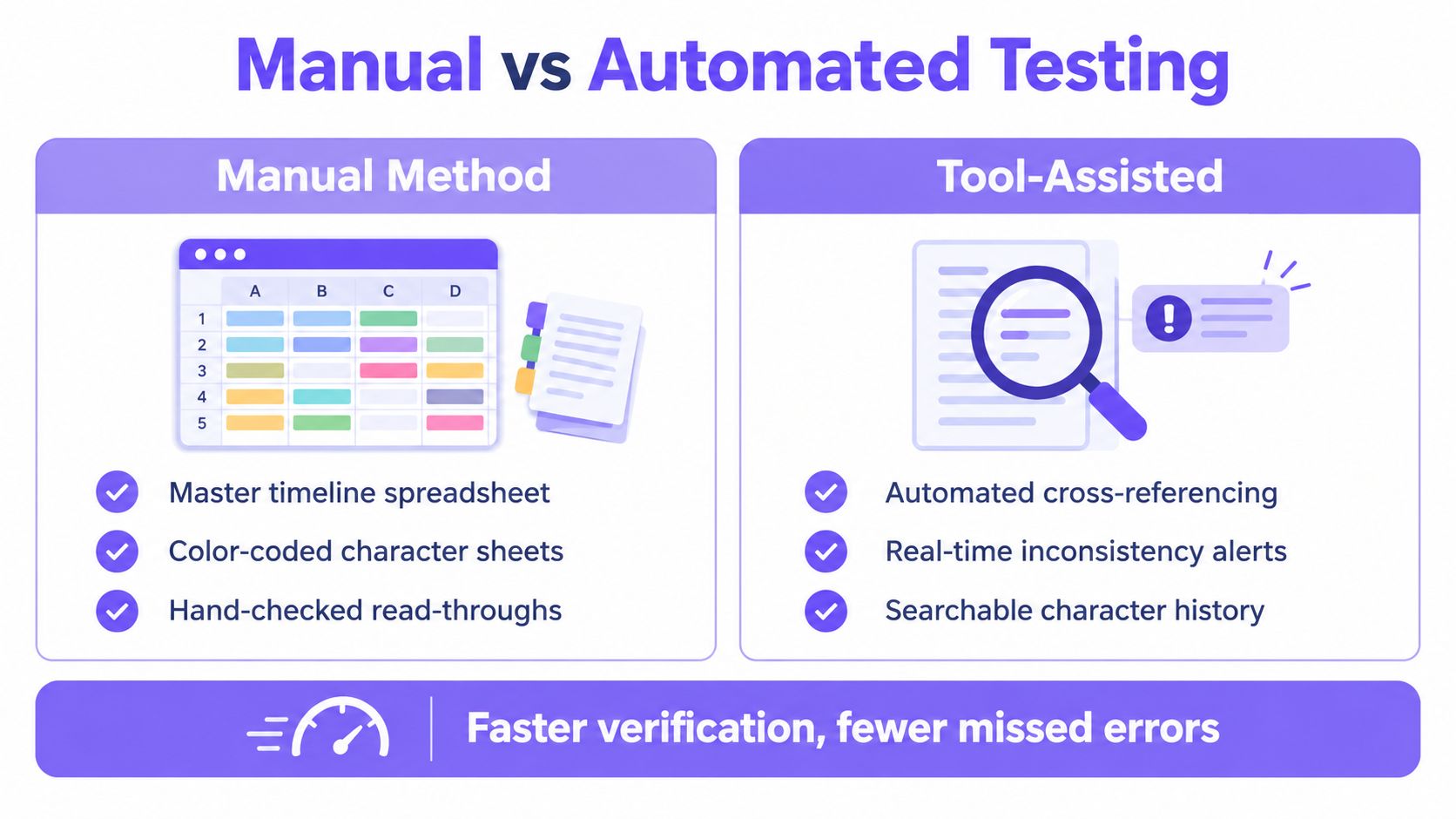
A master timeline is the most useful manual method for event sequence. Record the event date, location, characters present, and any important consequences. Then compare every time expression and scene placement against it. This catches the “last week” line that doesn't match the established date, but it depends on keeping the document current as the manuscript changes.
Character sheets and search-and-find handle a narrower problem. A sheet can record eye color, injuries, relationships, and secrets. Searches can show where a name or detail appears. But search results don't establish whether a reference is valid in story time, and a list of attributes won't automatically reflect every change made during revision.
The tradeoff is straightforward:
| Method | What It Does Well | Where It Breaks Down |
|---|---|---|
| Master timeline | Gives you a clear chronology and a record of locations and events | Requires manual updates and scene-by-scene comparison |
| Character sheets and search | Helps locate recurring details and track established facts | Doesn't connect each detail to its changing state across scenes |
| Tool-assisted checks | Can cross-reference manuscript details and surface likely conflicts | Still requires your judgment about whether a change is intentional |
Manual systems are free, and building one can sharpen your understanding of the manuscript. They work best when you can keep the record accurate without turning revision into clerical work. On a long book, a series with recurring characters, or a draft revised in separate chunks, that bargain often gets worse: the system grows while your available attention doesn't.
Tool-assisted analysis can reduce the repetitive comparison work, but don't confuse a flagged conflict with an editorial verdict. You decide whether a character's changed appearance is deliberate, whether an apparent timeline clash has an explanation, and whether a small inconsistency matters. If you're weighing software for your wider workflow, this overview of a digital product tool for 2026 offers useful context for thinking about tool fit. The practical choice is between doing every comparison yourself and using a system to find the passages that deserve your attention.
A System That Actually Holds the Manuscript for You
A character's appearance, knowledge, or relationships can change across a novel, but each change needs a place in the story. A continuity test should track those details by scene and story date, then compare each later reference with the most recently established state. Record concrete claims, connect them to where they appear, and flag conflicts for the writer to assess, as the checklist for editing a novel recommends.
The system should track character traits, knowledge, relationships, events, and world details as the draft changes. A useful alert shows the conflicting passages in context. You can then decide whether the detail is an error or an intentional change that needs a clearer cause. That is state verification, not merely searching an archive. The same fit-first logic applies to software choices, as this best digital product tool 2026 overview explains.
Novelium's Character Tracker and World Codex extract and track details across a manuscript, helping writers review character and setting consistency alongside the draft. Manual timelines and spreadsheets work when they fit the project. Once cross-referencing exceeds what you can reliably manage, let a system track the manuscript's state. Keep editorial judgment with you.
Novelium tracks character details and world facts across chapters, helping you find continuity conflicts without relying on memory or a static questionnaire. Visit Novelium to check your manuscript and focus on inconsistencies before readers find them.