What Are Static and Dynamic Characters? a Practical Guide
The advice that every important character needs to change is a good way to give an already crowded novel unnecessary arcs. The more useful question isn't whether someone grows. It's whether the manuscript establishes a coherent pattern of stability or change, then preserves the evidence through revisions. When a character behaves differently, readers need to understand whether they've changed, concealed something, or been written inconsistently.
Static Characters Are Not Cheap Characters
Calling a character static isn't a diagnosis of weak writing. It becomes an editorial problem when the label turns into permission to stop checking motivation: she's always hostile, he's always loyal, so apparently nothing else needs explaining. Repeated behavior still needs a credible cause, especially when circumstances make that behavior expensive.
A static character can exert substantial narrative pressure. Their consistency can establish a thematic position or make someone else's transformation visible, functions described in Humanities LibreTexts' discussion of characterization. Editorially, that means stability deserves the same scrutiny as change. A loyal companion who stays loyal after a betrayal needs an intelligible reason, not a permanent adjective in a character sheet.
Editorial test: Don't ask whether the character repeats a behavior. Ask whether the same governing commitment still explains that behavior under different pressures.
Low page time, limited interior access, and moral simplicity aren't useful substitutes for that test. Treat complexity and transformation as separate questions: how much does the reader understand about this person, and what materially changes during the narrative? A recurring character can require careful handling even when their central allegiance never budges.
The continuity obligation is therefore specific. Establish what remains fixed, identify what can vary around it, and check that later scenes respect the distinction. A prose profile saying fiercely loyal won't tell you whom that loyalty protects when family, institution, and personal debt finally pull apart.
Understanding Static and Dynamic Characters
So, what are static and dynamic characters when you're evaluating a draft? A static character remains substantially consistent in their defining psychological or moral orientation. A dynamic character undergoes meaningful internal development through experience. Treat those definitions as continuity models: compare an established starting state with the state the ending demonstrates.
The terminology has a related, but not interchangeable, history. In 1927, E. M. Forster published Aspects of the Novel and distinguished flat from round characters, with convincing surprise central to his account of roundness, as explained in the Open University's treatment of Forster's framework. Complexity concerns how a character is constituted; dynamism concerns development over the narrative. Don't collapse those questions into the same label.
This comparison gives the distinction a useful visual shorthand.
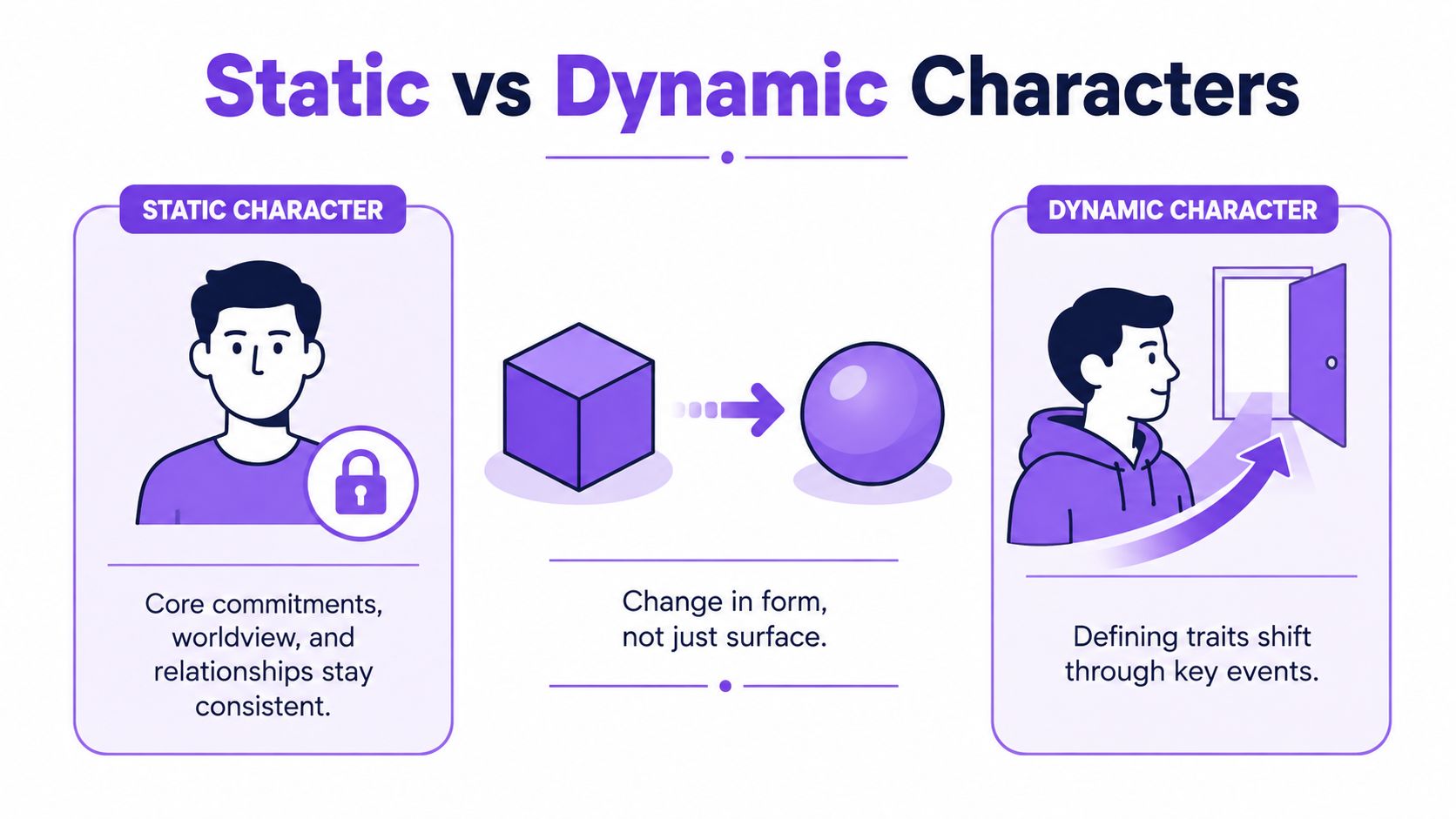
For manuscript analysis, think of a character's state as a set of connected dimensions rather than a single switch. Beliefs, goals, values, knowledge, relationships, and decisions don't necessarily move together. Someone can acquire decisive information while defending the same ethical principle, or abandon a relationship while remaining committed to the ambition that destroyed it.
Separate circumstance from internal state
A promotion, exile, injury, or lost home establishes a new situation. It doesn't, by itself, prove a new outlook. To assess development, compare what the character regards as true, necessary, permissible, or worth sacrificing before and after the experience.
That comparison also keeps the analysis proportionate. Don't classify every newly learned password as an internal transformation, and don't dismiss a quiet revision of allegiance because nobody delivers a speech. The practical question is whether the changed dimension matters to the character's subsequent interpretation and conduct. Record the scope of that change rather than reaching for a global label too early.
Choosing Between Static and Dynamic Characters
Choose the model according to narrative function, not prestige. If the central conflict depends on someone reconsidering an allegiance, you need development that the reader can trace. If the conflict depends on confronting an uncompromising position, changing its representative may weaken the ending rather than enrich it.
Nor does the dynamic option imply redemption. Del Mar College's character guide distinguishes substantial change from stability without making either a quality ranking. A deteriorating character can be dynamic; a deliberately consistent character needn't be poorly written. The editorial decision is about what the story requires, not which label sounds more refined.
Static and Dynamic Character Decision Matrix
| Character Type | Best Narrative Function | Required Evidence | Common Continuity Failure |
|---|---|---|---|
| Static | Maintain opposition, contrast, or a governing principle | Consistent commitment under materially different pressures | Abandoning that commitment for plot convenience |
| Dynamic | Carry a consequential revision of outlook or conduct | An intelligible cause and sustained consequences | Announcing change without demonstrating it |
| Mixed across dimensions | Preserve a central principle while revising knowledge, trust, or allegiance | Separate evidence for each affected dimension | Treating a local change as a complete personality replacement |
A dynamic lead creates a different continuity workload from a fixed antagonist. The lead needs a causal chain that survives scene cuts and reordered revelations. The antagonist needs enough range that consistency doesn't become repetitive staging. Neither workload disappears because the profile has the correct label.
Use character development documentation to specify the intended function before expanding the cast's arcs. Ask what would break if this person stayed the same, and what would break if they changed. If neither answer affects the manuscript, don't manufacture a transformation merely to complete a planning document. Give the character the development the narrative can support.
Examples That Expose False Character Arcs
Consider a hypothetical family matriarch who protects an institution even when it harms her daughter. At the opening, the daughter interprets that loyalty as admirable discipline; by the ending, she recognizes its cost and refuses it. The mother's unchanged position makes the daughter's altered allegiance legible. The useful contrast is between their commitments, not their respective amounts of dialogue.
A dinner scene can make that divergence visible without requiring either person to explain the whole family history.

Now take a witness who distrusts officials but gives testimony after coercion. Cooperation proves compliance, not trust. If the manuscript later presents that witness as comfortably reliant on official protection, it needs an intervening cause, unless the apparent comfort is itself strategic. Otherwise, the writer has converted an action under duress into an unsupported revision of belief.
The threshold matters: a literature review drawing on Laurence Perrine describes dynamic change as fundamental and lasting, rather than a temporary disturbance, in its discussion of static and dynamic characterization. A disguise, relocation, outburst, or startling declaration doesn't establish that threshold on its own.
A dramatic scene proves that something happened. Later conduct establishes what the experience meant.
A different hypothetical witness learns that a sibling committed the crime but continues protecting them. Knowledge has changed; outward behavior hasn't. Yet the same silence now involves informed complicity rather than mistaken loyalty, which can matter enormously to the ending. Track that altered basis for the decision instead of forcing every dimension to move together.
Tracking Character Arcs Across Chapters
Build the record around information that can make a scene wrong: what someone believes, knows, wants, values, owes, conceals, and chooses. Then attach each consequential change to its location in the manuscript. The key entry isn't becomes trusting. It's the passage where distrust is revised, what caused the revision, and the later decision that confirms it.
Use the following structure to separate intended development from what the draft demonstrates.
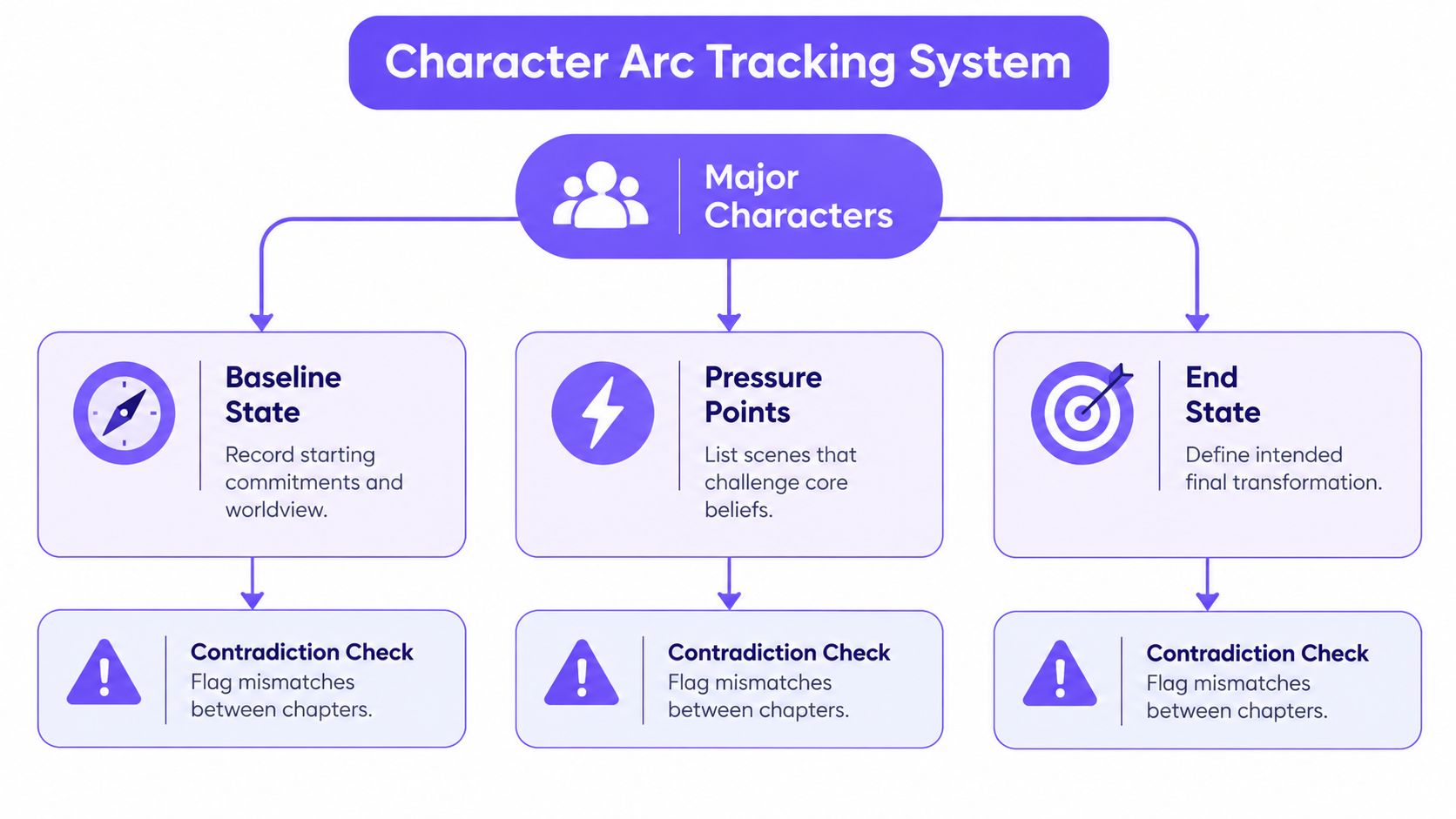
For each meaningful transition, retain prior state, trigger, revised state, and later confirmation. Include chapter or scene references so you can inspect the evidence instead of trusting the summary. Literary analysis distinguishes changes in commitment, perspective, knowledge, values, or behavior from changes of circumstance in this discussion of character development; operationally, your record should show where that distinction affects choices.
Keep intention separate from evidence
A development document describes what you intend the arc to mean. An arc-tracking system records what happens, when it happens, and which scenes support the interpretation. Do not replace the former with the latter: an intended transformation can remain absent from the prose.
Keep the entries versioned when you move revelations or rewrite encounters. If a disclosure moves later, every earlier decision that relied on it needs review. For mixed arcs, update knowledge, trust, and allegiance independently rather than overwriting the entire character description.
For an accompanying video, use the embedded player below.
The maintenance rule is simple: update the record when the scene changes, not during a ceremonial cleanup after the draft. Otherwise, you're checking the manuscript against an obsolete account of itself.
Why Static Profiles Fail at Manuscript Scale
The weakness of a conventional profile is its timelessness. It might accurately describe someone at the opening while contradicting their situation halfway through the book. Add recurring cast members, retrospective revelations, and reordered chapters, and a single biography stops answering the question that matters: what was true for this person at this point?
A spreadsheet can handle that distinction if you design and maintain it accordingly. The problem isn't the file format. It's storing evolving information in fields that invite you to overwrite the past: current allegiance, current injury, current relationship, current knowledge. Once the old value disappears, you've lost the basis for checking earlier scenes.
Keep consequential detail
Favorite food is useful continuity data when poisoning, scarcity, ritual, or recognition depends on it. Otherwise, it can remain enjoyable worldbuilding without occupying the same editorial priority as access to a secret. Rank details by the consequences of getting them wrong, not by how much pleasure you took in inventing them.
Revision rule: Every altered revelation creates a dependency check, not just a new sentence.
A hypothetical informant can't invoke evidence they haven't received. A recurring antagonist can't abandon a defining value merely because the escape scene needs cooperation. A reconciled couple can't behave as though reconciliation erased the betrayal's practical consequences. These aren't missing questionnaire answers; they're failures to preserve state and causality.
Check the affected scenes
When you revise a promise, disclosure, injury, or relationship, inspect both earlier setup and later reliance. A changed ending can invalidate an apparent turning point; a removed conversation can leave another character inexplicably informed. Preserve the distinction between author knowledge, reader knowledge, and character knowledge throughout that check. None of those grants automatic access to the others.
The source of truth should therefore remain connected to scene evidence. A polished biography is a useful reference, but it isn't a substitute for an evolving continuity record.
Build a Manuscript-Ready Character Continuity System
Audit the major cast against the actual draft. Mark each baseline, intended ending, consequential pressure point, and dimension that changes. Then inspect the evidence supporting those transitions, including the later behavior you're relying on as confirmation. For deliberately static characters, check that escalating pressure exposes their commitments rather than accidentally replacing them.
A character bible becomes useful for this work when its entries retain scene references and history, not just polished summaries. Check motivation, information access, relationship consequences, and callbacks against those references. Give special attention to passages written before a substantial structural revision.
The application interface is shown below.

A maintained spreadsheet, annotated manuscript, or dedicated tracking application can support that process. Novelium's Character Tracker and World Codex automatically extract and track character details across manuscripts, with local processing and encrypted storage addressing manuscript privacy. Those tools support the evidence gathering; the editorial judgment remains yours.
The useful output isn't a cast neatly divided into labels. It's a draft whose decisions remain intelligible after revision.
Keep stable characters deliberate, changed characters traceable, and unresolved contradictions visible until you've addressed them. A label doesn't control continuity. A living state record gives you something concrete to verify.
Novelium offers Character Tracker and World Codex tools for following character details across your manuscript instead of maintaining isolated profiles. Visit Novelium to start checking whether your static commitments and dynamic arcs hold together across chapters.