Visual Timeline Generator for Novelists That Catches Errors
The standard advice is to build your novel's timeline before you write. That advice works beautifully until the manuscript starts behaving like a novel.
A prewriting chart records intention. An 80,000-word draft records decisions, reversals, omissions, discoveries, and the occasional scene that was supposed to take place on Monday but somehow happens after Wednesday's consequences. Character questionnaires and spreadsheets don't catch that drift because they describe the story from above. They don't track what each character knows, where they are, or what has changed from scene to scene.
A visual timeline generator becomes useful when it stops being a polished planning board and starts acting like a continuity layer attached to the draft. The distinction matters. Timelines have long been used to make sequences and dependencies visible, from early industrial scheduling through modern software-based planning, and tools such as Preceden now serve hundreds of thousands of users across project management, legal work, education, research, and fiction writing (Preceden). Fiction needs the same visual discipline, but it needs a different kind of intelligence behind it.
Why Most Novel Timelines Fail Before Chapter One
By chapter five, the secondary character who was meant to leave has stayed, the midpoint arrives too early, and a secret sits with the wrong person. These are ordinary drafting changes, but they expose why a polished planning board rarely survives contact with a full manuscript.
“Map every scene before you draft” produces an attractive artifact. Trello cards line up neatly. Milanote boards resemble command centers. A spreadsheet gives every subplot a place and assigns dates to turning points. The trouble begins when the writer changes scene order, discovers a stronger relationship arc, or lets a character make a decision the outline never allowed.
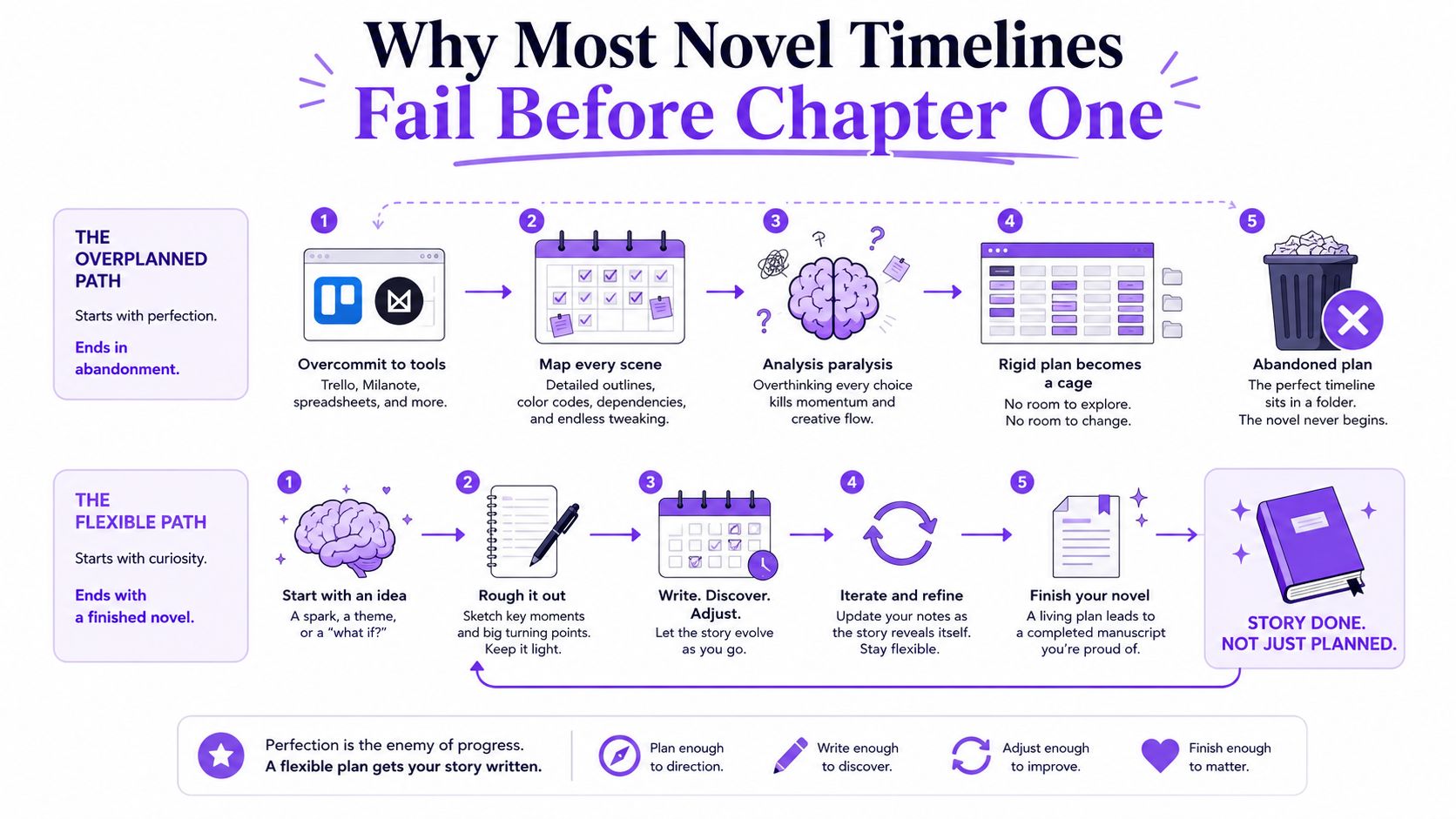
The planning artifact problem
Static timelines rely on manual maintenance. Alter one scene and the writer may need to revise the date, character sheet, chapter notes, and worldbuilding document. At some point, the timeline becomes an administrative chore, so it remains open in another tab while the draft moves on.
The gap stays manageable in a short manuscript. Across 80,000 words, it becomes a continuity risk. A profile can record that a character is grieving, injured, estranged, or unaware of a fact. It does not reliably show when that state changed, which scenes delivered the information, or whether later chapters honor the change.
Practical rule: Treat the timeline as evidence extracted from the manuscript, not as a promise made before the manuscript exists.
A stronger workflow starts with the actual pages. Draft the scene, extract its event and consequences, compare them with nearby scenes, then revise the source text when the sequence fails. Tools built for presentation or project management rarely perform that check. An extraction-based visual timeline generator can surface impossible travel, knowledge gaps, and state changes with the scrutiny of a sharp beta reader. A stronger timeline exposes what the story does, rather than what the writer intended it to do.
What a Visual Timeline Generator Does for Fiction
Most timeline tools serve presentation or project management first. Novelists need continuity checks. At 80,000 words, a polished board can display chronology while missing the impossible sequence buried between chapters. A fiction-grade tool should extract evidence from the draft and test whether the story's events can coexist.
It tracks more than dates. The shared frame should include events, elapsed time, locations, character states, knowledge states, and parallel threads. A fixed time axis lets writers compare event order with elapsed time, exposing gaps, overlaps, and sequencing problems (timeline visualization research).
The tool must also separate story chronology from reading order. A flashback may appear late in the book while belonging early in a character's lived sequence. Multiple viewpoints may cover the same afternoon from different angles. A character can remember an event before the reader sees it, but a response to undisclosed information requires a specific explanation in the manuscript.
| Function | Fiction Timeline | Project Timeline |
|---|---|---|
| Primary unit | Scene, event, revelation, memory, or state change | Task, milestone, or deliverable |
| Time model | Story chronology plus reading order | Calendar schedule |
| Dependencies | Knowledge, causality, location, character state | Task completion and resource dependencies |
| Parallel structure | POVs, plot threads, flashbacks, nested arcs | Teams, workstreams, and overlapping tasks |
| Error detection | Impossible travel, knowledge leakage, age drift, sequence conflicts | Late tasks, missed deadlines, and schedule overlap |
| Useful output | Continuity map for revision | Status view for execution |
The visual layer has a practical role. Timeline design research examines representation, scale, and layout, including color, size, and shape for distinguishing event attributes. Dynamic scale adjustment can use screen space more effectively when events cluster unevenly (timeline design research). In a novel, those choices make dense chapters, long time jumps, and overlapping plot threads easier to inspect.
Writers creating reader-facing material can also use adjacent tools, such as turn prompts into videos, to develop presentation assets from structured ideas. The continuity workflow has a different purpose: extract timeline events from the manuscript, compare them with surrounding evidence, and flag sequences a sharp beta reader would question. For an explanation of how a manuscript intelligence workflow extracts and verifies timeline events, examine how Novelium connects draft evidence with timeline analysis.
Continuity Errors a Good Timeline Catches
The most damaging continuity mistakes aren't usually dramatic. They're small contradictions separated by enough chapters that the writer's memory no longer connects them.
The stranded-traveler problem is a classic example. A character leaves Paris at the end of one chapter, appears in Boston in the next, and then participates in a meeting in Paris before the narrative has allowed for the journey. In a manuscript outline, those scenes may look correctly ordered. On a time-scaled visual timeline, the problem appears as an impossible location overlap or a travel gap that cannot contain the required movement.
Knowledge leakage is subtler. Character B reacts to information that Character A hasn't disclosed, or a narrator describes a fact that the viewpoint character has no access to. The timeline needs a knowledge state attached to the event, not just a marker for the scene. Once revelations are mapped, an early reaction becomes a state mismatch rather than a vague feeling that “something seems off.”
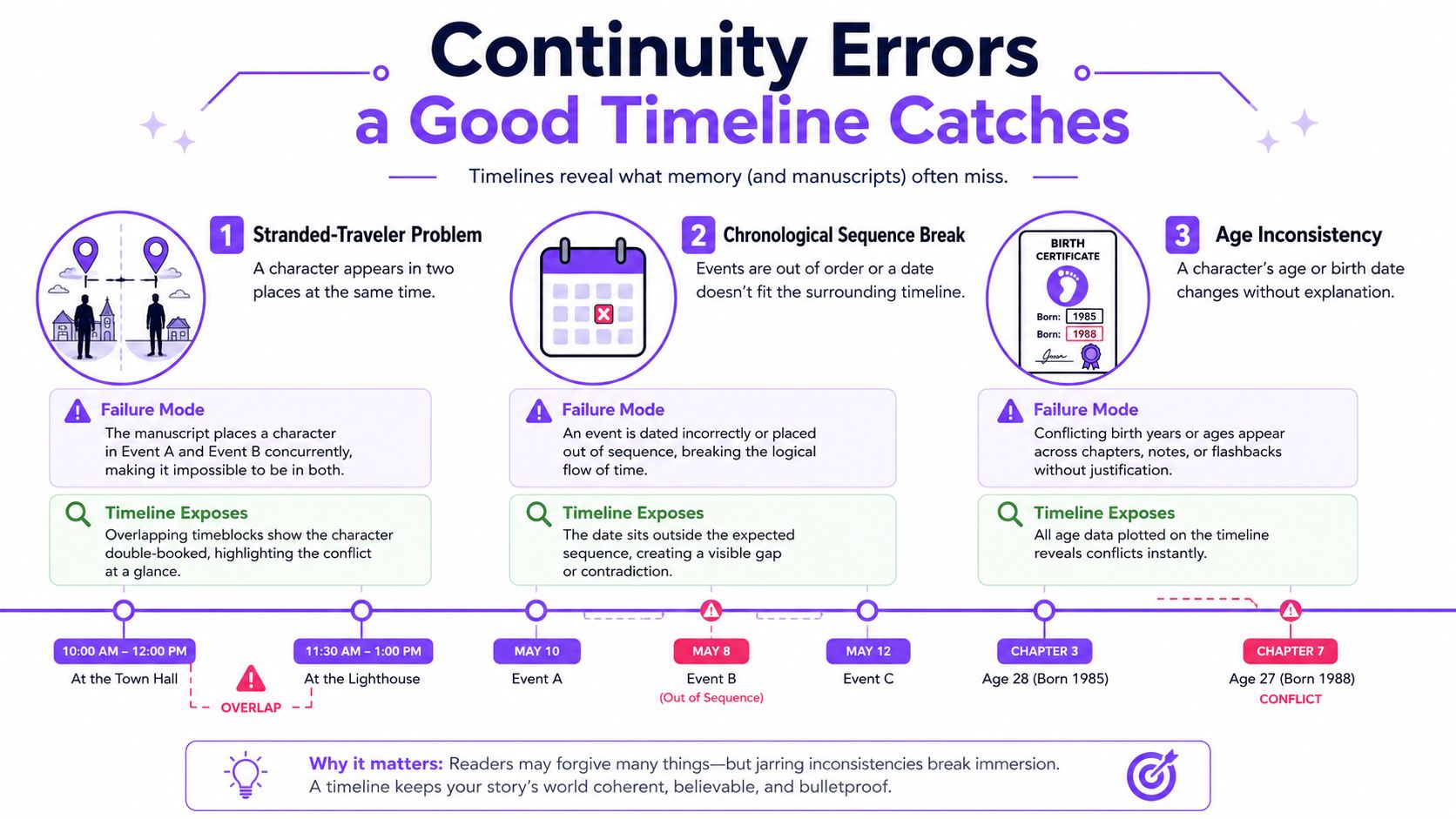
The quiet errors that survive revision
Calendar drift causes the same trouble. A scene establishes Tuesday, a later chapter treats the event as though it happened Thursday, and no intervening event accounts for the change. Moon phases create similar problems in stories where darkness, tides, rituals, or observation matter. A timeline view exposes the mismatch through a broken sequence, an unexpected gap, or inconsistent calendar metadata.
Age math becomes especially unreliable with children. A birthday passes off-page, a later scene describes the child at the wrong age, and the author's mental image wins over the facts already established. The timeline can anchor birth information, birthdays, and scene dates so the character's age changes when the story says it should, not when the writer happens to remember.
The distance between errors matters. Some appear in adjacent chapters. Others surface after a long subplot delay, when a fact introduced early has been contradicted much later. A useful visual timeline lets you filter by character, location, POV, or thread, then inspect the exact scene behind the warning. The continuity error glossary is useful for naming these failures precisely before you start correcting them.
A timeline won't decide whether a contradiction is intentional. It will show you where the manuscript asks the reader to accept two incompatible states.
The following visual demonstration reinforces the point without replacing the manuscript check:
Features That Separate a Writing Tool From a Gantt Chart
A timeline built for revision schedules misses the checks fiction demands, such as knowledge leakage, impossible travel, and a character acting before an event could have happened. Columns, milestones, colored bars, and drag-and-drop cards can organize tasks. They do not show whether the manuscript's sequence holds together across tens of thousands of words.
The first dividing line is extraction from prose. Re-keying every scene into a spreadsheet after drafting creates another maintenance job, and the map starts drifting from the manuscript. A writing tool should pull events, dates, locations, POV signals, and character references from the draft, then let the author correct a mistaken interpretation without rebuilding the entire timeline.
| Feature | Writing Tool | Generic Timeline Maker |
|---|---|---|
| Draft input | Extracts events from manuscript text | Requires manual entry |
| Character knowledge | Tracks when information becomes available | Usually absent |
| Multiple threads | Renders POVs and subplots separately and together | Uses labels or color bands |
| Duration logic | Interprets elapsed time, flashbacks, and jumps | Displays entered dates |
| Conflict detection | Flags impossible sequences and state mismatches | Shows visual overlap only |
| Revision loop | Links an event back to its source scene | Treats the chart as the final artifact |
| Privacy | May support local-first manuscript handling | Often designed around general cloud collaboration |
What earns its place in the workflow
Multi-thread rendering exposes pacing problems hidden by a single line. Separate a romance arc from an investigation, then overlay them. A blank stretch can show one thread vanishing while another dominates. A crowded cluster can reveal several revelations arriving before the reader has space to absorb their consequences.
Duration handling must survive ordinary fiction language. “Two days later,” a flashback, and a long time jump do not arrive as clean spreadsheet values. The system should represent relative time without forcing the writer to assign artificial precision to every event. Exact dates matter when duration, travel, age, or calendar conditions affect the plot. Otherwise, relative or undated events preserve flexibility, as explained in this story timeline guidance.
Privacy belongs on the checklist. Unpublished manuscripts contain commercial, personal, and creative material. A tool that processes drafts locally, or clearly explains storage and training practices, warrants closer scrutiny than one that only produces attractive cards.
Novelium's relevant feature set includes a manuscript-generated Timeline View, tracking for multiple storylines and POVs, and flags for impossible sequences, overlapping events, travel-time conflicts, and time jumps. It also connects extracted events to character and world details, bringing the tool closer to continuity review than project scheduling.
A Real Workflow With Your Draft in the Loop
Start with the draft, not the board. Write the scene that needs writing, leave uncertain dates relative when the plot allows it, and avoid inventing calendar precision just to make a planning document look complete.
At the end of an act or a substantial revision pass, run the manuscript through a visual timeline generator. The useful output should identify scenes with their event time, reading position, POV character, location, and relevant plot thread. You're not checking whether the chart looks balanced. You're checking whether the extracted map agrees with the prose.
Read the map like a skeptical beta reader
Suppose a chapter is marked Tuesday morning. The scene includes a character referring to a meeting that the preceding timeline places on Wednesday. That isn't a design issue. It's a contradiction between the character's knowledge state and the story chronology.
Click the flagged event, return to the chapter, and decide what needs changing. Perhaps the meeting should move. Perhaps the dialogue refers to an earlier conversation. Perhaps the chapter date is wrong. The timeline identifies the pressure point, but the manuscript still supplies the editorial judgment.
After the fix, run the extraction again. A timeline that remains separate from the draft becomes another document to forget. A timeline regenerated from the draft becomes a diagnostic view, similar to a style report or a proof pass.
Read the generated map after the prose has made its decisions. Don't force the prose to obey an obsolete outline.
This loop works particularly well for nonlinear novels. Keep story chronology separate from scene order, then inspect each view independently. A flashback can be perfectly placed in reading order while still creating an impossible age, location, or knowledge state in story time. Writers working through a substantial manuscript can also use Novelium's draft-writing workflow as a reference for keeping revision tools connected to the source text.
The final pass should focus on unresolved flags, not visual perfection. A sparse timeline may be correct. A beautiful timeline may still be wrong.
Systematic Tracking Is No Longer Optional at Novel Length
At short length, memory can carry a surprising amount of continuity. Across an 80,000-word novel, it cannot reliably retain every location, revelation, injury, date, object, relationship shift, and delayed consequence.
Character profiles expose the weakness. They describe temperament, history, and appearance, while a tracking system records what has happened, when it happened, and what the character could reasonably know at each point. Those records answer different editorial questions. A profile may say that a character is injured. A continuity check must show whether that injury has healed before the next scene.
Beta readers remain useful for plot holes and reader confusion, but a normal read will not reliably audit every travel interval or compare a stated age with an earlier birthday. Systematic tracking tests the manuscript against itself, catching contradictions that memory smooths over. The field's shift from hand-built charts to software-assisted visualization reflects the same practical need for a chronology that can be inspected and revised (Preceden's timeline history).
Drafting aids and continuity checkers serve different editorial jobs, and conflating them leaves gaps in both areas. Writers comparing options can review best AI writing tools for novelists, while keeping text generation separate from checks on sequence, knowledge, and cause-and-effect.
Novelium's Character Tracker and World Codex extract details across a manuscript. Its visual timeline maps chronology, parallel threads, POVs, and time-based conflicts. Its local processing model supports manuscript analysis without treating unpublished work as general-purpose training material.
For a series, a large cast, or a manuscript built around delayed consequences, continuity checking belongs in revision. It should run against the draft, identify impossible sequences, and leave the writer to decide whether the date, scene, dialogue, or premise needs changing.
Novelium's Character Tracker, World Codex, and visual Timeline View flag knowledge conflicts, location problems, time jumps, and other continuity issues. Visit Novelium to run your draft through a systematic continuity workflow before the next beta reader finds the mistake.