Understanding Chronological Order in Fiction Writing
Most craft advice treats understanding chronological order as a beginner exercise. Put events in the order they happen, add a few dates, and move on. That advice works until a manuscript becomes large enough to contain several timelines, multiple points of view, recurring characters, and scenes revised months after they were drafted.
At novel scale, chronology isn't a tidy line. It's a continuity system. A character's injury, knowledge, location, age, recovery, and relationship status all change over time, and every later scene inherits those changes. A flashback can be structurally elegant while the underlying story still contains an impossible sequence. A linear narrative can contradict itself without using a single time jump.
Writers don't usually fail here because they lack craft. They fail because they rely on memory for information that has become too distributed to remember reliably.
Chronological Order Is Not a Beginner Concept
Chronological order is often reduced to a simple question: what happened first? That definition collapses in a long manuscript. The meaningful question becomes: what had happened by the time this scene began, what did each character know, and what physical or emotional consequences were still active?
Children's understanding of temporal order develops gradually rather than appearing all at once. In research involving 3-, 5-, and 7-year-olds, children generally understood before and after earlier than terms involving duration or simultaneity, and even at age seven some relations involving since and until remained difficult research on children's temporal-order understanding. That finding matters to novelists because readers and writers use the same underlying machinery to track event order, detect sequence slips, and preserve continuity across extended narratives.
A professional manuscript creates a harder version of the same task. Chapter twelve may establish that a wound has closed. Chapter nineteen may describe the same wound bleeding again, with no new injury, infection, or reopening event. The prose can be polished, the scene can work emotionally, and the contradiction can still be real.
Practical rule: Treat chronology as a continuity discipline, not as a decorative feature of structure.
Human cultures have used calendars, writing, and historical timelines to place events in sequence for thousands of years. Written records made long-range chronology possible at scale, while modern archives still organize evidence through dated periods and ordered events a historical overview of timelines and chronology. Fiction writers face the same basic problem in miniature, except the evidence is scattered across scenes and filtered through character perspective.
Story Order and Narrative Order Are Not the Same
Story order is the chronological sequence of events inside the fictional world. Narrative order is the sequence in which the reader encounters those events. They can diverge without creating a mistake. In fact, most ambitious novels use that gap deliberately.
Take a simple example. The protagonist learns that her brother died in chapter four. That is a narrative event. The death itself occurs between chapters nine and ten in story order. The reader receives the knowledge before receiving the event that caused it.
The two sequences look like this:
| Story order | Narrative order |
|---|---|
| The brother dies | The protagonist learns he died |
| The aftermath begins | The protagonist investigates the circumstances |
| Evidence surfaces | The death is shown between later chapters |
The gap generates suspense, but it also creates obligations. The protagonist must behave as someone who already knows. Scenes before the death cannot contain consequences that depend on it unless the narrative has established another route to that information. The reveal must change the reader's understanding without violating the character's knowledge state.
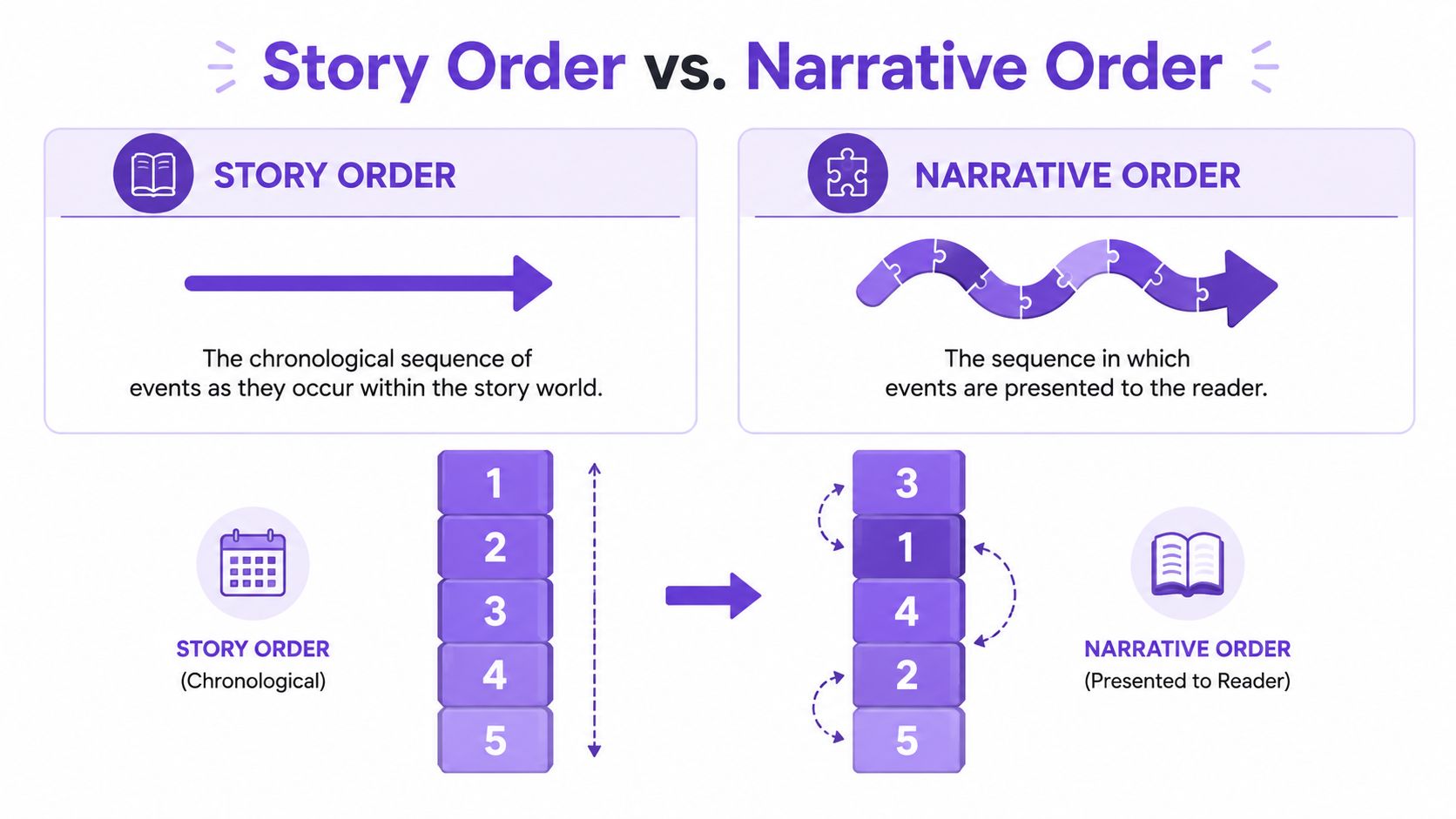
The distinction is especially useful when working with flashbacks, flash-forwards, and parallel threads. A scene's placement on the page doesn't tell you where it belongs in the fictional timeline. A useful discussion of these structural choices appears in ClipCreator.ai's narrative guide, which treats narrative structure as an arrangement of reader-facing information rather than a simple replay of events.
Don't use narrative order as a substitute for story chronology. Keep both records. One tells you what happened. The other tells you when the reader learns it.
What Actually Breaks in Long Manuscripts
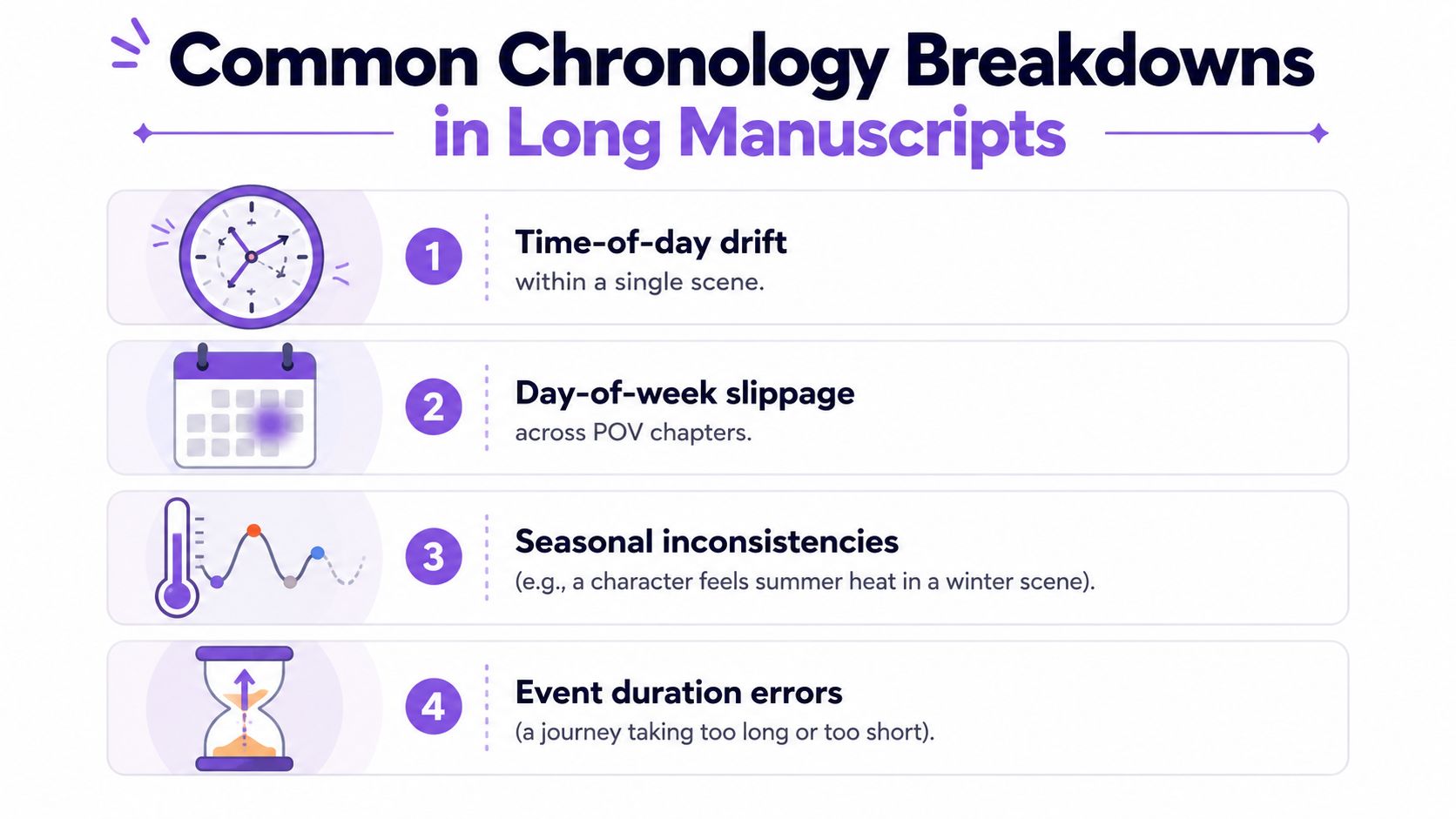
Timeline errors rarely begin with the central plot. They begin in small fields that no one thought to track. A scene starts in late afternoon, crosses into evening, and still has characters reacting as though the sun hasn't moved. A point-of-view switch turns Tuesday into Wednesday because each chapter was drafted from a different set of assumptions.
Use a full-manuscript scan to check the details that survive ordinary chapter review:
- Time of day: Track light, meals, work shifts, sleep, travel departures, and anything else that fixes the hour.
- Calendar movement: Verify weekdays, holidays, appointments, school schedules, and deadlines across point-of-view changes.
- Aging: Check children, pregnancies, birthdays, anniversaries, and characters whose roles depend on age.
- Season and weather: Compare clothing, temperature, daylight, vegetation, storms, and local conditions rather than trusting isolated descriptions.
- Travel duration: Match journeys to the distance and transport implied by the scene. A character can't leave one location, conduct a full meeting, and arrive somewhere distant five minutes later unless the story provides a reason.
- Recovery: Log when an injury happens, what treatment follows, and what limitations remain. A serious injury shouldn't vanish because the next scene needs the character to run.
A timeline isn't useful because it contains dates. It's useful because it exposes contradictions between scenes.
Chronological reasoning also becomes harder when sequences run backward or involve unfamiliar material. Research on temporal ordering found the strongest performance for familiar events in forward order and the weakest for unfamiliar events in backward order research on directional and familiar-event ordering. That pattern supports a practical editorial choice: build the forward chronology first, then validate reversals and complex reveals against it.
The Continuity Failures That Haunt Series Drafts
A familiar series problem looks harmless at first. A character born in autumn celebrates a spring birthday in a later book. A wound sustained on Tuesday is nearly healed by Friday, then appears fresh again two chapters afterward. A character who witnessed an event in the previous installment suddenly asks questions that only make sense for someone who wasn't there.
These errors usually enter through ordinary production habits. Chapters get written weeks apart. An old reference file remains open while a newer decision lives only in the author's head. A revision moves the inciting event but leaves three later references untouched. No individual scene announces the failure. The contradiction appears only when the manuscript's accumulated evidence is compared.
The problem intensifies in series fiction because each published book creates constraints for the next one. A character's age, injury history, loyalties, knowledge, and location become inherited data. You can't casually revise them without checking every dependent scene.
This is why a continuity error isn't usually a talent problem. It's a data architecture problem disguised as a prose problem. The manuscript contains the information, but the writer has no reliable way to query it.
A useful audit asks whether the current scene agrees with what the story has already established. The Novelium continuity error glossary frames the issue in those practical terms, as a mismatch between details that should remain consistent across the work.
The distinction matters because a chapter outline records intended movement. It doesn't necessarily record what the text now asserts. For that, you need tracking.
Profiles Are Not Tracking Systems
A character profile is a static reference document. It can record eye color, family background, allergies, education, backstory, and other stable facts. Those details have value, especially when a large cast makes basic retrieval difficult.
A profile doesn't tell you where the character is in chapter twelve, what they learned in chapter eight, which promise they made in chapter fifteen, or whether they can physically climb stairs after an injury. Those are live conditions, and they change as the manuscript changes.
A tracking system records state at scene boundaries. For each consequential event, note when it happened, when it was shown, who participated, who learned about it, and what changed. That level of detail catches a knowledge-state error that a conventional profile misses.
Consider a protagonist who swore revenge in the first book. In the third book, she conveniently fails to recognize the antagonist's face. That isn't automatically wrong. Memory suppression, disguise, altered appearance, trauma, or deliberate deception could explain it. But the manuscript must establish the reason. Without a logged state change, the omission reads like authorial forgetfulness.
Profiles answer who someone is. Tracking answers what is true right now.
The character bible glossary is useful for understanding the reference-document side of the distinction. For working continuity, add a changing record of location, knowledge, physical condition, relationships, possessions, and commitments. Most authors invest heavily in the first category because it feels like character development. Most continuity failures live in the second.
Designing Non-Linear Timelines on Purpose
A flashback shouldn't exist because the present-day scene isn't landing. That is improvisation wearing structural clothing. If the story needs a past event, decide what the reader must learn from it and why the present timeline can't deliver that information more effectively.
Before inserting a flashback, state its function in one sentence: the present timeline gains what by leaving it? The answer might be a changed interpretation of a character's motive, a withheld cause, or a contradiction between public history and private memory. If the answer is merely atmosphere, the flashback is decoration.
Parallel threads require the same discipline. Mark where each thread begins, where it intersects another, and which information crosses between them. A reader can follow separate timelines when the author controls the handoffs. They struggle when the manuscript treats every shift as self-explanatory.
The structural cost is cognitive. Each break in chronology asks the reader to rebuild context, identify the new temporal position, and reconcile what has already been revealed with what is now being shown. That work isn't free. A reversal can increase suspense, but repeated reversals without a clear payoff make the reader spend attention on orientation rather than consequence.
A chronological master record protects the design. Keep story order separate from chapter order, then map each flashback or parallel scene onto both. The nonlinear narrative glossary offers a useful vocabulary for discussing the form, but the practical standard is simpler: every departure from the present must earn its place.
Chronology as an Auditing Problem at Scale
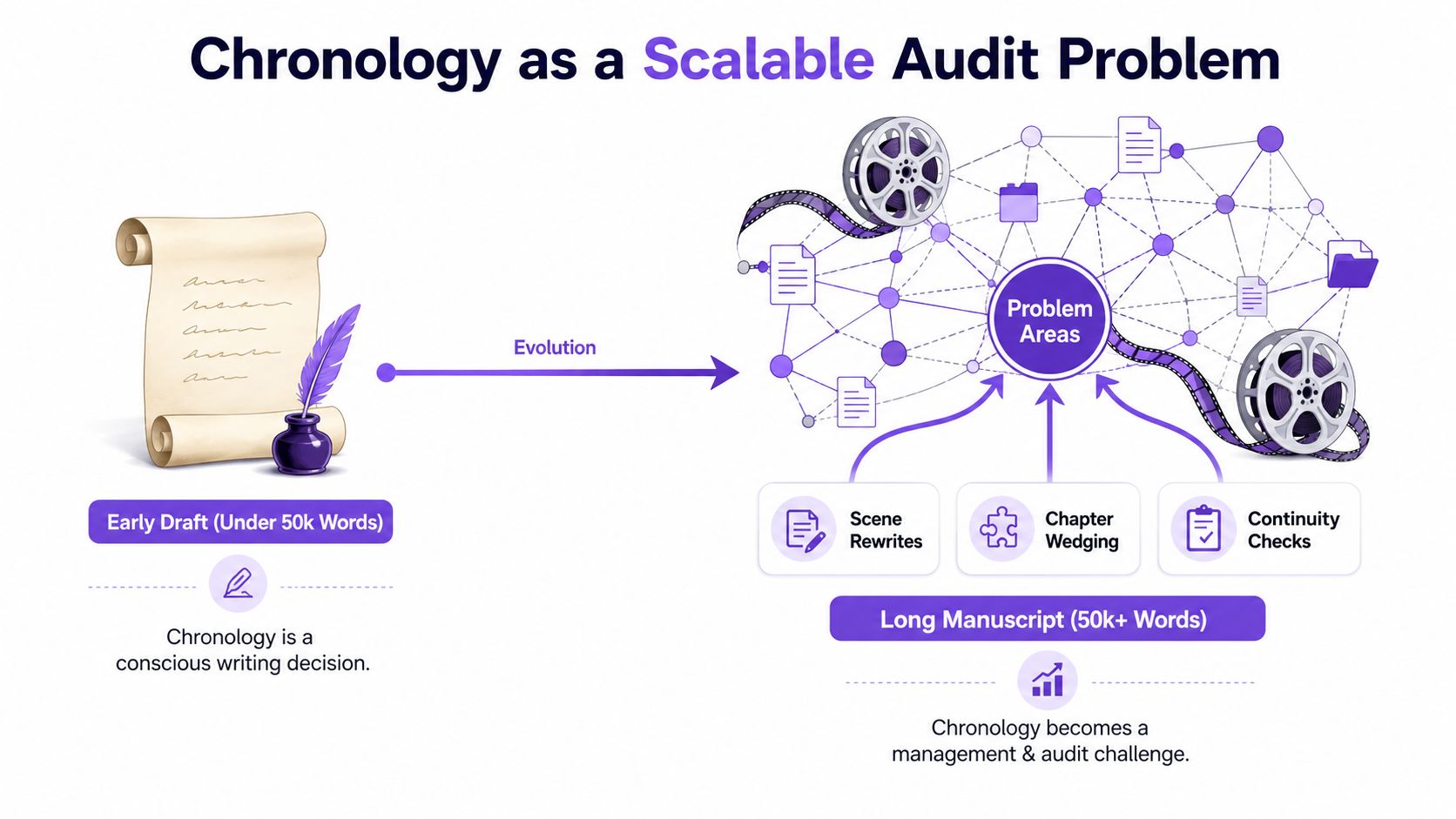
Once a draft becomes long, chronology stops behaving like a writing decision and starts behaving like an audit. Scenes are rewritten, chapters are inserted, and secondary timelines drift. Travel days, political seasons, recoveries, and pregnancies can all move out of alignment while the main plot still appears intact.
Treat the manuscript like a ledger. An outline describes intent. A ledger records what the pages contain. Every consequential event needs a defensible position in story order, and every later revision needs to be checked against the entries that depend on it.
Neurocognitive research supports the editorial instinct behind this approach. Establishing temporal order recruits mechanisms distinct from representing event content, with the left posterior hippocampus associated with temporal ordering and the anterior hippocampus associated with content representation; other regions linked to controlled processing and visual-spatial support also become involved research on the neural basis of temporal-order processing. In plain terms, knowing what happened isn't the same as knowing where it belongs.
Audit the sequence separately from the scenes. A beautiful scene can still occupy an impossible position.
Longer sequences create another problem for automated and human review alike. Recent work on temporal reasoning in language models describes local order being preserved while global consistency degrades as sequences grow longer recent work on long-sequence temporal reasoning. The practical lesson doesn't depend on any particular technology. Long timelines need explicit constraints, because local coherence won't guarantee global coherence.
What Serious Timeline Control Looks Like
Serious timeline control isn't one giant spreadsheet. It has three separate layers, each answering a different question.
| Layer | Purpose | What It Tracks | Failure If Skipped |
|---|---|---|---|
| Master chronology | Establish story order | Dated events and causal sequence | Events get placed according to chapter convenience |
| Narrative map | Control reader-facing order | Which chapter reveals which event | Reveals arrive before their logic is ready |
| Continuity register | Preserve scene-level state | Location, knowledge, injuries, weather, clothing, relationships | Characters and settings reset between scenes |
The master chronology comes first. Record every consequential event in the order it occurs inside the fictional world, independent of where the reader sees it. If you start with the chapter map, you'll often force the underlying timeline to serve presentation rather than logic.
The narrative map then translates that chronology into reading order. It records what the reader knows at each point, which is where suspense and dramatic irony live. A death shown late, a secret learned early, and a parallel investigation can all work if both orders remain visible.
The continuity register handles the dirty work. Refresh it at every scene boundary. Track who is present, where they are, what they know, what they carry, what has changed physically, and which relationships or promises are active. This is the layer that catches the fresh wound, impossible arrival, and forgotten revelation.
Chronology isn't merely a line of dates. It's a controlled relationship between events, presentation, and state. Once the manuscript becomes complex, that relationship deserves infrastructure rather than memory.
Novelium's Character Tracker and World Codex extract and track character details across a manuscript, while its Timeline feature visualizes chronology, parallel storylines, and time-based continuity issues. Visit Novelium to examine how systematic tracking can protect your next long manuscript from the small contradictions that become expensive at publication.