Taming the God-Mod: A Working Definition of Third Person Omniscient
Let's get straight to it. You know the textbook third person omniscient point of view definition: the narrator is a god, seeing and knowing everything, flitting into any character's head at will. But if you’re trying to wrestle an 80,000-word manuscript into shape, that simple definition isn't just unhelpful—it's dangerous.
Omniscience Isn't Knowing Everything. It's Controlling Everything.
The real game with omniscience isn't about access, it's about control. The hard work isn't just knowing it all; it's deciding what to tell the reader and when, without shattering the story's spell. Too many writers hear "omniscient" and take it as a free pass for chaotic head-hopping. The result? A confusing mess that pushes readers away and creates a continuity nightmare down the line.
This whole approach falls apart because it misses the most crucial point: what the narrator knows and what the characters know are two completely different things.
The Narrator vs. The Character
Here’s a better way to think about it. Your omniscient narrator holds the complete, beautifully rendered map of your story's world. They see every hidden path, every secret, every character's past and future. Your characters, on the other hand, are each clutching a tiny, crumpled corner of that same map. They can only see what’s right in front of them.
The art of omniscient POV is in choosing which piece of that big map to reveal, and when. This is where even the most complex manuscripts stumble. We've seen it time and again in the drafts we analyze: an author accidentally gives a character a piece of information they couldn't possibly have, just because the narrator knew it.
The biggest failure in omniscient POV isn't head-hopping. It’s when the narrator's intelligence becomes inconsistent. The narrator acts like a fickle god, knowing a character's deepest secret in Chapter 5 but conveniently forgetting it by Chapter 25 just to gin up some cheap suspense.
This leads to the kind of glaring continuity errors that sophisticated manuscript analysis tools are built to find. For example, a character acts cautiously around a traitor, even though the narrator only revealed the betrayal to the reader a chapter ago. Suddenly, the character's knowledge and the reader's knowledge have gotten tangled up, and the whole illusion crumbles.
A Better Definition for Working Novelists
Forget the academic jargon. For a writer juggling a huge cast and a twisting plot, a more useful definition for third person omniscient is this: A narrative mode that requires you to meticulously track narrator-level information and character-level information as two separate things.
This simple shift changes everything. It reframes the POV from the privilege of knowing everything to the responsibility of managing that knowledge. It stops being about what the narrator can do and becomes about what the narrator should do to tell the best story. That small distinction is what separates an amateur, confusing narrative from a masterfully controlled one.
Writing great omniscience is almost like being an architect of information. You have to ask questions that go way beyond what a simple character sheet can tell you:
- Why is the narrator revealing this specific piece of information right now?
- How does this tidbit serve the larger plot, the theme, or a character's journey?
- If I show this thought from Character B, does it kill the tension I've been building from Character A's perspective?
In this guide, we're going to break down the structural demands this POV puts on a story. We’ll move past the simple definition and get into the practical, high-stakes game of information control.
Distinguishing True Omniscient from Its Relatives
Let’s get this sorted out. We all know the textbook definitions, but when you're deep in a manuscript, the lines between omniscient, third-person limited, and third-person objective can get awfully blurry. This isn’t just some academic debate; it’s a practical diagnostic tool. In our experience analyzing manuscripts, misidentifying your own narrative mode is the root cause of countless consistency failures in complex stories.
And honestly, the confusion is understandable. These points of view are close relatives, not strangers. They all use he, she, or they. The real difference comes down to the narrator's access card. Who has clearance to get inside a character's head, and when are they allowed to use it?
Think of it like this: mastering omniscience isn't about knowing everything, but about controlling the flow of that knowledge to the reader. It’s a deliberate filtering process.
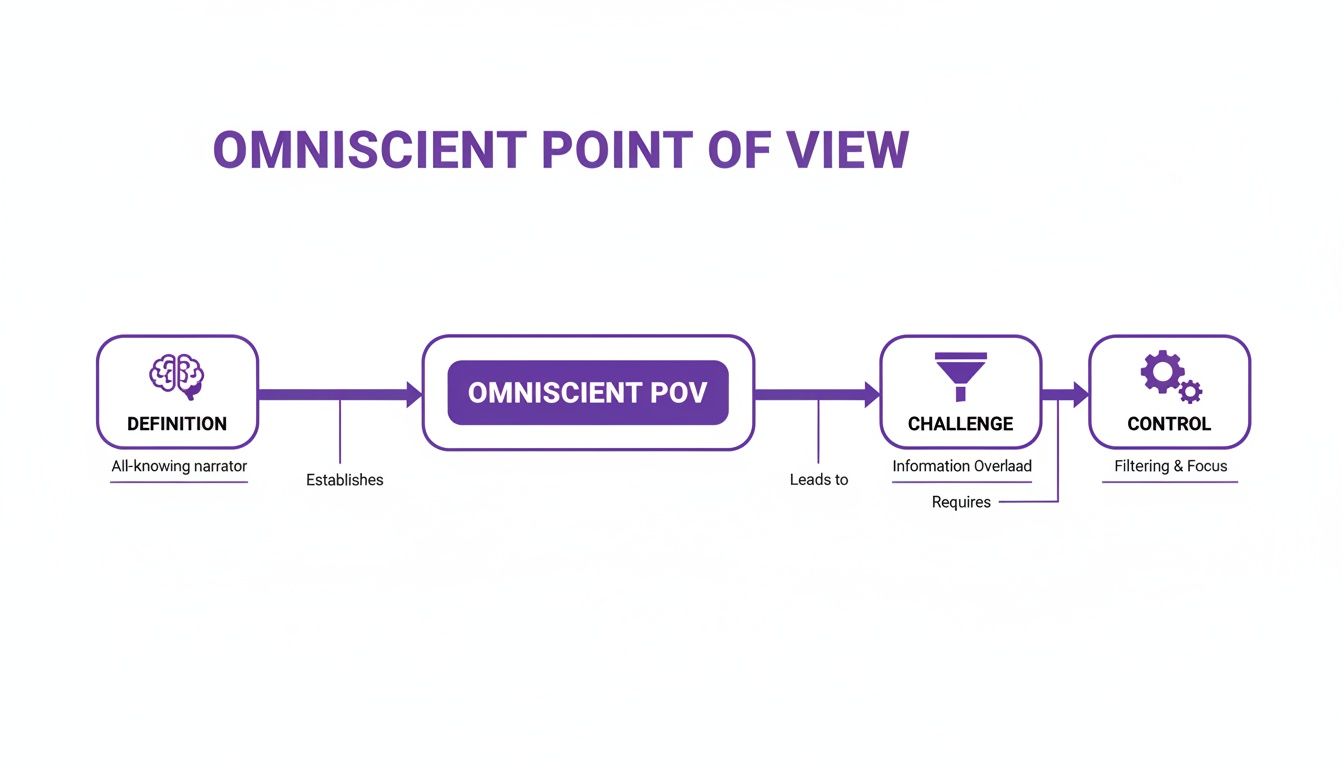
As you can see, the challenge isn't the knowing—it's the deliberate funneling of that knowledge to create a specific effect on the page.
Third-Person Limited: The Close-Up Shot
There’s a reason third-person limited is the king of modern commercial fiction. It gives you the intimacy of first-person without the claustrophobia. The narrator’s camera is basically strapped to one character’s shoulder per scene or chapter. Your reader sees, hears, and knows only what that single character does.
The rule here is brutally simple: if your viewpoint character doesn't know the assassin is hiding in the rafters, neither does the reader. The entire narrative contract is built on this shared journey of discovery. The moment you break that rule—even for a single sentence to tell us what another character is thinking—you shatter the reader's trust. It’s a classic unforced error that screams a lack of control.
Third-Person Objective: The Security Camera
Often called the "cinematic" POV, third-person objective is the polar opposite. Your narrator is a fly on the wall, a completely detached observer. It reports only what can be seen and heard, just like a security camera recording a scene. You get zero access to any character's internal thoughts or feelings.
This forces you to show emotion and intent purely through action, dialogue, and body language. It creates a stark, sometimes cold, narrative distance, but its power lies in what it withholds. The reader has to become a detective, piecing together motivations from external clues alone.
The core distinction is the source of information. In limited, information is filtered through a character's consciousness. In objective, it's filtered through external senses. But in true omniscient, it comes directly from a narrative intelligence that exists outside and above the characters entirely.
This table breaks down how that knowledge access differs, which is key to diagnosing what you're actually writing.
POV Knowledge Access Comparison
| Point of View | Narrator Knows | Reader Knows | Primary Consistency Challenge |
|---|---|---|---|
| Third-Person Limited | Thoughts/feelings of one character per scene. | Only what the viewpoint character knows. | Accidentally revealing information the viewpoint character couldn't possibly know (a POV break). |
| Third-Person Objective | No one's internal thoughts or feelings. | Only what can be externally observed (seen/heard). | Inadvertently slipping into a character's head and describing an internal state. |
| Third-Person Omniscient | Thoughts/feelings of any/all characters. | What the narrator chooses to reveal from anyone, anywhere. | Inconsistent application of knowledge; revealing too much and killing suspense (info-dumping). |
Seeing them side-by-side makes it clear: the power of each POV comes from its limitations.
True Omniscience: The All-Access Pass
And that brings us back to the third-person omniscient point of view definition that actually matters for writers. It’s not just about knowing everything. It’s about having an all-access pass and using it with surgical precision. The narrator can dip into Character A’s mind to show their crippling anxiety, pull back to describe a historical detail about the room that only the narrator could know, then pivot to reveal Character B’s secret, simmering contempt.
The danger, as we've seen in countless manuscript analyses using tools like Novelium, is using this freedom carelessly. A common flaw is a subtle slide from a tight limited perspective into an omniscient comment. The writer knows a key piece of information, so they let the narrator leak it, even though the viewpoint character for that scene is completely oblivious.
That isn't a clever use of omniscience; it's a POV break. It undermines the scene's tension and the novel's entire structure. Real, effective omniscience requires its own rigorous set of rules, defined and executed by an author who is always in control.
Why Modern Fiction Often Avoids Omniscient POV
For a long time, omniscient POV was the default setting for fiction. From Jane Austen to Leo Tolstoy, it was the way you told a story. Today, it feels more like a deliberate, almost niche, stylistic choice. And a rare one at that.
So, what gives? This isn't just about literary tastes evolving on a whim. The shift comes from what modern readers crave: a deep, personal connection with the characters. As fiction veered away from sweeping, plot-first sagas and leaned into intensely personal, character-driven journeys, the demand for a closer psychic distance exploded.
Third-person limited is practically built for this. It straps the reader right into a character's mind, giving them a direct, unfiltered feed of their thoughts and feelings. You get that sense of immediacy, of discovering the world right alongside them, which has become a hallmark of contemporary storytelling. Omniscient, by its very nature, keeps you at arm's length. The narrator is an interpreter, a guide standing between you and the characters.
A Problem of Control, Not Quality
This doesn't mean omniscient is the inferior POV. Far from it. When a writer nails it, they can achieve a kind of narrative breadth and thematic depth that a tight third-person limited can't touch. It’s the perfect tool for building delicious dramatic irony or weaving together complex, sprawling plotlines where you need to see the bigger picture.
The real reason so many writers—and their agents and editors—shy away from it is because it’s brutally difficult to control. That total freedom is a trap. Without a disciplined hand at the wheel, the narrative can dissolve into a confusing soup of head-hopping, yanking the reader from one character's mind to another without any clear purpose.
We see this constantly in manuscripts. A writer dips into one character’s thoughts for a single line, then jumps to another’s in the very next sentence, all within the same paragraph. That’s not masterful omniscience; it’s an uncontrolled narrative leak that just kills tension and leaves the reader completely disoriented. It’s a red flag that the writer hasn’t made a firm decision about how to deliver information.
Omniscient narration has seen a well-documented decline in contemporary publishing, with third-person limited now firmly established as the predominant POV choice. While historical analysis confirms omniscient’s dominance throughout the 18th and 19th centuries, modern market preferences have reversed this trend, favoring the intimacy of a limited perspective. Learn more about how publishing trends have shifted narrative perspectives on racheljrowlands.com.
The Modern Application of an Old Technique
So, is third person omniscient point of view definition just a dusty relic now? Not at all. It’s just become more of a specialized tool. Today, authors who use it tend to do so with very clear, self-imposed rules. Maybe they'll use it for a prologue to set a grand stage, or for brief, intermittent chapters to provide crucial context that no single character could possibly know.
The key word here is intentionality. Choosing omniscient can’t be a passive decision or, even worse, an accident that happens during a rewrite. It requires an architectural level of planning, more like mapping out a multi-generational saga than just tagging along with a single character.
For authors who thrive on meticulous outlining, this can be an incredibly powerful tool. But for those who write more by the seat of their pants, it can be a structural nightmare. We get into this dynamic a lot more in our guide to the ongoing debate between plotters and pantsers.
Ultimately, avoiding omniscient POV is often just a pragmatic choice. It asks a writer to manage not just a cast of characters, but also a separate narrative entity with its own voice and agenda. In a market that prizes character-first immersion, the focused lens of third-person limited is simply the more direct and, often, more effective tool for the job.
If you choose omniscient today, you're knowingly playing on hard mode. You’d better have a very good reason for it.
The Single Biggest Failure Point in Omniscient Narration
Let’s talk about where omniscient narration truly falls apart. Based on our analysis of thousands of manuscripts, the cardinal sin of this POV isn't clumsy head-hopping. That's just a symptom. The real disease is inconsistent narrator intelligence.

The narrator becomes a fickle god. In Chapter 5, it knows the king’s deepest, darkest secret. But by Chapter 25, when that secret would neatly resolve a conflict, the narrator conveniently forgets it exists to manufacture cheap, unearned suspense.
This kind of thing drives readers up the wall. It completely undermines the logical foundation of your plot.
The only way to avoid this trap is to stop thinking of your omniscient narrator as a disembodied voice and start treating it like a character. It needs its own rules, a clearly defined scope of knowledge, and a consistent purpose for every single piece of information it reveals.
Establishing Your Narrator's Profile
Before you even write page one, you need to define the operating system for your narrator. This isn’t a fun character questionnaire about their favorite color. Think of it as a mission statement, a set of hard-and-fast rules that govern how information moves from the narrator to the reader.
I call this creating a "Narrator Profile." It means answering a few key questions about its capabilities and limitations. These answers aren't just for you; they become the unbreakable contract between your story and your reader.
An untracked omniscient narrator is a plot hole waiting to happen. The moment it reveals something that contradicts a character's later actions or motivations, the narrative's credibility is shot. The problem is rarely the character's choice; it's the narrator's sloppy information management.
This profile dictates the logic of your entire book. A narrator who passes moral judgment on its characters creates a completely different story than one that remains clinically detached.
Defining the Rules of Engagement
To build this profile, you have to make some hard decisions. Your narrator's powers aren't limitless by default; you are the one who sets the limits. Here are the core parameters to define:
- Temporal Scope: Can your narrator see the future? Does it only know the past and the present state of all characters? If it drops a line like, "He didn't know it then, but this would be the last time he saw his brother alive," you've just established precognition. You have to use that power consistently, not just once for a dramatic punch.
- Moral Stance: Does your narrator have an opinion? Is it a judgmental Victorian moralist, a wry and cynical observer, or a completely neutral reporter of facts? Its tone and word choice must reflect this stance through the whole manuscript.
- Foreshadowing Policy: How does your narrator handle foreshadowing? Does it offer subtle hints woven into the description, or does it make direct, overt statements about what’s to come? Pick a lane and stay in it.
For example, we analyzed a manuscript where the omniscient narrator revealed in Chapter 10 that the protagonist, a detective, had a debilitating fear of water. But in Chapter 30, the detective fearlessly dives into a raging river to save someone. There was no intervening scene showing him overcoming his phobia.
This wasn't a character inconsistency. It was a narrator-level failure. The narrator offered up a critical piece of information and then completely ignored its implications later on. The fix isn't to change the character's actions; it's to enforce the narrator's own rules, ensuring every piece of revealed information has consequences and is tracked from its introduction to its resolution. Defining your third person omniscient point of view definition demands this level of structural rigor.
Tracking Narrator Knowledge Versus Character Knowledge

This is where all your lovingly crafted spreadsheets and character bibles fall apart. A static character profile is great for remembering a hero’s backstory or their mother’s maiden name. What it cannot do is track the ever-shifting gap between what that character knows and what your all-seeing narrator has told the reader.
That gap—that delta—is the brutal, central challenge of writing in omniscient POV. You're juggling two completely separate streams of information across hundreds of pages. If they cross, your entire plot can self-destruct. The real work isn’t just knowing the definition of third-person omniscient; it’s building a system to manage the fallout, scene by scene.
The Two Ledgers of Omniscience
The only way to wrestle this beast is to treat narrator knowledge and character knowledge as two different ledgers. Think of it like a double-entry bookkeeping system for your plot. For every critical piece of information—the location of the hidden will, the traitor’s real identity, the protagonist's secret fear—you have to log two distinct events.
First, you log when and how a character learns that piece of information. That entry goes into their personal knowledge ledger. Second, you log when and how the narrator reveals that same information to the reader. That goes into the narrator’s ledger, which represents what your reader knows at any given moment.
The classic blunder we see in manuscripts all the time is a character acting on information that only exists in the narrator's ledger. The reader was told in Chapter 3 that the safe combination is 12-34-56. Then, in Chapter 20, a character who was never anywhere near that revelation suddenly walks up and tries the combination. The author forgot who knew what. They tracked the information itself, but not who possessed it.
This kind of slip-up is almost invisible when you're buried deep in your own draft. After months or years with a story, the line between what you know and what a character is allowed to know gets hopelessly blurred.
Systematizing the Flow of Information
Trying to track all this by hand is a nightmare, but it's not impossible. It just demands a level of obsessive discipline most of us would rather spend on, you know, writing. For every key revelation, you need to log it.
- The Revelation: What’s the specific piece of info? (e.g., "Lord Ashworth is poisoning the king.")
- Character Acquisition: Which character learned this, where, and how? (e.g., "Elara, Chapter 12, overheard him in the stables.")
- Narrative Revelation: When did the reader find this out? (e.g., "Narrator, Chapter 9, through an omniscient aside.")
With these three points tracked for every single plot-critical detail, you can spot inconsistencies instantly. If Elara confronts Lord Ashworth in Chapter 11, your own system will scream at you that you've created a timeline paradox. Without that system, you might not catch it until a beta reader gently points out the gaping plot hole.
This is exactly the kind of problem our novel writing software was built to solve. Manually maintaining these ledgers for dozens of characters and plot points over 300 pages is just not sustainable. A platform like Novelium automates this, creating a verifiable ledger for what the narrator has revealed and flagging scenes where a character’s actions don’t line up with what they actually know. It turns that chaotic mess of sticky notes and spreadsheets into a clear, queryable database of who knows what, and when.
Still Have Questions About Omniscient POV?
Even for authors who've been at this for a while, getting an omniscient POV right can bring up some tricky questions during the draft and—especially—the revision. These are a few of the advanced puzzles we see writers wrestling with when they step into the shoes of an all-knowing narrator.
How Do You Avoid Jarring Head-Hopping?
The trick is all in the transition. You can’t just leap from one character's head to another in the middle of a single, frantic action. That’s a recipe for reader whiplash.
Think of your narrator as a camera operator. A smooth, deliberate pan from one character to another feels right because it serves a purpose. A sudden jump-cut in the same beat just feels clumsy and yanks the reader right out of the story. Often, the best move is to anchor a scene in one character's experience, only pulling back or shifting to another head for a specific, powerful reason that pushes the narrative forward.
Use paragraph breaks as your natural transition points. They signal a conscious shift in perspective, giving the reader a moment to adjust.
Can You Mix Omniscient and Limited POV in the Same Novel?
You absolutely can, but it has to be an intentional, consistent choice. It can't be an accident. Some contemporary authors pull this off beautifully, using what you might call a "variable third-person." They'll stick close to one character for several chapters, then zoom out into a more omniscient mode for a chapter to give the reader that broader, god-like context.
The one and only rule here is consistency. If you show the reader early on that the narrator can and will make these shifts, they'll accept it as part of the story's DNA. The problem comes when you’ve been writing in a tight, third-person limited POV for a hundred pages and then suddenly drop in a random omniscient sentence out of nowhere. The reader immediately sees the author's hand, and the magic is gone.
What Is the Best Way to Revise for Omniscient POV Consistency?
Honestly, a manual revision for this is a beast. It requires at least two separate, dedicated passes through your manuscript.
First, do a read-through focusing only on the narrator’s voice and knowledge. Is it consistent? Does it reveal information in an order that makes sense for the plot? You’re essentially making notes on the "rules" your narrator follows.
Then, do a completely different pass tracking only character knowledge. For every major plot point, ask yourself: "Who knows this, and when did they learn it?" You have to map that timeline against their actions to make sure no one acts on information they shouldn't have yet. It’s an incredibly time-consuming process, which is why automated tools have become such a huge help for complex stories. It's a different kind of problem than, say, navigating the ethics of writing with AI, as this is purely about the structural integrity of your world. A platform can track all this for you, flagging contradictions that might take you weeks to hunt down by hand.
Juggling what the narrator knows versus what each character knows is easily the biggest headache of writing in omniscient POV. It really demands a systematic approach that most of us just can’t pull off manually, not at scale anyway. Novelium was built to solve this exact problem. It automatically tracks every detail across your manuscript to ensure your narrator stays consistent and your characters act only on what they truly know.
Stop spending your precious writing time hunting for plot holes. Let our manuscript intelligence find them for you. Try Novelium today and see what your manuscript is hiding.