The Order of the Rose: What Every Writer Should Know
The popular advice is to “do your research” before using a title like the Order of the Rose. That's necessary, but it isn't sufficient. The core problem comes earlier: writers often assume the phrase names one coherent tradition, then build a court, hierarchy, ritual, and backstory from pieces that never belonged together.
For a novelist, that kind of mix-up is more than a history error. It creates continuity problems. A character may treat the rose as a sovereign decoration in one chapter, a peer-bestowed honor in the next, and a secret-society emblem by the finale. Readers can feel the contradiction even when they can't name it. The phrase has at least two documented historical lineages, plus a loose fictional cluster that borrows its atmosphere. The distinction matters because intertextuality works best when the borrowed signals are deliberate.
Why One Title Can Mean Several Things
The Order of the Rose doesn't point to a single institution. It can refer to the Brazilian Imperial Order of the Rose, a formal dynastic honor founded by Emperor Pedro I; the Society for Creative Anachronism's Order of the Rose, a living tradition tied to queens, consorts, and Crown Tourney culture; or a fictional organization invented for a novel, game, or tabletop setting.
Those are different worlds with different authorities. The Brazilian order belonged to a nineteenth-century monarchy. The SCA order belongs to a participatory historical-reenactment culture. Fictional versions may borrow the rose for romance, secrecy, religious symbolism, courtly menace, or simple dramatic elegance. The shared noun doesn't create a shared genealogy.
That distinction is easy to lose because “order” sounds authoritative in every context. It suggests ranks, oaths, regalia, and a membership ledger, even when a work uses the word loosely. A writer who imports one tradition's hierarchy and another's emotional meaning can accidentally produce an organization with no stable logic.
The phrase also sometimes brushes against Rosicrucian references, especially the Order of the Rosy Cross. That association belongs to a different symbolic and literary stream. A rose can signify devotion in one setting, dynastic legitimacy in another, and hidden knowledge in a third. Treating those meanings as interchangeable is how an evocative title turns into historical soup.
The useful question isn't “What does the Order of the Rose mean?” It's “Which Order of the Rose am I invoking, and what authority does that choice create?”
The Brazilian Imperial Order of the Rose
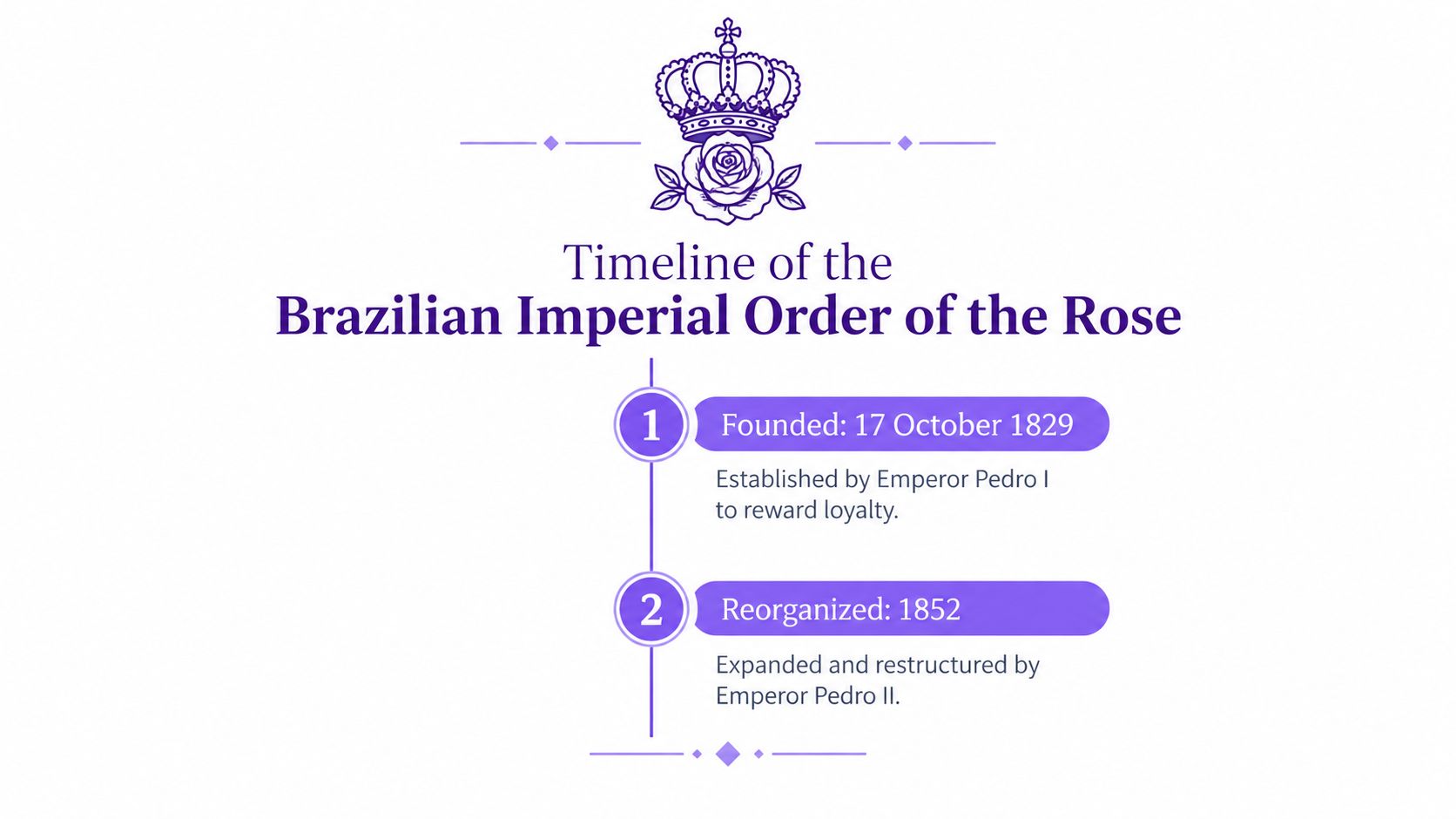
The Brazilian Imperial Order of the Rose has a firm historical spine. Emperor Pedro I instituted it on 17 October 1829 to commemorate his marriage to Amélie of Leuchtenberg, making it one of the major Brazilian dynastic orders of the nineteenth century. The founding date and marriage origin matter because the honor tied personal monarchy to public ceremony. It wasn't merely a decorative badge. It helped present the imperial household as a source of legitimate rank after Brazilian independence. (Historical account of the Order of the Rose)
Its organization was unusually precise. The order had six grades, with the upper classes limited to 16 Grand Crosses, 16 Grand Dignitaries, and 32 Dignitaries. Commander, Officer, and Knight had no stated numerical limit in the verified historical account. Those caps give a novelist useful social machinery: a promotion can be politically explosive because the vacancy matters, while a lower appointment can still carry prestige without implying entry into an impossibly tiny inner circle.
Why the numbers matter to story logic
The available evidence records that Pedro I granted only 189 insignia from 1829 to 1831. That small early total reinforces the character of the award as a selective court honor, not a mass decoration. It also gives a writer a clean way to dramatize access. A recipient isn't just receiving a pretty object. They're entering a controlled system in which the crown decides who deserves visible proximity to power. (Historical account of the Order of the Rose)
The order was abolished as a national decoration on 22 March 1890, after the fall of the monarchy. Its active life as an official state honor therefore spanned 61 years, a fact that should be linked directly to the historical record rather than rounded into vague “decades.” After abolition, it continued as a dynastic house honor rather than a state decoration. That shift changes who can confer it and what the conferment means.
If you're tracking this material in a manuscript, separate the founding event, the grade structure, the grant history, and the post-monarchy status. Fact-checking isn't just about checking whether a date looks plausible. It's about preventing a character from receiving a state honor after the state has stopped existing in that form.
The SCA Order of the Rose
The Society for Creative Anachronism's Order of the Rose is unrelated to the Brazilian imperial order. It emerged inside a living-history society, not a monarchy, and its authority comes from the society's ceremonial culture rather than a historical sovereign.
The SCA's historical account places the founding on Twelfth Night, AS II, corresponding to 6 January 1968, by King William the Silent and Queen Sheryl of Thespis. The order was created to honor people who had been queens or had served as ladies to fighters who won some of the earliest Crown Tourneys, at a time when there were no queens. That origin gives the title a distinctive emotional register. It recognizes service, partnership, and the social labor surrounding tournament achievement, rather than hereditary rank. (SCA history of the Order of the Rose)
The phrase “order” can mislead readers here. This isn't a state decoration with a sovereign's administrative machinery behind it. It's a tradition maintained through participation, ceremony, memory, and peer recognition. The recipient's status comes from belonging to a community that understands the award and continues to honor its holders.
That's a rich model for fiction because the authority is intimate. A character may care more about who recognizes the service than about the object placed in their hand. The award can carry private history, old alliances, and the judgment of people who were present when the recipient earned it.
Use cultural worldbuilding to track the difference between formal law and communal custom. If your fictional society has no crown, don't give its order royal powers by accident. If its members preserve a ceremonial tradition, show how that tradition survives through people rather than paperwork.
Two Orders, Side by Side
The Brazilian and SCA traditions share a rose motif, but the similarity ends quickly. One was a Brazilian imperial honor founded in 1829 and abolished as a national decoration in 1890. The other arose in the SCA's early ceremonial culture on 6 January 1968, with its meaning rooted in queens, consorts, and Crown Tourneys. The SCA source identifies the founding as Twelfth Night, AS II, while the verified historical account gives that calendar date as 6 January 1968. (SCA history of the Order of the Rose)
| Attribute | Brazilian Imperial Order of the Rose | SCA Order of the Rose |
|---|---|---|
| Origin | Instituted by Emperor Pedro I on 17 October 1829 | Founded by King William the Silent and Queen Sheryl of Thespis on Twelfth Night, AS II |
| Purpose | Dynastic and imperial recognition tied to distinguished service and rank | Recognition of queens and women who served fighters associated with early Crown Tourneys |
| Structure | Six grades, with upper grades capped and lower grades unlimited | A tradition of recognized members within the SCA's kingdom-based culture |
| Authority | Sovereign and state authority during the Brazilian monarchy | Ceremonial and communal authority within a participatory society |
| Symbolic register | Court honor, dynastic legitimacy, rank, and controlled access | Service, partnership, memory, and peer-sanctioned recognition |
| Current status | No longer a national state decoration after the monarchy fell | Continues as an SCA tradition with local kingdom context |
The material signs also differ. The Brazilian order is associated with formal insignia and the visual language of imperial honors. The SCA tradition is associated with the rose and ribbon, as well as ceremonial recognition such as a parchment scroll. Those objects don't perform the same narrative work. A sovereign's decoration announces official power. A community's scroll records belonging.
For a writer, the decision is foundational. Choose sovereign authority if the title should make a character legible to the state. Choose peer recognition if the title should expose service, loyalty, and communal memory. Don't combine the two unless the contradiction is intentional and tracked as a political problem.
Books, Games, and Other Works Using the Title
The fictional cluster around the title is less an archive than a constellation. Writers have borrowed “Order of the Rose” and “Order of the Rosy Cross” for knightly organizations, secret societies, fantasy factions, romance settings, and tabletop material. Those uses often share atmosphere without sharing continuity.
The Rosicrucian strand is especially slippery. It grows out of the late Renaissance pamphlet tradition associated with the Order of the Rosy Cross, where the rose and cross invite associations with concealed wisdom, spiritual transformation, initiation, and coded knowledge. That doesn't give a novelist one canonical organization to reproduce. It gives them a set of symbolic pressures that later fiction can reshape.
Fantasy uses tend to pull the rose toward visible institutions. A knightly order may use it as a badge of loyalty or chastity. A court novel may make it the mark of an elite faction whose members control access to the throne. A secret-society thriller may turn the flower into a sign that appears on letters, bodies, or forbidden manuscripts. Romance fiction often leans into devotion, sacrifice, and the tension between public vows and private desire.
Games add another layer because an order has to function mechanically as well as aesthetically. A wargame faction list might use the name to identify a disciplined military bloc, while a tabletop supplement might define ranks, privileges, enemies, and rituals for players to inhabit. In those contexts, the title needs operational meaning. Who can join? What can members command? What happens when someone breaks an oath? Atmosphere alone won't answer those questions.
Some works use “Rosy Cross” and “Order of the Rose” almost interchangeably, but a writer shouldn't assume readers will do the same. A title can signal esotericism, courtly romance, or military discipline depending on the surrounding vocabulary. The corpus remains loose. There isn't one master canon that licenses every use.
That looseness is useful. You can riff on the cluster, but you need to record which signals you're borrowing and which you're rejecting. A secret society with imperial grades is a different machine from a grassroots order of honored consorts, even if both pin a rose to a cloak.
What a Writer Can Borrow and What to Avoid
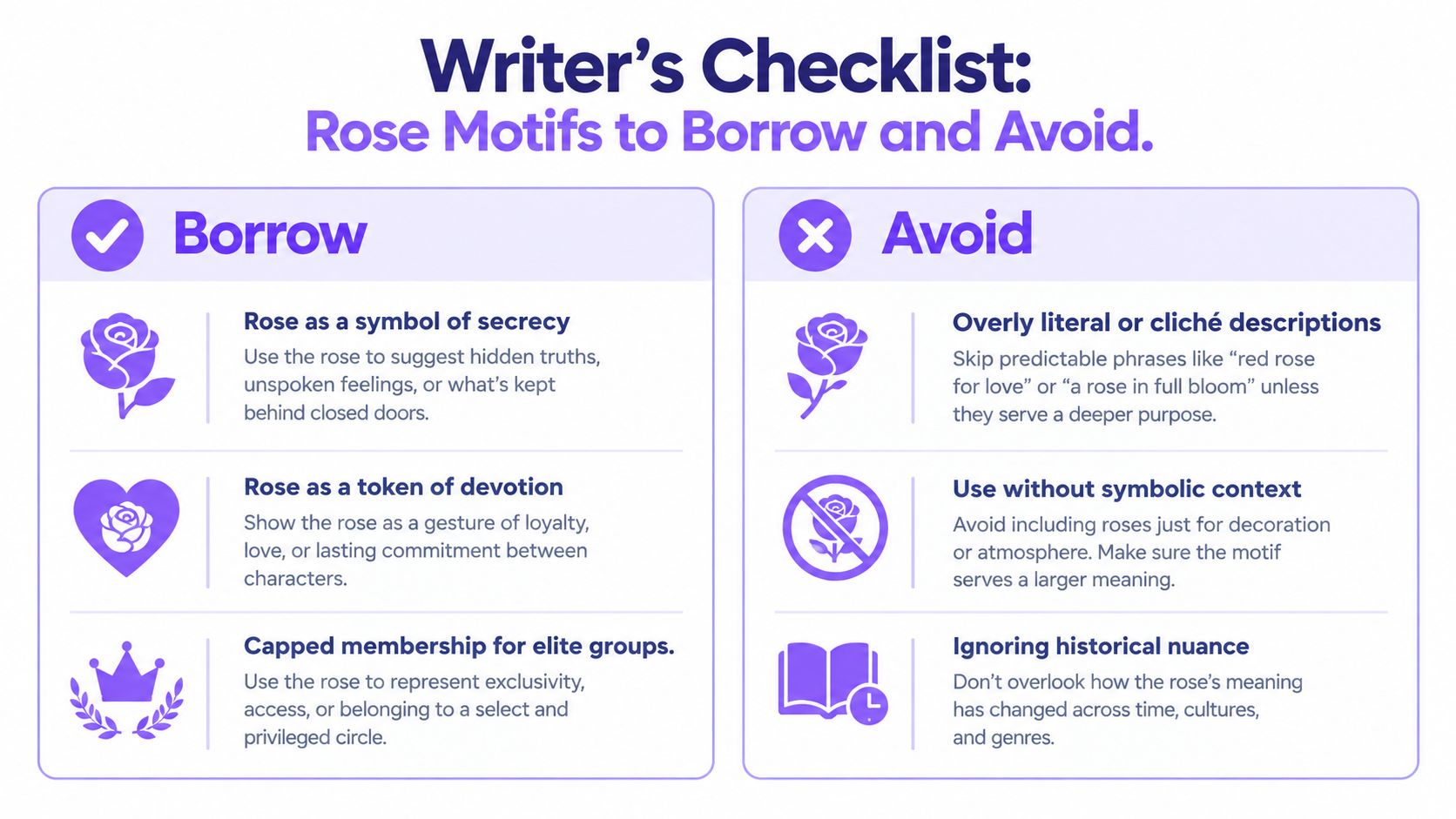
The rose works because it carries contradictory pressures. It's beautiful and armed. It suggests devotion, but also concealment. It can mark a public honor while hinting at private knowledge. The Brazilian lineage supplies rank, scarcity, dynastic legitimacy, and controlled access. The SCA lineage supplies service, partnership, memory, and recognition by peers. The Rosicrucian cluster supplies the darker charge of hidden doctrine and coded belonging.
Those motifs become useful when they affect plot rather than decorate the page. A capped order creates succession pressure. A peer-bestowed title can expose a character who never wanted public credit. A secret rose emblem can create false identification, especially if the symbol is available to both initiates and spies.
Practical rule: Decide who has the authority to confer the title before you decide what the title sounds like.
The obvious pitfalls are avoidable. Don't merge the Brazilian and SCA histories as though one evolved from the other. Don't treat Rosicrucian pamphlets as a single coherent text with a stable doctrine. Don't assume that a book, game, or supplement using the phrase is drawing on either documented order. The title may be pure invention.
Before adopting it, lock four decisions in your project notes:
- Authority: Is the order granted by a sovereign, inherited through a house, or recognized by peers?
- Purpose: Does it reward service, battlefield achievement, loyalty, secrecy, scholarship, or something else?
- Membership: Is access scarce, open, hereditary, earned, or concealed?
- Symbolic meaning: Does the rose represent devotion, danger, hidden knowledge, dynastic power, or competing meanings across factions?
Then track those decisions scene by scene. A character who calls the title an honor in one chapter and a clandestine initiation in another needs a reason. Novelists working with large casts already know that a static character profile won't catch this kind of drift. The title's meaning, the character's knowledge of it, and the institution's current status all need to evolve with the manuscript.
Novelium's Character Tracker and World Codex extract details across a manuscript and track character knowledge, relationships, events, and worldbuilding facts as the draft changes. Visit Novelium to check whether your Order of the Rose stays consistent from its first whispered reference to its final ceremony.