The Cultural Iceberg: Building Characters That Hold
The usual advice about the cultural iceberg is to look beneath a character's food, clothes, and accent. Fine. But looking isn't tracking, and a thoughtful character dossier won't stop you from contradicting that character halfway through a revision. For a working novelist, the useful question isn't whether you've imagined the submerged culture. It's whether you can identify which assumptions are still operative in any given scene.
Why the Cultural Iceberg Matters More Than You Think
Treat the cultural iceberg as a continuity schema, not a certificate of cultural awareness. The model distinguishes observable behavior from the values, beliefs, and assumptions that make that behavior intelligible. Its practical warning is that outsiders can see an action without understanding its meaning, as described in this Hall framework teaching summary.
That distinction matters inside a manuscript, too. You can preserve a character's vocabulary while changing their understanding of obligation. You can keep every ceremonial detail correct while letting a community abandon its established attitude toward authority whenever the plot needs a shortcut. A copyedit won't necessarily catch either problem, because no isolated fact is wrong.
Language research makes a useful starting point precisely because it exposes the limits of surface competence. A resource on making sense of rapid Irish belongs in the research folder for a manuscript involving Irish speech. But understanding the words doesn't settle what a particular character hears as intimacy, condescension, or an unwelcome claim on their loyalty.
Track the Rule Behind the Reaction
The manuscript-analysis question is sharper than whether a character feels authentic: Does this reaction follow from what the manuscript has already established? If not, locate the missing transition before polishing the dialogue.
A character can behave unexpectedly without behaving inconsistently. The difference is whether the manuscript supplies a reason.
That reason might be exhaustion, concealment, changed allegiance, or new knowledge. Don't demand identical behavior across settings. Demand an intelligible relationship between the character's established assumptions, present circumstances, and visible response.
That's a much more useful standard than adding another page of customs to the worldbuilding folder.
The Layers Above and Below the Waterline
The cultural iceberg is associated with anthropologist Edward T. Hall and commonly dated to 1976; its familiar approximately 10% visible and 90% hidden division is a teaching metaphor, not a scientifically measured ratio for every society, as the cultural iceberg overview explains. Read those proportions as an instruction about attention, not as cultural arithmetic.
Above the waterline sit dress, food, language, rituals, architecture, and everyday behavior. Below it sit beliefs, values, assumptions, perceptions, thought patterns, and expectations about relationships and time. The diagram is useful because it separates what you can describe from what you must interpret.
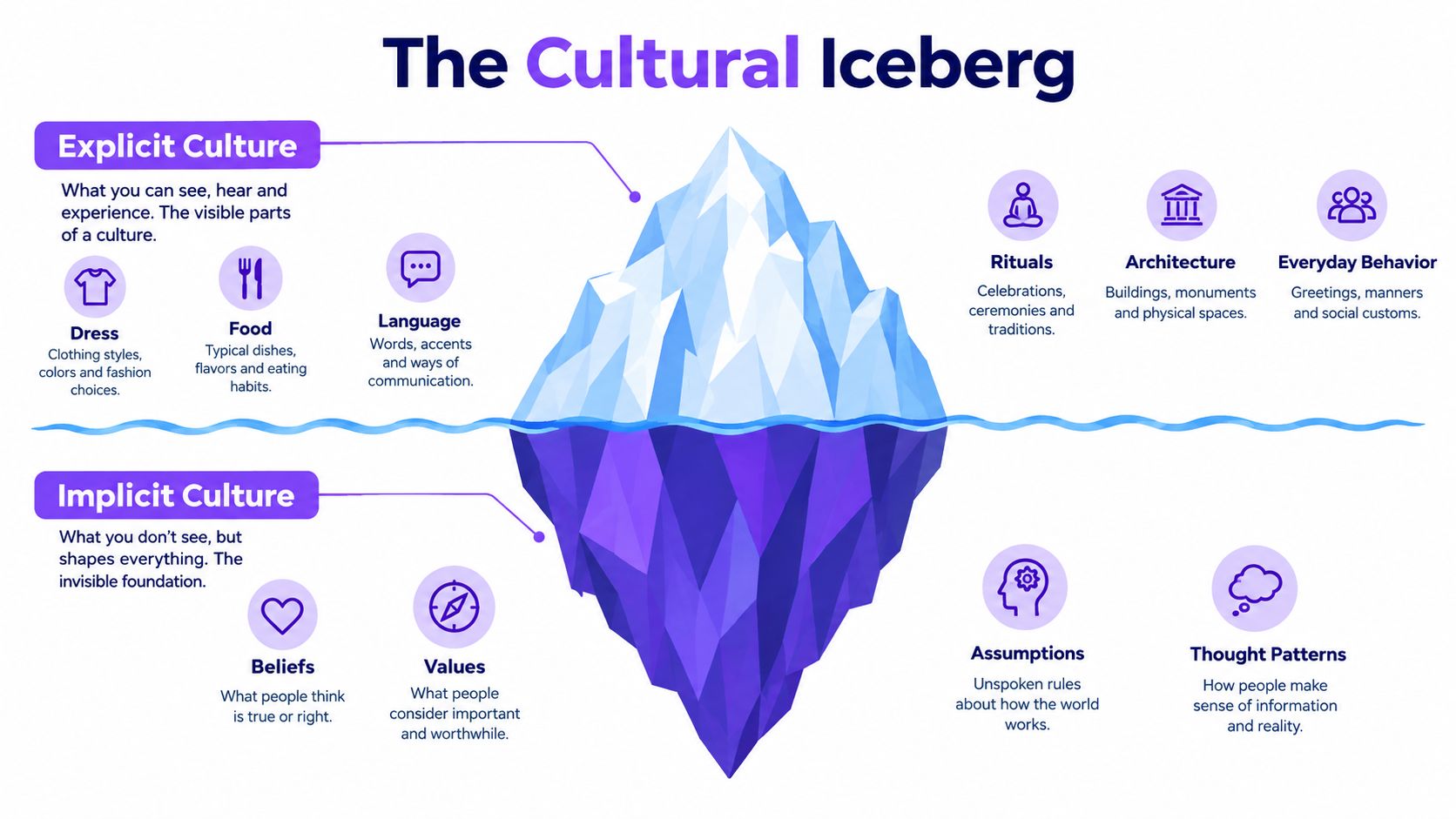
For manuscript purposes, translate those categories into decisions. Clothing matters when it signals rank, violates mourning practice, or exposes an allegiance. A meal matters when accepting it creates an obligation, refusing it insults someone, or sharing it changes who belongs.
Separate Rules From Expectations
Use distinct fields for codified rules, accepted conventions, and tacit expectations. A law against interrupting a ruler is different from a convention of waiting to be acknowledged, which is different again from a character's unspoken conviction that competent people shouldn't need permission to speak.
Practical rule: Record what breaking a custom means, not just what the custom requires.
Research into dining etiquette in Cuba offers a place to investigate visible practice. Don't turn a travel resource into proof of what every Cuban character privately believes. Establish the individual's relationship to the practice through context and further research.
That distinction belongs at the center of cultural worldbuilding. A catalogue of ceremonies describes a setting. A record of who respects, rejects, exploits, or misunderstands those ceremonies lets you maintain it.
Where Characters Actually Drift in Long Manuscripts
A profile can tell you that a character is religiously observant, speaks a regional dialect, and dislikes public emotion. It can't tell you whether those statements still describe the character at the current point in the draft. That requires evidence attached to scenes.
A useful research desk holds more than descriptions of places and people.

Consider these as diagnostic examples, not reported case histories. A stoic character suddenly confesses in public: check whether their restraint was a temperament, a family expectation, or a survival strategy. A foreign-born character's accent disappears: check whether you've intentionally reduced phonetic marking or accidentally changed their linguistic behavior. A religious character violates a taboo: check belief, necessity, concealment, and awareness before declaring a contradiction.
Knowledge Is Part of Cultural State
The deeper failure is often untracked permission. A character who uses a peasant dialect later adopts court register, but the manuscript never establishes where they learned it, whether they can sustain it, or what listeners infer. The problem isn't merely inconsistent wording. The draft has granted social competence without recording its acquisition.
The same distinction applies to secrecy and hospitality. Knowing a rule exists isn't the same as accepting it; accepting it isn't the same as obeying it under pressure. Track those states separately rather than compressing them into an adjective such as traditional.
Use this embedded video as an additional viewing resource while developing that diagnostic lens.
There's also a limit to the framework: cultural categories aren't reliable predictions of individual behavior. The intercultural communication discussion from MacEwan emphasizes cultural diversity and context. For characterization, keep group norms separate from the beliefs your specific character has learned, rejected, or performed for an audience.
Consistency Failures You Have Probably Already Shipped
Take a hypothetical envoy whose family treats public contradiction as an attack on collective standing. Early scenes establish that she challenges relatives privately. Later, she ridicules her brother before a delegation, and nobody registers a breach.
The failure isn't that she contradicted him. It's an unacknowledged change in social meaning. Keep the confrontation if it belongs in the scene, but give her a reason to choose public damage and let her brother understand that choice. A glance toward the witnesses, a calculated refusal to withdraw, or a later demand for restitution can preserve the conflict without making her culture evaporate.
When a Setting Borrows the Wrong Logic
Now take an invented coastal trading society contrasted with an inland warrior society. The coastal characters initially treat debt as transferable obligation, negotiation as competence, and delay as acceptable when it protects an agreement. Later, the same merchants demand immediate personal vengeance over a disputed contract.
That may be an excellent development. It isn't coherent merely because they still wear coastal clothing and eat coastal food. Establish the changed jurisdiction, the insult that converts commercial debt into personal dishonor, or the faction importing warrior values.
Preserve the breach when it creates drama. Repair the missing cause and consequence.
Series drift needs a different repair. Suppose a recurring investigator once understood funeral attendance as an obligation to the living, then dismisses it in a later book as empty ceremony. Don't overwrite the earlier belief with a new profile entry. Locate the experience that changed it, or restore the reaction the established state supports.
A useful consistency check tests those causal links rather than demanding repetitive characterization. Search the draft for moments involving refusal, promises, public disagreement, mourning, and repayment. Compare what the character does with what those actions previously meant, then distinguish deliberate rupture from revision residue.
Static Profiles Versus Evolving Tracking Systems
A character development document helps you invent someone. A character tracking system records what the manuscript has established about them. Confusing those jobs is why a beautifully maintained dossier can coexist with a contradictory draft.
The questionnaire isn't useless. It's the wrong authority once scenes start changing the answers. A character bible becomes useful for continuity when its entries carry scene references, chronology, and revision history rather than presenting every assertion as permanently true.
Character Tracking Approaches at Manuscript Scale
| Approach | What it tracks | Handles implicit layer? | Holds at 80k+ words? |
|---|---|---|---|
| Static questionnaire | Planned traits, background, preferences | Only as summary labels | Not without ongoing reconciliation |
| Spreadsheet tracker | Selected facts, relationships, scene references | Yes, if explicitly designed for it | Possible, but maintenance stays manual |
| Manuscript-linked extraction system | Details and changes found in the draft | Useful when interpretations remain reviewable | Better suited to scope, subject to author verification |
Treat the word-count column as a workflow comparison, not an empirical cutoff. There's no magic manuscript length at which spreadsheets fail. The issue is whether you can maintain relationships among evidence, chronology, and interpretation as revisions multiply.
Automatic extraction beats manual copying for finding distributed details. It doesn't excuse opaque conclusions about a character's culture. A workable system must distinguish explicit evidence from inference, show the supporting passage, and let you correct the interpretation.
Tracking standard: An entry without a scene reference is a planning note, not verified manuscript state.
Keep belief, knowledge, public performance, and actual behavior distinct. Record when each becomes established and when it changes. Otherwise, a later revelation can leak backward into earlier scenes, or a strategic lie can become the character's supposed conviction because it appears in dialogue.
The strongest system isn't the one with the most fields. It's the one you can reconcile with the current draft without reconstructing every character from memory.
Annotating Scenes at Both Iceberg Layers
For each culturally consequential interaction, record the visible action, the presumed norm, and the implicit meaning. Then add the viewpoint character's interpretation and the evidence supporting yours. That separation prevents you from treating an observer's mistake as an objective description of the setting.
Use the annotation pattern below as a compact scene record, not another questionnaire.
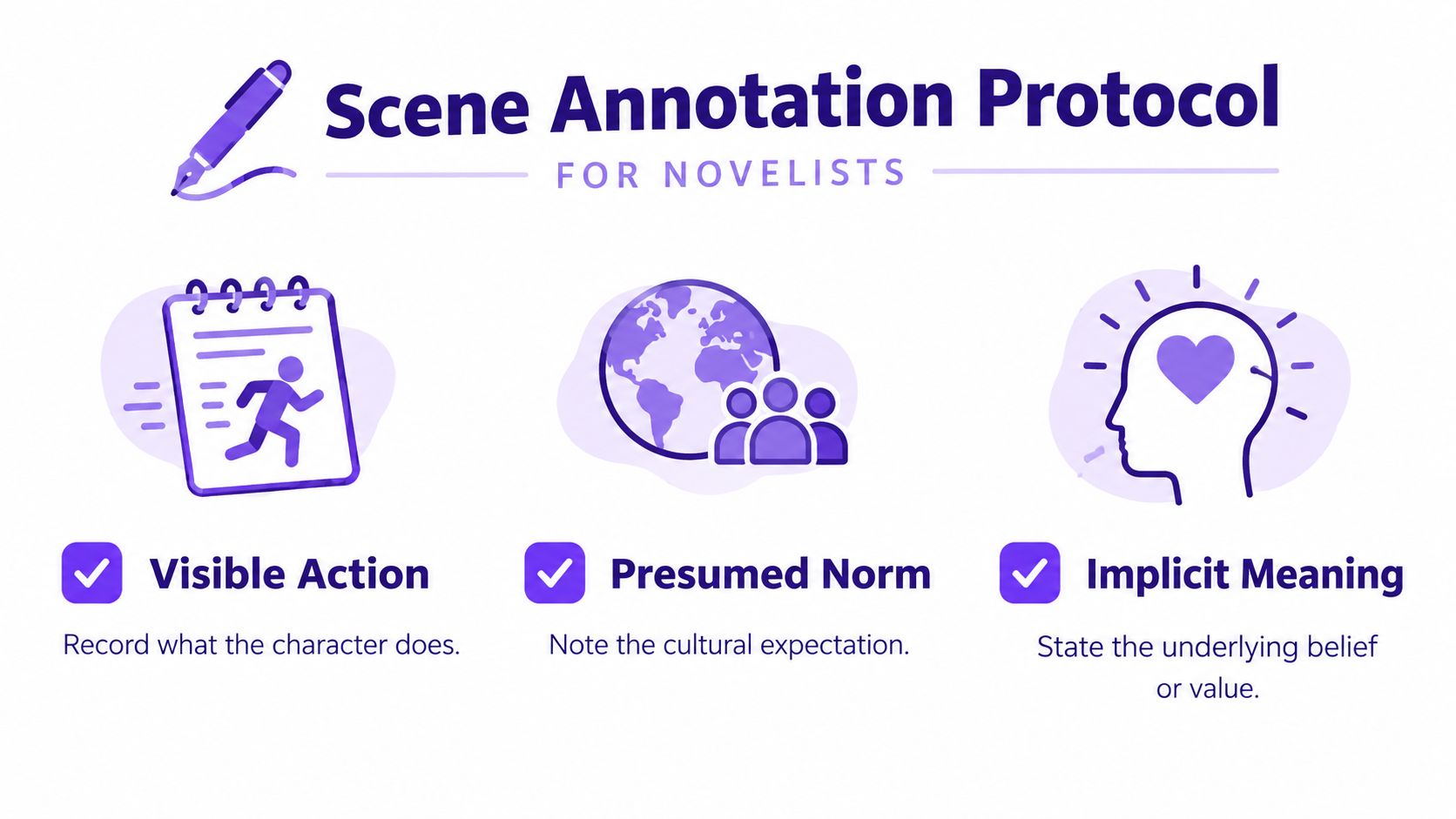
Suppose a guest refuses a seat. The visible action is refusal; the presumed norm is that sitting before the host signals entitlement. The host interprets the refusal as distrust, while the guest intends deference. Keep both interpretations available, and mark the norm as tentative until the manuscript establishes it.
Update Transitions, Not Just Entries
The European Commission's three-level framework distinguishes explicit rules, formal conventions, and informal expectations, with informal expectations often remaining invisible until breached. For annotation, that means recording which kind of rule a character thinks they're following.
Revision test: Can you point to the scene where the character's understanding changed?
When someone enters an unfamiliar cultural system, log what they notice, what they misread, and what they subsequently learn. When they deliberately violate a norm, record their awareness and intended effect. Ignorance, defiance, and strategic performance require different downstream reactions.
Don't replace an old belief after a conversion, betrayal, or migration without preserving the earlier state, attaching the transition to its scene, and checking later behavior against the changed understanding. Manual annotation can handle this, but it demands disciplined reconciliation whenever you move scenes or rewrite the event that caused the change.
The Payoff When the Submerged Layer Stops Slipping
The payoff isn't a cast that behaves predictably. It's a cast whose surprises withstand inspection. You can keep the betrayal, the public insult, and the abandoned ritual because you know what each departure costs the person making it.
That becomes especially useful when culturally distinct characters interpret each other. The Double Iceberg model describes encounters between visible behavioral systems whose larger, invisible value systems produce underlying friction, as outlined in the intercultural iceberg reading. In fiction, track both interpretations instead of assigning the scene a single correct meaning.
Make Revision Decisions From Evidence
When a reader flags a character as inconsistent, you can investigate a specific chain: established assumption, triggering event, interpretation, response. You no longer have to choose between defending the scene on instinct and rewriting the character wholesale.
For a series, preserve the endpoint of each character's knowledge and beliefs alongside unresolved misunderstandings. For an ensemble, keep the same event attached to different interpretations. For worldbuilding revisions, identify which characters learned the altered rule and which scenes depend on it before changing the surface details.
No tracker can guarantee coherence, and no cultural model can supply an individual's interior life. The writer still decides what the evidence means. Systematic tracking earns its place by making that evidence available when a revision would otherwise force you to trust memory.
Track implicit cultural state with the same discipline you apply to plot state. You wouldn't let a character act on an undiscovered secret. Don't let them act on an unestablished understanding of honor, obligation, or belonging either.
Novelium's Character Tracker and World Codex automatically extract and track character details across manuscripts, giving you a systematic foundation for checking culturally grounded behavior against the draft. Visit Novelium and start with a character whose obligations or loyalties change, then examine whether the surrounding scenes support that transition.