Terminology Consistency for Fiction Drafts That Hold Up
You're halfway through a long draft when a familiar name suddenly looks wrong. The character has been Mira for chapters, but the latest scene calls her Mara. You search the manuscript, find three spellings, remember a nickname introduced in an abandoned version, and open the spreadsheet where the “official” name is still recorded correctly. Nothing feels catastrophic. Yet the scene has already lost its grip.
That's terminology consistency in fiction. It isn't a cosmetic preference or a final spellcheck. It's a tracking problem involving every recurring name, title, place, object, invented word, and reference that carries meaning across a manuscript. In a complex novel, manual memory and static documents eventually lose the argument.
When the Right Name Slips and the Story Stalls
Mira appears in chapter three as the apothecary's apprentice. By chapter eleven, she's leaning against the kitchen door, arguing with the protagonist about a debt. The dialogue works. The tension is there. Then the protagonist says, “Mara, you don't get to decide that.”
The reader's attention leaves the kitchen.
They don't necessarily stop reading. They do something more damaging to the scene. They check their internal record of the story. Was Mara another character? Did the writer rename Mira? Is this a flashback? The brain searches backward through pages that had already become settled context, and the emotional thread you were building has to wait while the reader performs continuity repair.
That isn't a spelling-bee mistake. It's a tracking failure. The same failure can put a character on the wrong side of a timeline, give a tavern keeper the profession of someone who lives two streets away, or let a character use a title they lost several chapters earlier.
Practical rule: Treat every recurring term as a piece of story infrastructure, not as a word you'll remember to check later.
A minor inconsistency spends reader trust cheaply, but the cost rises when the error affects a major character, a central location, or a rule the plot depends on. Readers will forgive an occasional typo. They're less forgiving when the manuscript makes them doubt whether they understood what happened.
The unpleasant part is that the draft often feels sound while you're writing it. You know who Mira is. You know where the scene sits in the chronology. You remember what the artifact looks like. Then the manuscript grows beyond the capacity of memory to audit. The writer usually feels the break before any reader does, often in the quiet moment when a perfectly good scene suddenly refuses to feel finished.
What Terminology Consistency Actually Means
Terminology consistency is a property of the finished manuscript, not a house style preference sitting in a reference folder. A term is consistent when a recurring element appears in the intended form across chapters, points of view, flashbacks, dialogue, narration, and revisions.
That includes obvious items such as character and place names, but the work sits in the less obvious categories. Onomastic consistency keeps names and places stable. Lexematic consistency governs invented words, trade terms, magical concepts, and specialist jargon. Hierarchical consistency tracks titles and ranks as they change when a character earns, loses, or assumes authority. Referential consistency checks pronouns and possessives against the correct antecedent, especially when several characters occupy a scene.
The distinction from prose voice matters. A narrator can call a house “the old manse” while another character calls it “the Vey residence” if the difference is intentional and clear. Voice may vary by chapter. Terminology must vary only when the story gives the variation a reason.
The silent standard readers expect
Consistency is silent when it works. Nobody pauses to admire the fact that a fictional currency has one spelling throughout the book. Readers notice the system only when it produces noise. That silence makes the workload easy to underestimate, particularly in series fiction where names, artifacts, factions, and rules recur under pressure.
This is also why terminology matters outside fiction. Terminology checking research describes systems that flag domain-inappropriate words, enforce a term bank, detect inflectional variants, and support clearer retrieval. The same principle applies to a manuscript: approved forms give the editor something concrete to compare against, rather than forcing every decision back into personal memory.
Writers working across specialist vocabularies can also use an AI prompt glossary as a reference for unfamiliar technical language, but a glossary doesn't replace manuscript-level tracking. For a fiction-specific definition and examples, see Novelium's consistency check glossary. The important question isn't whether a term sounds plausible in isolation. It's whether the manuscript uses it deliberately and consistently wherever that term carries story meaning.
Why Character Bibles and Spreadsheets Stop Working
The usual advice is sensible at small scale. Build a character bible. Keep a spreadsheet. Check it before drafting each scene. The trouble starts when writers mistake a record of facts for a system that detects contradictions.
A bible can tell you that Mira has a scar over her left eyebrow. It can't tell you that chapter fourteen describes the scar over her right eyebrow, or that a later narrator notices a face that was previously hidden by a hood. A spreadsheet can confirm that Mira exists. It can't surface the moment when she becomes Mara in dialogue, Miri in a flashback, and an unnamed “girl from the apothecary” in the epilogue.
Static records have no scene awareness
The file grows stale as soon as the draft changes. A writer moves an event, changes a relationship, renames a faction, or cuts the scene that established a rule. The reference document remains accurate in the writer's head and inaccurate on the page, which is the dangerous combination.
Writers also consult static records less often as a project drags on. Not because they're careless, but because the document starts to feel like another manuscript to maintain. A single row cannot represent how a name behaves across a limited third-person POV, an omniscient chapter, a flashback, and a line of dialogue spoken by someone who uses a nickname.
A character bible stores what you decided. A tracking system shows what the draft actually contains.
That missing layer is the cross-reference between the record and the manuscript itself. The useful result doesn't merely say “Mira exists.” It says this form appeared in this chapter, in this context, beside these other references. Without that binding, consistency becomes a manual check performed by a tired brain at two in the morning. That's the least reliable auditor any novel can hire.
A character bible still has a place. Use it for decisions, backstory, motivation, and material you don't want to rediscover. Don't ask it to perform a job it was never designed to do. Documentation describes the intended story. Tracking compares intention with execution.
What a Tracking System Has to Capture
A useful terminology check starts with a canonical list, but it can't stop there. The system needs the approved form and the variants the writer typed. That means tracking proper nouns, place names, invented terms, ranks, titles, recurring objects, measurements, and currency conventions as connected entries rather than isolated search terms.
The list must evolve with the manuscript. New characters arrive. A temporary nickname becomes permanent. A faction changes its formal title. An artifact acquires a shortened name in dialogue. Each addition requires a rescan against the full draft, because the earlier chapters may already contain a form you've forgotten.
Greta Voss as a working example
Take a character whose canonical entry is Greta Voss. The map should record the approved name, known aliases, the contexts in which those aliases are legitimate, and every appearance that resembles one of those forms. “Greta” may be normal in intimate dialogue. “Voss” may be used by a hostile official. “Gretchen” might be an accidental drift, or it might be a family nickname established in a flashback.
The system shouldn't erase the variation. It should put the variation in front of the editor with enough context to decide. Terminology measurement in localized material similarly compares approved target variants with alternate renderings, using exact-match accuracy, window overlap, and terminology-biased TER to distinguish systems that preserve required terms more reliably. The editorial equivalent is simple: count and map the forms, then judge intent.
| Canonical Term | Variant Typed | Chapter | Context |
|---|---|---|---|
| Greta Voss | Greta | 3 | Narration introduces the apothecary apprentice |
| Greta Voss | Voss | 7 | Captain addresses her formally |
| Greta Voss | Gretchen | 12 | Dialogue from her older brother |
| Greta Voss | Gretta Voss | 18 | Narration during the harbor confrontation |
The output should be sortable by canonical term, variant, chapter, or context. A flat list of search hits creates more reading. A variant table supports an editorial decision about which form stays, which form gets explained, and which form gets corrected.
Version history matters here too. If a rename happened during revision, document file change tracking can help identify when the change entered the working file. That history is useful evidence, but it still won't tell you whether the old form remains in a scene you forgot to revisit. The manuscript scan closes that gap.
The Revision Pass That Surfaces the Real Errors
A reliable pass separates mechanical detection from editorial judgment. Run the stages in sequence, because each one produces the signal the next stage needs.
Raw variant sweep. Compare every recurring term against the canonical list. Flag every divergence without deciding whether it's wrong. The sweep should catch spelling changes, shortened forms, alternate titles, and inconsistent units without burying them under interpretation.
Context tagging. Read each flagged instance in its scene. Mark deliberate nicknames, formal titles, aliases, translation choices, and narrator-specific language as intentional where the manuscript supports that decision. This prevents the editor from “correcting” a variation that carries character or plot information.
POV audit. Check whether the term belongs to the current narrator's vocabulary and knowledge. A character may know someone as “Commander Voss” while the narrator uses “Greta,” or a later POV may recognize a place by a name that an earlier viewpoint character never learned.
Timeline cross-check. Test the term against the scene's moment. A title earned later shouldn't appear in an earlier chapter unless the story establishes a reason. The continuity guidance for fiction treats names, descriptions, dates, timelines, spatial arrangement, and world rules as connected revision targets because later mentions often conflict when they restate an earlier detail. Its recommended diagnosis for naming problems is to search the full text for every variant, not rely on memory or one read-through.
Global consistency read. Confirm, correct, or override each remaining flag. The final pass is editorial, not mechanical. You decide whether “the Black Gate” and “Blackgate” describe one place, two places, or a naming change the reader needs to understand.
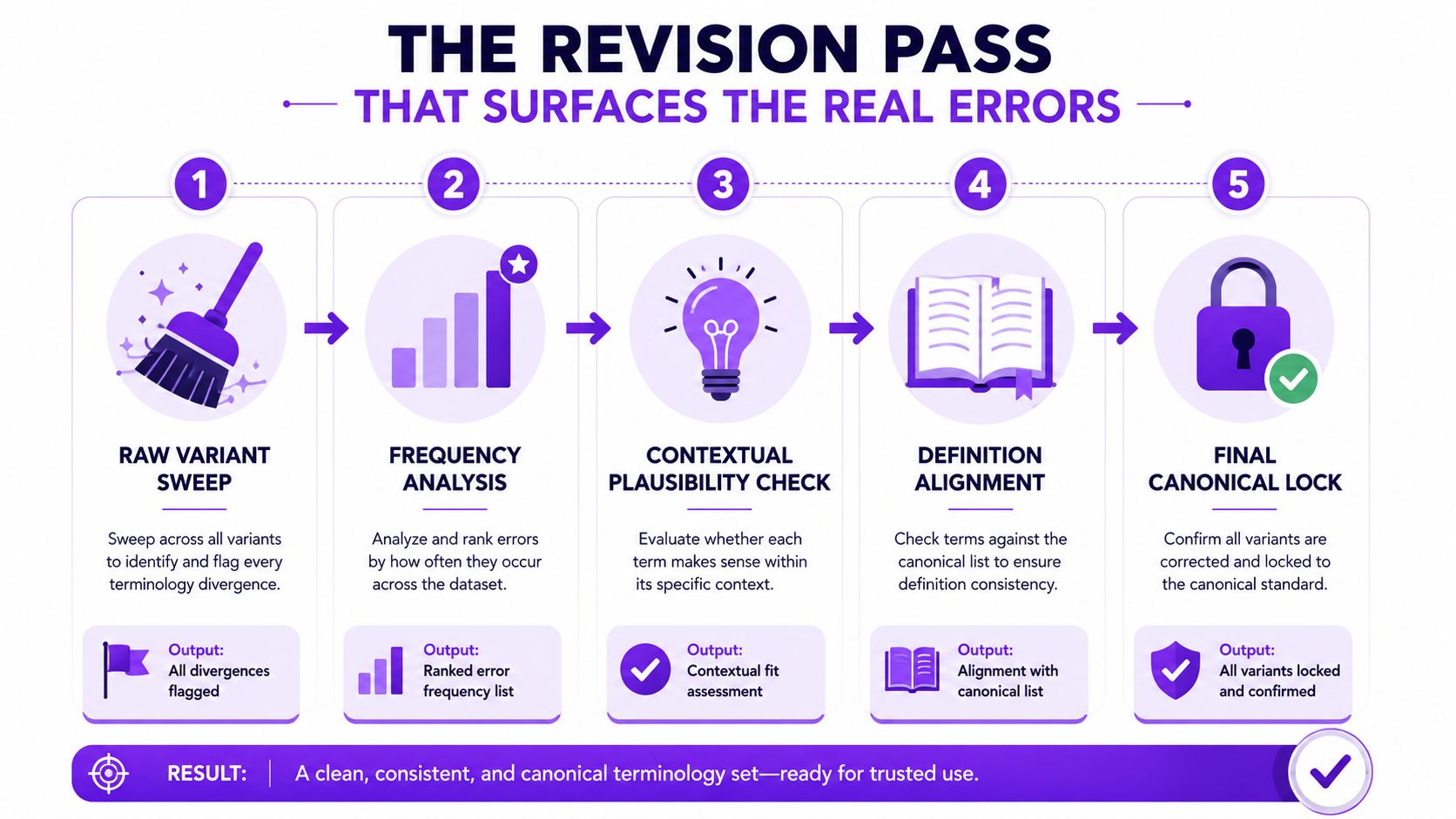
Doing the global read first drowns errors in stylistic noise. Skipping context tagging forces you to relitigate every flag from memory. The sequence keeps the machine useful and leaves the consequential decisions with the editor. A practical revision checklist can support the final read, but it shouldn't replace the sweep that generated the evidence.
Reading the Draft Locally and Keeping It Private
An unpublished manuscript is one of the most sensitive files on a writer's drive. It contains not only the novel, but discarded scenes, private notes, character secrets, personal research, and metadata that may reveal more than the writer intends to share. A consistency tool that requires uploading chapters to a remote service introduces a separate risk before it solves the editorial one.
Cloud-based grammar and consistency tools need the text on third-party servers to process it. Writers often focus on the visible chapter and overlook the surrounding material that travels with an upload, including comments, revision traces, notes, and document information. That may be acceptable for a public excerpt. It deserves a much stricter standard for a complete unpublished book.
Privacy supports better editing
A local analyzer reads the file in place, builds its term maps on the writer's machine, and returns flagged variants without sending the manuscript elsewhere. That changes the quality workflow, not just the privacy posture. Writers are more likely to run a thorough pass when they can include the scenes they haven't shown to an editor, agent, beta reader, or writing group.
Novelium offers local manuscript analysis through its Character Tracker and World Codex, which extract and track character details, terminology, setting facts, and world rules across a draft. It also supports consistency review for contradictions involving character details, timelines, settings, and story-world rules, allowing terminology errors to sit inside the broader continuity problem instead of being treated as isolated typos.
The editorial standard is straightforward: use a canonical record, bind it to every manuscript occurrence, preserve deliberate variation, and keep the full draft under the writer's control. A static bible helps you remember what you meant. A privacy-minded tracking system helps you see what you wrote.
Novelium's Character Tracker and World Codex automatically extract recurring character, place, object, and world details from your manuscript, then surface variants and contradictions across chapters. Visit Novelium to check a complex draft locally, keep the manuscript private, and replace late-night memory checks with evidence you can revise.