Template for Character Analysis: Track What Matters
The most popular advice about character templates is to write a biography. Sixty questions, favorite color, first heartbreak, the object they'd rescue from a burning house. Fill it in once and file it away. That document won't catch a single continuity error in an 80,000-word draft, because it records who a character is rather than what a character knows on a specific page.
A template for character analysis that survives revision works like an audit sheet. Every field has to predict a behavior you can check against a named scene, and every entry carries the chapter where the evidence sits. A profile that can't fail a test isn't tracking anything.
What follows is the field list worth keeping for a large cast or a series running on established canon, the order that stops you inventing motives backward, and the failures each field prevents.
The Template Fields That Carry Continuity
Nine fields do the work. Everything past them is worldbuilding, and it belongs in a separate file, because a document that mixes the two stops getting updated the first time a draft moves faster than the notes.
| Field | What to record | Why it matters |
|---|---|---|
| Stable traits | Traits the manuscript has made legible, each with the scene that established it | Anchors reader expectations for later behavior |
| Current goal | The concrete want in the present scene or arc | Explains each choice the character makes |
| Internal need | What the character lacks, often unnamed in the text | Drives the arc checkpoints |
| Beliefs and misbeliefs | What the character thinks is true and whether it is correct | Separates deception from honest error |
| Knowledge state | What the character knows at each dated event | Catches characters who know things too early |
| Relationships | Current alignment, debts and secrets with each major character | Shows which scenes change options |
| Allegiance and injuries | Changing conditions with the chapter where each changed | Prevents forgotten constraints |
| Timeline anchor | Age or life stage with absolute and relative dates | Catches age drift and sequencing errors |
| Arc checkpoints | Opening state, midpoint shift and closing state | Verifies that the arc actually happened |
The rule attached to each field matters more than its name. Stable traits need the scene where the trait became legible, because indirect characterization makes readers infer quality from behavior and dialogue while direct characterization states it outright (character in the arts)). Without that scene reference, a later contradiction has no baseline to fail against.
Knowledge state earns its keep most often. Date it. "She learns about the affair in chapter 9" is checkable. "She knows about the affair" is true somewhere and false everywhere else.
Narrative weight deserves a number too. A 2025 study of literature taught in U.S. high schools built a dataset of 396 books by 306 authors, annotated more than 1,500 characters, and identified 1,594 main characters at a threshold of 3% of a book's character mentions, an average of 4.03 main characters per book (Cultural Analytics). At four or five leads per book, secondary figures blur into each other unless their plot function is written down.
Practical rule: if a field can't be checked against a named chapter, it's a note, not a record.
Length discipline applies to the template itself. The same logic sits behind a seven-field weekly note layout for planning: a small fixed set of prompts you fill in beats a sprawling one you abandon by week three.
Most fields stay thin for minor characters, and thin is the correct entry when someone exists to hand over one piece of information in one scene. The table is the page you return to during revision, which is what turns it into a working consistency check instead of a document you wrote once and never opened again.
How to Fill In the Template in Sequence
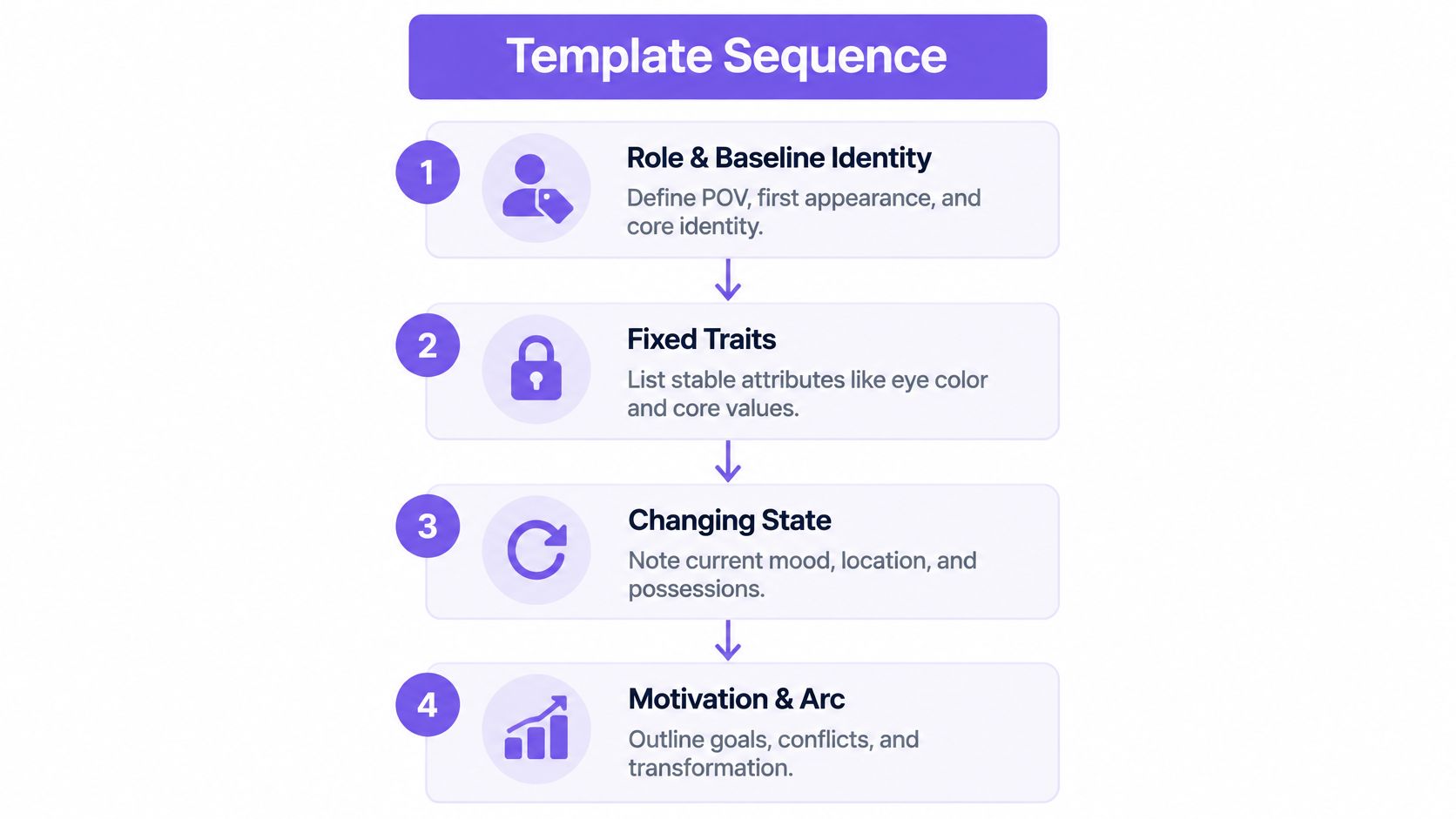
Order matters more than completeness. Fill the fields in sequence and you can't reverse-engineer a motive from the ending you've already written, which is the most common way a profile becomes self-justification rather than analysis. The order below borrows the broad craft sequence Purdue OWL describes for building and revealing characters in fiction (Purdue OWL).
Treat each step as an audit entry: it should name the scene that proves it, then predict what the character will do later.
- Role and baseline identity. POV or not, first appearance, and what the story needs this character to do.
- One external goal and one internal need, each with the scene where it first surfaces.
- The generative layer. Beliefs, fears, flaws and background conditions, with each flaw tied to a cause in the text rather than assigned at random.
- Obstacle and choices under pressure, plus the consequence of each choice.
- Opening and closing states compared, which is the only honest test of whether an arc happened.
Then run the acceptance test. Every major action should be explainable by the current goal, the knowledge state, the relationship context, or an established trait. Anything left over gets one of two labels: intentional development, or a contradiction to revise. A flaw with no cause in the text is a field to repair or delete.
Take a smuggler who refuses to lie in chapter 3 and lies to a customs officer in chapter 18. On its own, that's a contradiction. Filled in sequence, the chapter 12 betrayal sits in the record as the causal bridge, so the reversal gets logged as development instead of flagged as drift.
| Field | Chapters 3 to 12 | Chapter 12 onward |
|---|---|---|
| Stable traits | Refuses to lie to anyone, established in the chapter 3 dock scene | Still on record, so the chapter 18 lie is flagged as an exception |
| Current goal | Get the cargo past the customs post safely | Protect the crew while hunting the informer |
| Knowledge state | Does not know who informed on the crew | Learns the informer's identity in chapter 12 |
| Beliefs and misbeliefs | Believes honesty is a debt he owes no one | Believes the crew owes him silence after the betrayal |
| Allegiance and injuries | Loyal to the crew | Loyalty broken in chapter 12, lies to a customs officer in chapter 18 as labeled development |
| Arc checkpoints | Opening: honest to a fault | Midpoint: the chapter 12 betrayal. Closing: lies for the crew |
Voice is a separate pass. If you use persona prompts to draft interview questions for how a character talks under stress, a set of steps to build an AI persona can supply prompts, while the answers only count once they are entered as dated state changes tied to scenes.
Separating Fixed Traits From Changing State
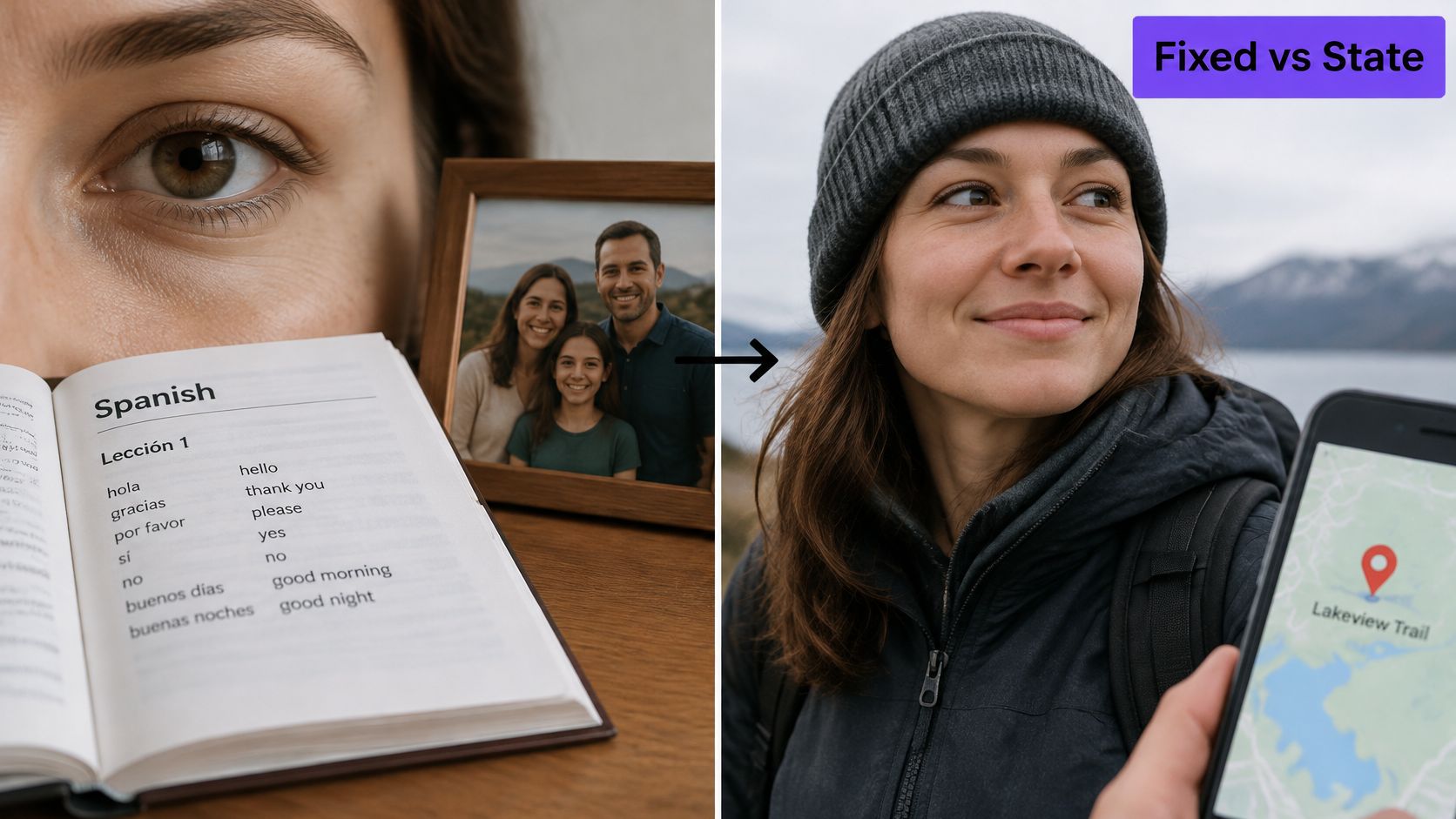
Apply one test to every field in the entry: does it predict a behavior a reader can check against a specific scene? Fields that pass and never move belong in the fixed column. Eye color, native language and core values get recorded once, each with the scene that established it. Fields that pass and change, current fear, discovered information, injuries, allegiance, emotional temperature, each need a dated entry naming the chapter where the change happened. Anything that fails the test is biography, and biography earns no row in a working template.
Timelines need both a calendar and a relative anchor. Tracking absolute dates alongside relative ones such as "three days after the inciting incident" is standard guidance for organizing character notes and worldbuilding, because calendar dating catches age drift while relative timing catches sequencing errors. The two catch different mistakes. A character can be the right age on every page and still learn a secret three chapters before another character reveals it.
Log the state change when you write the scene. Reconstructed at revision, it's a guess wearing a citation.
Each change gets one line at drafting speed: what changed, where in the draft, who witnessed it, who can now act on it. That line survives a scene you cut and later restore, and it beats rebuilding the change from memory.
Series fiction needs one more layer, a versioned change log for canon you revise. A rival's scar appears in book two while book one describes a clean face; with versioning, the log records the scar as added during revision, so earlier references get corrected instead of copied forward. Tag every fact as established canon, character belief, inference or deliberate exception, and the question "did I break this on purpose?" answers itself. That audit trail is what separates a static profile from a character development record with a memory.
Why Static Profiles Fail and What Breaks
The failure that shows up most often in the drafts we analyze is a profile that was accurate on the day it was written and wrong by chapter twenty. Adjectives don't fail, they just can't fail, which is the problem. "Brave" and "jealous" cannot separate a deliberate reversal from a forgotten constraint.
Two cases cover most of it. A character knows where her sister is hiding in chapter 9 and acts ignorant in chapter 12, and nothing in the draft flags the gap. A mentor takes a blade to the thigh in chapter 4 and walks without a limp by chapter 15, because the injury was entered as description instead of state. Readers build expectations from recurring behavior and monitor consistency as they go, including psychological traits they infer from a character's thoughts (Gerrig and Allbritton on the construction of literary character). A broken pattern costs more than a dropped detail, because the reader has already done bookkeeping you didn't.
Keep three layers apart in the record: what the character does, what the narration says they believe, and what they privately think. The same action reads as hypocrisy, concealment, growth or authorial error depending on which layer the manuscript has established.
Scale Turns a Missing Field Into a Plot Hole
A conventional novel runs 70,000 to 100,000 words, and each additional point-of-view character spawns a parallel story; one publishing guide estimates that cutting a single POV character removes roughly 20,000 words without necessarily removing the plot (Chapterly). That's why a single-page cast list stops working. For viewpoint characters, log appearances, knowledge acquired, decisions, unresolved threads. For secondary characters, log only the scenes where they change someone else's options.
| Failure | Typical cause | Field that prevents it |
|---|---|---|
| Character knows a secret before the scene that reveals it | Knowledge logged without a trigger scene | Knowledge state with dated entries |
| Dead character speaks or acts later | Deceased status not recorded or not updated | Current status with the chapter of death |
| Age jumps between dated events | Age not stored per event | Timeline anchor with age or life stage |
| Arc starts in act one and disappears | Arc checkpoints skipped | Opening, midpoint and closing state |
| Two secondary characters do the same job | Narrative function never recorded | Plot function per character |
| Injury from an early chapter vanishes | Injury stored as description, not state | Allegiance and injuries with the chapter of change |
| Sudden reversal with no cause | Missing causal bridge | Current goal with the pressure that changed it |
Every row is cheap to prevent and expensive to find, and the trigger scene is the part writers skip. Logging an outcome without its cause leaves you with a contradiction and no way to label it.
Move Your Profiles Into a Live Tracker
A static profile freezes your cast at the moment you wrote it, and the draft keeps moving. Current goal, injuries and knowledge state go stale within a chapter or two of revision, and no writer re-reads every scene of a full manuscript to update a spreadsheet. Past that point the document stops being the system of record.
Novelium's Character Dashboard extracts characters automatically from the text and tracks their physical descriptions, personality traits, backstory and arcs. It shows what information each character holds at every moment of the story, so the knowledge field stays current without upkeep. Story elements come out of the manuscript itself with no manual data entry, and it flags a character who appears after being marked deceased as soon as the name is written.
Run the switch as an audit. Pick the three most complicated characters in the draft, fill the nine fields for each from the current version, and compare your knowledge entries against the dashboard's knowledge view. The first mismatch is the evidence: either the profile drifted or a scene contradicts the record. A field I can't check against a specific scene after one revision pass doesn't earn its place in the template.
If arc checkpoints are the fields you skip, the arc tracking glossary entry explains how to grade them against scene-level evidence.
A template is only as good as the draft it's checked against, and the fields that matter are the ones that go stale first. Open your draft in Novelium and run the nine fields on your three hardest characters to see where the record and the pages disagree.