Story Plot Points: Fixing the Continuity Writers Miss
Most advice about story plot points starts in the wrong place. It tells you where the inciting incident, midpoint, and climax belong, then assumes the manuscript will behave because the beats are present. That's how you end up with a beautifully mapped novel in which a character knows a secret before learning it, a dead suspect appears in a later scene, or a relationship changes between chapters without anyone earning the change.
Plot points aren't merely structural milestones. They're continuity checkpoints. Each one changes what a character knows, wants, risks, can do, or can no longer do. If you track only the event, you're tracking the visible surface of the plot. The consequential data sits underneath it.
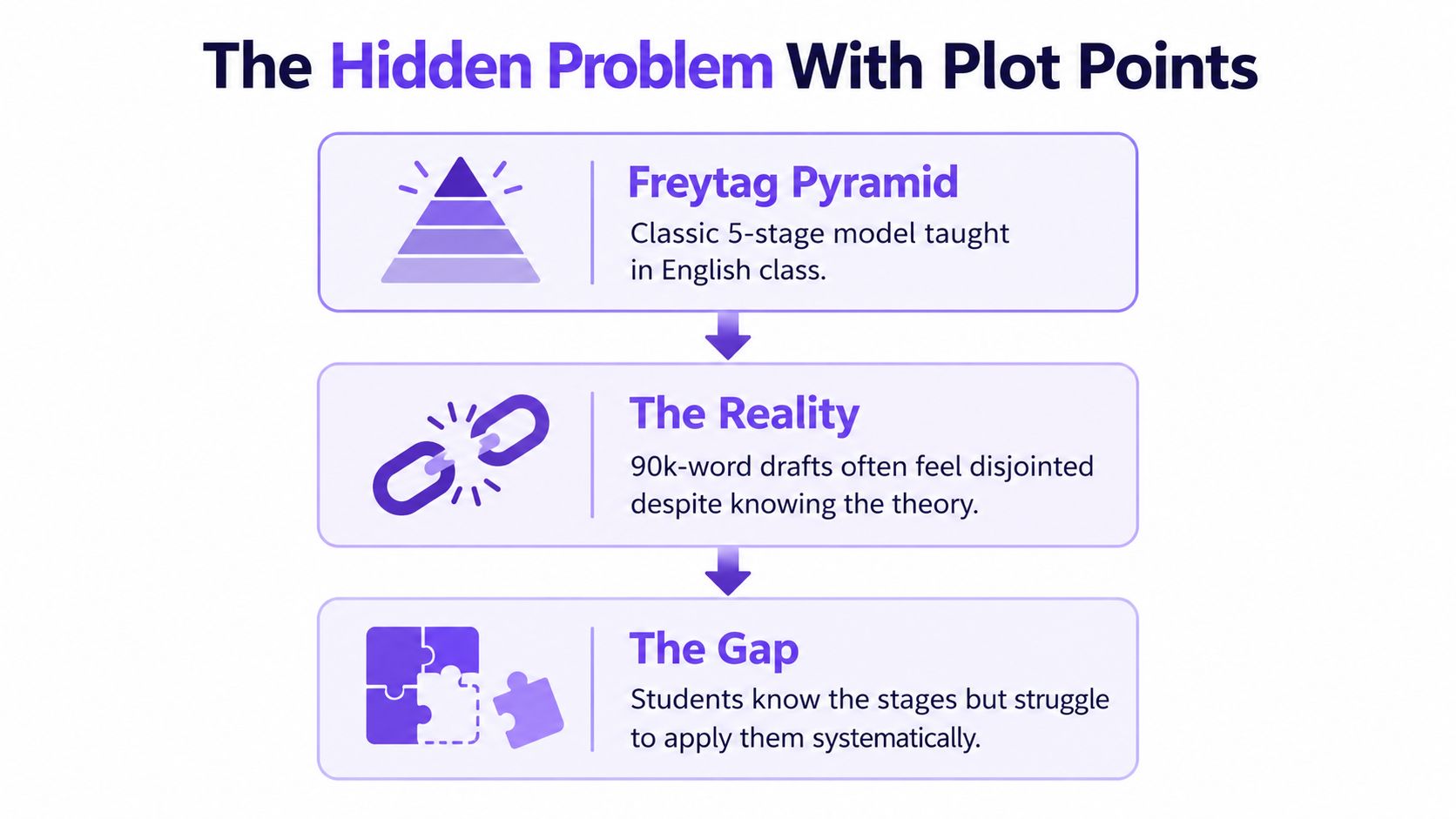
The Hidden Problem With Plot Points
We all know the familiar five-stage model, exposition, rising action, climax, falling action, and denouement. It's the Freytag pyramid associated with Gustav Freytag in the nineteenth century, and it remains a useful framework for literary analysis, as this overview of plot structure explains.
The framework isn't the problem. The problem is treating it as a checklist. A writer can identify every stage and still produce a draft that feels strangely unstitched because the story's state changes aren't being carried from one scene to the next.
A protagonist who discovers a betrayal in one chapter has new knowledge in every subsequent chapter. That knowledge should affect their dialogue, choices, suspicions, and relationship with the person responsible. If the manuscript treats the discovery as a dramatic moment but fails to preserve its consequences, the plot point becomes decoration.
The same issue appears in complex series fiction. A character's injury, alliance, pregnancy, arrest, confession, or access to information changes the conditions of later scenes. A plot point matters because it closes one route and opens another. The Novelium glossary entry on plot points is useful for this distinction, because an event only earns structural importance when it changes what happens next.
Practical rule: Don't ask only whether a plot point is exciting. Ask what becomes impossible after it, what becomes possible, and who knows about the change.
That question turns structural mapping into a continuity system. The point of the midpoint isn't merely to sit in the middle. It must alter the protagonist's operating reality. The climax must resolve pressures that the earlier beats created, not pressures you added because the ending needed more noise.
Spacing Beats by Percentage, Not Just Page Count
Page count can make a draft look orderly while the story drifts. A percentage map gives you a practical diagnostic: it shows whether pressure is building at the expected stages and whether each major beat changes the continuity of the manuscript.
A commonly used eight-beat model places the major turns at approximate points: Inciting Event at 12%, First Plot Point at 25%, First Pinch Point at 37%, Midpoint at 50%, Second Pinch Point at 62%, Third Plot Point at 75%, Climax at 88%, and Resolution at 100%. The structural timing analysis from Helping Writers Become Authors presents these beats as checkpoints rather than rigid laws. That distinction matters. A beat can arrive on schedule and still fail if it leaves the character's knowledge, options, or relationships unchanged.
For a 100,000-word novel, the framework places the Inciting Event near 12,000 words, the First Plot Point near 25,000 words, and the Midpoint around 50,000 words, following the percentage structure described in this four-act structure guide. The later turns fall near 62,000, 75,000, 88,000, and 100,000 words. Use those positions as pressure tests. If the protagonist reaches the middle without a meaningful change in options or stakes, adding a midpoint label will not repair the draft. The story has failed to change state.
The Inciting Event generally falls near 10% to 15% of overall runtime because it disrupts the existing equilibrium and introduces the central dramatic situation, as described in this academic conference paper on modern film theory. The range allows for genre variation while exposing an opening that spends too long arranging furniture before creating a problem.
A percentage map won't write the novel for you. It will show you where the novel is refusing to make a decision.
Track more than chapter length. Map each scene to its plot function, then record the state change: what the protagonist knows, wants, can do, or has lost. Ten scenes can pass with polished prose while the manuscript stalls if none of those conditions changes. The reverse problem also occurs. Several reversals packed together without consequence or transition make the draft feel rushed, not tense.
Scene rhythm operates at a smaller scale. The same structural timing discussion reports an average scene and subscene length of about 55 seconds, with setup and climax averaging 47.1 seconds compared with 60.1 seconds for complication and development, a statistically significant difference reported as t = 89.6, p < .0001, d = 18.1. A novel does not need to imitate film timing. Exposition can carry complexity, while climactic sequences often gain force when scene turnover accelerates. Use the pattern to test pacing, then check whether each transition also preserves the character's changed state.
Why Character Profiles Fail at Scale
The character questionnaire fails for a simple reason: it records identity, not continuity. Favorite color, childhood pet, formative wound, and private fear may help you generate material, but none of them tells you what the character learned in Chapter 4, whom they now distrust, or which promise they can no longer break without contradicting the manuscript.
That distinction matters in a long novel. A static profile says the detective is allergic to peanuts. A tracking system records that the allergy was established in an earlier scene, who witnessed the disclosure, whether the detective has access to safe food, and whether a later meal creates a practical problem. If she casually eats a peanut-flour muffin several chapters later, the issue isn't a missing detail in her profile. It's a broken state history.
Character development describes transformation. It answers questions about the arc, the internal resistance, and the person the character becomes. Character tracking preserves the facts that make every scene compatible with the scenes around it. One is interpretive. The other is forensic.
Writers managing a recurring cast also need to track relationships as changing conditions, not permanent labels. “Allies” isn't enough. Record when the alliance began, what each person believes the other has done, what information remains concealed, and whether a public betrayal changed the terms. Resources on benchmarking character models can help clarify why a model must be evaluated across changing contexts rather than treated as a fixed description.
The practical difference becomes obvious during revision. Development notes help you decide whether a character's choice feels emotionally earned. Tracking notes help you catch the fact that the character couldn't make that choice because they were unconscious, elsewhere, uninformed, injured, or still committed to a conflicting agreement.
The video below offers another perspective on organizing story plot points and managing the pressure of a developing draft.
A profile evolves when you rewrite it. A tracking system evolves every time the manuscript changes. That's the standard a complex novel requires.
Tracking Knowledge and State Changes
The cleanest way to diagnose a plot is to track transitions. At the Inciting Event, the old equilibrium stops working. At the First Plot Point, the protagonist commits to a route that wasn't previously available or necessary. At the Midpoint, a revelation or decision often changes the direction of the story and forces the character into a more consequential relationship with the central problem. The three-act structure explanation from Backstage treats the midpoint as a directional reversal or point of no return, which is more useful than labeling it merely “the middle.”
Consider a mystery. The detective finds a receipt in Chapter 5 and learns that the suspect lied about being at a restaurant. From that scene onward, the receipt belongs in the detective's knowledge state. She may misinterpret it, dismiss it, or conceal it, but she can't investigate the suspect in a later chapter as though the lie has just surfaced.
That failure is common in manuscripts with multiple points of view. The author remembers the clue. The viewpoint character doesn't. Or the reverse happens, and a character reacts to information they couldn't have received. Readers may not name the problem, but they feel the scene become false.
Narrative research describes turning points as events that significantly alter the conditions of everyday life, and links those shifts to later milestones in a person's life story, as shown in this peer-reviewed study of agentic shifts. That logic works for fiction because a plot point is not just an occurrence. It's a change in the character's available reality.
Track states such as:
- Knowledge: what the character knows, suspects, misunderstands, or has forgotten.
- Access: where the character can go, whom they can contact, and what resources they control.
- Risk: what exposure, injury, obligation, or loss now threatens them.
- Relationships: what has been promised, broken, concealed, or renegotiated.
Use a timeline in fiction to anchor those transitions to chapters and scenes. The point isn't to turn drafting into administration. It's to stop asking a late-stage spreadsheet to reconstruct logic that should have been preserved while the story changed.
Avoiding the Drift With Real Examples
Romance exposes continuity drift quickly because readers track emotional status with unusual precision. The protagonists meet at a coffee shop, clash, and begin dating. A rival then enters the story. If the heroine behaves as though she's unattached, or the rival knows about her former relationship before she has told him, the scene doesn't merely contain a small factual error. It changes the emotional contract of the book.
The fix isn't another paragraph in a character biography. Record the relationship state at each relevant scene. At the coffee shop, they're strangers. After the clash, they're wary. After the first date, they're privately interested. Once they begin dating, the heroine's obligations, boundaries, and interpretation of the rival's attention all change.
A useful scene audit asks three questions:
- What changed? Identify the new fact, decision, loss, alliance, or threat.
- Who knows? Separate confirmed knowledge from suspicion, hearsay, and reader-only information.
- What follows? Check the next appearance of every affected character, object, relationship, and plot thread.
Ordinary pacing advice often falls short here. Pacing is plot progression over time, and one expert treatment defines fast pacing as significant plot advancement within a short reading interval, while slow pacing takes longer to produce meaningful advancement, as explained in this pacing analysis. But progression isn't enough if the character's internal ledger resets between scenes.
The reader will forgive a slow chapter more readily than a character who forgets the story they're in.
The same problem appears in thrillers. A weapon changes hands, but the next chapter places it back in the original owner's drawer. An ally learns the antagonist's identity, then behaves as though the antagonist is still unknown. A character leaves town under surveillance and returns without an explanation. These are not ornamental details. They determine whether the plot's cause-and-effect chain holds.
Track the consequences immediately after each major beat, then audit the next appearance of every affected element. That catches the failures that a broad outline misses.
Tools for the Professional Writer
For long manuscripts, a spreadsheet usually breaks at the exact point it becomes useful. You add a column for a subplot, then another for a relationship state, then another for object history. Soon the layout records fragments, but it no longer shows how a revelation in one chapter affects a decision several chapters later.
The better approach is a dynamic record that connects characters, knowledge, relationships, events, objects, scenes, and timeline positions. You need to see not only that a plot point exists, but which states it changes and whether later scenes honor those changes.
A manual system still has value during planning. Scrivener, Word, Google Docs, and plain-text notes can hold scene summaries and revision flags. Dictation can also speed up the capture of continuity notes while you're away from the desk. A resource on how to improve writing with dictation is useful if your strongest observations arrive while walking, commuting, or rereading printed pages.
For manuscript-scale analysis, Novelium's Character Tracker and World Codex extract and track character details across chapters, including traits, knowledge states, relationships, and events. Its timeline and plotline views connect macro-level story plot points to the smaller continuity changes that make those points credible. Writers can use writing software for manuscript analysis when a draft has outgrown isolated notes and needs a live view of how its parts interact.

The point isn't automation for its own sake. It's to align the structural map with the continuity record. Your Inciting Event should change the available options. Your Midpoint should alter the trajectory. Your Climax should pay off information, promises, conflicts, and consequences that the manuscript has established.
Novelium tracks character details, knowledge states, relationships, timelines, and plot threads across a manuscript so you can find continuity breaks before they reach readers. Visit Novelium to test a more systematic way to review your next complex draft.