Story Character Planner That Survives a Real Manuscript
Most character planners fail for a simple reason: they describe who a character is before the story begins, then stop recording what happens afterward. That works for a short story. It breaks in a long novel, a series, or any manuscript where an ensemble cast keeps acquiring secrets, injuries, debts, loyalties, and contradictory memories. A useful story character planner isn't a questionnaire. It's a live record of narrative change.
The distinction matters because writing software has moved beyond simple note-taking. Reedsy's 2026 writing-tools guide describes tools such as Plottr, Campfire, and Scrivener as systems for organizing characters, scenes, timelines, research, and manuscript sections. The category has matured. The problem is that many writers still use mature tools like filing cabinets.
Why Most Character Planners Die at Chapter Twelve
The standard one-page character sheet is a snapshot. It captures a character's name, appearance, history, motivations, and perhaps a few personality notes before chapter one. Then the manuscript starts changing the character, and the sheet sits untouched in a folder.
By 30,000 words, the protagonist's values, skills, fears, and voice may no longer match the original profile. That isn't carelessness. The document was never designed to record live change. It can't tell you when the character stopped trusting her brother, learned to pick a lock, acquired a limp, or began lying about the murder.
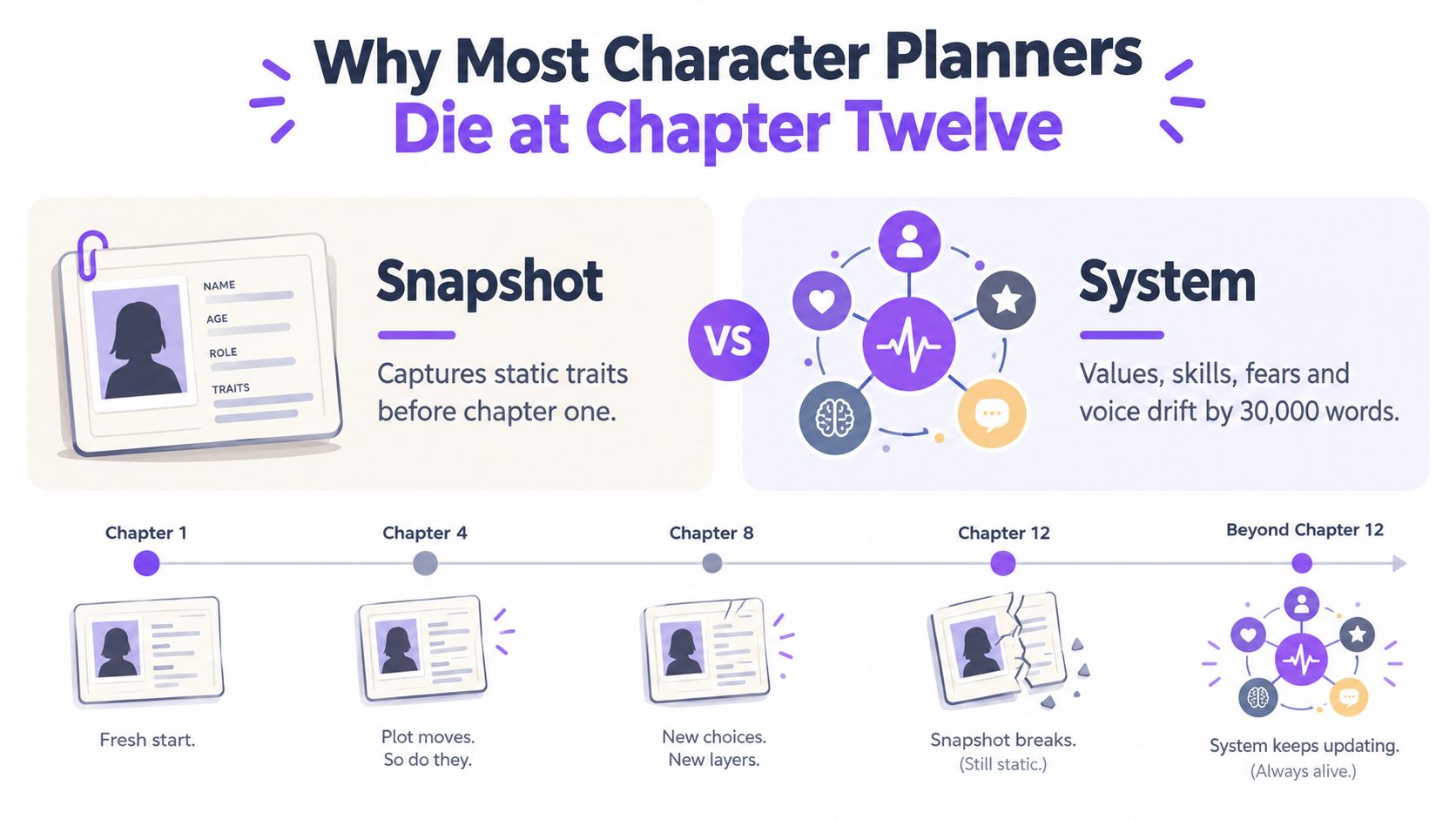
Static profiles create moving contradictions
Relationship fields fail in the same way. A profile might say that two characters are allies, while the actual manuscript has moved through suspicion, betrayal, reluctant cooperation, and renewed distrust. The web diagram remains attractive and completely wrong.
Physical details fare no better. A scar gets listed once and never checked. A character loses a knife in a fight, then draws it six chapters later. A debt disappears from the story because it exists only in a note the writer no longer consults. These aren't glamorous errors, but they damage reader confidence faster than an imperfect metaphor.
Practical rule: If a fact can change, it needs a scene anchor. A profile without an anchor is a claim, not a record.
A durable planner behaves more like a ledger. Each new fact receives a scene reference, a word-count position, and a status showing whether it remains current. That lets you see not only what a character knows, but when the manuscript established it and whether a later scene overturned it.
The broader lesson applies to any narrative system. A useful content playbook for authentic brands treats identity as something expressed consistently across changing contexts. Fiction needs the same discipline, except the identity changes on purpose. Your planner must preserve that evolution instead of freezing the character at the moment you filled in the form.
The Five Buckets of Character Data That Matter
A character planner needs five working buckets. Everything else is optional decoration until the manuscript proves it matters.
Identity anchors hold the facts copy editors and readers rely on: full name, aliases, age at story start, and birth date. Record these as canonical fields, not loose prose. If the character's age changes because the timeline changes, the planner should show the revision rather than leaving two plausible ages in circulation.
Physical inventory covers the details scenes can contradict. Track clothing, weapons, injuries, vehicles, debts, and other possessions that enter the action. A Marine captain whose prosthetic leg disappears from chapter 40 has a continuity problem, not a characterization problem. The same applies when a stolen vehicle turns up in a later scene without explanation.
Voice and behavior fingerprints protect dialogue from flattening. Store speech tics, gesture habits, vocabulary boundaries, and emotional defaults. A thief whose Cockney dialect vanishes in the second act doesn't need another personality questionnaire. The draft needs a voice comparison against earlier appearances.
The relationship ledger should record the parties involved, the history between them, the current trust position, and the last scene that changed it. A betrayal might shift a trust field from 6 to 2, but the number isn't the important part. The important part is that the change has a cause, a location, and consequences in later scenes.
The fifth bucket is knowledge state. For every meaningful scene, log what a character personally witnessed, what someone told them, and what they inferred. This is the bucket most static profiles skip, and it causes the most expensive mistakes in multi-POV fiction.
| Bucket | Example Fields | Typical Failure Without It |
|---|---|---|
| Identity anchors | Name, alias, age, birth date | Contradictory ages or names |
| Physical inventory | Injury, weapon, vehicle, debt | Objects and physical conditions appear or vanish |
| Voice and behavior | Speech tic, gesture, vocabulary | Dialogue becomes interchangeable |
| Relationship ledger | Trust, history, last change | Allegiances shift without narrative support |
| Knowledge state | Witnessed, told, inferred, concealed | Characters act on information they can't know |
A detailed character bible can contain far more material, but these five buckets are the minimum operational set. Worldbuilding is useful when it affects scenes. If it never changes behavior, access, conflict, or continuity, it belongs in your creative notes, not in the tracking layer.
Knowledge States Beat Trait Lists Every Time
Trait lists answer who the character is. Knowledge states answer what the character has seen, been told, or figured out by a particular point in the manuscript. Those are different questions, and only one of them protects reveal timing.
A list of twenty traits doesn't tell you which trait is active in chapter 47. It won't show whether Mira has learned that Victor is her uncle, whether she merely suspects it, or whether the reader knows it while Mira remains unaware. Trait lists scale poorly because they describe a character outside the sequence of events that gives those traits meaning.
Knowledge states scale because they attach information to scenes. In a multi-POV thriller with three narrators and one shared secret, each narrator needs a separate information history. The secret can be revealed to one narrator, implied to another, and concealed from the third. A later line of dialogue must respect all three states.
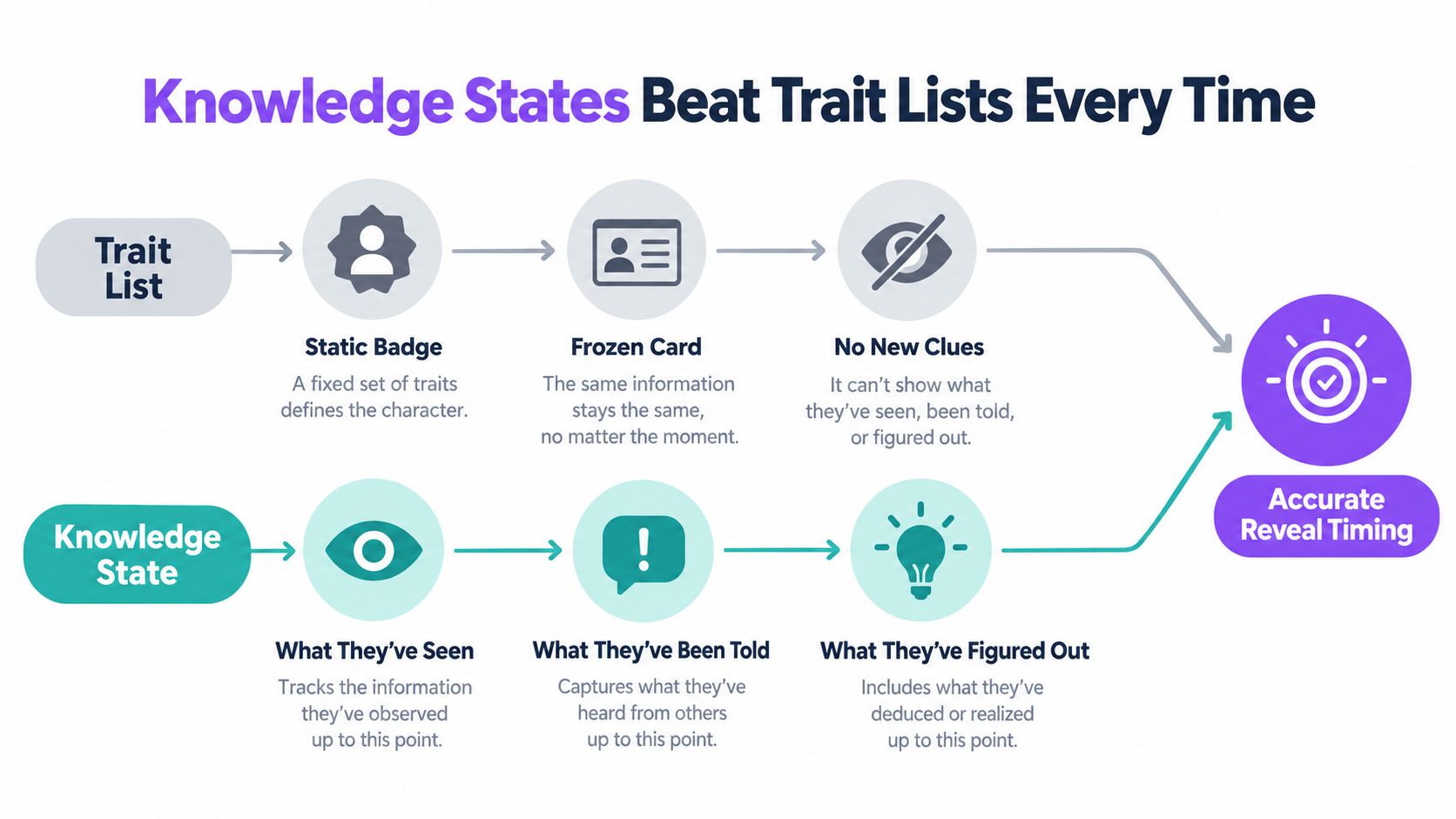
The profile is only the header
The knowledge log is the body of the planner. It records the moment a character sees the blood on the floor, hears the alias, recognizes the handwriting, or deduces that two apparently separate events are connected. It can also record false beliefs, because a mistaken conclusion is still a state that governs behavior.
For long-form serial fiction, this distinction becomes unavoidable. An academic discussion of event-indexed memory maps describes how authors working across millions of words and years can lose track of established facts, character states, and temporal sequences, making knowledge, relationships, and dates more useful than static bios alone (event-indexed memory maps).
A character profile tells you what to put on the page. A knowledge state tells you what the character is allowed to say.
A beta reader may catch the mistake at page 350. Repairing it then can mean rewriting setup, dialogue, reactions, and subsequent reveals. The planner should catch it at the sentence that introduces the impossible information.
A Real Continuity Failure and How to Catch It
Consider a manuscript scenario built around a supporting character named Lena. In chapter 28, Lena tells the protagonist that their father used a false surname during the war. The problem is that the protagonist doesn't learn this fact until chapter 41. Lena has no scene in which she could have discovered it, and the draft never establishes that she was present for the original conversation.
The planner contains the fact under the protagonist's record. It doesn't contain Lena's access to the information, so the writer assumes the line is safe. The error isn't a wrong biography. It's a missing knowledge-state entry.
A basic audit would filter the manuscript by character, scene index, and fact. The query is straightforward: show every scene where Lena speaks or thinks about the false surname, then compare each occurrence with the scene where Lena witnessed, received, or inferred that information. If the result returns chapter 28 before any valid entry, the line needs revision.
| Character | Chapter / Word Count | Knowledge Entered | Knowledge Available at Scene | Flag |
|---|---|---|---|---|
| Lena | Chapter 28 | Father used a false surname | No acquisition scene recorded | Flag |
| Protagonist | Chapter 41 | Learns the false surname | Available from chapter 41 onward | Clear |
| Lena | Later scene | References the surname again | Depends on a missing earlier source | Review |
The fix might be simple. Lena could have learned the fact in an earlier conversation, or the line could become a question rather than a confident statement. The point is that the writer needs to make the information path explicit.
A continuity error often looks tiny in isolation. In a complex novel, it exposes a missing connection between scenes, characters, and time.
The audit question belongs beside every important line of dialogue: What does this speaker know at this exact word count? Not what they know by the end of the book. Not what the author knows. What they know here.
The Same-Session Update Workflow
Planners fall behind when writers treat updating them as a separate administrative task. It should be the final part of the writing session, not a weekend chore performed after memory has blurred.
Write the scene first. Don't interrupt a difficult passage to maintain a database. Once the scene is stable enough to close, scan for facts that will affect later continuity. Look for new injuries, objects, revelations, relationship changes, discoveries, lies, and changes in what each viewpoint character knows.
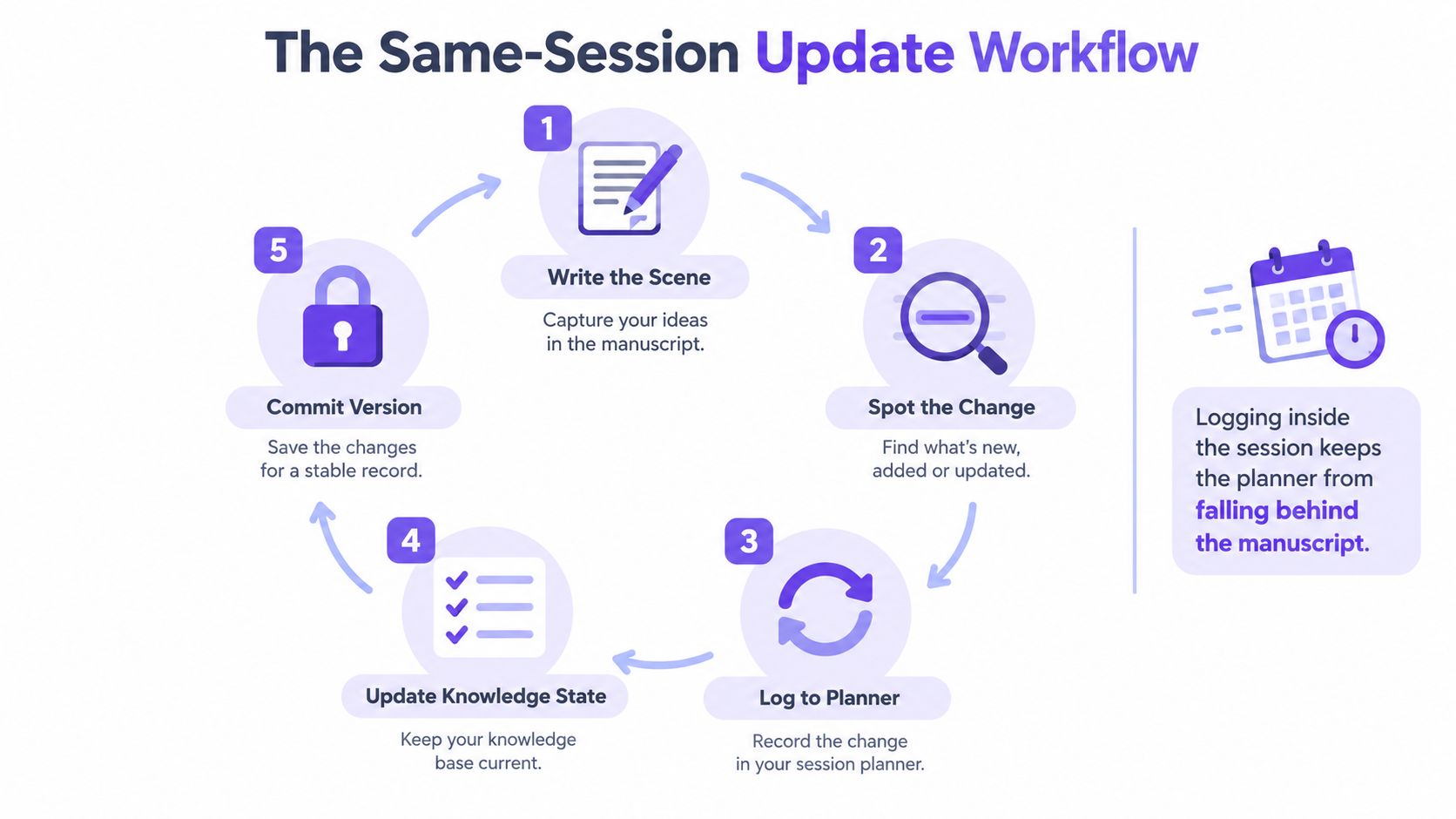
Make the update part of the session
Use this sequence:
- Write the scene. Finish the creative work before switching into audit mode.
- Spot the change. Identify every new fact, physical alteration, possession, relationship shift, and disclosure.
- Log it to the planner. Put each change in the correct bucket rather than burying it in a general note.
- Anchor the entry. Add the scene index or word-count position, then update the relevant knowledge states.
- Commit unresolved threads. Tag questions that still need an answer in the next session.
The fourth step is where most systems earn their keep. If a character learns a secret, update that character's knowledge state and check the other characters present in the scene. If a relationship changes, update both sides of the ledger. If an object changes hands, record the transfer.
A small habit compounds across a 100,000-word draft. That quantitative example belongs to the workflow because the more pages a manuscript contains, the more expensive memory-based tracking becomes. The relevant discipline is not exhaustive note-taking. It's immediate capture of facts that future scenes will rely on.
Working standard: If a new fact matters enough to remain in the manuscript, it matters enough to enter the planner before you close the session.
Scaling the Planner to Series, Ensembles, and Local Drafts
A single protagonist can conceal a weak tracking system. An ensemble exposes it immediately. Minor characters recur across books, inherit old injuries, carry knowledge from earlier volumes, and sometimes become central long after their first appearance. A practical ensemble-cast guide treats the roster as a network, not a list of names.
Series fiction adds another pressure point. Shared knowledge diverges between volumes. A fact seeded in book one must remain true in book four, unless the change is deliberate and recorded. A minor character may gain importance later, requiring retroactive depth without contradicting their earlier voice or history. Dates and ages also need arithmetic checks, because timeline slips become easier to catch when every interval and age change is written out in sequence, as Plotlens explains in its continuity guidance.
Privacy belongs in the architecture, not in a footnote. Unpublished manuscripts contain commercial plans, personal material, and work that shouldn't be copied into a service without a clear reason. Local processing reduces the exposure created when drafts leave the device, while version control reduces the risk of conflicting records across imports and revisions.
The same principle applies when comparing writing software outside fiction. Anyone evaluating script tools for TikTok should ask what the tool extracts, where drafts go, and whether the workflow preserves a reliable source of truth. Novelists need the same scrutiny, with continuity added to the checklist.
The right system automatically extracts character details, relationships, backstory, arcs, and knowledge states from the manuscript, then lets you inspect those records at a specific point in the story. Novelium provides that kind of Character Tracker and World Codex workflow, with local manuscript processing, scene-linked character information, and continuity checks designed for evolving drafts. It fits the method because it treats character data as changing records rather than decorative profiles.
Stop rebuilding a static character sheet and start tracking the facts that change scene by scene. Use Novelium to extract character details, relationships, knowledge states, and world information from your manuscript, then audit the moments where continuity usually breaks.