The Real Reason Your Novel's Opening Is a Trap
Look, we've all heard the standard advice for starting a story. "Grab 'em with a killer hook!" "Drop the reader right into the action!" "Establish the stakes on page one!" And you know what? It's not bad advice. If you're penning a 5,000-word short story where you can see the end from the beginning, it's pretty solid.
But that advice is dangerously thin when you're staring down the barrel of an 80,000-word novel, let alone a sprawling multi-book series. It focuses entirely on the reader's immediate thrill while completely sidestepping the author's biggest headache: keeping the whole damn thing from falling apart later.
The Real Cost of a "Great" Opening
At Novelium, we've seen it time and time again in the thousands of manuscripts we’ve analyzed. The most expensive mistakes—the ones that force you to gut entire subplots or perform emergency surgery on a character arc—almost always have their roots in some tiny, innocent-looking detail you tossed into the first few chapters.
A character mentions a past trauma offhand. A long-forgotten war gets a passing reference. An heirloom is described with a specific, unique flaw.
Each one feels like simple flavor text at the moment, but it’s not. It's a promise you're making to the reader. That little detail just became a data point, and now you're on the hook to track it across hundreds of pages. The "move fast and break things" energy that generic writing advice encourages is exactly what shatters your narrative down the line. It doesn’t matter if you’re a meticulous outliner or you write by the seat of your pants; this problem comes for everyone. You can read more on how different writers tackle this in our breakdown of plotters vs pantsers.
Your First Chapter Is a Database
It’s helpful to reframe the whole problem. Your opening pages aren't just a greeting card to the reader. They’re the genesis block of your story’s entire continuity system. Every piece of information becomes an entry.
- A character’s scar: Where’d he get it? Does the story he tells about it ever change?
- A political alliance: Who are the key players? What does each side really want?
- A mention of "last Tuesday": What was the actual date? What else was happening in the world on that day?
Your opening chapter isn't just telling a story; it's logging the initial state of every critical variable in your fictional world. When that log is messy or incomplete, the story inevitably breaks down.
For a professional author, starting a novel is less about finding a poetic first line and more about kicking off a flawless system of record. It's about laying a foundation of verifiable facts that can support the weight of the entire narrative. If you get this part wrong, you’re not just looking at a bit of prose revision later. You’re performing structural repair on a collapsing plot.
The Critical Shift from a Character Bible to Live Tracking
Let’s be honest, we all started with a character bible. It’s a rite of passage.
You spend a week filling a document with backstory, personality quirks, favorite foods, and that one formative childhood memory involving a broken music box. It feels productive. It feels professional. Then you start writing page one, and that meticulously crafted document becomes a museum piece almost immediately.
The fundamental flaw of the character bible isn't the information it holds; it's that the information is frozen in time. Characters aren't static sculptures. They’re living, breathing things whose entire reality changes with every scene. A character bible tells you who your protagonist was before the story started, but it’s completely useless for tracking who they are by Chapter 17.
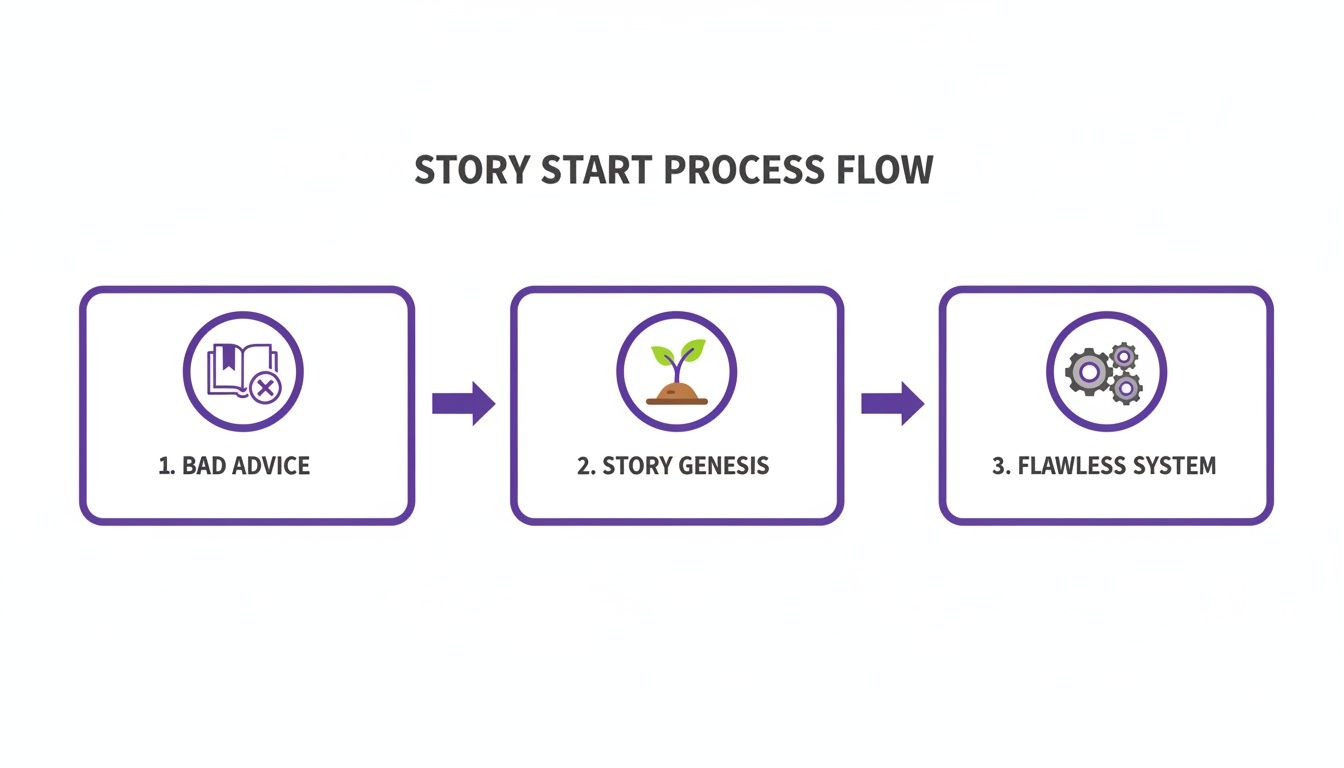
This really gets to the heart of it. Moving past generic advice means treating your story's beginning not just as a creative act, but as the creation of a system you can rely on.
The Problem of State
When we see complex manuscripts fall apart, it’s rarely because of a poorly defined personality. The real culprit is a breakdown in state tracking.
"State" is just the sum of a character’s knowledge, physical condition, and relationships at any single point on the timeline. It’s the data that changes.
A character who learns a devastating secret in Chapter 3 cannot act ignorant of it in Chapter 10. A character who breaks their arm in a fight can't be serving a volleyball in the next scene. These aren’t character development issues; they are catastrophic system failures. Your beautifully written character bible, with its notes on eye color, won't save you from this.
The most common continuity errors we analyze are not about who a character is, but what a character knows or is physically capable of doing in a given scene. The spreadsheet you made before you started writing is blind to the reality on the page.
What professional novelists need isn't a better character profile. It’s a completely different tool: a live tracking system. This isn't a document you create and then reference. It’s a dynamic record that logs a character’s state as it evolves throughout the manuscript. Think less of a bible and more of a flight data recorder for your narrative.
Static Profiles vs. Dynamic Tracking
Let's put this into practice. A static profile is an archive of the past. A dynamic tracking system is a log of the present. One is for brainstorming; the other is for execution.
Your old character bible tells you your character hates spiders. A live tracking system tells you that as of Chapter 8, Scene 2, she is currently trapped in a cave full of them, has one flashlight with a dying battery, and just found out her "ally" is the one who sealed her inside.
One piece of information is trivia. The other is a set of active variables that dictates her immediate actions, emotional state, and future decisions. For a short story, you can probably keep that in your head. For a 120,000-word novel, trying to mentally juggle the changing states of a dozen key characters is a direct path to plot holes and exhausting, expensive rewrites.
The difference really comes down to whether your tools are helping you brainstorm or helping you execute a complex project. One is a picture, the other is a video. You need the video to catch the mistakes.
This is exactly why we built Novelium the way we did. We saw that the real problem for authors wasn't a lack of character depth, but a lack of systemic continuity. The platform is designed to automate this tracking process, functioning as the live system that traditional methods just can't provide.
You can learn more about how it works to maintain consistency across your entire manuscript. The goal is to stop treating characters like static entries in a database and start tracking them as they actually are: constantly changing variables in a complex system.
What You Actually Need to Track From Page One
Let’s be honest. You don't need to log your protagonist's favorite coffee or the eye color of a character who walks on for a single scene. That’s just worldbuilding trivia, and confusing it with actual continuity tracking is how you end up with a monster spreadsheet you abandon by chapter five.
When we run manuscripts through our analysis tools, the errors that break a story almost never come from forgetting little details. They come from untracked, state-dependent information that quietly unravels the plot.
The real trick is knowing the difference between a static detail and a dynamic variable. Starting a story right means knowing which pieces of information are going to change over time—because those are the ones that need a timestamp. After analyzing thousands of manuscripts, we've found that the most catastrophic plot holes almost always trace back to a failure in tracking one of three things.

Knowledge State
First up, and most critical, is the Knowledge State. What does a character know, and—more importantly—when did they learn it? This is the number one cause of sophisticated plot failure, bar none. You drop an offhand comment in Chapter 2, but by Chapter 18, you've forgotten the source and have the character react with shock, as if they're hearing it for the first time.
This isn’t just about big secrets. It's the subtle pile-up of information that shapes how a character sees the world and makes decisions. If your protagonist learns his rival has a sick daughter on page 12, he can't be surprised by this "revelation" during the climax. Tracking knowledge isn't about making a list of facts; it's about logging the timestamp of each discovery to keep a character’s actions grounded in what they actually know.
Physical State and Inventory
Next is the character’s Physical State and Inventory. This sounds so simple, but it’s shockingly easy to mess up across 100,000 words. Who is injured, and how badly? A character who gets a deep knife wound in their left arm can't be flawlessly scaling a castle wall with that same arm two chapters later, unless you’ve explicitly written in some miraculous healing.
Inventory is just as vital. When a character pockets a specific key, a coded letter, or a single enchanted arrow, you have to track that object's existence and location. I’ve seen countless manuscripts where a critical item is secured in Chapter 4, lost during an escape in Chapter 11, and then magically reappears in the hero’s pocket in Chapter 20, just in time for the final fight. It completely shatters the reader's immersion.
A simple log entry—"Ch. 4, Sc. 2: MC acquires silver key from guard's belt"—prevents this entire class of error.
Tracking isn’t just about preventing mistakes; it’s about creating opportunities. Knowing a character is injured or has lost a key forces you to write more creative solutions, deepening the conflict and making their eventual success more earned.
Relational State
Finally, there's the Relational State. How has the dynamic between two characters changed over time? Relationships aren't static. Two characters might start as bitter rivals, shift to grudging allies, and end up as trusted friends. Each of those states dictates the subtext, dialogue, and body language in their scenes.
If you don't track these shifts, their interactions become inconsistent. A character might use a term of endearment that only fits their "trusted friend" state while they are still in the "grudging ally" phase, which feels jarring and unearned.
This is especially crucial in genres where relationships drive the plot. Think about romance and fantasy, which often feature complex relational arcs and absolutely dominate the current book market. For instance, romance leads with 21% of indie authors calling it their primary genre, followed closely by fantasy. The "romantasy" subgenre has become a bestseller phenomenon. To learn more about what's working for indie authors, you can explore the full 2025 survey results. For these stories, tracking how a relationship evolves isn't optional; it's the core of the whole narrative.
By focusing your energy on these three dynamic categories from page one, you're building a tracking system that's both powerful and manageable. You aren't just starting a story; you're setting up the guardrails to keep it from flying off the tracks.
How Your Opening Chapters Define Your Timeline Integrity
Your first few chapters are where you set your story’s internal clock. It’s where you establish the season, the day of the week, maybe even the exact time a scene kicks off. It all seems so simple, so fundamental, that it's dangerously easy to get wrong without even realizing it.
This is exactly where most timeline snags are born. It's not the big, complicated, time-jumping finale that breaks a book; it’s the quiet, seemingly harmless detail on page five that unravels into a temporal paradox by page 305.
We’ve seen manuscripts where a character somehow lives through three different "Mondays" in what was supposed to be a single week. We've watched protagonists attend a Tuesday morning meeting, only to go to a Friday night party that very same evening. These are the kinds of mistakes that are nearly impossible to catch when you're reading through your own work, but they scream out to an attentive reader and can completely gut your story's logic.
Anchoring Your Internal Clock
That opening isn't just a hook for the reader; it's your chance to drop anchor in your story's timeline. When you kick off a new story, you're not just introducing people and places—you're defining the physical laws of your narrative universe. And time is the most important law of all.
Get it right from the start, and you can save yourself from the agony of timeline-gutting revisions down the road.
The most solid method we’ve seen is something we call scene time-stamping. This isn't just about jotting down a date in a separate outline. It's about weaving temporal markers right into the fabric of your scene transitions, creating a chain of events that you can actually verify from the very beginning.
This doesn't mean you need to start every chapter with "The date was October 31st." Honestly, that often feels clunky and forced. The best time markers are usually relative and feel like a natural part of the prose.
- "The next morning, the frost had..."
- "Three hours later, the coffee was cold..."
- "By the time the sun set on Thursday..."
Phrases like these do more than just show time passing. They create a concrete, trackable sequence. Your first marker sets the anchor, and every one that follows builds on it, link by link.
A robust timeline isn't a rigid calendar you force onto your story. It's a flexible, interconnected chain of events that grows organically from the text itself, strong enough to withstand the inevitable shifts and changes of revision.
Building a Flexible Timeline from Chapter One
A classic mistake is to map out a hyper-detailed timeline in a spreadsheet and then try to cram your story into it. This approach is brittle. The second you decide to combine two scenes or weave in a new subplot, that whole static timeline shatters. You need a system that adapts and evolves with your manuscript.
A flexible timeline is built on relative markers, not absolute ones. The relationship between "Tuesday morning" and "Tuesday afternoon" is fixed. If you later decide to shift that entire day's events to Wednesday, the internal logic still holds perfectly because the sequence—morning followed by afternoon—remains intact.
The real trouble starts when those connections get lost. A character can’t leave for a three-day journey on Wednesday and arrive "the next day" on Friday. This might seem painfully obvious, but stretched across 300 pages and months of writing, these tiny logical gaps grow into gaping plot holes.
As you start your story, focus on forging those sequential links between scenes. Every time you write a transition that moves the clock forward, you're adding another link to your timeline's chain. The stronger those connections are in your opening chapters, the more resilient your entire narrative will be. By verifying this sequence from the get-go, you're not just writing an opening—you're engineering a story that can hold its own weight.
Setting the Stage for Your World
When you're writing fantasy, sci-fi, or even sprawling historical fiction, your opening chapters are landmines of your own making. Every detail you introduce—a rule of magic, a political alliance, a piece of forbidden tech—isn't just window dressing. It's a law you're writing into the stone of your universe.
The biggest mistake I see writers make is treating this as an info-dump. They're so eager to show the reader their cool world that they forget every detail is a promise. It’s a contract.
If you establish in Chapter 1 that magic drains a sorcerer's life force, you can't have him casting world-breaking spells in the climax without showing the catastrophic physical toll. If a certain metal is declared indestructible, it can't be conveniently melted down when the plot demands it. Readers always notice these things. It shatters the very immersion you've worked so hard to build.

From Info-Dump to Internal Codex
Here's a mental shift that changes everything: treat every piece of worldbuilding in your opening chapters like a trackable entry in a codex. This isn't about creating a pretty, leather-bound book of lore for yourself. It’s about codifying your own rules so you can enforce them across hundreds of pages.
Think of it this way. Every time you establish a "fact" about your world on the page, you've created a new entry.
- You write: Magic requires a verbal component spoken in the Old Tongue.
- Your mental codex entry: Magic System > Verbal Component > Old Tongue. Now you can check every instance of spellcasting against that rule.
- You write: The Atreides family holds the fief of Caladan.
- Your mental codex entry: Political Factions > House Atreides > Fiefdoms > Caladan.
You're not just decorating your story; you're building its internal physics.
A world feels immersive not because of the volume of its lore, but the consistency of its laws. The opening chapters are where you write your constitution. A good tracking system is how you enforce it.
This Isn't Just About Art
Getting this right isn't just about satisfying your inner perfectionist. In a global book market projected to hit over $213 billion by 2033, reader trust is your most valuable currency. Consistency is how you earn it.
Breaking your own rules is the fastest way to lose a reader, especially the die-hard fans of a long-running series. Trust me, they are the ones who will remember the tiny detail from book one that you forgot by book three.
Building a System That Lasts
Codifying your world from page one is about future-proofing your story. It prevents that sickening moment deep in the second act when you realize a rule you casually dropped on page ten has completely broken your magic system or a major political subplot. It saves you from the kind of structural rot that forces massive, soul-crushing rewrites.
Your goal is a world that feels real because it is real—within its own consistent rules. And you don't get there with a static wiki you build before you start writing. It's done with a dynamic system that logs rules as they appear on the page, creating a verifiable source of truth for your world.
For complex projects, using dedicated worldbuilding software isn't a luxury anymore; it's a core part of professional execution. It turns your world's rules from scattered notes into a powerful tool for keeping your story straight.
Questions From the Writing Trenches
Even when you know you need a better system, ditching old habits for a more rigorous way of tracking your manuscript can bring up some questions. Here are a few we hear all the time from professional novelists who are tired of wrestling their complex stories into submission.
Isn't This Level of Tracking Overkill for a First Draft?
I get it. There’s a romantic idea that the first draft should be pure, chaotic creation, with cleanup happening somewhere down the line. But while that messy exploration is a vital part of the process, ignoring your story's foundation isn't creative freedom—it's just accumulating structural debt.
The mistakes that derail manuscripts aren't typos. We're talking about a character knowing something they couldn't possibly know, a timeline that folds in on itself, or an object that appears out of thin air. These aren't simple fixes. Correcting them often means rewriting entire subplots or gutting a character's arc.
Tracking key details from page one isn’t about putting your creativity in a straitjacket. It’s about building a stable framework so your brilliant, messy ideas don't cause a structural collapse later. Think of it as laying the foundation before you build the house; it prevents an avalanche of revision work that can stall, or even kill, a project.
My Story Is Character-Driven. Do I Really Need This?
Absolutely. In fact, you might need it more than anyone.
A character-driven story lives and dies on the authenticity of its characters' reactions and their internal journey. That authenticity shatters the moment a continuity error pops up. If a character’s entire emotional arc hinges on them not knowing a secret, but you accidentally have someone else reference it in dialogue five chapters too early, their motivation is instantly compromised.
For these kinds of stories, consistency in knowledge, relationships, and emotional states isn't just a technicality. It’s the engine of the plot. Solid tracking ensures your character’s inner world stays logical and believable, which is the very bedrock of a compelling character-driven narrative.
Can I Start This Halfway Through My Manuscript?
Yes, and it’s an incredibly powerful diagnostic tool. Dropping a system like this onto a work-in-progress is like running a full diagnostic on a complex machine.
You can go back and build your timeline and character trackers based on what you’ve already written. The process itself will immediately throw up red flags for inconsistencies you almost certainly missed while you were deep in the creative flow. You can, for instance, suddenly see every single mention of a specific magical artifact to check if its location and ownership are consistent from scene to scene.
It's so much better to find and fix these issues at the 40,000-word mark than after the draft is "finished" and all the narrative threads have become a tangled, interdependent mess. It gives you a clear, actionable roadmap for your revisions.
How Is This Different From Just Using a Detailed Outline?
This is a crucial distinction. An outline is a map of your intentions. A live tracking system is a record of what you actually wrote.
We’ve all been there. No manuscript survives first contact with the blank page. You discover things as you write, characters take unexpected turns, and brand-new subplots emerge from the ether.
Your outline might say that Character A learns the big secret in Chapter 15. But in the heat of writing a tense scene, you gave another character a juicy, revealing piece of dialogue back in Chapter 12 that completely gave the game away. A static outline will never catch that. A true tracking system analyzes the text itself—the ground truth of your story. It follows what’s on the page, not just what you planned to put there.
Ready to stop chasing continuity errors and start writing with confidence? Novelium is the manuscript intelligence platform built for professional novelists. It automatically tracks your characters, timeline, and worldbuilding, flagging inconsistencies before they become plot holes.