Your Opening Isn't a Hook. It's a Contract.
For any novelist wrestling with a complex project, the start of a story is far more than a hook. It's a binding contract. In those opening pages, you are making promises about character, stakes, and the fundamental physics of your world. You're laying the foundation for an 80,000-word structure, and a weak slab will crack under the weight.
Your Opening Is a Promise, Not Just a Hook
Let's kill a sacred cow. Agonizing over the perfect first sentence is, for a novelist, a profound waste of time. A sharp hook matters, sure. But the real architectural work of an opening happens across chapters, not in a single, perfectly polished line.
When we analyze manuscripts, the cracks rarely appear in the opening paragraph. They show up fifty pages later, stemming from a promise made at the beginning that was never fulfilled—or worse, was completely contradicted.
Getting this right is a huge deal. A shaky beginning can undermine an entire project, a reality starkly reflected in the market. A staggering 80% of authors with 1-3 published books earn under $100 per month. That number, from a survey of over 1,300 authors, shows just how critical a strong, coherent start is for building a readership that actually pays. You can dig into more author survey results from Written Word Media to see the full, sobering picture.
The Contract of Character State
The single most critical promise you make is establishing your character's initial "knowledge state." This isn't their backstory or eye color. It's the specific, actionable information they possess the moment the story begins. This is the baseline from which all change is measured.
This initial state is a three-part inventory:
- What they know for certain: The facts, skills, and relationships they rely on without question.
- What they think they know: The misconceptions, biases, and false assumptions that are about to drive the conflict.
- What they absolutely don't know: The crucial gaps in their awareness that the plot is going to ruthlessly exploit.
Failing to lock down this knowledge state is the number one cause of consistency failures we see in long-form fiction. A character can't suddenly forget they know how to pick a lock in chapter ten if you established it as a core skill in chapter one. The reader will notice, and the illusion shatters.
The start of a story isn't just about introducing a character; it's about calibrating their worldview. This calibration becomes the baseline against which every future decision and revelation is measured.
Seeding Future Payoffs
This initial knowledge state is your primary tool for seeding subplots and thematic questions. The information your character lacks becomes the engine for mystery and suspense. The lies they believe become a rich source of dramatic irony.
For example, your protagonist starts the story believing her mentor is a hero. That belief is a trackable asset. Every interaction is filtered through that lens. When contradictory evidence appears, the tension comes from the clash with that initial, firmly established state. If you haven't nailed down that initial belief, the eventual betrayal feels cheap and unearned.
Your opening chapters are not an introduction. They are the act of laying down narrative tracks. If those tracks are misaligned from the very beginning, the story will inevitably derail, no matter how beautiful the prose.
The In Medias Res Fallacy

Let's talk about the most misunderstood piece of writing advice: "start in the middle of the action." It’s well-meaning, but it’s responsible for more confusing, alienating, and frankly unreadable opening chapters than any other trope.
When done well, an in medias res opening is a thing of beauty. When done poorly, it’s a mess.
The problem comes from a misunderstanding of what makes an action-packed opening work. Dropping your reader into a firefight or a spaceship dogfight isn't automatically compelling. It only becomes compelling when the reader has just enough context to understand what’s at stake on a human level. Without that, it’s just noise.
Every time we see a manuscript fumble this, the pattern is identical. The author tosses the reader into a scene overflowing with jargon, frantic movement, and a bunch of names, but they’ve forgotten the three pillars that give action meaning.
The Triad of Implied Context
For an action opening to land, the reader needs to grasp three things almost instantly, even if the details are fuzzy. This isn't about exposition. It’s about a quick frame of reference so they know who to root for.
- A Clear, Immediate Goal: What does your point-of-view character want to achieve right now, in this scene? Forget their series-long ambition. What is their minute-to-minute objective? Escape the room. Disarm the device. Get the message to the captain.
- An Obvious, Immediate Obstacle: What is actively stopping them? The locked door. The ticking clock. The guards storming the hallway.
- A Palpable, Immediate Consequence: What happens if they fail? This is the most important part, and the one most often forgotten. The bomb goes off. The data is lost forever. They get captured.
Without this triad, you don't have tension. You have confusion. Your reader is floating in a sea of meaningless action, unsure of what matters or why they should care.
A successful in medias res opening doesn't withhold context; it compresses it. It uses the character's actions and immediate desires to imply the stakes, trusting the reader to connect the dots without a history lesson.
Backstory Belongs in the Reaction
So, how do you provide this context without grinding the story to a halt? You weave it into the reaction, not the action itself.
The firefight shows the character’s skill, sure. But the moment they duck behind cover is your chance to drop in a single, critical line of internal thought about why they cannot let that package fall into enemy hands.
This technique is fundamental to crafting a solid start of a story that hooks a reader without bewildering them. For authors who outline every beat, this is straightforward. But even for those of us who write by the seat of our pants, getting this right is non-negotiable. If you're curious how different writing styles tackle this, our discussion on plotters versus pantsers has some relevant insights.
The bottom line is simple: action is only interesting when contextualized by stakes. By focusing on the Goal-Obstacle-Consequence triad, you ensure your high-impact opening orients your reader instead of pushing them away from page one. Your job isn't just to create chaos—it's to provide clarity within it.
Your Narrative Voice is a Compass
Think of your narrative voice as more than stylistic flair. For a full-length novel, it’s the reader's compass. It's the filter through which every event, emotion, and judgment is processed. An inconsistent or generic voice in the opening chapters is a red flag to a reader. It signals that the story doesn't have a coherent point of view, and they can sniff that out from a mile away.
The voice you choose dictates everything.
A cynical, first-person noir detective describes a rainy street completely differently than an omniscient narrator in a sweeping fantasy epic. The detective notices the grime in the gutter and the quiet desperation in a stranger's eyes. The epic narrator might see that same rain as a divine portent or a dreary backdrop for dynastic struggles. The voice isn't just describing the scene; it’s telling the reader what matters.
Getting this right has a massive commercial impact. The romance genre, for instance, pulls in $1.4-1.5 billion a year in the US alone. A survey of over 1,300 authors revealed that paranormal romance writers were 2.5 times more likely to land in the top earning brackets. These writers get it: the voice must perfectly match reader expectations from the first line. If you want to dive deeper into these numbers, you can explore more fiction sales statistics from From Whispers to Roars.
Training Your Reader
Your opening chapters are where you teach the reader the "rules" of your narrator's perspective. Is this narrator reliable? Are they an all-knowing god, or stuck inside one character's head? Do they have a dry wit, or are they prone to flowery prose? You establish these rules from page one, and you must stick to them.
Consistency is everything, especially in stories with multiple points of view. We have seen countless drafts where the voices of three different POV characters blur into a single, generic narrator. When a battle-hardened soldier suddenly starts thinking in the same internal rhythm as a sheltered diplomat, the whole illusion shatters. Each voice has to be a distinct, unbreakable filter.
Voice is the operating system of your story. If you install a buggy, inconsistent version in the first chapter, the entire narrative will crash before you hit the midpoint.
Voice as an Evolving System
The voice you establish on page one also has to be robust enough to carry the entire novel. It needs room to evolve as the character grows, but without losing its core identity. This is a classic trap. Writers diligently track physical details but forget to track the subtle shifts in a character's internal monologue and perspective over 300 pages.
Maintaining this vocal consistency across a long manuscript is a serious challenge. It requires a system that does more than list traits. If you're curious how technology can help, our guide on AI writing software for novelists explains how tools can track these nuances, making sure your narrator's voice remains a reliable guide from the first page to the last.
Ditch the Character Profile. Start Tracking.
This is where quiet continuity errors are born. The ones that don't announce themselves until you’re 60,000 words deep and realize your protagonist is shocked by information they actually learned in Chapter Three.
Your entire plot rests on your characters’ information state at the start of the story—what they know, who they’ve met, and what’s rattling in their pockets. Get this wrong, and you guarantee contradictions down the line.
Based on our manuscript analysis, the most catastrophic plot holes almost always trace back to a poorly defined starting point. This isn't about filling out character questionnaires. It’s about the systematic, scene-by-scene tracking of a character's awareness.
Volatile Data vs. Static Data
Here’s the thing: most writers track the wrong stuff. They build massive documents detailing a character's favorite food or childhood pet. That’s static data. It rarely changes and has little impact on the moment-to-moment mechanics of your plot. It’s worldbuilding, not character tracking.
The information that actually breaks a complex manuscript is the volatile data. This is the stuff that changes constantly. This is the data you have to monitor with obsessive precision, especially in the opening chapters.
- Knowledge: What specific facts does the character possess right now? Who do they believe is an ally? What lies are they operating under?
- Location & Proximity: Where are they, and who knows it? Who did they just see in the hallway? This simple data point prevents characters from magically appearing where they shouldn't be.
- Possessions: What is physically on their person? A key, a weapon, a stolen letter. An item can't be used in Chapter Ten if it was lost in Chapter Two.
- Immediate Goals: What is their active, driving objective in this scene? Not their life's ambition, but their immediate intent.
This visual shows how the character’s state of mind acts as the filter between your authorial voice and what the reader ultimately understands.
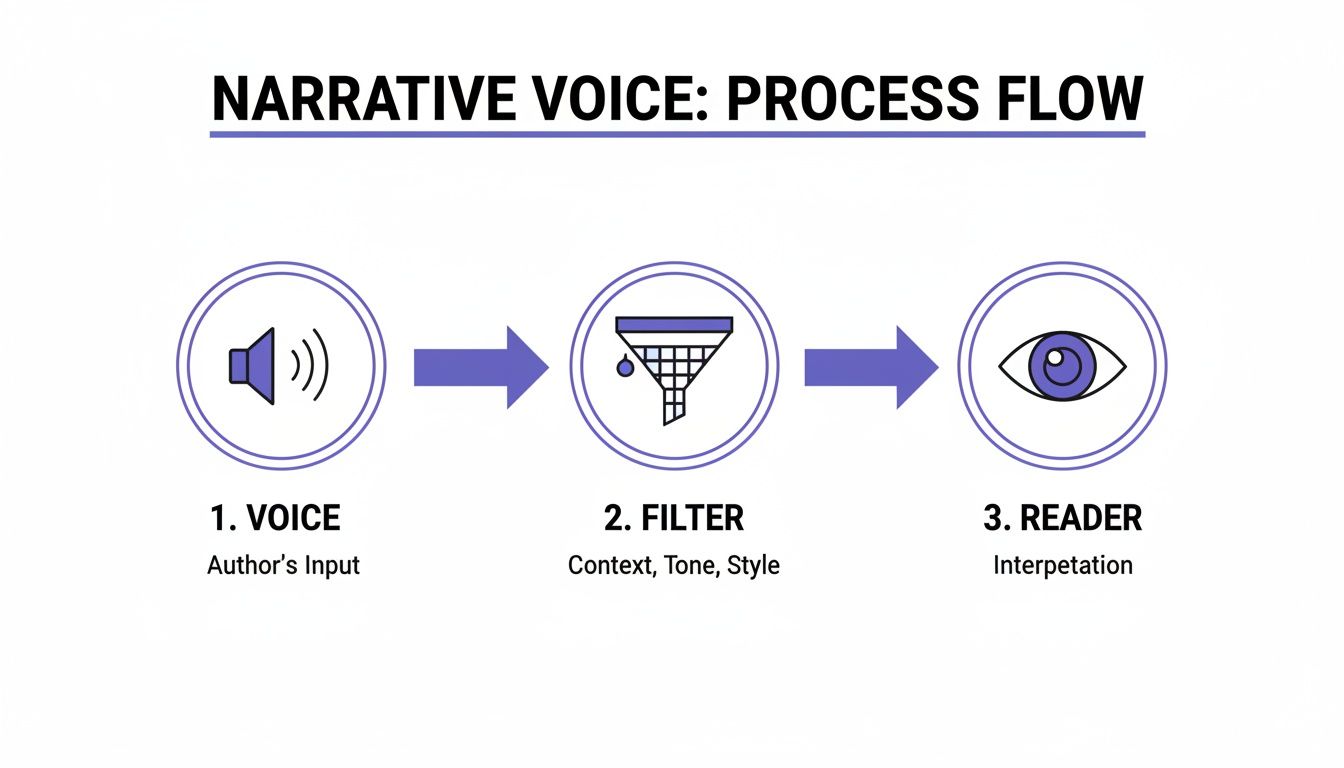
A character's information state is the primary lens through which readers experience the story.
Tracking volatile data isn’t a one-time setup; it’s a dynamic ledger. A character's information state at the end of Chapter One becomes the starting state for Chapter Two. When a character learns a secret, that’s a transaction. When they hand off an object, that’s another. A spreadsheet can barely handle this for a single POV, let alone a sprawling epic with a dozen viewpoints.
Most character profiles are static portraits on a wall. What you actually need is a live GPS tracker showing where your character is, what they know, and where they're headed next.
This meticulous tracking is your only real defense against the kind of insidious plot holes that force painful, deep-tissue rewrites. When you lock down the initial information state, you aren't just creating a character. You're deploying a fully consistent, logical asset whose actions will hold up under the most intense reader scrutiny—from the first page to the final, satisfying conclusion.
Worldbuilding Belongs in the Conflict, Not the Prologue
Let’s get one thing straight: worldbuilding is not a prologue.
In your opening chapters, its only job is to inform the immediate conflict and your character’s choices. Anything else is dead weight, grinding your narrative to a halt before the story even gets off the ground.
We see this constantly in otherwise strong manuscripts. Authors get so wrapped up in their intricate histories that they front-load the story with lore that has zero bearing on the scene at hand. The reader doesn’t need to know the entire history of the Elven civil war when your protagonist is just trying to steal a loaf of bread.
The pressure is real. The global publishing industry is on track to hit $126.8 billion, and with self-publishing growing at twice the rate of traditional publishing, the competition is fierce. Fantasy and romance authors, in particular, are finding massive success—but only if their openings deliver. Find out more about current publishing trends.
Functional vs. Ambient Worldbuilding
To avoid the info-dump, you need a ruthless filtering system. Think of your worldbuilding in two distinct categories: functional and ambient.
- Ambient worldbuilding is texture. It's the two moons in the sky, the strange fabric of a character's clothes, the unusual slang they use. These are details that don't need an explanation; their purpose is to make the world feel different and lived-in.
- Functional worldbuilding directly impacts the scene's mechanics. It’s the law that makes stealing that bread a capital offense. It’s the magical ward on the door that the protagonist has to bypass. These are the rules of the game the reader must understand to follow the action.
The trick is to treat functional worldbuilding as strictly need-to-know information. If a detail doesn’t directly raise the stakes or present an obstacle in the current scene, save it for later.
Your world is revealed through your character’s interaction with it. A single detail shown through action is worth ten paragraphs of exposition. Don’t tell us magic is dangerous; show us the burn scars on the mage’s hands as she hesitates to cast a spell.
Make Your World Part of the Story
How do you deliver that necessary functional worldbuilding without lecturing the reader? You do it through conflict.
Have your character push against the rules of your world. When they try to do something and fail because of a societal norm, a physical law, or a magical barrier, you've just organically revealed a crucial piece of information. This method forces you to keep the worldbuilding tethered to your character's immediate problems.
Of course, managing all these details across a sprawling manuscript is a huge challenge. It’s easy to forget what you’ve revealed and when, which is where a dedicated worldbuilding software solution becomes your best friend for tracking continuity.
Forget the lore bible for now. In your opening, your only goal is to make the world an active participant in your character’s struggle—not a passive backdrop for a history lesson.
Burning Questions About Story Openings
Even writers who've been at this for years get tripped up by the opening. It’s the part of the manuscript most vulnerable to subtle mistakes that blossom into full-blown plot holes. Let’s tackle some of the thorny questions that always come up.
How Do I Introduce a Complex Magic System Without an Info-Dump?
This is a classic fantasy problem. The answer? Focus on effect, not theory.
At the start, your reader doesn't need a textbook on your magic system's taxonomy. What they do need is to see its immediate impact on your character and their world. What does it cost them to use it? What tangible problem does it solve—or, even better, what new problem does it create?
Introduce only the rules relevant to the opening scene's conflict.
Instead of a lecture on the five schools of elemental magic, show your protagonist desperately trying to pull moisture from the air to douse a fire. Then, show them failing because they're missing the right component. In a single, tense action, you’ve taught the reader that magic has strict rules and tangible costs, all without a line of exposition.
My Story Starts Slow. How Do I Keep It Engaging?
A "slow" start is only a problem if it's a static one. The key isn't a car chase or a dragon attack; it’s about creating internal momentum.
You can keep a quiet opening absolutely riveting by introducing a pressing personal question or a small, unsettling mystery in the character's immediate life. Maybe it's a cryptic letter that arrives, a sudden and inexplicable debt, or a single, strange comment from a trusted neighbor that just feels wrong.
The goal is to create narrative tension, not just physical action. A compelling personal problem is just as powerful as a ticking bomb for making a reader turn the page.
Just make sure the character is actively trying to understand or solve this puzzle, even if they're just sitting in a quiet room thinking it through. Their focused effort is what gives the story the forward thrust it needs.
In a Multi-POV Novel, Whose Perspective Is Best to Start With?
Simple. Start with the character whose immediate problem best represents the novel's central conflict.
Think of this character as the reader's primary entry point into your story's core themes and stakes. This isn't always your "main" protagonist. It's the character whose situation is the most immediately volatile, the most consequential. Their viewpoint should be the one that raises the most interesting questions and nails the precise tone you're going for.
Whatever you do, avoid opening with a prologue from some obscure character unless their actions are the direct and immediate catalyst for the main story. Otherwise, you risk getting the reader invested in a perspective that doesn't pay off, which can feel like a bait-and-switch. Your opening POV choice is a critical promise about whose story this really is.
Your opening chapters set up hundreds of data points—character knowledge, object locations, timeline sequences—that are just about impossible to track by hand. Novelium is the first manuscript intelligence platform designed to protect your story's continuity. It analyzes your draft right on your device, flagging plot holes and inconsistencies in real time so you can build a rock-solid narrative from page one. Stop hunting for errors and start writing with confidence. Find out more at novelium.so.