The Best Software for Novelists Manages Your Story, Not Just Your Words
Let’s be direct. The best software for novelists isn’t a fancier word processor. It’s a system built to manage the sprawling, complex details of your story so you don’t have to. For anyone juggling a long manuscript, a multi-book series, or a cast of characters that could fill a small town, the real work isn't just writing—it's tracking. You need to get the consistency management off your plate and let a system handle it. It’s the only reliable way to catch the continuity errors that manual methods always miss.
Why Your Meticulous Character Bible Is Failing You
We’ve all built them. The sprawling spreadsheets, the exhaustive character questionnaires, the digital binders we’re convinced will be our story's single source of truth. You can burn a whole week filling out every last detail, from your protagonist's favorite childhood breakfast to their maternal grandmother's maiden name. It feels productive. It feels professional.

But then, 80,000 words deep into the manuscript, that perfect system falls apart. The character bible, once a beacon of clarity, has become a graveyard of outdated information. This isn't because you weren't diligent enough. It's a fundamental flaw in the entire approach. A character profile is a static document, and your manuscript is a living thing.
The Static Document Problem
Here's the core issue: a traditional character bible is a snapshot of your character before the story kicks off. But stories aren't static. Characters learn, change, and forget things scene by scene. Their relationships evolve. Their physical state shifts. A pre-written document just can't track this dynamic state. It knows your character has a scar on their left arm, but it has no idea they picked up a new one on their right in Chapter 12.
The fatal flaw of the character bible is that it captures intent, not execution. It documents what you planned for a character, not what they actually know, possess, or believe on page 173.
From analyzing thousands of manuscripts, we see this exact failure play out over and over. It's the source of the most common and maddening continuity errors. The kind that force you into a painful manual reread, cross-referencing your bible against the text page by agonizing page.
Where Consistency Actually Breaks Down
Beginner writing advice obsesses over static traits like eye color or birthplace. Yes, those are important. But they're rarely where a complex novel truly falls apart. The real damage comes from dynamic, state-dependent information that a spreadsheet simply can't handle.
Here’s what we've observed goes wrong in long-form fiction:
- Knowledge Tracking: A character in Chapter 3 doesn't know the villain's secret, but by Chapter 20, they do. A static profile can't track that progression. We constantly see writers accidentally have that character react to the secret in Chapter 15, creating a massive plot hole.
- Object Possession: Your detective picks up the murder weapon in the first act. But did she still have it when she was ambushed in the third act? Manually tracking the chain of custody for a key item across 300 pages is a nightmare waiting to happen.
- Relationship Status: Two characters start as enemies and slowly become allies. Your character bible says "enemies," but the manuscript shows a complex, evolving dynamic. This leads to dialogue or internal monologue that feels emotionally out of sync with their most recent interaction.
These aren't trivial mistakes. They are the kinds of errors that yank a reader right out of the story and undermine the logical integrity of your world. The problem isn't that you need a better 50-question questionnaire. The problem is the questionnaire itself. It's an artifact that can’t keep pace with the demands of a modern series or an epic fantasy. For that, you need something more like what the best worldbuilding software can offer: a system that lives and breathes right alongside your manuscript.
The Critical Shift from Character Development to Character Tracking
To manage a sprawling manuscript without losing your mind, you have to make a conceptual leap. You must understand the massive difference between a "character development document" and a true "character tracking system." They aren't the same thing. Confusing the two is a direct path to plot holes and continuity errors.
A character development document, your profile or story bible, is a pre-writing exercise. It's a snapshot in time, an architectural blueprint you draw up before breaking ground. It’s useful for establishing a baseline, but its value plummets the moment you type "Chapter One."
A character tracking system, on the other hand, is a live GPS. It doesn't just show you the planned route; it actively monitors your position, recalculates when you take a detour, and alerts you to wrong turns in real time. This is the fundamental shift every serious novelist must make when looking for the right software.
What a Tracking System Actually Does
A real tracking system doesn't care about your character's favorite food unless they order it on page 212. It’s not interested in backstory fluff. Instead, it focuses on the dynamic data points that impact plot integrity. Its job is to monitor the manuscript itself, not your pre-drafting intentions.
This means it's constantly asking questions that a static document can't process:
- Knowledge State: What does this character know right now, in this specific scene? Have they learned the secret yet? Did another character lie to them, creating a false belief that should be driving their actions?
- Physical State & Location: Where is this character, physically, at this point in the timeline? Did they twist their ankle in the previous chapter? Because it should still be hurting them here.
- Object Possession: Who has the coded letter? Who’s holding the key? Tracking the chain of custody for critical props prevents them from magically appearing in someone's pocket just because the plot needs them to.
- Relationship Status: How did this character's last interaction with their rival end? A good system knows their last conversation was a bitter argument, stopping you from writing their next scene with an inappropriately friendly tone.
This is the information that actually maintains consistency. The rest is often just worldbuilding you do for yourself.
A character profile is a birth certificate. A character tracking system is a real-time medical chart, financial ledger, and surveillance feed all rolled into one. One tells you where the character started; the other tells you their exact condition on page 257.
Separating Signal from Noise
The failure of old methods isn't just that they're static; it's that they encourage you to track the wrong things. Your spreadsheet might have a column for "biggest fear," and that's a fine psychological trait for motivation. But that's not where plot holes come from.
We've analyzed enough manuscripts to see that the real consistency killers are almost always tied to the flow of information and physical reality within the story's timeline. A character can't act on information they don't have yet. They can't be in London on Tuesday morning if they were in Tokyo on Monday night. It’s that simple, yet so easy to get wrong.
A dynamic tracking system automatically pulls this information out and monitors it as you write. It builds a living model of your story world based on what's actually on the page. This frees you from the impossible task of holding every single detail of a 100,000-word manuscript in your head at once. It’s not about replacing your creative intuition; it's about offloading the thankless job of logical bookkeeping, which is precisely what modern software for novelists should be doing for you.
Core Features That Actually Matter in Writing Software
Let’s cut through the noise. Most tools calling themselves "software for novelists" are really just fancy text editors with a digital corkboard and some folders. They’re fine for organizing files, but they do nothing to help you manage the actual story living inside those files. For anyone wrestling a complex project, that’s not going to cut it. You need software that does more than just hold your stuff; you need a tool that actively helps you make sense of it.
The bedrock of any truly modern novelist software rests on a few non-negotiable features. These aren’t gimmicks. They are the core functions that separate a professional-grade system from a simple writing app, and they directly address the kind of consistency failures we see in manuscripts every day.
Automated Continuity Tracking
First and most critical is automated continuity tracking. I don't mean a system where you have to manually tag items or create links yourself. That's just more administrative work. I'm talking about software that actively reads your manuscript and flags contradictions as you write.
Imagine your protagonist, Jane, has a severe peanut allergy you mentioned in Chapter 2. Then, deep in the weeds of Chapter 15, you write a scene where she casually grabs a peanut butter cookie. A powerful continuity tracker catches that instantly. It’s your safety net, catching the tiny human errors that are almost inevitable in a 100,000-word draft. It keeps an eye on character traits, what they know, what they look like, and alerts you the second something doesn't add up.
This concept map shows how we need to think about this—evolving from a simple, static character file to a system that provides this kind of deep, active oversight.
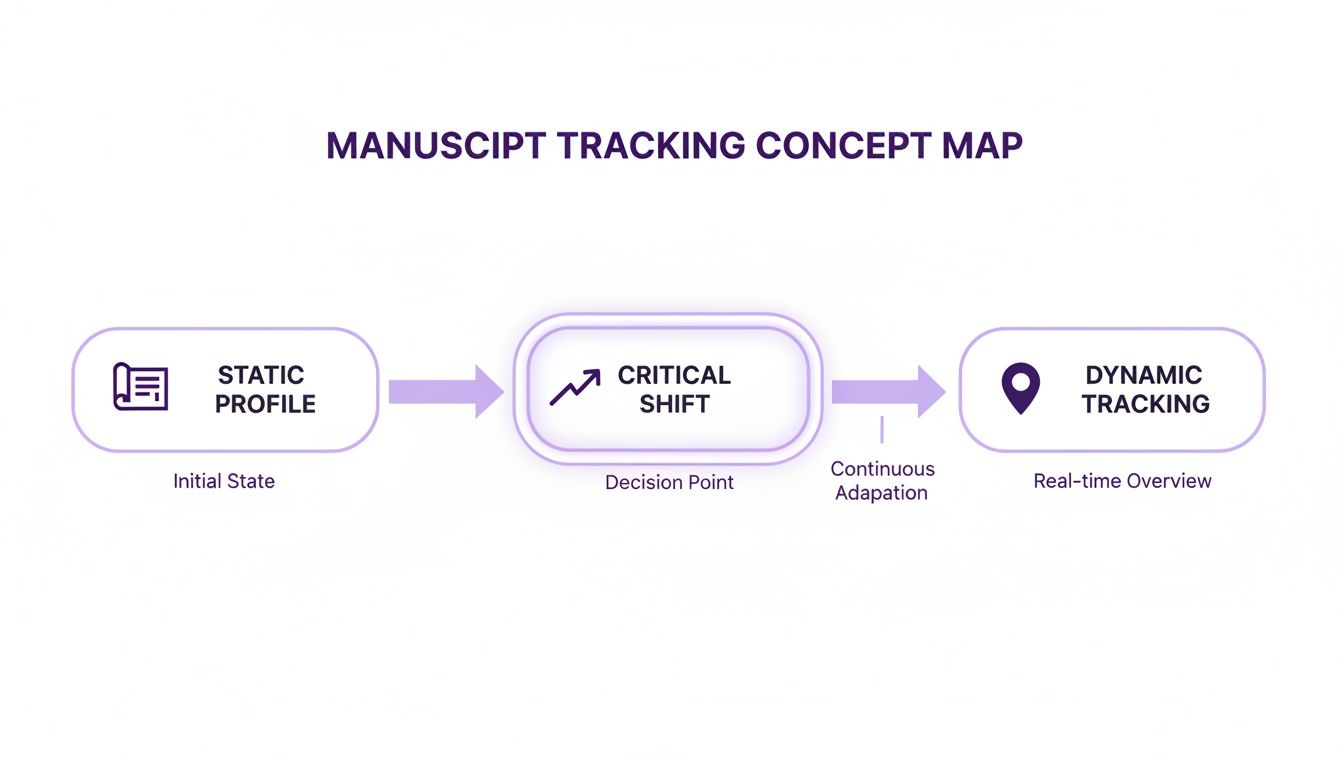
It’s about moving from a static blueprint to a dynamic, real-time GPS for your manuscript's internal logic.
Dynamic Timeline Visualization
The second pillar is a dynamic timeline. A huge failure point in complex novels is getting the temporal logic wrong. We’ve seen manuscripts where a character is somehow in two cities on the same day, or where events on a "Tuesday" are followed by events that happened the previous "Monday." These mistakes completely shatter a reader's immersion.
A dynamic timeline tool automatically pulls every date, time, and sequential event from your text and maps it out for you visually. Crucially, it's not a timeline you build by hand; it’s one the manuscript generates for you. This lets you see your entire plot laid out chronologically and spot impossible sequences in a heartbeat. It’s the only way to be certain your character didn't just fly from New York to London in three hours.
True manuscript intelligence doesn’t just store your data; it interrogates it. It asks: "Does this scene make logical sense given everything that has happened on the page before it?"
Pacing Analysis and Beta Reader Integration
Finally, any software worth its salt has to provide tools for revision and feedback. This is where a book is truly made. A pacing analyzer gives you a scene-by-scene rhythm map of your book. It visualizes word counts and tension, helping you diagnose those sluggish sections or breakneck passages that need more room to breathe. You can see, at a glance, if your second act sags or if your climax feels rushed.
The other crucial component is an integrated beta reader feedback system. Instead of juggling dozens of commented Microsoft Word docs and trying to make sense of conflicting emails, the software should centralize all of it. It should let you see where readers agree, where they get confused, and—critically—where they stop reading. This turns a mess of scattered opinions into actionable, consensus-based data. Features like these transform your software from a simple drafting tool into a comprehensive platform for polishing a manuscript to a professional standard.
Why Local Processing and Data Privacy Are Non-Negotiable
Let's talk about something most of us never think about until it's too late: who owns your manuscript when it lives on someone else's server? In the excitement of trying new software, we tend to skip the fine print. But when your novelist software processes your work in the cloud, you're placing an enormous bet on that company's security, its ethics, and its future.
Your unpublished novel is your single most valuable piece of intellectual property. Sending it off to a remote server for analysis opens up a pandora's box of risks. Is your work being used to train some third-party model? Can a disgruntled employee access your files? What happens to your manuscript if that company gets acquired or goes belly up? These aren't paranoid fantasies; they're basic business questions every author needs to ask.

This is about maintaining complete, undisputed control over your creative work. Anything less is an unacceptable gamble for a professional author.
The Gold Standard Is Local Processing
The only real solution to this problem is local processing. The idea is simple but powerful: all the heavy lifting and analysis of your manuscript happens right on your computer. The software runs on your machine, reads the files on your machine, and shows you the results on your machine. Your words never leave your hard drive.
This setup is fundamentally different from cloud-based tools that force you to upload your manuscript. With local processing, you aren't granting a third party a license to host, handle, or potentially mine your data. Your privacy isn't some "policy" you have to take on faith; it’s a structural guarantee baked into the software's design.
When your manuscript is processed locally, you hold all the keys. You aren't just a user of the software; you are the sole custodian of your work. It’s the digital equivalent of working on a password-protected laptop that never connects to a public network.
Your Privacy Checklist When Evaluating Software
As you look at any new tool, especially one with advanced analytical features, you have to become a privacy hawk. Your IP is on the line. Many companies have vague privacy policies, so hunt for clear, unambiguous promises.
Your non-negotiable checklist should include:
- 100% Local Processing: Does the tool explicitly state that all manuscript analysis happens on your device? If it needs an internet connection to run its core functions, that’s a massive red flag.
- Encrypted Storage: If the software stores any project files or notes, are they encrypted? Your data should be unreadable to anyone but you.
- An Explicit "No Training" Policy: The terms of service must state, in no uncertain terms, that your manuscripts will never be used to train any models. This is an absolute deal-breaker.
- Data Portability: Can you easily export your work and all its related data at any time? Your work should never be held hostage in a proprietary format.
These aren't just nice-to-haves; they are the absolute baseline for protecting your career. The conversation around advanced manuscript analysis often gets tangled up with valid concerns about data privacy. If you want to see how the right tools handle this, you can learn more about privacy-first writing software for novelists built on these principles. Your work is too important to gamble with.
How Intelligent Software Fits Into Your Professional Workflow
Let’s be honest: adopting a new tool can feel like a chore. The last thing any writer wants is to blow up a process that already works. The best software for novelists isn’t a rigid box you cram your creativity into; it's a smart layer you add to your existing workflow, making everything faster and more accurate. Think of it as augmenting your process, not replacing it.
First, getting your work into the system has to be painless. This is non-negotiable. Any professional-grade tool worth its salt needs rock-solid import and export features. You should be able to drag and drop your manuscript from Word or Scrivener and have it ready to go in seconds—no lost formatting, no manual data entry. Your time is for writing, not fighting with file converters. This flexibility ensures the software adapts to you, not the other way around. Once your manuscript is in, you decide how and when to use its analytical power, fitting it into the natural rhythm of your work.
Finding Your Ideal Workflow Model
There’s no single “right” way to use manuscript intelligence. From what we’ve seen, writers tend to fall into two main camps, and both are equally valid. It all comes down to your creative temperament and how you attack a new draft.
The Live Checker
This is for the writer who craves immediate feedback. As you draft, the software hums along in the background, acting as a real-time continuity editor. If you write a line that contradicts something you established fifty pages ago, you get an alert right then and there. This method stops errors from ever taking root. It’s perfect for writers who revise as they go and like to keep their draft as clean as possible from the start. The payoff is a first draft that's structurally much sounder, which saves a massive amount of time in revision.
The Batch Analyst
This approach is for the writer who just needs to get the whole story down without interruption—the classic "vomit draft" creator. You pour your entire first draft out in your favorite writing app, ignoring potential slip-ups to keep the creative momentum going. Only when the draft is complete do you import the whole thing for a comprehensive diagnostic check.
The goal of manuscript intelligence is to meet you where you are. Whether you're a meticulous planner who revises on the fly or a pantser who writes a messy first draft, the software should serve your process.
This completely changes the daunting task of self-editing. Instead of starting a slow, manual reread where you’re trying to catch every mistake from memory, you run a single analysis. The software produces a clear, actionable report detailing every timeline error, character contradiction, and plot hole it found.
A Real-World Example
Let’s make this concrete. Imagine you just finished the 95,000-word first draft of a political thriller. You import the .docx file into a manuscript intelligence platform. In minutes, the batch analysis is done.
The report it generates becomes your revision roadmap. It has flagged 37 specific errors you might have spent weeks hunting for by hand.
- It catches a timeline impossibility in Chapter 22, where your protagonist flies from DC to Berlin in a physically impossible four hours.
- It notices that a supporting character, who was shot in the left shoulder back in Chapter 5, is suddenly complaining about a sore right shoulder in Chapter 18.
- It highlights five separate times when characters discuss a piece of classified intel before they were actually briefed on it in the story’s timeline.
You now have a clean, exportable checklist. You can work through this report to surgically fix the logical and continuity problems, feeling confident that the structural integrity of your story is solid. You didn't change how you wrote the draft; you just added a powerful quality control step before diving into line edits. This is how modern software for novelists should work—as a partner, not a dictator.
Choosing the Right Tool for Each Stage of Writing
The search for the perfect novelist software usually starts with a mistake: the idea that one single tool should take you from the first spark of an idea to the final export. It's a tempting thought, but it almost always leads to compromises. The tool you need for that chaotic first draft is completely different from what you need for a surgical, line-by-line revision.
Trying to make one piece of software do it all is like using a sledgehammer for both demolition and fine cabinetry. It doesn't work. A smarter approach is to build a flexible toolkit that supports you at each stage, rather than looking for a one-size-fits-all solution that's mediocre at everything.
Tools for the Drafting Stage
When you're drafting, only one thing matters: getting the story down. You need speed, flexibility, and as little friction as possible. The best tool is the one that vanishes, letting the words pour onto the page. This is where simple, distraction-free editors or dedicated writing apps come into their own. A heavy-duty analytical tool at this stage is just a distraction. You don't need real-time continuity reports when you're still figuring out what the story even is. Forcing yourself into a rigid, highly structured environment can kill the creative spark you need to get 80,000 words written.
Use whatever helps you write the fastest. That might be a minimalist text editor or a more structured app—for a deeper look at the options, see how different tools stack up when comparing Novelium vs Scrivener for your writing process.
Tools for the Editing and Revision Stage
Once the draft is finished, your job changes completely. You're no longer the creator; you're the analyst. Now, you need power, precision, and diagnostic insight. Your mission is to take the manuscript apart and find what’s broken. This is exactly where manuscript intelligence platforms become essential.
In drafting, the author is the artist. In revision, the author is the detective, hunting for clues that point to plot holes, broken timelines, and character inconsistencies.
This stage demands software that can do a deep structural dive. You need a tool that can automatically map out a timeline to spot impossible sequences, track who knows what to flag contradictions, and visualize your story's rhythm to identify sluggish sections. A simple word processor can't do any of that. Revision is when you bring in technology to see the logical flaws that are invisible when you’re too close to the words.
Tools for the Pre-Publication Stage
Finally, as you get closer to publishing, your needs shift one last time toward collaboration and formatting. At this point, it’s all about managing feedback from beta readers and getting the manuscript ready for its final form. The right software for this stage should pull all that feedback into one place, letting you spot consensus issues from multiple readers without having to juggle a dozen different documents. It also needs to provide clean, reliable export options for eBook and print. This ensures your polished manuscript makes a smooth trip from your desk to the reader's hands. By matching the right tool to the right task, you stop fighting your software and finally let it work for you.
A Few Common Questions About Software for Novelists
I get it. You have a process, it works, and the last thing you want is new software mucking it all up. It's a valid concern. Let's walk through the most common, practical questions we hear from working writers.
Will This Kind of Software Mess With My Creative Process?
Not a chance. The point of manuscript intelligence is to get the tedious, logical stuff out of your way so you can focus on the creative work. Think of it less like a co-writer and more like a hyper-competent assistant. It's the person in the background who manages continuity and keeps track of all the details, freeing you up to live in your characters, nail the voice, and tell a great story. It won’t suggest plot points or write a single word for you; it just makes sure the world you’re building hangs together.
Can Any Software Really Handle a Multi-Book Series With a Huge Cast?
This is exactly where tools like this earn their keep—and where spreadsheets and notebooks fall apart. A platform built for complexity can juggle a staggering number of characters, locations, and events across an entire series. Because it automatically pulls out and links information, it can tell you in an instant if a character's backstory in book five accidentally contradicts a tiny detail you dropped in book one. That’s a task that’s nearly impossible for a human brain to do with 100% accuracy, especially when you’re wrestling with hundreds of thousands of words.
Is It a Pain to Get My Existing Manuscript Into a New System?
It absolutely should not be. A non-negotiable feature you should look for is seamless import. Any professional-grade software for novelists has to play nice with standard formats like .docx and .scriv.
The whole process should be as simple as dragging and dropping your file. You should be able to pull your entire manuscript in, have the system start analyzing it immediately, and see the results in seconds—no manual data entry, no reformatting, no nonsense.
Any tool that makes you do complicated, manual setup is just giving you more admin work. It completely defeats the purpose. You need a system that adapts to your work, not the other way around.
Stop hunting for plot holes and start focusing on your story. Novelium’s manuscript intelligence platform gives you the power to find and fix consistency errors in minutes, not weeks. Analyze your manuscript for free today.