Snowflake Method Writing for Long Novels
The most popular advice about Snowflake Method writing is also the least useful: finish the outline, then write the book. For a long novel with competing viewpoints and recurring characters, that treats planning as a contract when it should be a test. Your draft will expose decisions you got wrong. The useful question isn't whether you followed every step. It's whether you can change the design without leaving half the cast operating on obsolete information.
Ten Snowflake Steps and What Each Produces
Randy Ingermanson, novelist and theoretical physicist, developed the method through repeated expansion of a compressed idea; he applied its nonfiction precursor to his physics thesis in 1986 and wrote out the fiction steps around 2002, according to Kay DiBianca's interview with Ingermanson. The snowflake analogy matters: elaborate the pattern without accidentally replacing its identity.
Snowflake steps, outputs, and what they lock
The standard sequence and its core artifacts follow Deckle's Snowflake Method guide; treat the working time boxes below as scheduling recommendations, not deadlines.
| Step | Output | Typical time | What it locks |
|---|---|---|---|
| 1 One sentence | Single-sentence novel summary | About 1 hour | Protagonist pressure, opposition, stakes |
| 2 One paragraph | About five sentences covering setup, major disasters, ending | Same first sitting | Story shape and disaster sequence |
| 3 Major character sheets | One page each covering motivation, goal, conflict, change, storyline | About 1 hour per major character | Who carries the book and why |
| 4 Plot skeleton | One page, most paragraphs ending on disaster | A few hours | Agreement with the paragraph |
| 5 Character synopses | Each major character's whole-book story | With cast expansion, a day or two | Arc agreement with the plot |
| 6 Four-page synopsis | Plot, subplots, ending | About a week | Sequence before scene planning |
| 7 Character charts | One page per major, half a page per other important character | A day or two | Stable motive versus changing goal |
| 8 Scene spreadsheet | Ordered scenes with viewpoint and outcome | Several days | Scene order against synopsis |
| 9 Scene narratives | Optional fuller scene descriptions | Only if the book needs it | Texture before prose |
| 10 Draft | Manuscript checked against earlier layers | The writing itself | Execution rather than unexamined redesign |
Working rule: A later layer tests the earlier layer. It doesn't quietly invent a different book.
“Locks” means establishes a working decision, not forbids revision. If you need an accompanying organizational workflow, Narrareach's novel outlining walkthrough offers a practical companion. For a manuscript of 80,000 words or more, use these artifacts as comparison surfaces, not ten separate assignments to complete and forget.
Which Steps to Skip and When to Reverse
Which Snowflake steps to run by project
| Project | Run these steps | Delay or skip | Signal to reverse |
|---|---|---|---|
| Multi-POV or large cast | 1 through 8 | Delay 9; always optional | A POV uses a fact another hasn't shared |
| Mystery or thriller | 1 through 6, then 8 | Keep 7 light; 9 optional | A revelation repeats or arrives early |
| Series with recurring people | 1 through 3, 5, 7, 8 | Don't freeze 6; 9 optional | Book 2 breaks a motive established in book 1 |
| Literary or discovery draft | 1 through 4 | Delay 8 and optional 9 until exploratory chapters exist | A scene proves the sentence wrong |
| Single-POV commercial novel | 1, 2, 4, 6, 8 | Keep 3 short; 9 optional | Disasters no longer escalate |
These are editorial recommendations, not admission requirements for serious novelists. Outlining isn't the grown-up alternative to discovery writing. Writeloom's Snowflake Method discussion describes a planning process often framed as roughly one to two weeks, but completing that process doesn't establish that your story works.
The method suits large casts, multiple viewpoints, and heavy world rules because you can compare interconnected decisions before drafting their consequences. It becomes counterproductive when you mistake completeness for certainty. Beyond the synopsis, more expansion can freeze formulaic pacing or spend the discovery that a literary draft needs.
Reverse when the evidence changes
A scene that disproves your premise is evidence, not insubordination. So is a disaster with no remaining consequence, a viewpoint character using unshared information, or an epiphany arriving without any experience that could produce it.
Don't defend an outline because you spent the weekend formatting it.
Revise the sentence if the central pressure has changed. Then adjust the paragraph, character arcs, and scene plan wherever that change reaches. You don't need to rewrite every artifact after every discovery, but you do need to inspect the affected ones.
For a series, keep cast and scene records live between books. For discovery-led fiction, write exploratory chapters before demanding spreadsheet certainty. The stopping point is usable control, not maximum documentation.
Why Character Pages Fail Without State
A character profile can be accurate and still be useless for continuity. It describes the person outside narrative time, while you need to know what that person can plausibly do at a particular moment. Another paragraph about childhood won't fix that mismatch.
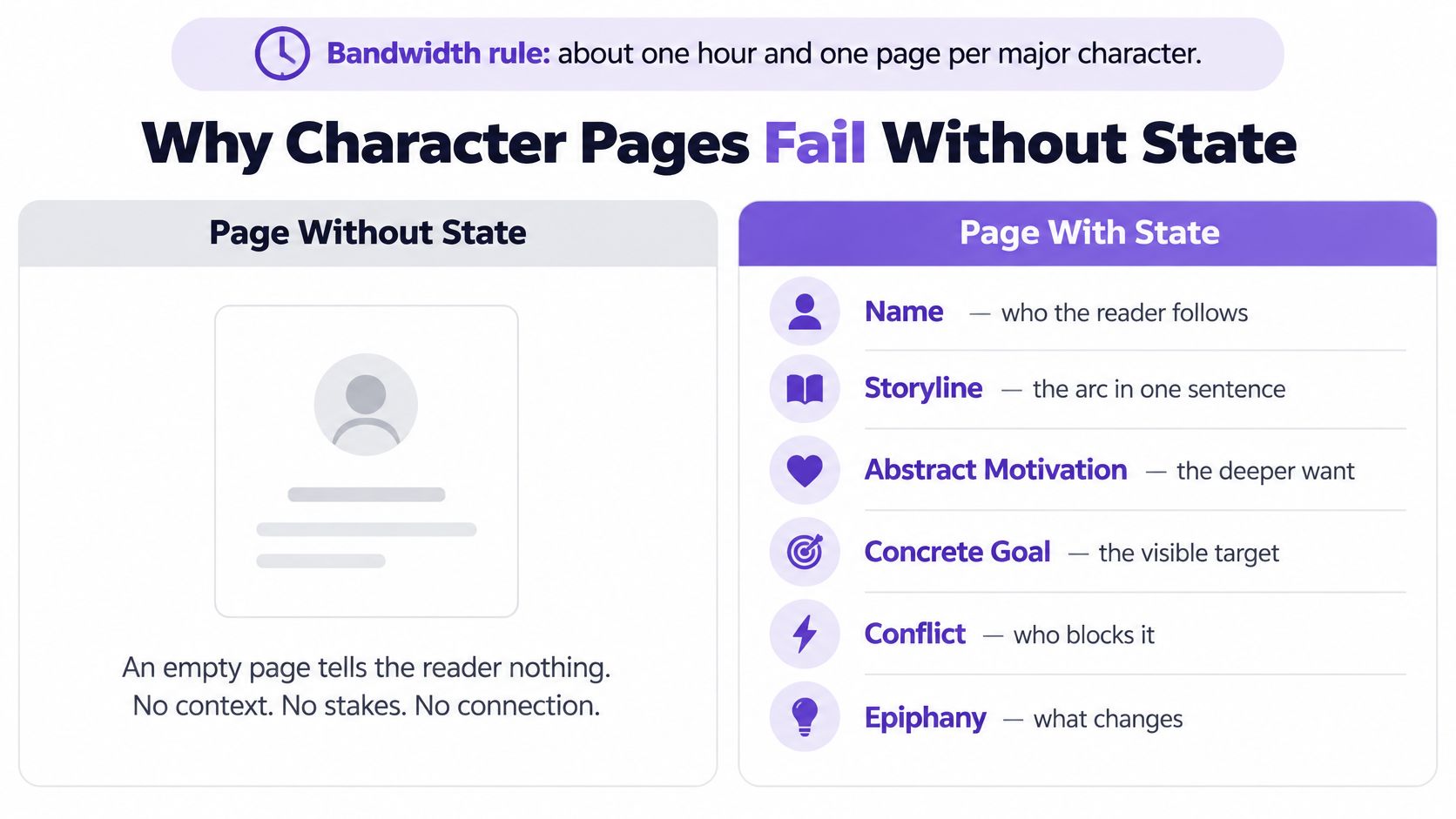
Allocate bandwidth before adding fields. Ingermanson's Snowflake Method document prescribes about an hour and one page per major character, covering name, a sentence-length storyline, abstract motivation, concrete goal, conflict, epiphany, and a paragraph-length storyline summary; later expansion gives each major character a page and other important characters half a page, with a day or two allocated to that cast pass.
Secondary characters need a defined record, not equal planning time. Record the recurring captain's allegiance and the conditions under which it changes. Don't improvise incompatible loyalties every time you need access to a ship.
Separate motive from current objective
Say a spymaster's enduring motive is protecting her sibling. In chapter twelve, she spares an enemy she previously intended to kill. That turn works if, in chapter nine, she learned that the enemy is her sibling's contact.
Her motive hasn't changed. Her information has, so her immediate objective changes with it. Without that discovery attached to the relevant scene, a revision can make a coherent choice look like a personality swap.
Tracking test: Can you identify the event that made this decision possible?
A character bible provides the reference structure, but biography alone isn't enough. Prioritize actionable facts: knowledge, allegiance, promises, injuries, access, and current objectives. Favorite foods matter only when they affect something the manuscript must preserve.
A development document designs the arc. A tracking record stores knowledge, relationships, and goals at a particular point in the book. The Snowflake character sheet can seed that record. It isn't the record itself.
How to Expand a Long Novel in Order
Don't copy the same plot into progressively longer documents and call that validation. In Ingermanson's original Snowflake Method explanation, progressive elaboration takes the story from a compressed summary toward increasingly detailed planning. For long fiction, the practical benefit is checking agreement before you multiply a decision across subplots.
Start with pressure, opposition, and stakes in the sentence. Expand to a paragraph containing setup, the major disasters, and the ending. When you build the page skeleton, check that its turning points still produce those consequences rather than merely resembling them.
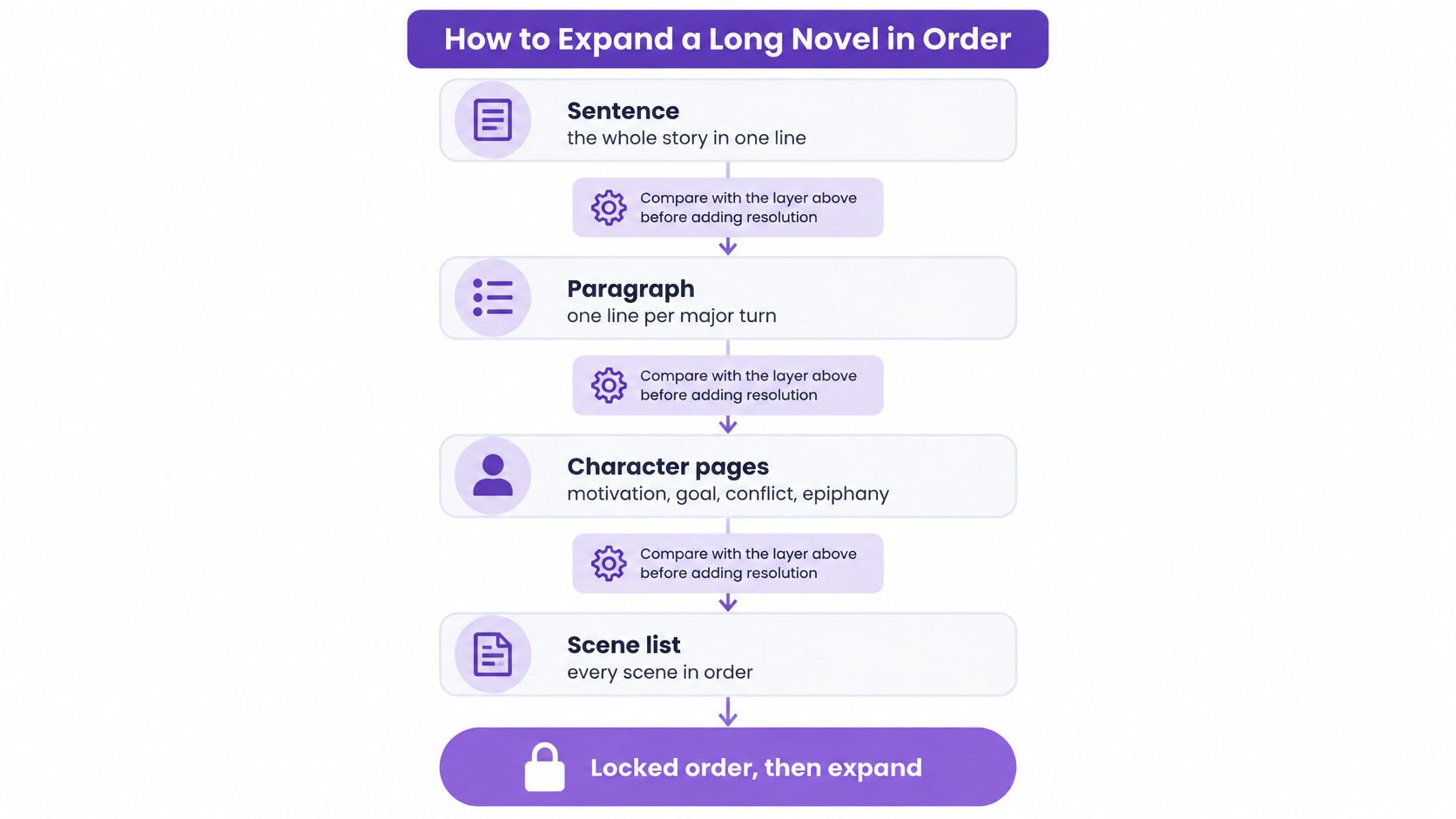
Compare each character synopsis with the plot page before expanding the sequence. Then build scene rows containing viewpoint, time, location, goal, conflict, and outcome. A resource such as our guide to how to outline your novel can help organize that work, but the comparison is the important part.
Repair the smallest affected layer
Suppose a multi-POV fantasy begins with this premise: an exiled heir returns after the capital's second siege and must govern the survivors. During expansion, you move the heir into the capital before that siege so she can witness a betrayal.
That isn't an innocent scheduling change. She now experiences the event that originally defined her absence, potentially changing her authority, guilt, alliances, and access to witnesses. You've altered the book's governing pressure.
Decide which version you want before touching the scene spreadsheet. If the arrival moves, rewrite the premise and the plot page, then inspect the heir's arc and every subplot relying on her absence. If the original premise stays, give the betrayal to another witness or move its discovery.
Fix the decision where you can see its consequences, not wherever the spreadsheet happens to expose the symptom.
Put a ceiling on preparation
For a working schedule, reserve a day for the sentence and paragraph, a short cast-development pass, and several further working sessions for scene order. Give difficult structural questions the time they need, but don't award every secondary character a private planning retreat.
Set a prose start date. Each expansion should answer a decision you couldn't safely make at the previous level. If you're only adding decorative detail, stop expanding. You have enough material to test in scenes.
Continuity Errors a Synopsis Still Hides
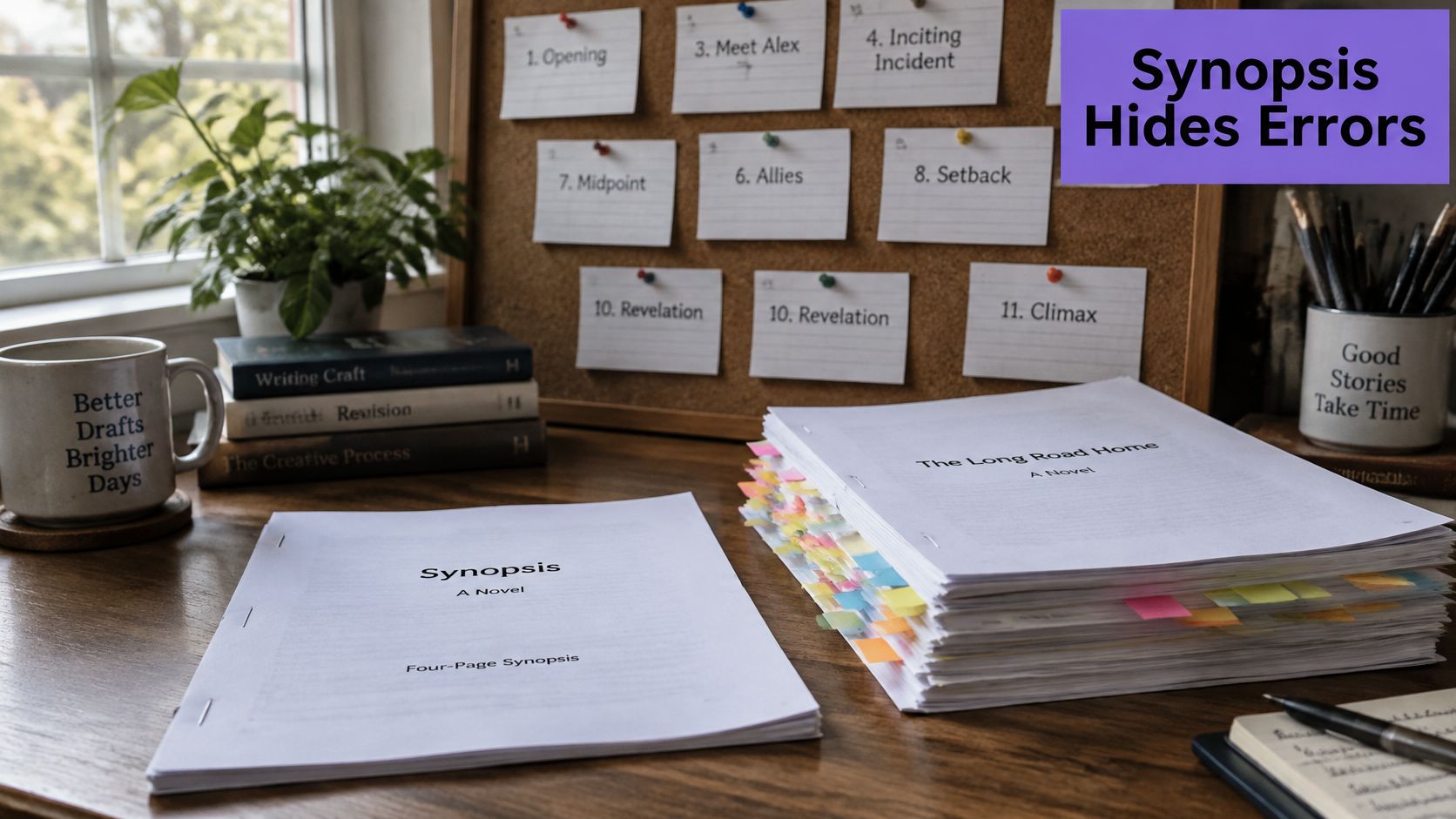
A clean four-page synopsis establishes outline consistency, not manuscript consistency. Creativindie's Snowflake planning resource provides a useful planning framework, but the verification you need concerns the actual sequence of knowledge, movement, and change.
Your plot can remain intact while a detective quotes an unopened letter. The investigation still reaches the planned culprit. The detective just gets there using information nobody gave her.
Record what changes within the scene
Require every scene record to contain time, location, participants, newly available knowledge, relationship state, and important object state. For discovery drafts, add these records after exploratory scenes exist. Don't pretend you established them beforehand.
| Failure in the prose | Record that exposes it |
|---|---|
| A detective quotes a letter before opening it | Knowledge acquisition and access |
| A necklace becomes a ring | Object identity and description |
| Monday's council precedes Tuesday dawn after a three-day journey | Elapsed time and location |
| A confirmed-dead character attends a relocated meeting | Participants and alive/dead state |
None of these hypothetical breaks comes from a missing goal or flaw. Each is a continuity error created by a mismatch between the scene and the story's established state.
When you move a scene, revise its record and inspect the scenes that consume its information or consequences. A revelation moved earlier changes who can act; a meeting moved later changes who can attend. A profile that stays finished while the manuscript changes is already suspect.
This verification belongs between scene planning and prose, and it must survive every structural revision. Otherwise, you're checking yesterday's book.
Run the Draft Against the Earlier Layers
Once the scene list supports the draft, stop producing synopsis pages. Either begin prose with live state checking or add the verification fields before you write. More summary won't tell you whether someone passed the key to a character who has already left.
Keep reviewer feedback equally concrete. TheContentMap's five-part comment structure for reviewers is a useful companion for organizing notes; ask readers to identify the passage and the contradiction rather than diagnose a vague character problem.
The Snowflake designs the book. Tracking keeps that design coherent after you change it.
Novelium provides that checking layer from the manuscript itself. We automatically track story elements such as characters, world details, and timeline entries without manual data entry, including what each character knows at every moment. Your manuscript stays private throughout the process.
The tool doesn't replace your design decisions, and it never writes your story. Keep the earlier layers editable, draft forward, and investigate knowledge, timeline, and object conflicts when they appear. Your job is to decide whether the new scene improves the novel, then make the rest of the manuscript agree.
Novelium's Character Tracker and World Codex extract and track character and world details across your manuscript, so your Snowflake plan doesn't become an abandoned reference file. Visit Novelium to check your draft's knowledge states, timeline, and continuity while you keep writing the book.