Sci Fi World Building That Actually Holds Together
Most advice about sci-fi world building starts with invention. Design the species. Draw the map. Name the moons. Build a wiki so elaborate it could qualify for diplomatic recognition.
That approach produces beautiful notes and brittle novels. By the third draft, the colony's food supply no longer matches its climate, a character knows something they never learned, and a supposedly isolated government communicates across a planet with suspicious convenience. The problem isn't imagination. It's constraint tracking.
At novel length, every invented element creates obligations. A faster-than-light drive needs a cost, a range, and a social consequence. A hostile planet needs consequences for agriculture, architecture, medicine, and migration. A new technology needs to appear in kitchens and courtrooms before it can credibly decide the climax. The setting must survive not just a wiki page, but page 200.
Most Worldbuilding Advice Solves the Wrong Problem
The popular assumption is that worldbuilding means generating enough material to make a setting feel deep. That's the wrong measure. Depth isn't the number of cultures in your notes. It's the number of causal relationships your manuscript can maintain without contradicting itself.
A setting works like a small economy. Change one variable and three others move. Give a population cheap atmospheric transport, and distance changes. Change distance, and trade, policing, migration, military strategy, and family separation change with it. Give a city permanent darkness, and you've altered energy policy, sleep, religion, architecture, and the value of windows. The invention is easy. Governing its consequences is the work.
Editorial rule: If an element has no effect outside the paragraph where you introduce it, it's decoration.
The familiar “iceberg” model still has value, but only if the hidden material controls what appears on the page. This iceberg theory of worldbuilding becomes useful when the unseen rules explain visible behavior. It becomes procrastination when you keep adding submerged lore instead of checking whether the existing lore still functions.
The most damaging failures we observe in long manuscripts are mundane. A character crosses a continent in a day despite earlier travel constraints. A society with instant communication still behaves like a feudal network. A rare medical treatment appears whenever the plot needs it, then vanishes when its availability would solve another problem. Readers don't need to calculate orbital equations to sense that something is wrong. They notice when consequences arrive selectively.
Stop treating the setting as a collection of ideas. Treat it as a governed system. Record the rule, identify who knows it, locate where it applies, and track what changes when another rule enters the story. That's how a world holds together at 80,000 words and beyond, where memory and intuition stop being reliable production tools.
Where the Concept Actually Comes From
The concept of constructing a coherent imaginary world predates modern science fiction, but the terminology has a traceable relationship with scientific thought. The phrase “world-building” appeared in the Edinburgh Review in December 1820, and physicist Arthur Eddington used it in his 1920 book Space, Time and Gravitation to describe imagining worlds governed by different physical laws. The related term “world-builder” is documented from 1942, while world-building became established in science-fiction and fantasy criticism by 1974. These dates are documented in the history of worldbuilding.
That lineage matters because science fiction inherited more than the word. It inherited the habit of stipulating rules and examining consequences. A speculative world isn't persuasive because it contains scientific vocabulary. It's persuasive because the stated conditions remain operative when they become inconvenient.
The academic treatment is broader than physics, covering geographic, social, cultural, and institutional coherence. The scholarly discussion of world-building in science fiction also places architecture inside the genre's history, showing how built environments can express political and social organization rather than function as visual wallpaper. The Crystal Palace, for example, helped inspire the dystopian glass towers in Yevgeny Zamyatin's We, published in 1921.
That's the contract with the reader. You can invent the premises. You can bend physics, biology, or economics. You can't announce a rule and then suspend it whenever the plot needs a shortcut. Hard science fiction gets called demanding because readers expect continuity between systems. The standard isn't perfect prediction. It's accountable invention.
Treat Your Setting as a Stack of Interlocking Systems
Build from the bottom up. The base layer is physics, including gravity, thermodynamics, light speed, and chemistry. Above it sit geology and planetary conditions. Biology grows from those conditions, sociology responds to biology and material limits, and technology develops through the pressures created by all the lower layers.
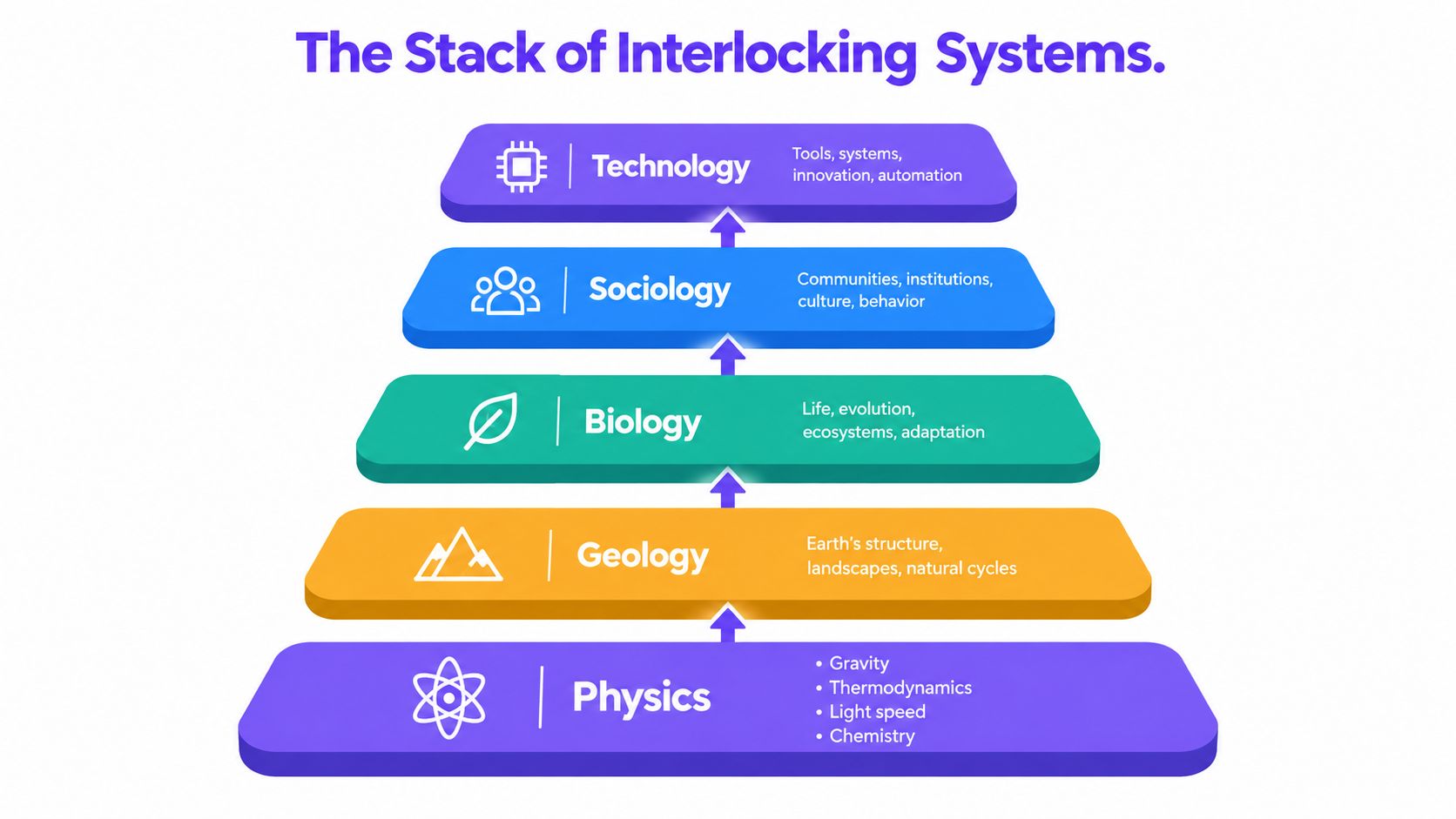
The order matters. Writers who design from the top down often start with a government, an aesthetic, or a dramatic city and then retrofit the conditions that supposedly produced it. That's how you get desert empires with no visible water economy, underground civilizations with ordinary surface assumptions, and planets whose climate exists only where the camera happens to be pointing.
Take stellar output as the starting decision. If a star produces less usable energy for a planet, photosynthesis or its local equivalent faces a harder ceiling. That affects primary producers, which limits herbivores, which limits predators. The settlement can respond with artificial supplementation or imported calories, but those solutions create infrastructure, dependency, and political vulnerability.
Follow one decision upward
Suppose the primary energy supply is unreliable. Agriculture becomes storage-dependent. Storage requires protected facilities and authority over distribution. Distribution determines which settlements survive a bad season. Those settlements gain influence over law and trade. Families alter their work patterns around preservation, and religious rituals may develop around the opening of reserves.
The original decision was physical. The consequences are social, legal, architectural, and intimate.
The same method works for technology. A propulsion system with limited range produces staging stations, fuel monopolies, and predictable bottlenecks. Those bottlenecks shape military planning and make certain regions strategically valuable. If communication is slower than travel, command structures decentralize. If communication is faster than travel, central authorities can issue orders long before they can enforce them.
For a deeper framework on separating hard science fiction mechanics from space opera assumptions, these sci fi narrative structure basics offer a useful companion to systems-based planning.
Make the stack visible in your notes
Don't write a single undifferentiated world bible. Keep separate rule sheets for physical conditions, ecological limits, social institutions, and technologies, then connect them with explicit consequences. When you change one rule, audit the layers above it.
Your readers may never see the full stack. Your characters will live inside its effects.
The Orbital Mechanics That Quietly Run Your Planet
Astronomy becomes useful when it stops being wallpaper. A planet's stellar luminosity, semimajor axis, orbital eccentricity, and axial tilt jointly shape climate and habitability. NASA's explanation of how scientists assess exoplanet habitability makes the central point clearly: being in a star's habitable zone isn't enough. Planetary size, atmospheric composition, and host-star stability matter too.
Day length governs more than sunsets. It affects sleep, shift work, school schedules, animal behavior, heat management, and the design of public space. Axial tilt drives seasonal variation, while eccentricity can make different parts of the orbit radically unequal in agricultural value. A planet with no meaningful tilt won't support familiar Earth-like seasonal customs. A highly tilted planet may force populations to migrate, store food, or abandon regions during severe climatic phases.
NASA's Kepler-452b example gives a useful calibration point. It orbits at approximately 1.05 astronomical units and completes an orbit in about 385 days. That modest difference from Earth's year is enough to alter calendars and accumulated scheduling assumptions, even before a novelist adds eccentricity, unusual rotation, or multiple moons.
| Orbital Variable | Direct Physical Effect | Plot-Driver Consequence |
|---|---|---|
| Stellar luminosity | Changes the energy available to the planet | Controls agriculture, settlement value, and energy politics |
| Semimajor axis | Sets the planet's average distance from its star | Influences climate expectations and migration geography |
| Orbital eccentricity | Changes how strongly conditions vary across the orbit | Creates unequal seasons, storage crises, and contested calendars |
| Axial tilt | Redistributes seasonal and latitudinal heating | Shapes labor cycles, festivals, military campaigns, and architecture |
| Day length | Determines the rhythm of light and darkness | Alters sleep systems, shift economies, and settlement design |
A tidally locked world creates a different problem. Permanent day, permanent night, and the moving or stable boundary between them generate settlement patterns unlike latitude-based civilizations. The habitable region may become a narrow political corridor rather than a broad temperate zone.
Continuity check: Put the planet's day length, year length, tilt, and seasonal calendar in the chapter timeline. If chapter eleven contradicts chapter three, readers will feel the error even when they can't name the orbital variable responsible.
Ecology as an Energy Budget, Not a Bestiary
A credible alien ecosystem isn't a catalogue of memorable creatures. It's an energy network. Start with the source, whether sunlight, chemosynthesis, geothermal activity, or imported biological material. Then track how usable energy moves through producers, herbivores, omnivores, predators, decomposers, and settlements.
Ecological theory commonly uses a rough rule that about 10% of available energy reaches the next trophic level, as described in this Cambridge ecology excerpt on energy flow and food webs. That isn't a universal law for every invented organism, but it's a useful warning. A society that depends on giant herbivores and multiple layers of carnivores needs an unusually productive energy base or an artificial subsidy.
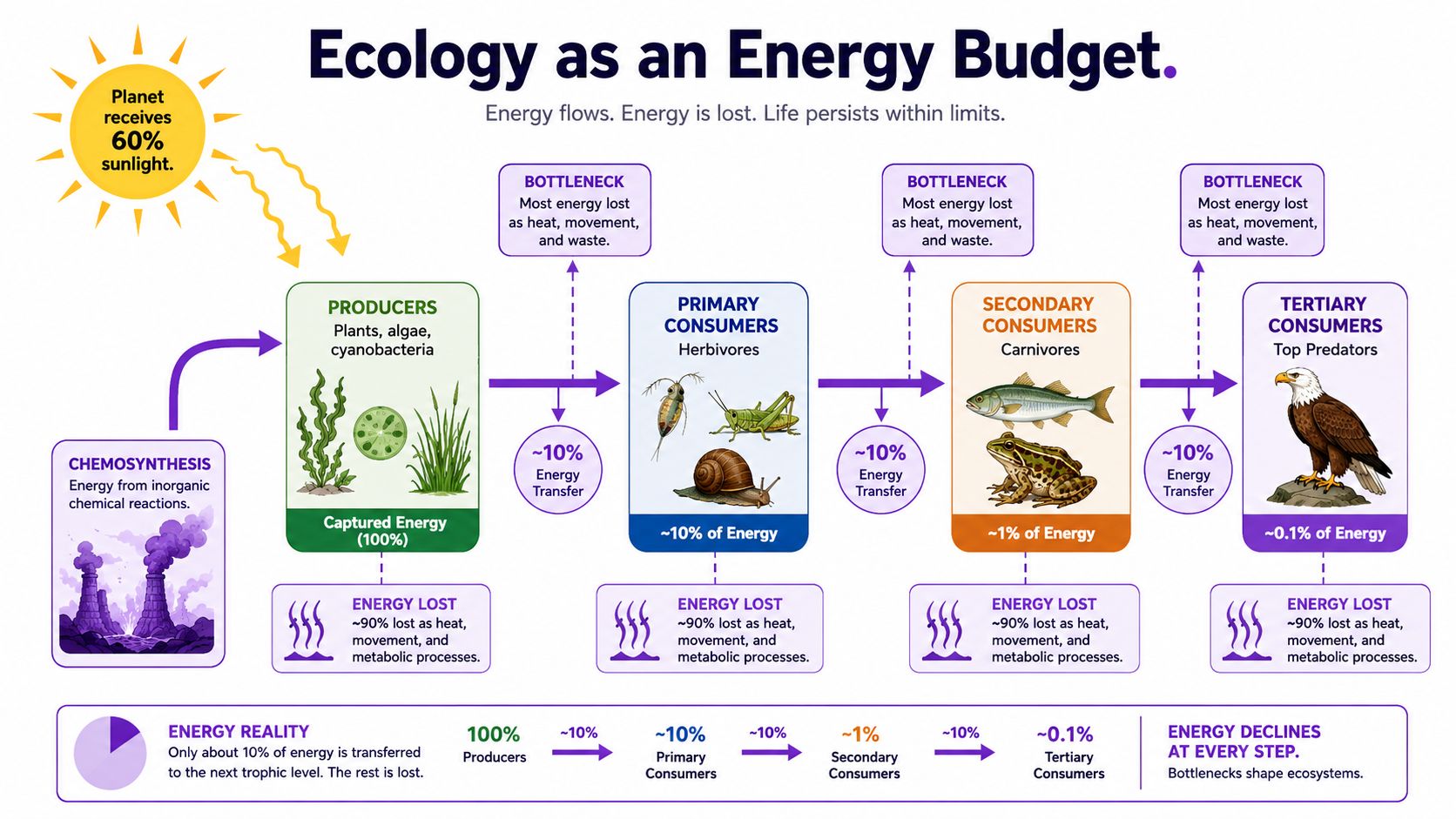
A planet receiving 60% of Earth's sunlight appears in the required ecological model, but don't treat that figure as an isolated flourish. It must reduce or redirect primary productivity unless another energy source compensates. A low-energy world may support a sparse biosphere, a coastal civilization that exploits concentrated resources, or a society built around artificial light. Its politics will focus on access to production, storage, and protected growing space.
Design the bottleneck first
A useful fictional food web has a limiting resource. Perhaps producers grow only near infrared-rich light. Perhaps microbial mats depend on exposed mineral vents. Perhaps reproductive cycles require a narrow temperature window. The bottleneck tells you where power accumulates.
Remove a predator and don't stop at “prey numbers rise.” Trophic cascades can push through herbivores and primary producers, causing overgrazing, vegetation loss, soil erosion, or algal blooms. Introduce an engineered herbivore and it may increase meat production while exhausting staple crops or disrupting nutrient cycling.
The speculative biology framework is more useful than a species list because it forces you to track metabolism, reproduction, limiting resources, and ecological dependency. Your characters should encounter those constraints in rationing laws, livestock policy, military logistics, and ordinary meals.
Trace the Tech Into the Household Before You Trace It Into the Plot
An invention isn't finished when you name it. It's finished when a character has to decide whether to use it on an ordinary day.
Take a personal fabrication unit. Don't begin with the spectacular object it creates. Begin with labor. Which repair workers lose income? Which new jobs appear around calibration, feedstock, inspection, and design licensing? Does a household need technical training, or does the device hide its complexity behind a subscription?
Then move into law. Who's liable when the unit produces a defective medical component? Who can inspect it? Which materials are restricted? Does the state control patterns for weapons, identity documents, or patented medicines? A technology that bypasses manufacturing doesn't eliminate regulation. It relocates the fight.
The household reveals consequences that the plot summary hides. A fabrication unit changes kitchen storage, repair habits, inheritance, and the meaning of ownership. A memory-editing clinic changes consent, evidence, family testimony, and the emotional status of a shared past. If the technology exists only in laboratories and military briefings, readers experience it as scenery.
Follow the social externality
The most valuable question isn't what the invention can do. It's who benefits, who becomes obsolete, who controls access, and what new problems appear when it works reliably. A technology can function perfectly and still produce adoption friction, resistance, black markets, religious objections, or deliberate refusal.
The same principle applies to identity. Someone who refuses memory editing may be treated as trustworthy by one community and dangerously obsolete by another. A person who relies on fabrication may be seen as resourceful, fraudulent, or dependent, depending on local law and class position.
Research on technology-focused science fiction identifies reader interest in themes including technology ethics, climate policy, and governance. The discussion of worldbuilding questions for authors is useful here because it points toward consequences rather than specifications. Build the Tuesday scene before you build the revolution.
Plausibility Is About Distribution, Not Prediction
Readers forgive technology they can't verify when the society around it operates with integrity. They want to know who gets the device, who pays for maintenance, which jurisdictions permit it, and what happens to people left outside the system.
A fusion reactor can power one coastal megacity while interior towns still burn coal. A neural implant can be available only to citizens above a tax bracket. A climate adaptation system can protect wealthy districts while informal settlements remain exposed. None of these arrangements requires a lecture about feasibility. The unequal access does the explanatory work.
A plausible invention doesn't appear everywhere at once. It arrives through infrastructure, law, capital, habit, and resistance.
Many manuscripts misdiagnose their own problems at this point. A writer gets notes about “hard science fiction plausibility,” then adds more technical detail, while the underlying contradiction concerns distribution. If a technology is expensive in chapter two, it can't become casually universal in chapter twelve. If a government restricts access, characters need a reason to bypass the restriction. If the technology requires rare components, the supply chain must exist somewhere in the story's causal background.
Model diffusion by jurisdiction, class, profession, and generation. Let one community reject the dominant system for practical or cultural reasons. Let another adopt it enthusiastically and discover that dependence creates a different vulnerability. Uneven access generates resentment, smuggling, labor conflict, and political power without requiring the author to prove every engineering detail.
The world feels real when different characters occupy different technological realities. That difference should shape vocabulary, expectations, fear, and memory. A person raised in a district without reliable power won't treat an energy shortage as an abstract policy debate.
Build the World, Then Track It Like a Production Log
An 80,000-word manuscript exposes continuity failures that a polished development document can hide. You need a tracking system that records the setting's state across scenes, not just a description of what the world is supposed to be. Character notes describe who someone may become. Character tracking records what that person knows now, believes now, carries physically, has changed with others, and still does not understand.
Science fiction makes this distinction harder because setting facts move through characters. A captain learns the drive's limitation. A mechanic discovers that limitation is false. A politician acts on outdated orbital data. If your notes store only the final truth, they erase the difference between reality and belief, which is exactly where continuity breaks under revision.
Use four connected records, then update them whenever a scene changes the state of the world.
Keep a rule sheet per system
Write each governing rule, its exceptions, its cost, and the people or institutions aware of it. For a jump drive, record its range, recharge requirements, failure conditions, and public understanding of those limits. A world bible can hold the canon, but it cannot show which version a scene used. Keep rules easy to find while revising chapter twenty-six, rather than burying them in undifferentiated prose.
Lock physical details
A location index should record stable facts such as gravity, climate, entrances, travel times, hazards, and the position of important objects. Add scene-specific changes when they occur. If a character hides a weapon in a room, the later retrieval must match the room's established layout or explain what changed.
Log diffusion and knowledge
Track where a technology exists in chapter order, who can access it, and which characters know it exists. Apply the same discipline to information. A secret becomes continuity material once you record who possesses it, who suspects it, who has been misled, and when each state changes.
A timeline must reconcile travel, communication lag, injuries, aging, and simultaneous events. Relativistic travel makes the separation between ship time and origin time particularly important. At gamma = 10, a traveler experiences one year while approximately ten years pass for people at home, and reaching that factor requires a velocity of about 99.5% of the speed of light. The acceleration burden is severe, with a circular trajectory under one light-year wide requiring continuous acceleration exceeding 192 times Earth gravity, according to this analysis of relativistic time dilation and acceleration. Store ship time and origin time as separate fields, or a long series will age the wrong characters.
Audit before each revision pass
Before revising a chapter, inspect the records touched by its scenes and log contradictions instead of correcting them from memory. Then trace each changed rule to every dependent scene. This creates a useful distinction between a deliberate retcon, an unresolved error, and a character's mistaken belief.
Language belongs in the same audit. A constructed language gains credibility through dialects, prestige forms, loanwords, taboo terms, irregular grammar, and language loss tied to political contact. The research on constructed languages and fictional history makes the practical point that fictional languages have no native speakers unless the author creates the communities and timespans that drive their evolution.
Use a spreadsheet, structured world bible, or manuscript analysis platform to maintain the rule, location, knowledge, and timeline records. The tool matters less than checking each scene's state change and causal dependency before the draft teaches readers that your world cannot keep its promises.
Novelium's Character Tracker and World Codex extract character details, knowledge states, locations, technologies, events, and world rules across a manuscript, then surface contradictions and timeline problems as the story evolves. If your setting has outgrown memory and scattered spreadsheets, visit Novelium for a continuity check before readers find the holes.