What "Run On Sentence Meaning" Really Means for a Novelist
We’ve all been there. Staring at a sentence that just feels… off. It goes on too long, tangles up a couple of ideas, and leaves your reader rereading it just to figure out what’s happening. Chances are, you’ve stumbled upon a run-on sentence. And for a professional writer, it's more than a simple grammar mistake—it's a crack in the narrative illusion.
What a Run On Sentence Actually Is
Let's get straight to it. A run-on sentence isn't just a long sentence. Length has nothing to do with it. A run-on is a structural failure where two or more independent clauses—complete thoughts that could stand alone as sentences—are improperly joined.
Think of it as an actor fumbling a critical line. The audience is jolted out of the story, forced to stop and decipher what was supposed to be said. That’s exactly what a run-on does to your prose. It doesn’t just earn a red mark from an editor; it actively sabotages your storytelling. It creates reader fatigue, forcing your audience to mentally untangle a jumble of ideas that should have been clear and distinct. This hiccup kills tension, muddies character motivation, and obscures the cause-and-effect chain that makes a plot compelling.
The Two Core Types of Run On Sentences
When you get down to it, almost all accidental run-ons come in two main flavors. Learning to spot their distinct structures is the first real step to hunting them down in your own drafts. The distinction isn't just academic; it helps you diagnose why a sentence feels wrong.
| Type | Structure | Example |
|---|---|---|
| Fused Sentence | [Independent Clause][Independent Clause] | The hero drew his sword the dragon roared in defiance. |
| Comma Splice | [Independent Clause], [Independent Clause] | The hero drew his sword, the dragon roared in defiance. |
The fused sentence is a blunt-force error—two complete thoughts slammed together. The comma splice is sneakier and far more common in polished drafts. It happens when a writer tries to connect two full sentences with just a comma, which isn't strong enough for the job. It’s an easy mistake to make when the ideas feel closely related, but it creates a rhythmic stumble that tells the reader something is off. You can find more writer-specific data in this analysis of common sentence errors.
The key takeaway isn't about acing a grammar quiz. Understanding the run on sentence meaning is about maintaining absolute control over the rhythm, clarity, and impact of your writing. It’s about making sure every single sentence serves the story without distraction.
Spotting Fused Sentences and Comma Splices in the Wild
To get a feel for what a run-on sentence is, we need to put the two main culprits under a microscope. These are the errors that sneak past even seasoned writers, turning crisp prose into a muddle that forces your reader to stop, backtrack, and untangle your meaning.
Learning to spot their unique signatures is one of the most critical self-editing skills you can develop.
The Fused Sentence: A Head-On Collision
The fused sentence is the brute-force error—a head-on collision between two complete thoughts with absolutely nothing separating them. No punctuation, no connecting word. It’s the grammatical equivalent of two characters talking over each other, creating a breathless, jarring effect that scrambles the cause-and-effect relationship between ideas.
- Before: The alarm blared he grabbed the relic and sprinted for the exit the floor buckled beneath him.
- After: The alarm blared. He grabbed the relic and sprinted for the exit just as the floor buckled beneath him.
The fix isn't just about dropping in a period. It's about re-establishing the timeline of events. The revision gives each action space to land, creating impact and clarity.
The Sneakier Comma Splice
The second, and far more common, offender is the comma splice. This one is subtle. It happens when a writer joins two complete, independent sentences with only a comma. A comma’s job is to signal a brief pause, not a full stop, making it too weak to properly separate two distinct ideas. This mistake tends to happen when the two thoughts feel very closely related, tricking us into thinking a simple comma is enough. The problem is so widespread that it plagues even practiced writing. You can dig deeper into these findings over at the St. Louis Community College's writing resources.
A comma splice creates a false connection. It tells the reader that two complete thoughts are merely items in a list, robbing them of their individual power and creating a rhythmic stumble in your prose.
Let's look at how it can muddy the waters in internal monologue:
- Before: She couldn't trust him, he had lied about his past too many times.
- After: She couldn't trust him; he had lied about his past too many times.
By swapping that weak comma for a stronger semicolon, the relationship between the two thoughts becomes crystal clear. The second clause now directly explains why she couldn't trust him, making the entire statement feel more confident and intentional.
How to Fix Run Ons Without Killing Your Voice
Fixing a run-on sentence isn’t just about following grammar rules. It's a stylistic choice. This is where you level up your prose from simply being correct to being genuinely compelling. The goal isn't just to satisfy a grammar checker but to pick the fix that best serves the rhythm and mood of your scene.
You have four primary tools in your kit, and each one lands differently on the page.
First, know what you’re looking at. This decision tree breaks down the two main offenders, which is the first step toward finding the right solution.
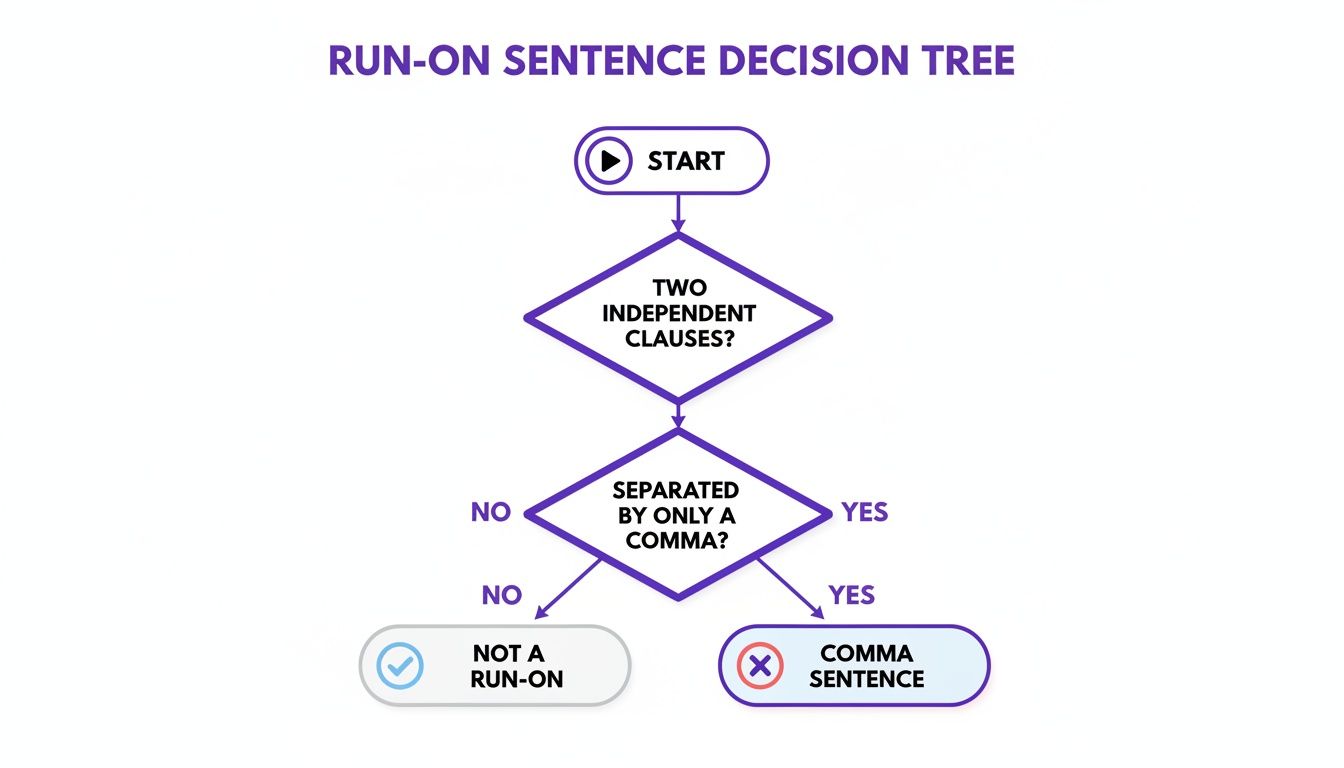
Both fused sentences and comma splices mash complete thoughts together without a proper boundary. Your job as the writer is to decide what kind of boundary they need.
Method 1: The Full Stop (Period)
The simplest fix is the period. It creates a hard break. Use it when you want two ideas to stand on their own, giving each one space and letting the reader take a breath. It’s clean, direct, and powerful.
Method 2: The elegant Link (Semicolon)
A semicolon is a more nuanced choice. It connects two closely related independent clauses, hinting at a cause-and-effect relationship or a direct continuation of the same idea. It’s your way of telling the reader, "These two thoughts are separate, but they absolutely belong together." It's a fantastic tool for keeping momentum without creating a rushed feeling.
Method 3: The logical Bridge (Conjunction)
You can also drop in a comma followed by a coordinating conjunction (for, and, nor, but, or, yet, so). This does more than fix the grammar; it explicitly defines the relationship between the two clauses. "But" signals a contrast, "so" shows a result, and "and" adds new information. This choice does the interpretive work for the reader.
Method 4: The Restructure (Subordination)
Finally, you can restructure the sentence. This usually means turning one of the independent clauses into a dependent one that can't stand on its own. This fix gives you the most control, letting you decide which idea is the main event and which is just supporting information. It's the best way to fine-tune the rhythm and emphasis of the sentence.
Deciding which fix to use comes down to the effect you're trying to create. Each choice shapes the reader's experience differently. This table breaks down the options and their stylistic impact.
Choosing Your Run On Sentence Fix
| Method | How It Works | Stylistic Effect |
|---|---|---|
| Period | Creates two separate sentences. | Creates a definitive pause. Makes each idea feel distinct and impactful. Good for sharp, punchy prose. |
| Semicolon | Links two closely related independent clauses. | Creates a softer pause. Shows a strong connection between two ideas without spelling it out. Adds sophistication. |
| Conjunction | Adds a comma and a word like 'and', 'but', or 'so'. | Explicitly defines the relationship (addition, contrast, cause). Creates a smooth, logical flow. |
| Restructuring | Changes one clause into a dependent phrase. | Subordinates one idea to another, clarifying focus and emphasis. Offers the most control over rhythm. |
The point isn't to memorize rules but to build an arsenal. Each fix changes the music of your writing. A period is a drumbeat, a semicolon a connecting chord, and a conjunction a bridge between verses. Getting a handle on these fixes transforms a tedious technical correction into a powerful stylistic upgrade. For novelists who want to streamline their editing workflow even more, some advanced tools are getting good at spotting these structural issues. You can see how AI writing software for novelists can help you maintain clarity in your prose without losing your voice.
When to Use Run-On Sentences on Purpose
Alright, we’ve covered how to fix run-ons. Now for the fun part: breaking the rules like an artist.
An intentional run-on is a high-risk, high-reward move. When you pull it off, it can be one of the most powerful tools in your fiction arsenal. It’s the difference between a sloppy mistake and a deliberate stylistic choice that makes the story sing. The secret is purpose. An accidental run-on feels clumsy and yanks the reader out of the story. A deliberate one plays with rhythm to create a specific emotional or psychological feeling, pulling the reader in deeper.
Capturing a Character's State of Mind
One of the most effective ways to use a run-on is to mirror what’s happening inside a character’s head. When someone is frantic, spiraling, or panicking, their thoughts aren’t neat and tidy. They’re a chaotic jumble of fears, impressions, and half-baked plans. A controlled run-on can capture that chaos perfectly, forcing the reader to feel that same breathless confusion.
- Standard Prose: She saw the open door. She had to get out. The guards were closing in behind her. Her heart was pounding in her ears.
- Intentional Run-On: The door was open she had to get out the guards were closing in her heart pounded in her ears a frantic drumbeat against her ribs she just had to run.
The second example doesn't just tell you she's panicked; it makes you feel it. The lack of pauses forces you to read faster, mimicking her adrenaline. The grammatical mess reflects her mental mess.
A deliberate run-on has rhythm and purpose, enhancing the reader's immersion. A sloppy one just causes confusion and pulls them out of the story you've so carefully built.
Building Unbearable Momentum
Run-ons are also incredible for building momentum during a high-stakes action sequence. By fusing actions into a single, relentless sentence, you create a sense of unstoppable velocity. The reader doesn’t get a chance to pause and breathe because the characters don't, either. Think of it like a long, unbroken camera shot in a movie chase scene.
- Example: He vaulted the fence and hit the ground running sliding on loose gravel and scrambling back up without losing a step as the sound of sirens grew louder and the shouts behind him became more frantic he just kept moving.
This structure drags the reader along, creating a propulsive energy that short, choppy sentences can't match. It’s a technique that works best for writers who are confident in their narrative voice, a topic we explore when discussing the differences between plotters vs pantsers and how they approach prose. The trick is to ensure that even though the sentence is long and breathless, it’s still coherent. You want to guide the reader through the chaos, not lose them in it.
A Practical Editing Checklist for Run-Ons
Catching sneaky, accidental run-ons means switching hats. You’re not the creator anymore; you’re the editor. Your job isn't to get lost in the story but to stress-test the sentences that deliver it. This is your battle plan for a systematic hunt.
Rereading your manuscript from the beginning won't cut it. You're too close to the story. You need a more disruptive approach—a focused editing pass with a single mission. It’s more effective than trying to catch everything at once.
The Auditory Pass: Read It Aloud
Your best tool is your own voice. Read a chapter out loud, at a natural, conversational pace. Your lungs are the ultimate punctuation detectors. Every time you stumble, run out of breath, or force a pause where there isn't punctuation, circle that spot. That awkward gasp for air is almost always a sign of a fused sentence or a comma splice. It's the simplest way to hear where the rhythm of your prose has gone off the rails.
Hunt for Common Triggers
Some words are magnets for comma splices. They create a logical connection in your head, which tricks you into sticking two independent clauses together with a flimsy comma. On your next editing pass, do a specific search (Ctrl+F is your friend) for sentences that use these words:
- However
- Therefore
- Then
- Also
- Furthermore
When you land on one, ask: can the clauses on either side of this word stand alone as complete sentences? If the answer is yes, you've almost certainly found a comma splice. Cleaning up these common errors is a huge step toward polishing your prose. This proactive hunt can be made easier with the right tools; some of the best writing software can flag these potential tripwires.
The point of an editing checklist isn't just to find mistakes. It's about building a system that lets you disengage from the story's emotional pull and focus entirely on the mechanical integrity of your sentences.
Edit in Reverse
This sounds weird, but it works. Start with the last sentence of a chapter and read backward, one sentence at a time, until you get to the beginning. This technique shatters the narrative context. It forces you to look at each sentence purely on its grammatical and structural merits, without the story's momentum pulling you along. You will be amazed at how many awkward phrases and blatant run-ons suddenly jump off the page when stripped of their narrative camouflage.
A Few Lingering Questions on Sentence Structure
Once you get the hang of the basics, the world of sentence structure opens up, and so do the questions. Novelists often bump up against tricky situations where textbook definitions of a run-on don’t cover the messy reality of writing fiction. Here are a few pointed answers to questions that go beyond simple grammar rules.
Is a Long Sentence the Same as a Run-On Sentence?
No, and this is the most important distinction a novelist can make. A long sentence can be perfectly correct—even beautiful—as long as its clauses are properly hitched together. A 150-word sentence built with intention is a powerful stylistic choice.
A run-on, on the other hand, is a structural error. It’s not about length. It happens when two or more independent clauses are smashed together without the right glue. The sentence “He left she cried” is a classic fused run-on, and it’s only four words long. Length is irrelevant; structure is everything.
Can I Use Run-On Sentences in Dialogue?
Absolutely. In fact, you should. Dialogue is one of the best places to consciously break grammar rules for the good of your story. Real people don’t speak in perfectly polished sentences, especially when they’re furious, ecstatic, or terrified. Using a run-on in dialogue is a killer characterization tool. It can show a character’s emotional or mental state far more powerfully than pristine grammar ever could. Let your characters sound like people, not a style guide.
The real test for any stylistic choice is its effect. Does the sentence create the feeling you wanted—urgency, confusion, breathlessness—without yanking the reader out of the story? An effective stylistic run-on feels intentional and deepens the narrative; a bad one just trips up the reader.
Does the Use of Run-On Sentences Vary by Genre?
While the grammatical rule doesn't change, audience tolerance for intentional run-ons definitely varies. Literary fiction often plays with experimental prose, using long, sprawling, and sometimes deliberately fragmented or run-on sentences to create a specific voice or a stream-of-consciousness feel.
On the other hand, most commercial fiction—especially fast-paced thrillers or action-adventure—banks on shorter, punchier sentences to keep the momentum going. In those genres, an accidental run-on is jarring because it messes with the tight, clean pacing the reader came for. Know your genre’s conventions before you start breaking them.
How Do I Know if My Intentional Run-On Is Working?
The line between a brilliant stylistic choice and a confusing mess comes down to impact. Does the sentence do the job you hired it for without making the reader scratch their head? The best way to check is to read it out loud. Does the rhythm serve the scene's mood, or does it sound like you fell asleep on the keyboard? Even better, give it to a beta reader you trust, without explanation. If they tell you they stumbled over that specific sentence or had to read it twice, it’s not working.
Finding every last structural flaw in an 80,000-word manuscript is a soul-crushing task. If you're tired of hunting for run-ons, plot holes, and character inconsistencies by hand, check out Novelium. Our manuscript intelligence platform analyzes your draft locally on your device, flagging continuity errors so you can focus on the story, not the syntax. See how it works at https://novelium.so/.