Your Round Character Definition Is Killing Your Novel
The textbook round character definition is simple: a character who is complex, contradictory, and capable of surprising us. E.M. Forster coined the term a century ago, and we’ve been nodding along ever since.
We all know the theory.
But for writers managing 100,000-word manuscripts or multi-book series, that definition is a trap. It focuses on the what—the blueprint of a complex character—but completely ignores the how. The real work isn’t designing a round character on paper. It’s keeping them round, consistent, and believable from the first page to the last without your plot collapsing into a heap of contradictions. The problem isn't definition; it's execution at scale.
The Static Profile Is a Dead Document

Let’s be honest: most character profiles are well-intentioned lies.
We fill out those fifty-question dossiers before we type "Chapter 1," dutifully recording our hero's favorite movie, their childhood pet, their deepest secret. It’s a snapshot, a single moment of creation frozen in time. And that’s precisely why it fails. It’s a photograph of a person who doesn’t exist yet, not a log of the fluid, messy reality of a character evolving through conflict.
Forster’s original idea of a character "surprising convincingly" is brilliant, but the tools we use to achieve it are fundamentally broken. You can discover more about the history of this foundational concept, but the historical definition won't save you during a rewrite.
The traditional character bible is archival, not operational. It tells you who the character was when you first dreamed them up, but it's completely silent about who they are on page 284, after betrayal, loss, and a few hard-won victories. It can’t track the dynamic data that actually matters for maintaining continuity.
The Myth of the Complete Dossier
At Novelium, we analyze manuscripts for consistency, and the fallout from this static approach is the single most common source of catastrophic errors. It's not about writers being forgetful; it’s about the fact that the human brain isn't built to track thousands of evolving data points simultaneously.
We see protagonists whose defining cynicism evaporates mid-novel for no reason. We see characters whose core trauma, the engine of the first act, is conveniently forgotten during the climax because the plot needed them to be brave.
These aren't rookie mistakes. They’re systemic failures. They happen when a character with a documented, crippling fear of heights suddenly scales a skyscraper without a second thought, because the author forgot a detail they wrote 80,000 words ago. They happen when a master detective fails to connect two obvious clues, because the writer lost track of which pieces of the puzzle the character actually possessed in that scene.
These breaches of character logic shatter a reader's trust. They flatten a beautifully round character into an inconsistent puppet, jerked around by the needs of the plot instead of their own established psychology. For a character to feel real, they can't be a static character; they must be irrevocably changed by their journey.
A character profile is a birth certificate. It proves they exist but tells you nothing about the life they’ve lived since. To maintain consistency, you need a living ledger that tracks every wound, every victory, and every new piece of information they acquire.
The failure isn't in the initial act of creation. It’s in the lack of a system to track that character's real-time evolution from "once upon a time" to "the end."
From Character Bible to Character Ledger
The solution isn't another fifty-question profile digging into their favorite color. It’s time to stop thinking like a biographer cataloging a life that's already happened and start thinking like a forensic accountant. A truly round character isn't a statue to be described; they are a running ledger of experiences, knowledge, and relationships.
Every scene is a transaction. A character enters with a certain emotional balance and a specific set of known facts. They exit with new information, a shifted perspective, or a damaged relationship—a tangible, quantifiable change. This is what a practical round character definition looks like.
That traditional static character bible you spent weeks on? It's useless for tracking this dynamic state. It’s a snapshot, but your story is a film. You need a character ledger—a system that logs the delta, the change, from one scene to the next.
This approach forces you to ask the questions that actually prevent plot holes. What does Jane know at the start of Chapter 5? What critical information does she learn by the end? How does that new knowledge logically alter her interaction with Mark in Chapter 6? This is the connective tissue that stops a complex character arc from falling apart. The research on why round characters are so effective shows their power comes from this believable evolution, not from a long list of pre-written traits.
This flow chart sums up the problem we see constantly. It shows how static character profiles lead directly to consistency failures and, eventually, gaping plot holes.
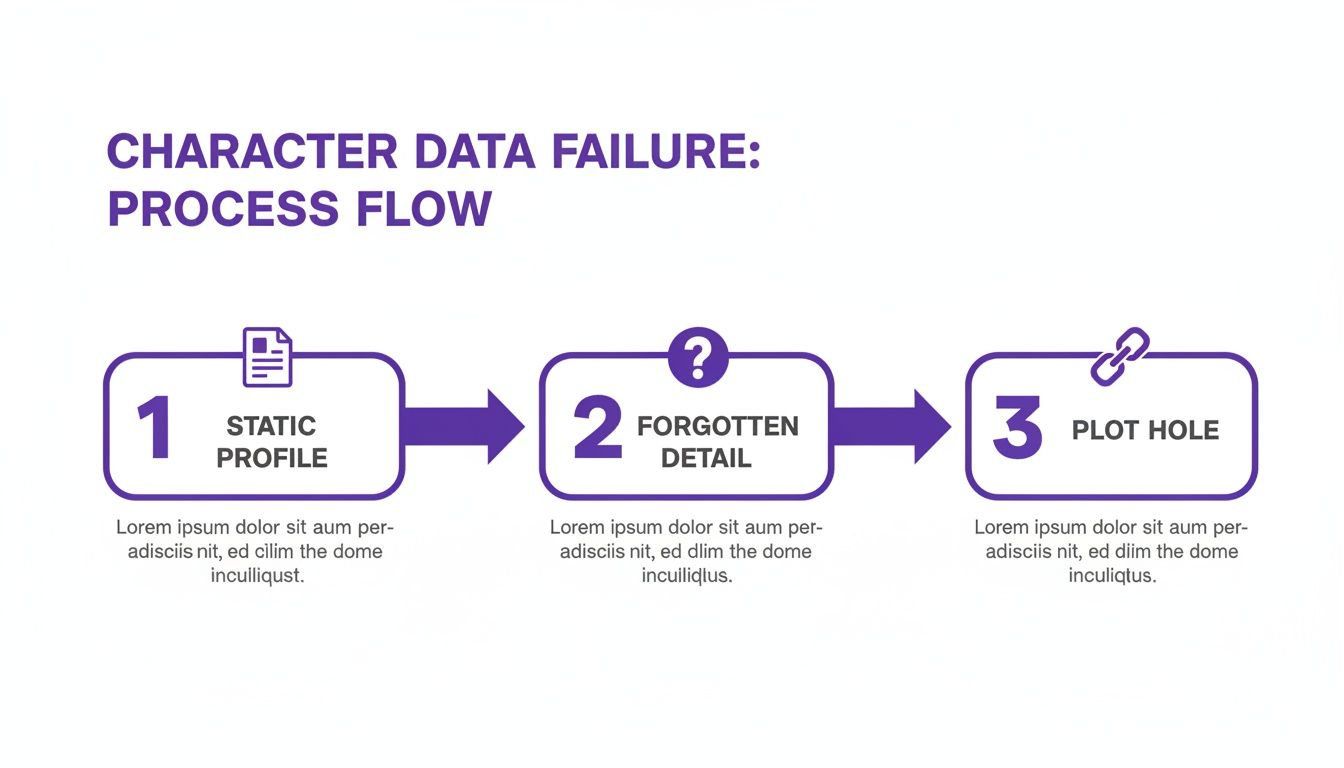
It’s a straight line from a static profile, through an inevitably forgotten detail, to a catastrophic plot hole. This isn't a failure of your memory; it's a failure of your system.
The mistake is documenting backstory instead of tracking the accumulation of the story itself in real-time. A ledger tracks assets, debts, and transactions. For a character, these are knowledge, emotional wounds, and plot events. A character only feels real when their present is a direct consequence of their past. The only way to guarantee that consistency across 300 pages is to track those consequences meticulously, transaction by transaction.
What Actually Matters for Character Consistency

Your character’s favorite food doesn't matter, unless they’re a chef fighting to save their restaurant. Most of the fluff in character bibles is for our own benefit, not the story's. For a complex narrative, only a handful of dynamic data points are critical. These are the load-bearing walls of your character. If they hold, your character feels real. If they wobble, the whole structure collapses.
The Knowledge State
The single most important thing to track is your character's Knowledge State. What they know—and, critically, when they learn it—is the absolute bedrock of logical plotting. The most common consistency error we see is a character who knows something they haven't learned yet. It's the hero recalling a clue from a conversation that won't happen for three more chapters. It’s the villain anticipating a plan they couldn't possibly have overheard. These aren't just mistakes; they're narrative poison. A systematic consistency check on their knowledge at the start and end of every scene is non-negotiable for a tight story.
The Relationship State
Next is the Relationship State. Relationships aren't static labels like "ally" or "enemy." They are fluid, volatile, and deeply contextual. A nasty argument in Chapter 10 must color their interactions in Chapter 15, even if the main plot has moved on. The subtext, body language, and things left unsaid are all dictated by the current status of that relationship. When you lose track of this, characters devolve into plot functions. They become friendly or hostile based on what the scene requires, not the accumulated weight of their shared history.
Evolving Core Motivations
Third, you must track the evolution of their Core Motivations. A character's primary goal at the start is rarely the same one they have at the end. These motivations must shift as the stakes change and they absorb new information. The key is to pinpoint the specific on-page event that forces that transformation. It can't happen off-screen between chapters. Without tracking these pivot points, a character’s arc feels unearned and their change of heart arbitrary. Their transformation is the entire point, which is why studies read more about these findings and character definitions consistently link compelling character growth to commercial success.
Intentional Contradictions
Finally, track their Contradictions and Hypocrisies. This is where the magic of a round character lives. A character who preaches honesty but constantly lies to their family is fascinating. But these contradictions must be intentional, not accidental. A character described as meticulous who constantly makes careless mistakes isn't complex; they're poorly written. By systematically tracking these four elements, you move beyond a simple round character definition. You’re building a framework that stops your character from collapsing under the weight of a long narrative.
Why Spreadsheets and Wikis Are Graveyards for Good Intentions
You’ve tried the spreadsheet. You’ve built the private wiki. And if you’re like most writers, those systems are now digital ghosts, haunted by outdated information. They fail for one simple reason: friction.
Every time you need to update a character's knowledge or log a new emotional wound, you have to break your flow. You leave your manuscript, open another program, hunt for the right cell, and manually type the change. That context switch is a creativity killer. That level of manual upkeep isn't sustainable across a 100,000-word project. The wiki that was supposed to be your single source of truth becomes just another obsolete archive.
The failure of spreadsheets isn't a failure of writer discipline. It’s a failure of tool design. Creative work demands flow, and manual data entry is the enemy of flow. When a beta reader flags an inconsistency—"Wait, how did she know the killer’s identity here?"—the problem is that it’s impossible to hold 3,000 evolving data points in your head while trying to craft the perfect sentence. Nobody can do that. It’s an impossible cognitive load.
A spreadsheet can tell you your character is afraid of clowns. It can't read Chapter 27 and flag the fact that you just wrote a scene where they calmly stroll through a circus tent. A static document can't analyze your narrative for contradictions. This is the chasm between a data repository and manuscript intelligence. The first is a dumb box where you store facts. The second is an active partner that analyzes the story as it evolves, connecting cause and effect across hundreds of pages.
You don't need another character worksheet. You need to offload the immense burden of continuity tracking. You need a system that automates consistency so you can focus on mastering the narrative—ensuring your execution of a round character definition is flawless, not just well-intentioned.
Common Questions About Character Tracking
Even when writers see the logic, a bit of skepticism is natural. We’re artists, and "system" can sound suspiciously like "formula." Let's address the most common hang-ups.
Is Tracking Every Little Detail Creatively Stifling?
It’s the opposite. The goal isn't to track the color of a character's socks. It’s about keeping tabs on the critical things that make or break continuity: what they know, who they trust, and what drives them. When you automate that, you free up creative energy. Instead of constantly flipping pages to ask, "Wait, did she know that yet?" you can stay immersed in the scene, confident the underlying logic is sound. It’s a structural safety net that encourages more ambitious arcs because you know you won't lose the thread. It’s the practical side of building a good round character—it keeps all that wonderful complexity from becoming a mess of contradictions.
How Does This Work for a Huge Cast or a Multi-Book Series?
This is exactly where a dynamic tracking system goes from a nice-to-have to an absolute necessity. A static character bible for a 20-character cast across a sprawling trilogy isn't just an administrative nightmare; it's obsolete the moment you write a new chapter. A system that can follow your characters scene-by-scene, manuscript-by-manuscript, is the only sane way to manage that complexity. It can tell you, instantly, a character's last known location, what they knew at the end of Book Two, and how their relationship with another character has changed over a million words. This is what prevents continuity errors that pull loyal readers out of a series they love.
My Process Is Messy and Intuitive. How Does a System Fit In?
A good system works for you, not the other way around. It shouldn't force you into a rigid, linear box. It should hum along quietly in the background, analyzing your "messy" draft and flagging potential issues without judgment.
An effective tracking system doesn't dictate your process; it validates your intuition. It's a silent partner that catches the logical inconsistencies your creative brain might overlook while you're deep in the zone.
Go ahead and write by the seat of your pants. Change your mind. Rewrite entire subplots. The system simply re-analyzes the manuscript as it stands and points out any new contradictions your changes might have created. It adapts to your process. It handles the memory, so you can handle the magic.
Tired of manually tracking thousands of details in spreadsheets that go stale? Novelium is the manuscript intelligence platform built for professional novelists. It automatically analyzes your draft to find plot holes, timeline errors, and character inconsistencies, letting you focus on the story, not the bookkeeping. Stop patching plot holes and start writing with confidence. See how Novelium can safeguard your manuscript today.