Pulp Sci Fi Explained: Tropes, History, and Writing Tips
Most advice about pulp sci fi starts with the wrong object. It points at rayguns, rocket ships, brass goggles, and perilous damsels, then calls the job done. That's costume design, not story design. A working pulp writer is managing velocity, escalation, and payoff, while the retro surface gives the reader an immediate promise about the kind of ride they're buying.
The form grew out of commercial conditions that rewarded fast comprehension and hard turns. Its best lessons still apply to long novels, especially novels with large casts, recurring technology, and enough moving parts to make continuity a genuine production problem. Pulp isn't a museum piece. It's a pacing discipline wearing a loud jacket.
Why Pulp Sci Fi Is Not What You Think It Is
The lazy definition of pulp sci fi is visual. Put a chrome rocket on the cover, add a villain with a ray pistol, throw in a hostile planet, and the genre supposedly appears. That reading mistakes the packaging for the mechanism. Pulp works because the story keeps presenting a problem the reader understands quickly, then forces a consequential response before interest has time to cool.
A useful definition of science fiction begins with the story's speculative pressure, not its wardrobe. The futuristic device matters because it changes what a character can do. The alien environment matters because it limits movement, supplies, communication, or survival. The monster matters because it turns an abstract threat into an immediate physical decision.
Velocity is the contract
Classic pulp prose often feels breathless because the scene earns its space by doing work. A hook arrives early. Conflict enters before the premise has been over-explained. The protagonist's response creates a new problem, and the scene closes with a result that demands another response.
That doesn't mean every scene needs explosions. It means every scene needs forward pressure. A scientific discovery can provide pressure. So can a betrayal, an equipment failure, a political order, or a single piece of information that makes the previous plan impossible.
Practical rule: If a scene can be removed without changing anyone's options, it isn't pulp. It's atmosphere waiting for a job.
The original audience wasn't buying period recreation. They wanted an accessible adventure that could deliver its premise without making them wade through ornamental delay. Modern writers should keep that contract while discarding the flatter assumptions that often came with it.
Nostalgia is a weak substitute for structure
Retro details can establish tone in a sentence, but they can't sustain a novel. Zippered suits and brass instruments don't create character friction. A period-flavored control panel doesn't produce a moral dilemma. A solo hero who never misreads a situation gives the plot no useful resistance.
Treat the aesthetic as a delivery system. The question is whether the story creates a chain of visible choices, each one narrowing the next set of options. That's why pulp can sit comfortably inside space opera, planetary romance, eco-thriller, or mystery. The surface changes. The engine remains a rapid exchange between problem, choice, consequence, and reveal.
The Magazine Era That Built the Genre
Pulp sci fi was a publishing system before it became a recognizable style. The broader pulp magazine tradition began in 1896, when Frank Munsey turned Argosy into an all-fiction magazine. That commercial decision helped create the cheap-fiction market speculative writers later used. Science fiction already appeared in general pulp venues, including The Argosy and The All-Story, before specialist magazines arrived. Its early history is a migration, not a clean birth.
Hugo Gernsback gave that migration a dedicated home with Amazing Stories in 1926, widely treated as the first magazine devoted solely to science fiction. The launch helped establish science fiction as a commercial category distinct from fantasy, weird fiction, and adventure. Gernsback favored idea-first hooks, explanatory gadgets, and stories that made a speculative premise legible at speed.
That editorial demand shaped prose as much as it shaped plots. Magazine writers had to deliver immediate readability, accessible adventure, and regular momentum. Per-word payment and editorial selection rewarded opening lines that established danger or wonder quickly. You can examine the wider mechanics of period magazine production through this content library for publishers. The craft lesson is direct: the market punished slow setup.
Each era left a usable technique
The 1930s widened the field's appetite for lost worlds, exotic settings, and technological spectacle. Across the 1930s and 1940s, futuristic technology, space travel, alien or monster imagery, and dangerous environments became familiar pulp signals. These elements worked as fast promises. A reader could recognize the kind of trouble arriving before the story explained every detail.
Later editorial changes, especially at Astounding, pushed science fiction toward stronger characterization and greater scientific plausibility. That shift proves pulp could evolve under pressure. Writers did not have to abandon speed to improve human decisions. The stronger approach keeps the premise moving while giving the cast conflicting goals, incomplete information, and consequences that cannot be solved by one flawless hero.
The useful inheritance isn't an old cover style. It's the editorial insistence that a speculative premise must generate action.
The historical arc is commonly described as coming of age in the 1920s, peaking in the 1930s, and ending with the decline of the last pulp magazines in the early 1950s. Scholarship often places the pulp era roughly from 1926 to 1955, while another widely cited endpoint is 1971, when Ranch Romances stopped publishing. Specialist science-fiction pulps are also described as running from roughly 1930 to the mid-1950s, with Science Fiction Quarterly often identified as the last sf pulp, ending in February 1958. The boundaries vary because the market declined gradually rather than switching off on one agreed date.
Paperbacks, comics, and television pressured the pulp system, while derivative output blurred the line between a sharp formula and a tired pastiche. The form survived through technique. Writers carried the hook, escalation, and reveal into digests, novels, and later serial fiction. For modern writers, that history supplies a working mandate: replace the flat solo hero with a cast whose choices collide, then build each installment around a new turn that keeps the reader buying the next page.
The Defining Tropes and What They Actually Do
Pulp tropes work best when you treat them as functional machinery. A trope isn't a reward for recognizing the genre. It's a tool that changes the reader's experience at scene level. Use it properly and the story accelerates. Use it as wallpaper and the manuscript starts wearing a costume it hasn't earned.
Futuristic technology creates a forced choice
A ray gun should alter the protagonist's options immediately. It can disable a life-support system, expose a false identity, destroy evidence, or make a nonviolent plan impossible. The object earns its place when someone must decide what to do with it before the scene can continue.
The same principle applies to teleportation, artificial gravity, memory editing, alien translation, or lost machinery. Explain only the part that affects the current decision. Then make the technology misbehave, carry a cost, or reveal a conflict between what the protagonist wants and what the device allows.
Exotic worlds compress the plot
A hostile planet isn't a scenic backdrop. It's a pressure chamber. Its atmosphere, terrain, weather, ecology, or distance from help should force resource rationing and tactical compromise. The environment needs to make one plan unavailable and another plan dangerous.
A useful scene test is to remove the setting and see what survives. If the same confrontation could happen in a warehouse on Earth, the world isn't doing enough structural work. Make the environment change the timing, the available allies, or the price of retreat.
Monsters externalize discovery
Monster imagery is often dismissed as juvenile, but the creature can perform serious narrative labor. It can embody the threat the characters have misunderstood, expose a hidden property of the planet, or force a team to reveal how it behaves under fear.
The first encounter shouldn't merely prove that the monster looks alarming. It should deliver information. The creature's attack can show that weapons don't work, that it recognizes a character, or that the apparent monster is protecting something more consequential.
The Big Idea must arrive as a promise
A bright speculative idea is the purchase promise. If the story is about a city that edits memory, a machine that predicts rebellion, or a language that changes physical law, the opening should make that promise visible. Don't bury the premise under generic travel, waking-up, or equipment-checking scenes.
Use each trope to stack pressure. The technology creates the decision, the world makes the decision costly, the monster reveals a hidden rule, and the Big Idea changes what the reader thought the conflict meant. That recognizable pattern is what readers feel as genre, even when they can't name the individual components. A trope becomes memorable when it alters the plot rather than decorating it.
The Subgenres Writers Actually Use Today
Modern pulp sci fi isn't one lane. Writers usually borrow the pacing discipline for a neighboring form, and each hybrid carries a different reader contract. Pick the contract before you pick the props.
| Subgenre | Reader Contract | Common Pitfall |
|---|---|---|
| Space opera | Large-scale conflict, political consequence, and an ensemble whose relationships generate motion | Treating scale as a substitute for individual decisions |
| Eco-thriller | Rapid danger tied to resource pressure, climate consequence, and morally compromised solutions | Turning the science into lectures while the plot waits |
| Lost-tech adventure | Discovery, gear-up momentum, escalating access to buried or forbidden capability | Making the artifact interesting while its users remain interchangeable |
| Retro-future mystery | Period atmosphere, puzzle logic, and revelations that reframe the world | Confusing aesthetic detail with evidence and deduction |
Space opera needs distributed agency
Asimov, Niven, and Becky Chambers represent different approaches to large-scale speculative storytelling, but the shared challenge is coordination. Scale works when ships, governments, crews, and factions make the protagonist's path more complicated. The modern version should resist the invincible solo captain and give specialized characters reasons to disagree.
The pacing contract is broad movement with local friction. Worldbuilding can be dense, but each political or technological fact must affect a negotiation, a mission, or a relationship. Ensemble chemistry isn't decoration. It's the propulsion system that replaces the old lone-hero shortcut.
Eco-thrillers need urgency with teeth
Kim Stanley Robinson's Mars trilogy and Paolo Bacigalupi's work show how speculative adventure can carry environmental and resource conflict. The danger must remain physical and immediate, but the solution shouldn't be morally clean. Extraction, displacement, logistics, and governance become plot forces when characters can't save everyone or preserve every principle.
The trap is mistaking topicality for drama. Name the pressure through choices. Who gets the water, who controls the route, who absorbs the contamination, and who benefits from the emergency measure? The reader should feel the ethical cost while the plot keeps moving.
Lost technology and retro mystery reward control
Andy Weir, Tobias Buckell, and vintage Doc Smith demonstrate the appeal of gearing up, testing capability, and pushing into the unknown. The artifact needs a sequence of thresholds. Each new function should solve one problem while creating a larger one.
Gail Carriger and Maurice Broaddus show how retro-future mystery can combine atmosphere with investigation. The period surface should conceal clues, distort authority, or complicate access to information. If the reader can remove the brass fittings without damaging the puzzle, the setting is ornamental.
Reference Works Worth Stealing From
Read the famous books for ambition, then read the under-read stories for technique. E.E. “Doc” Smith's Lensman series is a laboratory for momentum engineering. The prose can be blunt, but the escalation is unapologetic. Every capability opens a larger threat, and the narrative keeps widening its field of consequence.
Leigh Brackett's planetary romances offer a different lesson. Her prose is tighter, her heroes harder-edged, and her worlds arrive through selective sensory pressure rather than encyclopedia delivery. Jack Williamson's “With Folded Hands” demonstrates how a single controlling idea can sustain cold dread across a complete narrative. Study how long the premise remains active without requiring constant novelty.
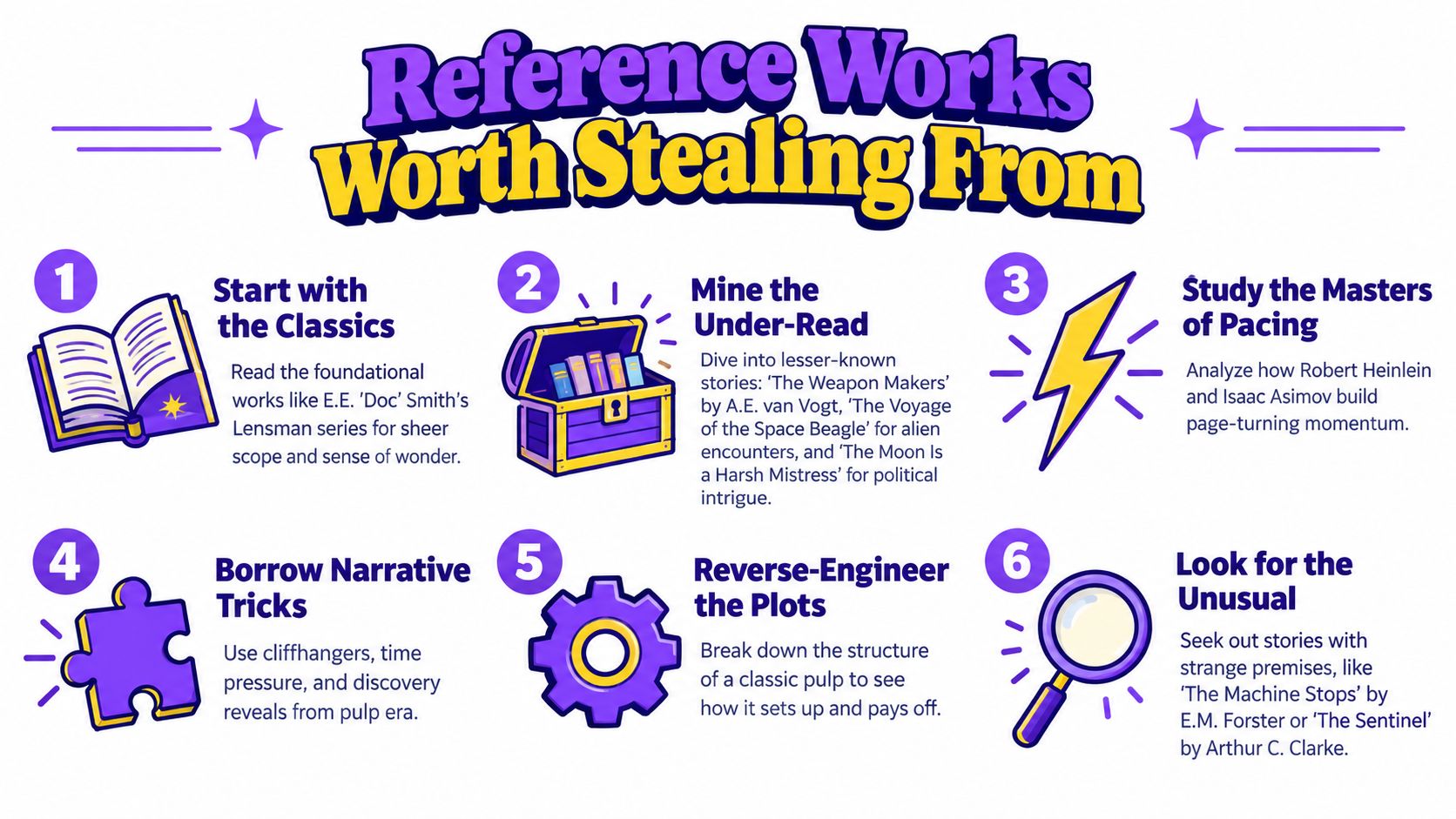
Alfred Bester's The Stars My Destination remains a craft benchmark because its velocity never cancels consequence. The book moves aggressively, but transformation, revenge, and social power remain entangled. C.L. Moore's Northwest Smith stories are equally valuable for writers who need lean, atmospheric pulp that doesn't collapse into empty spectacle.
Mine contrasts, not just influences
Alastair Reynolds's Revelation Space teaches sense-of-wonder scale and the management of a large speculative architecture. Cat Rambo's You Sexy Things is useful for ensemble voice, especially when several distinctive personalities must share the same forward drive. Don't copy their surfaces. Identify what each scene makes the reader anticipate.
The lesser-known work often teaches more because its machinery is exposed. A famous novel can seduce you into imitating tone. A compact story shows how a reveal arrives, how an object changes meaning, or how a final reversal pays off an apparently minor detail.
For current submission research, check the stated guidelines at Strange Horizons, Clarkesworld, and Galaxy's Edge. Markets change, so verify current openings, formats, and rights before sending anything.
Writing Pulp Sci Fi Without the Sins
Modernize pulp by preserving its acceleration and replacing its lazy defaults. The flat solo hero is the biggest offender. Build an ensemble in which one character holds a secret, another carries a grudge, and another changes allegiance by the climax. Those conditions create internal propulsion. The crew doesn't merely accompany the mission. It keeps changing what the mission means.
Tie the MacGuffin to a moral question that exists beyond the adventure. Resource extraction, governance of powerful systems, and refugee logistics can turn a familiar device into an urgent conflict. Don't paste a contemporary concern onto a ray gun. Make the device distribute risk, privilege, or survival in a way that forces the characters to choose who pays.
Make every trope load-bearing
An exotic world must produce at least one tactical constraint. A monster must embody or expose the story's thematic threat. The central idea must be defended, complicated, or reversed by the final scene. If the ending leaves the premise untouched, the opening promised more than the novel delivered.
At sentence level, use a strict operating rhythm:
- Open mid-action: Start with an active problem, not a neutral orientation sequence.
- Control paragraph length: Keep paragraphs under 120 words when the scene is operating at high velocity.
- End on change: Close every chapter on a reversal, revelation, or newly impossible choice.
- Budget sensory detail: Give the reader three concrete images per scene, then return to action or consequence.
These aren't beginner exercises. They're production controls for a long manuscript. A high-speed novel still accumulates continuity debt. If the captain learns a fact in one chapter, the next chapter can't treat that fact as unavailable unless ignorance has a reason. If a piece of equipment was destroyed, the rescue plan can't depend on it later. Pulp forgives exaggeration. It doesn't forgive confusion.
Writers who want to generate pressure without recycling familiar setups can use curated resources such as 10 writing prompts for screenwriters, then discard anything that produces only a premise. The useful prompt is the one that forces a decision under constraint.
The velocity test: If a bored commuter can finish chapter one on a single subway stop, the pulp engine is firing.
That test doesn't mean every chapter should be short or frantic. It means the reader should always know what has become urgent, what has changed, and why the next page matters.
The 2026 Revival and Your Place in It
The current revival is best understood as a structural opportunity, not a retro holiday. Recent commentary describes renewed interest in high-stakes science fiction, ensemble casts, climate-threat narratives, and modernized adventure gear, but it doesn't quantify demand. The sensible response is to stop treating “comeback” as proof of a market and start treating it as permission to build sharper work.
The historical record supports that broader view. Pulp science fiction has always moved through mixed-genre systems, and scholarship notes that 45% of science-fiction stories in general pulps crossed genre boundaries in the relevant historical discussion, as documented in the Oxford Academic research. Today's pulp sci fi may function less as a standalone shelf than as a packaging strategy for space opera, eco-thriller, lost-tech adventure, and retro-future mystery.
Make four decisions before drafting
Pick one subgenre and state its reader contract in a sentence. Choose a velocity target for the opening, then decide which craft repair will prevent the book from becoming pastiche. Finally, choose an actual market and work backward from its guidelines instead of writing an abstract “pulp novel” with no destination.
Small presses, magazines, indie novellas, and serialized audio dramas are well suited to the form because each can foreground momentum and recurring hooks. The ensemble model also carries pressures that a flawless hero can't. A crew can disagree about climate risk, governance, extraction, or who gets evacuated, and those disagreements produce plot rather than merely commentary.
Don't spend 2026 curating old covers. Draft a chapter that makes the speculative promise visible, give every major crew member a conflicting form of influence, and track what each person knows after every reversal. Then submit a finished piece to a current market after checking its live guidelines. Strange Horizons, Clarkesworld, and Galaxy's Edge are identifiable places to research this week, not vague symbols of an imagined revival.
The next defining pulp work won't be the one with the most convincing brass goggles. It'll be the one that delivers speed without flattening people, spectacle without decorative machinery, and a future whose stakes feel dangerous because the characters can't solve them cleanly.
Pulp sci fi depends on velocity, but large manuscripts make it easy to lose track of who knows what, which device still works, and whether a supposedly dead character has returned. Novelium's Character Tracker and World Codex extract and track those details across your manuscript, helping you catch continuity failures before they reach readers. Visit Novelium and put your next high-speed science-fiction draft through a systematic continuity check.