Outlining a Chapter That Holds Together at 100,000 Words
Most advice on outlining a chapter starts with the hook, the midpoint, and the cliffhanger. That's tidy, teachable, and insufficient for a long novel. By chapter nine, an event list has usually lost the plot in the least glamorous sense: someone knows a secret they haven't been told, a knife has migrated between rooms, an injury has vanished, or a dead character wanders back into the manuscript because nobody logged the death.
A durable outline tracks more than what happens. It records what changes, who knows about it, who possesses what, and which obligations survive the scene break. For a manuscript of 100,000 words, the outline has to function as a living state model, not a promise you made to yourself during an optimistic week of planning.
Why Most Chapter Outlines Collapse by Chapter Nine
The popular chapter template is an event list. A character arrives, an argument happens, evidence appears, somebody leaves, and the chapter ends on a question. That summary may be accurate, but accuracy isn't the same as usefulness. It tells you what the camera sees while ignoring the conditions that make the next scene possible.
At Novelium, we see the consequences when character tracking fails. A character reacts to news they couldn't possibly know. A supposedly broken wrist becomes magically functional. An object disappears from a locked room and reappears in somebody's pocket. In a multi-POV manuscript, one character's private discovery leaks into another viewpoint without a reveal, giving the reader accidental omniscience.
Practical rule: If your outline records events but not state changes, it isn't controlling continuity. It's providing captions.
The problem gets worse when writers treat the first outline as a rigid contract. Research reported by the American Psychological Association on outlining and revision describes writing as more effective when planning, drafting, and revision interact rather than proceed as sealed stages. The same report discusses outlining as a way to expose connections and unsupported claims, while showing that its usefulness varies with the writer's self-monitoring ability.
That matters for fiction because scenes discover things. A motivation sharpens. A secondary character becomes more dangerous than expected. A reveal changes the logic of an earlier chapter. The outline must change with the manuscript, or it will preserve an obsolete version of the story.
A chapter that survives a long draft therefore answers a harder question than “What happens?” It answers: What is different at the end, and which later scenes depend on that difference?
The Five Fields Every Chapter Unit Actually Needs
Begin with a short narrative overview of the chapter's major movements. A 500 to 800-word overview gives you enough room to describe sequence, logic, escalation, and the chapter's relationship to the book's larger argument or emotional movement. That range is recommended in chapter-planning guidance from The Panorama's method for developing a chapter roadmap.
Then convert the overview into scene or paragraph-level units. Each unit needs five operational fields:
- Viewpoint character: Who filters the scene, and whose knowledge limits the reader?
- Immediate goal: What does that character try to obtain, prevent, conceal, or understand now?
- Obstacle: What blocks the attempt, including resistance, missing information, time pressure, or a competing obligation?
- Turning point: What new fact, decision, reversal, or consequence changes the direction?
- End-state change: What is different when the unit ends?
That final field is the one most outlines neglect. “Mara confronts Ellis” is an event. “Mara leaves believing Ellis lied, while Ellis gains possession of the ledger and becomes responsible for hiding it” is a state transition.
| Outline Field | What It Records | Failure It Prevents |
|---|---|---|
| Viewpoint character | Perception and knowledge boundary | Accidental omniscience |
| Immediate goal | Local pressure and intention | Passive scenes with no causal drive |
| Obstacle | Resistance or constraint | Convenient solutions |
| Turning point | Direction-changing event | Flat sequences of activity |
| End-state change | New situation, knowledge, relationship, or stake | Chapters that leave no structural trace |
A worked chapter unit
Suppose the chapter begins with Mara entering a railway office to recover a ledger before the inspector arrives. The unit might read like this:
Viewpoint: Mara. Immediate goal: retrieve the ledger without alerting the clerk. Obstacle: the clerk has already found a torn page and is waiting for an explanation. Turning point: Mara realizes the page contains Ellis's handwriting, not hers. End-state change: Mara leaves with the ledger, believes Ellis has been investigating her, and owes the clerk a favor because she lies to escape.
That entry gives the next unit something to work with. Mara carries the ledger, suspects Ellis, and owes a favor. If the next chapter has her calmly trust Ellis with the evidence, the contradiction is visible before you draft it.
This kind of planning costs cognitive work up front. Ronald T. Kellogg's 1987 study in Written Communication on prepared written outlines found that outlining improved the quality of resulting letters while increasing time spent translating ideas into text, without improving overall efficiency. The useful takeaway for novelists is blunt: outlining isn't a speed hack. It is an external planning system that can reduce avoidable restructuring.
For writers refining their wider workflow, the 5 step writing process is useful because it treats planning, drafting, and revision as connected activities rather than a single race toward pages. Keep that same flexibility here. Your unit fields are diagnostic, not sacred.
The distinction between scene movement and reflective response is also worth preserving in your outline. The scene and sequel glossary entry gives you a clean vocabulary for separating external pursuit from the processing that follows, without pretending every chapter needs the same rhythm.
Hooks, Cliffhangers, and the Reader's Information State
A hook isn't automatically suspenseful because it contains danger. A cliffhanger isn't automatically effective because somebody points a gun. Both work when they alter the reader's information state at the right moment.
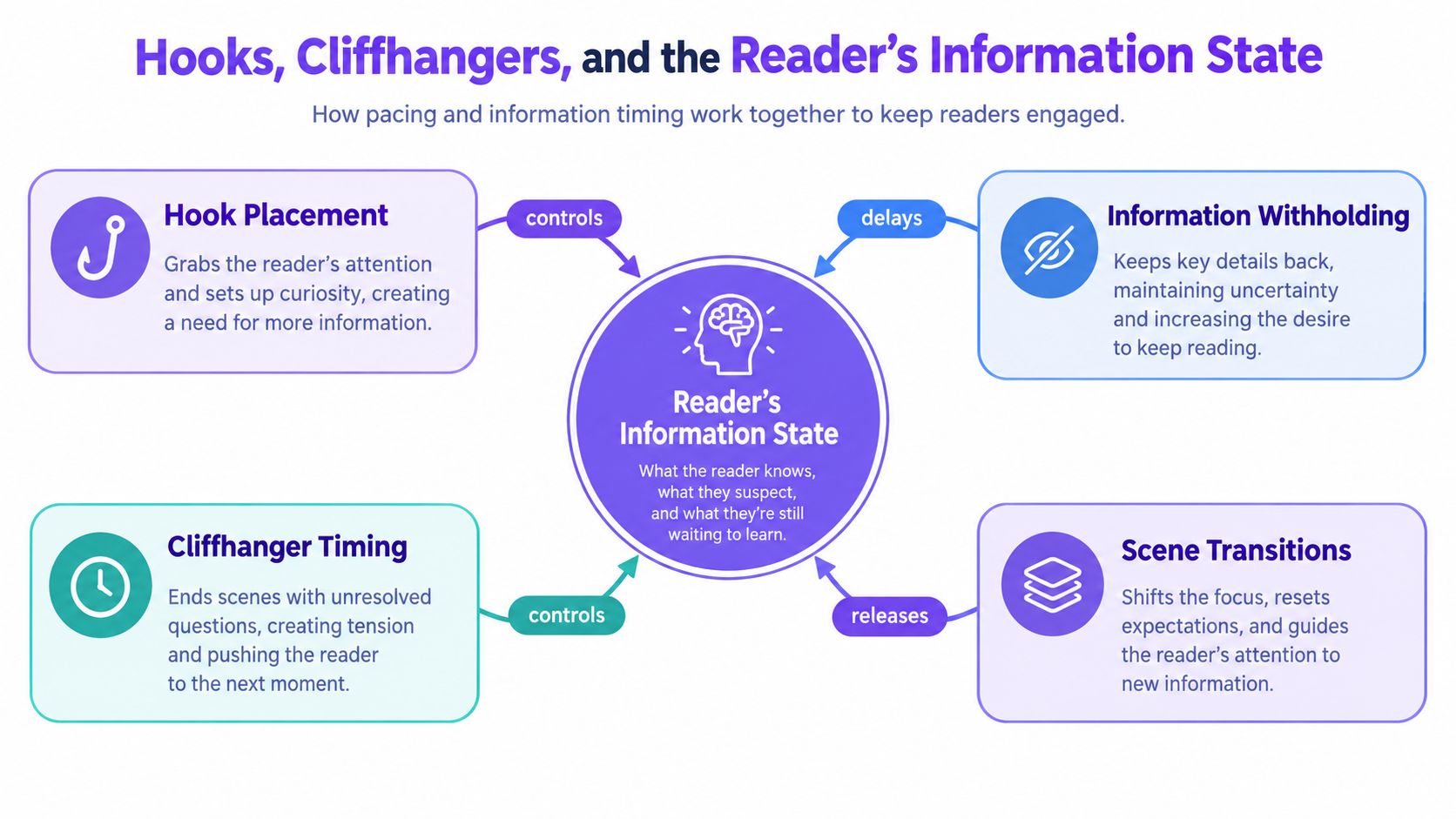
Most chapter templates ask for a hook, important scenes, and an ending. They rarely ask who knows what. Add those fields yourself: newly learned facts, false beliefs, withheld information, evidence available to the reader, and permissible conclusions for each viewpoint character.
A mystery collapses when the detective draws a conclusion from evidence they haven't seen. A thriller loses credibility when a witness reacts to a threat delivered in another location. Romance suffers when one character behaves as though a private confession has already happened. Multi-POV fiction is especially exposed because the writer knows the whole manuscript and can unconsciously hand knowledge to the wrong person.
Track the gap, not just the reveal
For every chapter unit, write two short records. One describes what the reader knows. The other describes what the viewpoint character knows, believes, misunderstands, or refuses to admit. If those records become identical too early, suspense may flatten. If the character learns something before the reader has received the evidence, the scene needs a deliberate reason for that asymmetry.
A practical example: the reader sees a red scarf left at the crime scene, but the detective hasn't entered the room yet. The detective can suspect that someone was present only after seeing the scarf or receiving a credible report. If she says, “He wore the red scarf,” before either event occurs, the outline has allowed knowledge to jump tracks.
The same logic applies to repeated revelations. If Mara learns about the ledger in chapter four, discovers it again in chapter seven, and reacts as though it is new in chapter ten, the problem isn't pacing alone. It's an unrecorded knowledge state. List the fact separately for each character and mark whether it is known, suspected, falsely believed, concealed, or available only to the reader.
Hooks and cliffhangers then become information decisions. A hook can withhold the identity of a caller while revealing that the call changes the protagonist's obligation. A chapter ending can release the fact that Ellis has the ledger while withholding why he took it. The tension comes from controlled distribution, not theatrical noise.
The Continuity Ledger Inside Your Outline
A continuity ledger runs beside the chapter outline and records changed conditions at scene boundaries. Mine would include location, possessions, known facts, injuries, obligations, lies in circulation, and time-sensitive constraints. Worldbuilding that never affects one of those variables may be enjoyable, but it isn't a continuity control.
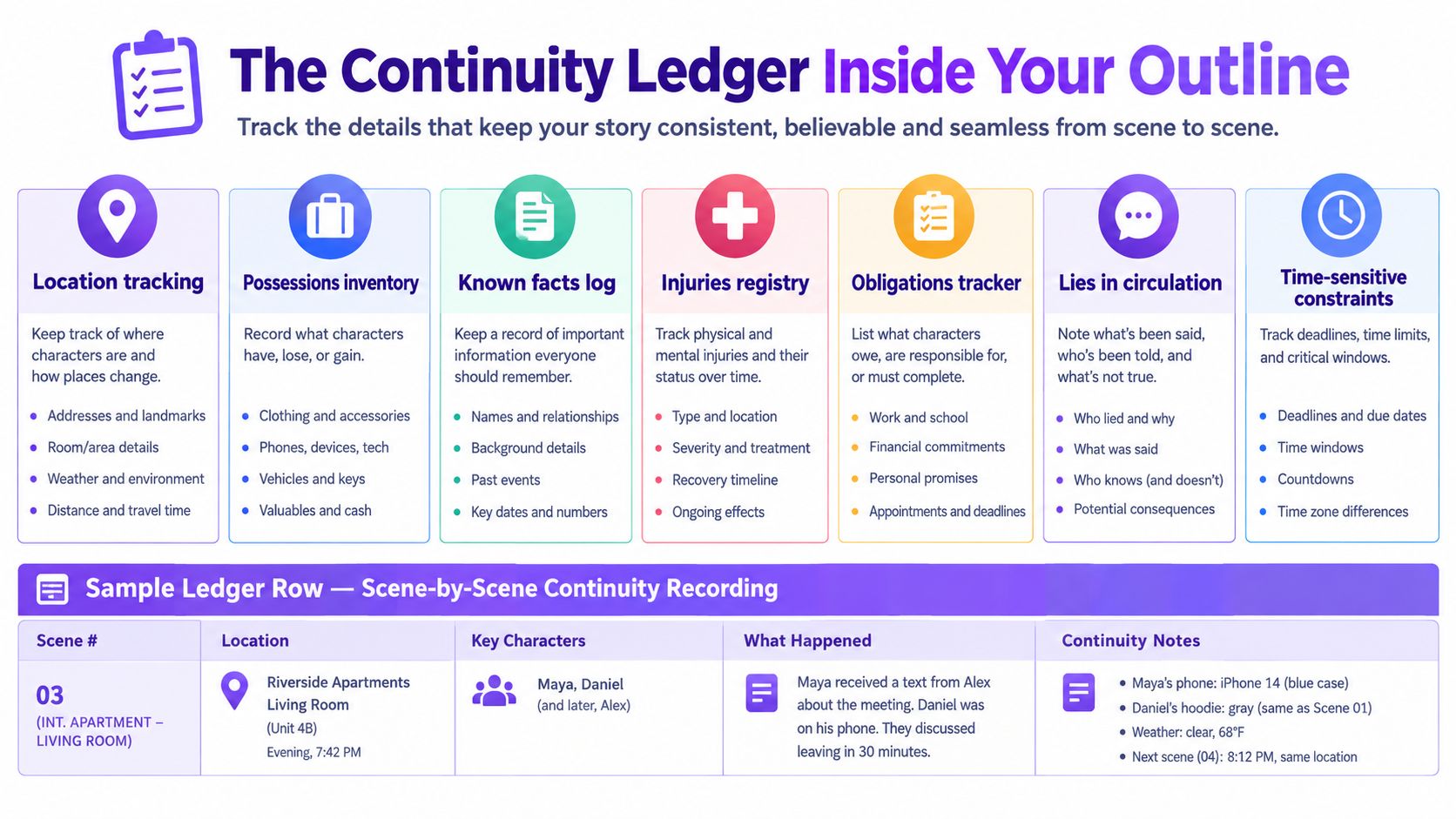
After every scene, record who learned what, what changed hands, what physical condition changed, and what new obligation or lie exists. At each chapter break, verify elapsed time and current location. After every reveal, update the information state for each affected character separately.
Before a scene with many dependencies, check every participant. Can they be present? Are they informed enough to behave this way? Are they motivated to attend? Do they have the object, injury, access, or authority the scene requires?
A chapter with no recorded change may contain beautiful prose, but it is structurally invisible to the manuscript's state model.
The ledger also gives you a useful way to classify errors:
- Physical inconsistencies: A scar, injury, possession, or physical limitation changes without a depicted cause.
- Psychological inconsistencies: A character behaves against an established motivation without an intervening evolution.
- Plot inconsistencies: A dead character returns, or a lost object appears without recovery.
- Timeline inconsistencies: Events occur in an impossible order, or travel and recovery take no believable time.
The key distinction is between a deliberate transformation and an unlogged state change. A character can stop favoring an injury, abandon a belief, lose a ring, or die. The outline only needs to identify the transition and record its consequences.
Watch this short visual explanation before building your own ledger.
A consistency check glossary entry is useful when you need to distinguish a genuine contradiction from a detail that has intentionally evolved. The manuscript doesn't need every fact to remain fixed. It needs every meaningful change to have a traceable cause.
Checking Pacing and Structure Before You Draft
Before drafting, label every outline entry as setup, escalation, reversal, aftermath, or transition. Then ask whether it changes the protagonist's situation, goal, knowledge, relationship, or stakes. If an entry changes none of those, it may be atmosphere, repetition, or a scene that belongs elsewhere.
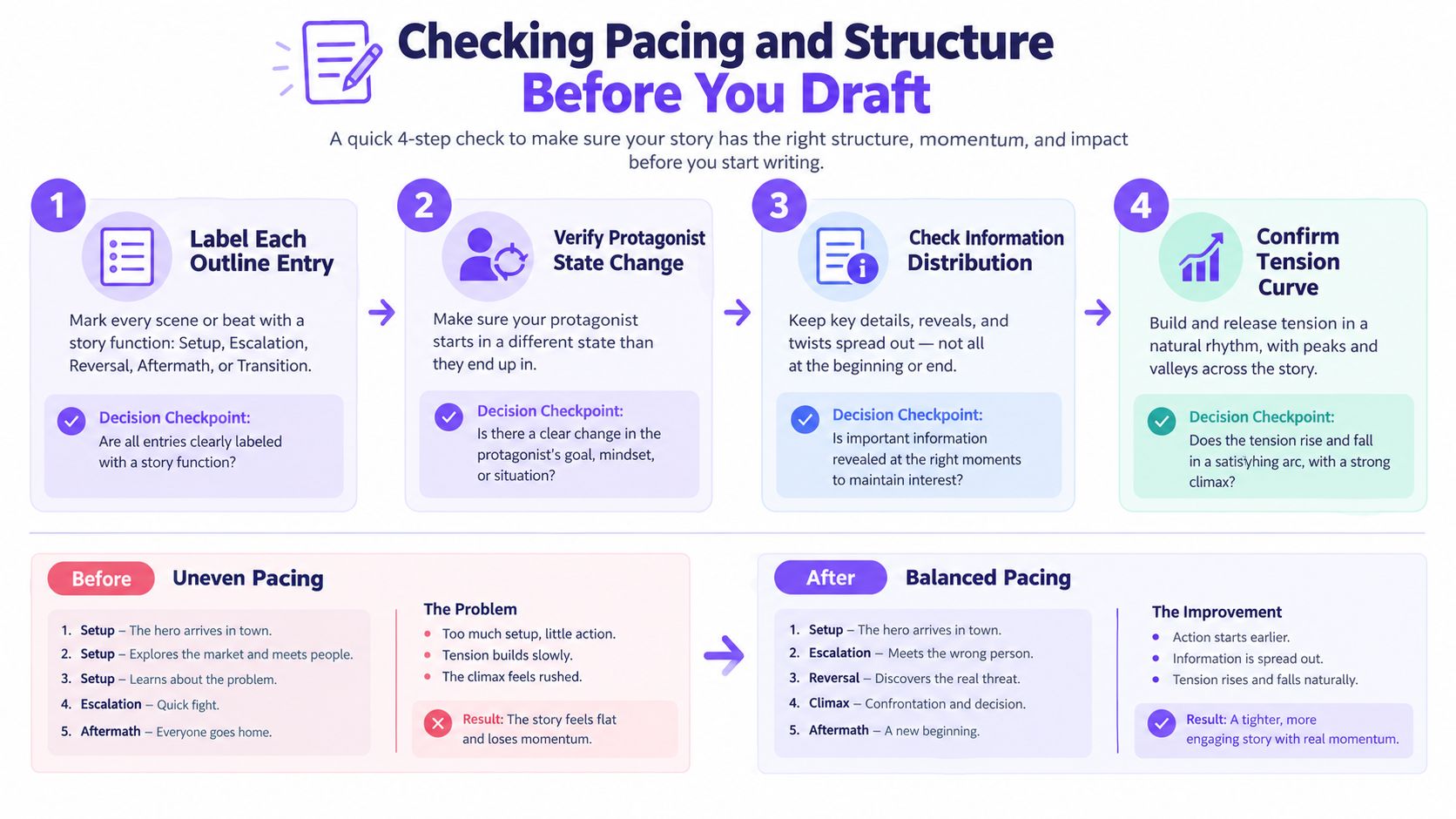
Dan Harmon's Story Circle gives chapter-scale outlining a useful mechanical test. Its eight steps are You, Need, Go, Search, Find, Take, Return, and Change. Applied to a single chapter, the sequence doesn't require a complete miniature novel. It asks whether the character moves from stability through disruption, adaptation, discovery, cost, return, and consequence. A chapter can perform only part of the circle, but it should usually perform a turn rather than sit inert as “more setup.”
At the novel level, the rough 25% setup, 50% confrontation, and 25% resolution structure is a planning heuristic, not a law. Squibler's novel-outline guidance presents those proportions as a measurable starting point for noticing an opening that sprawls or an ending that races. Use the pattern as a diagnostic signal, not a template you obey against the story's needs.
After drafting, compare the ledger with the manuscript. Flag impossible transitions, duplicated revelations, unmotivated exits, and chapter endings that create no new question or consequence. A reverse outline can help here because it reconstructs what the manuscript does rather than what you intended it to do. Chelsea Abdullah's discussion of reverse outlines shows why that post-draft view can expose material that looked necessary during drafting but contributes nothing to the finished structure.
When Manual Tracking Stops Scaling
The ledger works until a long manuscript or large cast makes manual updates easy to skip. At that point, characters can enter scenes with knowledge, obligations, or objects they should not have. Continuity errors spread through unattended transitions.
Novelium's Character Tracker, World Codex, visual timeline, and pacing analyzer help maintain those records across a manuscript. The chapter-outlining journey shows how to turn them into a working chapter outline rather than a static summary.
Use systematic tracking when the manuscript outgrows your memory. Keeping the ledger current lets you catch contradictions while scenes remain easy to change, producing cleaner drafts.
Novelium's Character Tracker and World Codex extract character, relationship, knowledge, object, and event details. Its timeline and pacing tools support scene-by-scene continuity checks. Visit Novelium to map an outline that keeps pace with the whole book.