Novel Writing Timeline for Complex Drafts
The most popular advice about a novel writing timeline is also the least useful for a complex book: set a word-count target, write every day, and celebrate when the draft is finished. That works if your only problem is producing pages. It fails when chapter twenty reveals that a character couldn't have arrived, remembered, survived, or known what the plot requires.
A serious timeline isn't a productivity scoreboard. It's a continuity defense system. For an 80,000-word manuscript with several point-of-view characters, parallel plotlines, recurring objects, and a calendar that matters, the question is not just how quickly you can draft. It's whether the story's changing states remain possible after scenes move, chapters expand, and entire sequences disappear.
The Hidden Cost of Ignoring Chronology
Drafting speed is easy to measure, which is why writers talk about it so much. Continuity repair is harder to see until the manuscript is structurally tangled. A fast first draft can become a slow, expensive rewrite when a missed deadline, impossible journey, or premature revelation forces changes across chapters that once seemed unrelated.
The historical record offers a useful corrective to the modern fixation on speed. Don Quixote was first published in 1605 and completed in its second part in 1615, while the English-language novel accelerated through Daniel Defoe's Robinson Crusoe in 1719, Samuel Richardson's Pamela in 1740, and Henry Fielding's Tom Jones in 1749. The form developed over centuries before becoming a dominant commercial category, as this history of the novel timeline documents. A novel writing timeline deserves the same patience. The finished book is a system, not a burst of output.
Why word count hides the real workload
By 1850, English novel production had reached 10.5 new novels per million readers each year, a milestone discussed in this history of the English novel. That figure describes an expanding publishing culture, not an ideal drafting speed. It also shows why production and quality shouldn't be treated as the same measurement.
In practice, the bottleneck arrives during revision. One revision guide notes that many published authors complete about 5 to 10 meaningful drafts, while another says some reach about 10 drafts. A documented comparison found that less than 10% of the first draft remained unchanged in the final version, according to Novelium's revision guidance. Every substantial pass creates opportunities for chronology to drift.
Practical rule: Track what changes after every scene, not only what the scene contains.
A static calendar records dates. A working timeline records state. Who knows the secret? Which hand has the key? Is the injury fresh, healing, or disabling? Has the character slept? Has the weather changed? Those facts determine whether the next scene can happen. The timeline in fiction glossary is useful only if you treat the timeline as an active model of the manuscript rather than a decorative planning page.
What Actually Breaks in Long Manuscripts
Character questionnaires fail because they describe a person at rest. They might tell you a detective has green eyes, distrusts authority, and owns a revolver. They don't tell you that the detective lost the revolver in chapter twelve, learned the suspect's name in chapter seventeen, and shouldn't recognize the suspect's handwriting in chapter twenty-three.
A character development document answers questions about design. A character tracking system records changes across scenes. Those are different jobs, and confusing them is how continuity errors survive a competent draft.
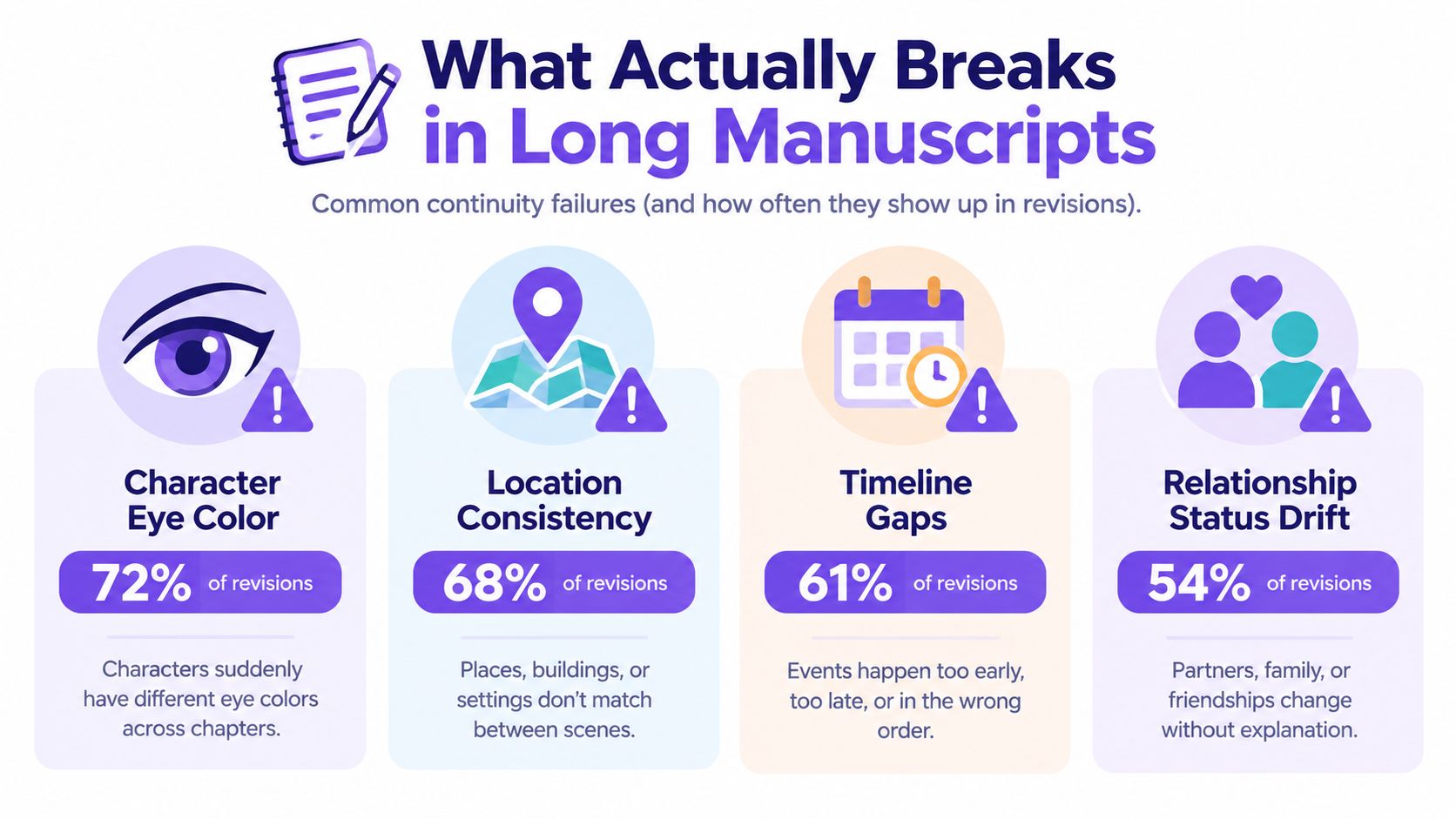
The details that carry structural weight
The useful entries in a timeline are the ones that constrain later scenes. Keep them visible:
- Temporal anchors: Named weekdays, seasons, appointments, deadlines, rituals, battles, and day-night changes.
- Physical state: Injuries, fatigue, hunger, illness, clothing, possessions, and recovery time.
- Knowledge state: What each point-of-view character has witnessed, inferred, been told, or still believes.
- Movement: Locations, travel time, transport, weather, and whether two characters can plausibly cross paths.
- Relationship state: Estrangement, marriage, allegiance, imprisonment, death, and any reversal that changes how later dialogue reads.
Worldbuilding trivia belongs elsewhere unless it affects one of those constraints. The exact history of a minor village may be delightful, but it won't protect the manuscript from a character attending an appointment after being established in another city. A named weekday is more dangerous than a page of invented mythology. Once you write “it's Tuesday,” the rest of the book has to obey a real calendar, which is why chronology errors in fiction can lead to corrected printings.
Editors also check deadlines, appointments, rituals, battles, weather, seasons, injuries, fatigue, hunger, and scene deletions because those details break when a manuscript grows. The novel editing checklist for continuity treats the timeline as a record of what happens on each day, week, or month. That approach catches the failures a character bible can't.
Building a Living Chapter Log
Build the log while drafting, then rebuild it after the first draft. Don't wait until the book is “finished.” By then, you'll be reconstructing a history from memory, and memory is exactly what failed when the contradiction entered the manuscript.
Start with one row per scene, not one row per chapter. A chapter can contain a morning departure, an afternoon confrontation, and a midnight discovery. Those events may share a chapter number while having completely different continuity consequences.
Give every scene a state record
Use a simple chapter log with fields for chapter, scene, POV, approximate day, approximate hour, location, elapsed time since the previous scene, and the scene's state changes. The final field matters most. Record what each relevant character knows, gains, loses, suffers, promises, or misunderstands.
A useful entry might read like this:
| Field | Example |
|---|---|
| Chapter and scene | 18, scene 2 |
| POV | Mara |
| Time | Thursday, late afternoon |
| Location | North station |
| Elapsed time | About six hours after the warehouse fire |
| State changes | Mara sees the ledger, injures her wrist, believes Ivo is dead |
| Open constraint | The train leaves before nightfall |
That isn't an outline of the scene's emotional purpose. It's a ledger of facts later scenes must respect. If Mara appears at dinner with an uninjured wrist, or Ivo sends her a message after she believes he died, the contradiction becomes visible before line editing buries it.
Update it when the draft misbehaves
Nonlinear drafting makes this essential. If you write the third-act convergence before the midpoint, enter the scene where it belongs chronologically, then mark its drafting status separately. Don't force writing order and story order into the same column.
The log should also track parallel arcs. When three POVs converge in a city, record each arrival independently. One character's “same evening” may be another character's “next morning” if travel, sleep, or a time-zone change matters. A detailed scene list framework helps keep the narrative order distinct from the story's actual chronology.
Run a quick check whenever you move, merge, or delete a scene. Recalculate travel, waiting time, injuries, possessions, and knowledge. A deleted interrogation can remove the only moment when a character learned a password. A merged chapter can make a supposedly exhausted character fight twice without rest. The log isn't there to punish discovery drafting. It gives discovery a traceable record.
Manual Spreadsheets Versus Automated Tracking
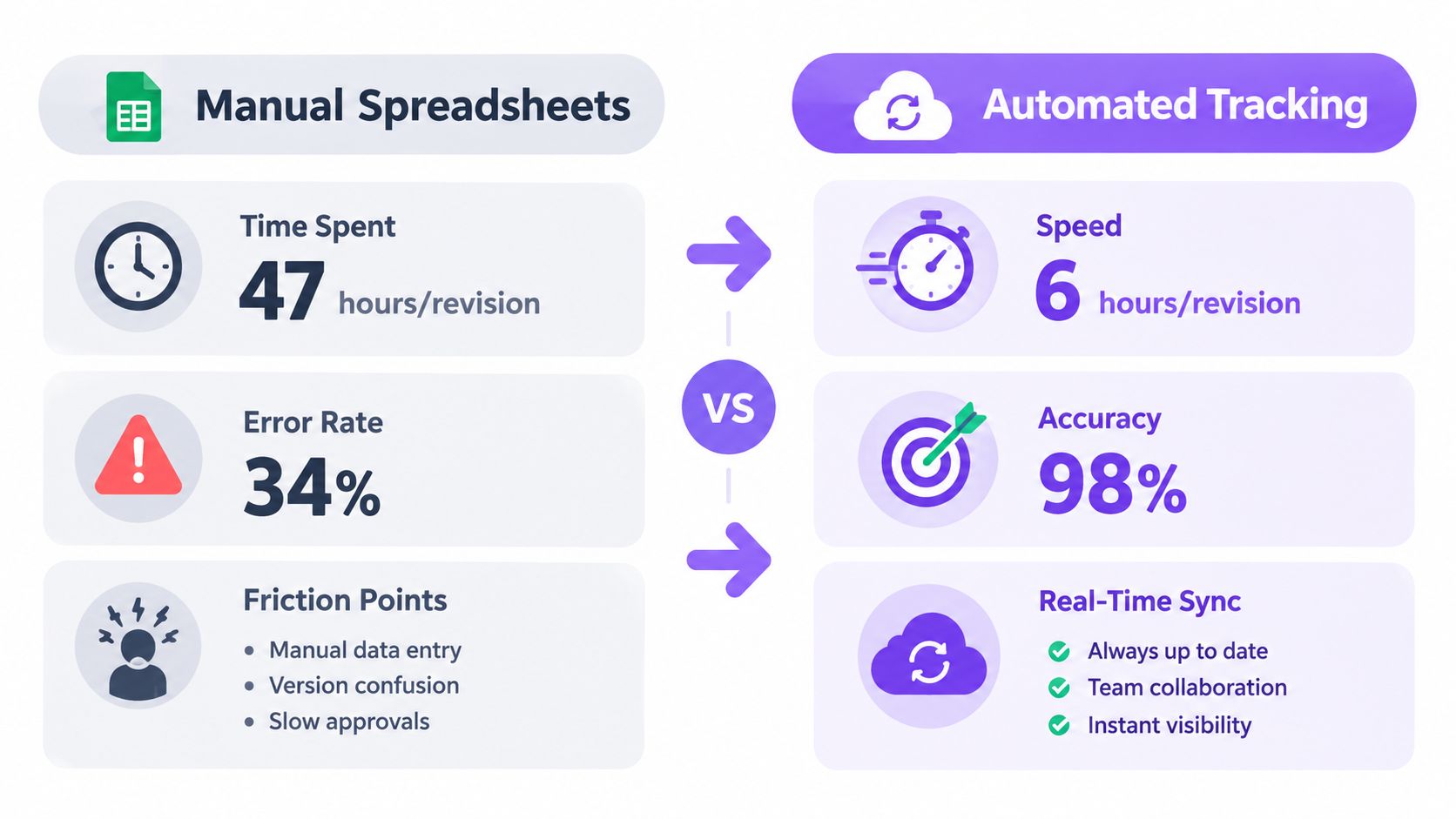
Spreadsheets work when the manuscript is small, the timeline is linear, and the writer is disciplined about updating every dependent entry. They become fragile when revisions change the shape of the book. Move a scene and you may need to edit its date, every later elapsed-time note, several character knowledge entries, and the location sequence. Delete a scene and you may not remember which fact disappeared with it.
Color-coded index cards have the same strength and weakness. They make structure visible, but they don't understand that removing a conversation also removes a character's reason to trust someone. A spreadsheet can store a state. It can't reliably infer every consequence of changing that state.
Manual tracking is excellent for thinking. It is poor at remembering every dependency after a major rewrite.
Automated manuscript intelligence tools take a different approach. They extract names, objects, dates, locations, relationships, and knowledge cues from the manuscript, then surface conflicts for review. That doesn't eliminate editorial judgment. It moves the tedious retrieval work away from the writer so the writer can decide whether an apparent contradiction is intentional.
For a single linear novel, a document and a focused reverse outline may be enough. For a series with recurring characters, multiple timelines, or a large cast, systematic extraction becomes more defensible. Novelium's Character Tracker and World Codex automatically extract and track character details across manuscripts, while its timeline view organizes events and dates so writers can inspect chronology and parallel storylines. It supports Word, Scrivener, Google Docs, and plain text workflows, with local manuscript processing and encrypted storage described by the publisher.
Writers managing deadlines outside the manuscript may also find a broader deadline tracker apps review useful for comparing project-level tools. Those apps can organize tasks and milestones. They won't know that a character's broken arm is still broken, which is the distinction that matters here.
The following visual captures the operational difference between manual maintenance and automated synchronization.
This short video offers another way to think about timeline management in a manuscript workflow.
The Continuity Review Pass
Don't check chronology while polishing sentences. You can't assess rhythm properly while also deciding whether a character's fever should have broken. Separate the passes, give each one a narrow question, and preserve the manuscript's structural flexibility until the logic holds.
The practical order is continuity, developmental, line, then polish, a sequence also recommended in Novelium's editing workflow. The first pass checks the world-state. The second checks whether scenes escalate and revelations arrive in the right order. The third handles clarity and rhythm. The final pass catches surface errors.
Pass one checks what can be true
Read with the chapter log open. Verify chronology, possessions, injuries, knowledge, location, travel, weather, fatigue, and relationship status. Don't improve prose. Mark contradictions, missing transitions, impossible waits, and facts that have no believable source.
Then check the manuscript from each major POV. A character can't react to information they haven't received, even if the reader knows it. A narrator may know more, but the viewpoint character's perceptions still need to obey the scene's information boundary.
Pass two checks what must happen
Once the state record is coherent, inspect scene order, escalation, causality, and revelation timing. A timeline can be perfectly dated and still fail because the antagonist's plan depends on a clue that arrives too late, or because a character solves a problem before the scene that teaches them how.
A reverse outline is particularly useful here. It turns the completed draft into a map of actual events rather than intended events, which makes dead scenes and duplicated revelations easier to spot. Send the manuscript to beta readers only after this internal work. Their feedback is more useful when it isn't merely reporting contradictions you already expected to fix.
Pass three and four protect the reading experience
Line editing comes after structural decisions. Once the sequence works, tune clarity, rhythm, repetition, and voice. Polish follows, because correcting commas in a scene you later delete is an especially dull form of wasted labor.
The consistency check guide gives the right mindset: inspect the manuscript as a connected system. A continuity review isn't a hunt for embarrassing typos. It's a test of whether every later event has earned its conditions.
Scaling Your Continuity System
A single-book log can become a series-level codex. Keep permanent facts separate from book-specific states. A character's eye color belongs in the enduring profile. The scar acquired in book one, the false name used in book two, and the secret revealed in book three belong in a chronological state history.
That distinction protects creativity. You can change the story while drafting, but you won't accidentally treat an abandoned version as canon. The system should preserve decisions and flag conflicts, not dictate what the story is allowed to become.
Writers who manage several projects also benefit from separating long-term goals from daily execution. A practical resource on goal planning for ADHD adults can help with that broader planning problem, but the manuscript still needs its own factual state record.
The professional standard isn't a prettier spreadsheet. It's a timeline that survives revision, multiple POVs, recurring characters, and the inevitable scene that gets moved at midnight. Track the living state of the book, and complexity becomes manageable rather than mysterious.
Novelium reads your manuscript locally and tracks characters, knowledge states, relationships, events, objects, and chronology across chapters. Visit Novelium to test a systematic continuity workflow before the next revision turns one small timeline error into a book-wide repair job.