Novel Timeline Template: The Two-Track System That Scales
The tidiest timeline in your project folder is usually the one doing the most damage. A sheet full of exact dates reads like a record of what happens in the book. Most of the time it records what you assumed while drafting, and once the cells are filled those assumptions are invisible.
Narrative theory settled the underlying problem long before anyone built a spreadsheet. Gérard Genette's Narrative Discourse, published in 1972, set out a systematic framework for sequence, duration and frequency, and its central move still holds: the time that passes in the imagined world is not the same as the space used to narrate it. A novel covering several years in a few pages, or giving an entire chapter to five minutes, is making a design choice, not committing an error.
What follows is the template worth copying, plus the two things most templates leave out: a separate track for reading order, and a confidence label on every date.
The Novel Timeline Template to Copy Today
One row per scene, two clocks in the same row. That's the design. Build it in a spreadsheet, a database or a plain text table, and fill the fields in the same order every time, because the order is what turns a list of events into a model you can test.
Core fields for a scale-ready timeline
| Field | What to record | What it catches |
|---|---|---|
| Scene and reading position | Chapter, scene number, POV | Reveals that land before their setup |
| Story date | In-world date or relative anchor | Impossible sequences and weekday slips |
| Elapsed time | Duration since the previous scene | Journeys and recoveries that happen too fast |
| Time of day | Part of day, meal or light the scene depends on | Scenes that ignore the light, meals or deadlines around them |
| Location and presence | Places and characters in the scene | Characters in two rooms at once |
| Knowledge changes | What each character learns here | Information used before the character could know it |
| Date status | Stated, inferred, assumed or contested | Locked dates that were only guesses |
| Causal dependency | The earlier scene this one requires | Consequences that precede their causes |
Start with scene and reading position, since it's the only field that records where the reader is standing. Then the story date, which can be a calendar date or a relative anchor such as three weeks after the fire. Relative anchors are legitimate; they just need to resolve to something eventually.
Elapsed time comes next because journeys and recoveries are where drafts break. Time of day earns its place only when a scene depends on light, meals or a deadline, so leave it thin everywhere else. Location and presence is the cheap field that stops a character attending a funeral in Bristol and a court hearing in Leeds on the same afternoon.
Knowledge changes and causal dependency are the two that carry the weight at manuscript length. Knowledge changes records who learns what in this scene; causal dependency names the earlier scene this one needs in order to make sense. Together they catch the failures that cost real money to fix, like a detective acting on a fact nobody has told her, or a confrontation firing before its trigger.
Date status is one word: stated, inferred, assumed or contested. Fill it in even when the answer feels obvious.
The test: if the sheet can't tell you who knew a fact at a given point in the draft, it has failed at manuscript length, however tidy it looks.
Why Story Time and Reading Order Need Separate Columns
A single chronological list survives right up to the first flashback. After that it becomes a liability, because it can only answer one question at a time: when did this happen, or when does the reader find out. Those answers diverge the moment a manuscript carries a flashback, an alternating POV or a parallel plotline.
The difference is easiest to see side by side.
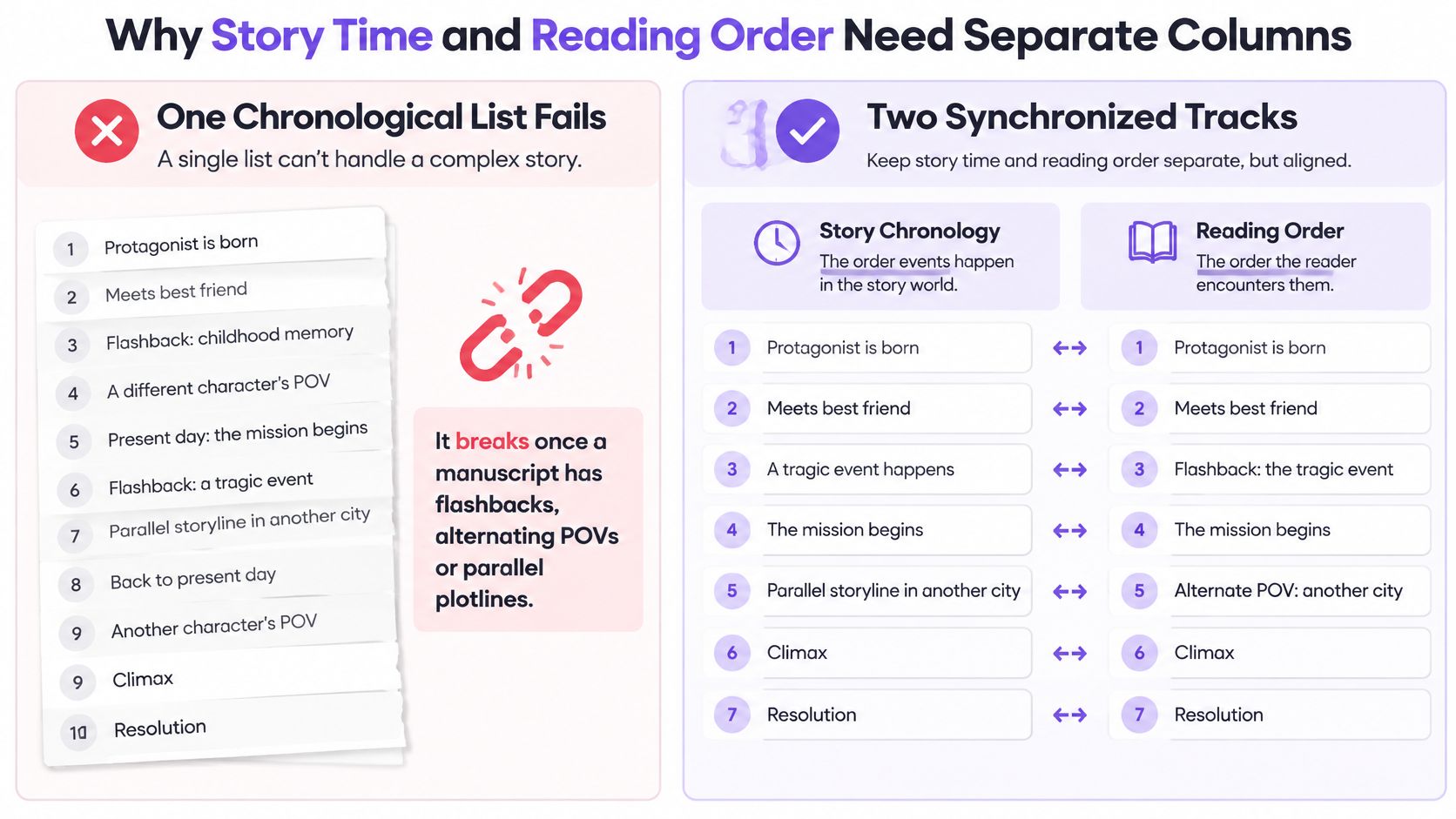
The workable version uses two synchronized tracks: story chronology, the order events occur in the fictional world, and reading order, the order scenes appear in the manuscript. Novelium's breakdown of timeline structure puts the validation routine plainly: sort once by story date to detect impossible sequences, then sort by chapter order to verify that reveals happen only after the relevant character could know them. Nonlinear structures also need explicit flashback and flash-forward markers, plus a reconciliation pass confirming that no consequence precedes its cause.
Take a mystery where the alibi scene sits in chapter four but takes place on the Thursday, after the body is found on Wednesday in chapter nine. Reading order tells you what the reader knows when they reach chapter four. Story chronology tells you whether the alibi holds. One sheet, two sorts, no rebuilding.
Readers have a limit here, and it's lower than most writers assume. Two timelines run comfortably when each keeps a recurring signal: a dated chapter heading, an era-specific object, a character who names the day. Three unmarked tracks in the same stretch of chapters draw the complaint that the book is confusing, even when every date checks out. Mark each shift in the reading-order track so you can see exactly where a new clock starts.
One clock, one signal: a flashback with no dated heading, no era cue and no character who names the day gets read as a mistake long before it's read as a structure.
Why Character Profiles Fail and What Tracking Replaces
The static character profile is where continuity goes to die. It records what a character is (traits, backstory, a wound from the age of nine) and never what they know, where they stand or what they're carrying on page 212. Those are different documents. A development doc helps you invent. A tracking log stops the manuscript contradicting itself.
Keep the distinction clean, because conflating them is what produces the 60-question questionnaire nobody opens twice. Development work still matters, and if you're still generating raw material for a character, Acres guide to story brainstorming is a better use of an afternoon than another trait grid. It just isn't tracking. Nor is arc tracking, which tells you where a character lands by the final chapter and nothing about where they're standing in chapter fourteen.
The failures that reach a copyedit fall into recognisable shapes. An object changes identity somewhere around the midpoint: a necklace in chapter three, a ring in chapter twenty. A character meant to be twelve during the fire is effectively fourteen once someone does the arithmetic. A character dies in chapter nineteen and answers a phone in chapter thirty, because nobody logged the funeral.
The age check is the one writers skip and the one that's purely mechanical. Plotiar's timeline template guidance is blunt about it: record the year of birth for every character who appears at two or more points in time, then calculate age at each anchor, citing the scene where the age appears. Under the manuscript's chosen birthday convention, a character who is twelve during a fire and a fire date must produce twelve. The same maths catches a character too young to have served, worked, graduated or remembered an event as an adult.
Series fiction turns this into a load-bearing problem, because backstory is distributed across volumes and a small age adjustment in book one can contradict dates set in book three. Ages belong beside event dates, not in a separate character sheet that drifts out of sync with the plot.
This is the gap tracking software exists to close. Novelium tracks what each character knows at every moment of the story, and pulls characters, world details and timeline entries from the manuscript with no manual data entry, which is the only version of this discipline that survives a third revision.
Ask one question of any character: what did she know in chapter fourteen? If the answer isn't written down somewhere, you're holding it in your head, and your head is the least reliable storage medium in the project.
Marking Stated, Inferred and Assumed Dates
A precise-looking date creates false confidence. If a spreadsheet says 14 March, nothing on the screen distinguishes a date printed in the text from one you reverse-engineered from a character's age at a funeral. Six months later, you'll treat it as fact and build three chapters on it.
Most template guidance still skips this. As The Novel Kit's review of timeline templates notes, existing templates recommend one row per event, story-world ordering, anchor dates, character ages and chapter references, yet they rarely explain how to separate facts stated in the manuscript from dates the author inferred, or what to do when those inferences change. One template does label entries "stated or inferred." It isn't standard.
Date status labels and collision rules
| Status | Source | Rule when it collides |
|---|---|---|
| Stated | Appears directly in the manuscript text | Locked and wins every collision |
| Inferred | Derived from anchors, such as birth year plus character age | Moves when its anchor moves |
| Assumed | Working guess not yet in the text, such as a four-day trip | Flagged for checking before it is locked |
| Contested | Deliberate ambiguity or an unreliable narrator's claim | Both versions tracked side by side |
Anchors come in two kinds. Immutable anchors are dates stated in the text or fixed historical events: a war's end, a coronation, a date on a headstone. Movable anchors are the inferred dates hanging off them. Change one immutable anchor and you've started a dependency chain: every event built on it recalculates, and every scene citing those dates needs re-checking.
When two labels collide, the stated date wins and the inferred date moves. That rule alone resolves most arguments with yourself at 2am.
Contested dates deserve special care, because they're often the plot. If an unreliable narrator gives a date that contradicts the physical evidence in chapter twenty-two, both entries stay live and both get status labels. Deleting the "wrong" one flattens the ambiguity you built.
Uncertainty tracked deliberately beats chronology tracked precisely. A timeline with hidden guesses manufactures errors, and the reader finds them for you.
Duration Gaps and How to Recalculate Downstream Events
Durations are estimates, not facts, and they're skewed. Travel, recovery and research don't cluster neatly around an average; the long tail is where your plot lives. Project-scheduling research summarised by the Project Management Institute on critical chain scheduling makes both points: activity durations are statistical quantities with right-skewed distributions, so unusually long delays stay plausible, and nominal estimates often do not represent a realistic 50% probability of finishing on time.
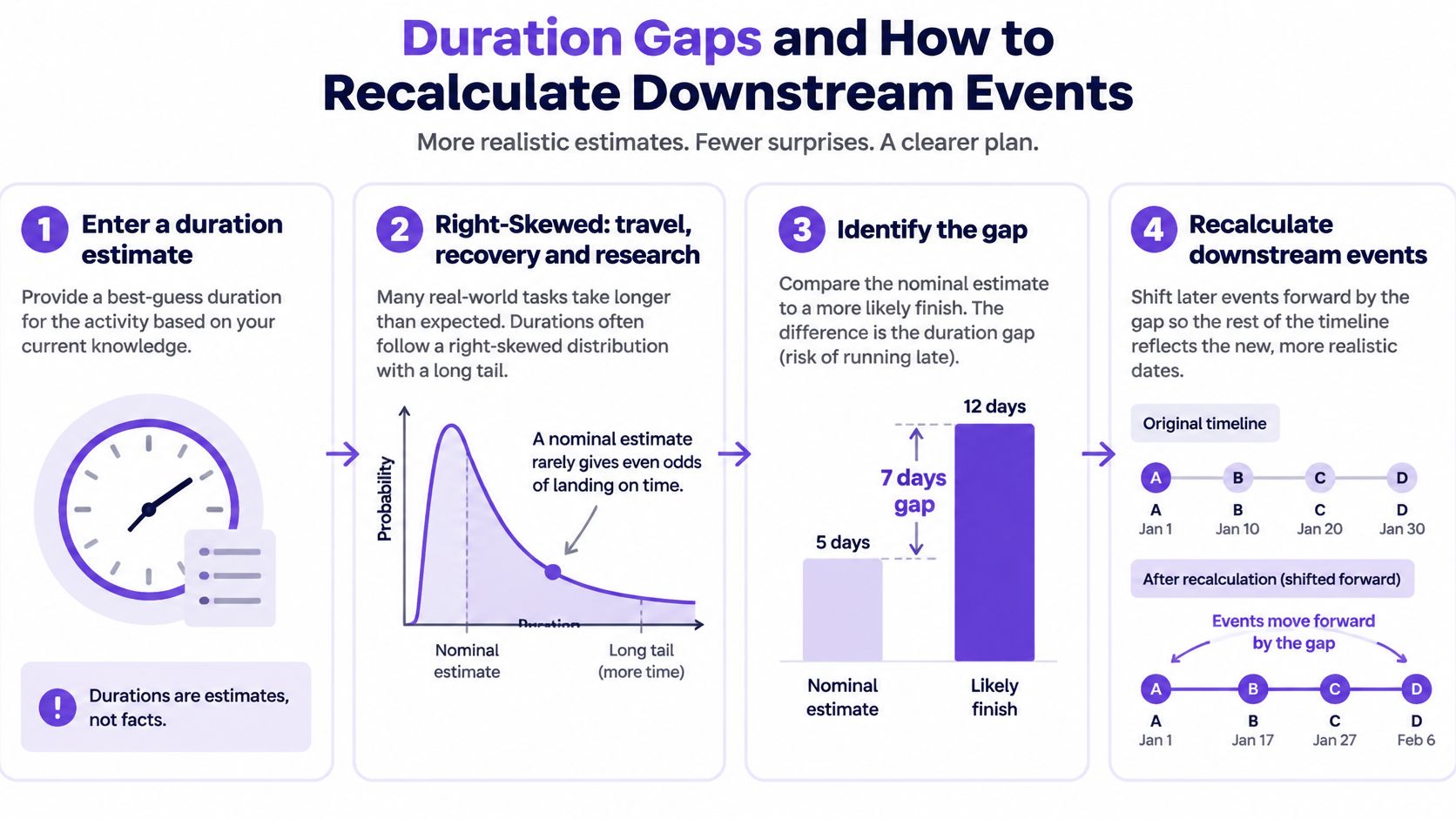
So give each uncertain interval three numbers instead of one. A three-day journey becomes two days minimum, three most likely, six maximum. Now a scene landing on day seven is a discoverable contradiction rather than a feeling.
Run the recalculation as a fixed sequence whenever an anchor moves.
- Mark the anchor and list its dependents. Every scene that cites the date goes on the list, including the ones buried in a subplot you haven't opened since March.
- Recalculate both ends. For each downstream event, work out the earliest possible and the latest plausible date given the new anchor.
- Flag anything outside its interval. A scene that falls before its earliest possible date, or after its latest plausible one, is a contradiction to resolve, not a timestamp to nudge.
- Check weekdays, seasons and ages. A shifted anchor breaks a Tuesday, moves a scene out of autumn, or makes a character too young for a line of dialogue that stays in the draft.
- Prioritise the critical path. Events whose delay would invalidate several later scenes get your attention first; a timestamp affecting one sentence can wait.
- Audit the decorative time phrases. "Next morning" and "three weeks later" are load-bearing whether you meant them to be. Confirm the travel and recovery time behind each one.
- Re-sort both ways. Story date first, then reading order, and read the results again.
Say a hospital stay gets extended by two days. Three later scenes break at once: a discharge conversation, a wedding a character can't reach, and a deadline that was tight before the injury. A timeline error audit catches all three in one pass. A line edit catches none of them, because each sentence is fine on its own.
Do this before line editing. After a copyedit, every fix costs you a scene you've already polished.
How the Timeline Changes as the Manuscript Grows
One timeline plays four roles across a book's life, and treating it as a single static artefact is why so many get abandoned in the middle of a second draft.
During outlining it's a sketch, mostly guesses with a few anchors. During drafting it becomes a log, recording what you wrote. In revision it's a validator. Across a series it's a shared record, the thing that stops book four contradicting book one.
For pacing, the three-act model gives usable reference bands rather than laws. Act One occupies the first 25% of the manuscript, Act Two the middle 50% and Act Three the final 25%, which in an 80,000-word novel works out at roughly 20,000 words for setup, 40,000 for escalating complications and 20,000 for climax and resolution. Common milestones sit near the 25% mark for the first major turning point, 50% for the midpoint reversal and 75% for the late plot point that launches the final act; some systems place the inciting incident at 10 to 15% and the climax at 88 to 90%. Editor World's outline of three-act structure is careful to call these planning conventions, and that's the right frame. Use them as bands, keep tracking exact dates inside them.
The payoff appears with multiple plotlines. Map each subplot against the same 0 to 100% progression and you can see whether a thread develops too early, stalls through the middle or resolves after the main conflict has already landed. A romance that peaks at 60% and then idles is a structural problem the date column won't show you.
Then there's the point where one sheet stops working. When a manuscript alternates between two eras, or runs several POVs on separate clocks, give each clock its own sheet and link them only where they must agree. One sheet with everything in it becomes unreadable at around the third timeline.
For a series, a date fixed in book one becomes an immutable anchor, and every later volume checks against it before drafting rather than after. Keep one master template per series, versioned by draft, so the record of what changed survives the revisions that follow. The outline is where the sketch lives; the master template is where the truth lives.
Set Up Continuity Tracking Before Your Next Draft
Past roughly 80,000 words, or as soon as a second book is in progress, a hand-kept spreadsheet stops being reliable. Not because the sheet is wrong, but because the number of cross-references outgrows what one person can re-check after every structural revision. You fix a date in chapter six and eight downstream scenes change status.
Automated tracking should do four things: read the draft, build the chronology from dates already in the text, validate durations such as pregnancies, seasons and journeys, and flag conflicts as you type rather than at the next full read. Novelium tracks characters, timeline and plot threads and catches timeline inconsistencies, flags conflicts such as a pregnancy spanning eleven months the moment the conflicting date is entered, and derives story elements from the manuscript with no manual data entry. It never writes your prose and never suggests plot changes, so the judgement stays yours.
This week's sequence:
- Copy the template from the top of this piece into a spreadsheet, all eight fields.
- Fill in the first three chapters only, including date status on every row.
- Run both sort passes, story date then reading order, and note every flag.
- Compare that result against a tracked version of the same three chapters and count what the manual pass missed.
The template above gets you a chronology you can test, but maintaining eight fields by hand across a 120,000-word manuscript with two timelines and a cast of nineteen is where most systems collapse. Novelium builds the chronology automatically from the dates already in your draft, validates durations such as pregnancies, seasons and journeys, and flags a pregnancy that spans eleven months the moment you type the conflicting date, all while tracking what each character knows at every point in the story. Import your manuscript at Novelium and put the two sort passes to work on a timeline you didn't have to build row by row.