10 Names for Evil Characters That Actually Work
A menacing name is not a substitute for a villain. Harsh syllables can announce danger, but they can't create motive, pressure, or dread on their own. The strongest names for evil characters produce a specific reader effect: social power, ironic contradiction, alienation, identity loss, or the sense that a person has become a force.
The practical problem appears later, usually when the manuscript has grown large enough to punish loose notes. A character profile records the original name, perhaps a title and a few aliases. It doesn't necessarily track who knows the alias, when the title changes, how the pronunciation works, or whether the villain has begun answering to a dehumanizing label. We see continuity failures of that kind repeatedly in complex manuscripts.
The ten approaches below are useful because each creates a different effect. Treat the name as a moving part of the novel, not a decorative label. If the name changes the reader's understanding of the character, your tracking system must record that change too.
1. Phonetically Harsh Consonants
Names such as Krath, Vex, Skar, Malachai, Scourge, and Thrax create friction before the reader understands the character. Hard consonant clusters make the name feel clipped, abrasive, or difficult to welcome into the mouth. That can establish menace quickly, especially for a primary antagonist who needs to register on the page before the first confrontation.
The method works best when the sound does some work the character doesn't repeat. If every scene gives the villain a cruel line, a violent gesture, and a name packed with k, x, and th sounds, the prose starts underlining its own point. Voldemort demonstrates a more controlled version of the approach. Its sound is memorable and severe, but it isn't just a pile of aggressive consonants. Sauron, Diablo, Lich King, and Malthael show how fantasy and games often combine compact sound patterns with symbolic or mythic weight.
Practical rule: Say the name aloud in the kind of sentence your characters will actually use. If it feels theatrical every time, it won't survive sustained dialogue.
Reserve the most abrasive names for the antagonist who deserves that acoustic emphasis. Give secondary villains different textures, perhaps a soft first name, an ordinary surname, or a title that carries the threat. Track how often the name appears in narration and dialogue. Repetition can turn a sharp name into background noise, particularly in scenes where several characters address the villain directly.
A manuscript tracker should also distinguish the spoken form from the written form. Record pronunciation, shortened versions, insults, and formal variants. If one character says “Vex” while another uses “Vexar,” that difference should signal relationship or status, not accidental drift.

2. Inverted Virtue Names
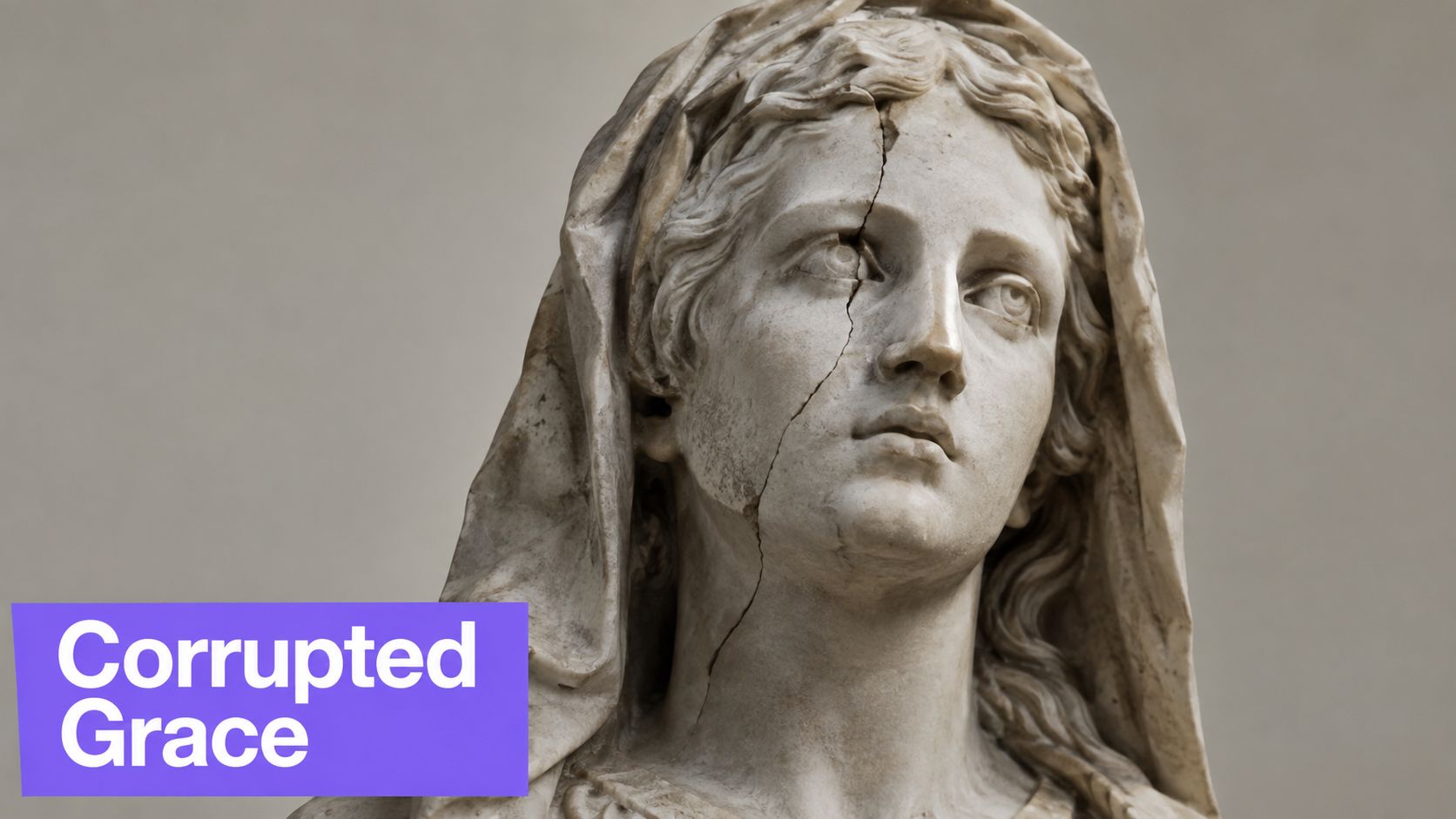
Grace, Mercy, Charity, and Hope become dangerous names when their owners embody the opposite. A ruthless Grace forces the reader to hold the name's promise beside the character's conduct. A sadistic Mercy turns every use of the name into an accusation. The contradiction creates pressure without requiring the prose to call the villain wicked.
Don't use the virtue as a random flourish. Establish why the character received it, who chose it, and whether the name was once sincere. A name given by hopeful parents produces a different effect from one imposed by a cult, an enemy, or the villain herself. The most durable irony comes from action. If Mercy never faces a choice involving compassion, the name is only a label.
Dolores Umbridge offers a related contrast rather than a direct virtue name. The name doesn't promise kindness, but the character's polished presentation and bureaucratic cruelty create a mismatch between social respectability and behavior. That contrast can be more unsettling than a character called something obviously infernal.
Let other characters react to the name early. Someone may laugh at Grace's name, refuse to use it, or insist that she has disgraced it. Those responses turn naming into conflict. Then record the villain's own relationship to the name. Does she embrace it, resent it, weaponize it, or reclaim it after years of contempt?
Static development notes fail here. The profile may say “Mercy, antagonist,” but the manuscript needs to know whether the heroine still calls her Mercy after learning what she has done, whether the villain introduces herself by that name, and whether a former ally uses it as an act of defiance.
3. Aristocratic or Hereditary Naming Patterns
Lord Ashford Vale, Duchess Margot Thorne, and Viscount Everard Blackwood arrive with built-in social architecture. Their names suggest inheritance, old money, ceremony, and institutions that have allowed one family to keep power without meaningful scrutiny. The reader doesn't merely meet a bad individual. The reader meets a person protected by a structure.
A title only works if it controls something concrete. Decide whether Lord Ashford Vale commands a court, owns land, controls a military appointment, or determines who receives legal protection. A vague aristocratic label creates costume. Specific authority creates threat. Build the family tree and record the relationships that make the villain's position durable.
Your naming conventions need to survive every address. Is the character “Duchess Margot Thorne” in public, “Your Grace” in court, “Margot” to a sibling, and “Thorne” to a resentful former servant? The shifts should map power, intimacy, fear, and rebellion. Naming conventions for complex fictional worlds deserve their own record because a title isn't just part of a name. It changes who can speak freely.
Literature and fantasy often use deliberate renaming to signal an attempted escape from an earlier identity. Voldemort's chosen name, for example, turns self-invention into a claim of power. That kind of transformation becomes stronger when the manuscript tracks who accepts the new name and who refuses it.
Keep title changes attached to chapter-level events. A coronation, exile, inheritance, or public disgrace can alter the villain's official designation. If the narration continues using an obsolete title without intent, readers notice the continuity error before they analyze its thematic meaning.
4. Occupational or Descriptive Titles as Names
The Surgeon, The Warden, Mother, The Collector, The Architect, and The Inquisitor replace personal identity with function. The reader learns what the villain does before learning who the villain is. That makes the character feel institutional, ritualized, or almost impossible to reach as an individual.
This approach suits systemic evil particularly well. The Surgeon isn't frightening because the word sounds dark. The title becomes frightening when medical authority, trust, and bodily vulnerability collide. Mother can be worse than a demonic name if she controls shelter, food, or belonging while using care as a weapon.
Decide whether the title is a name, a job, or a reputation. If the character has a personal name that nobody knows, the gap can drive suspense. If everyone knows it but still uses The Warden, the choice reveals obedience or contempt. Apply the convention consistently. Characters with ordinary personal names should make the title feel deliberate by contrast.
“The title is the mask. The missing name is the wound.”
Track responses, not just vocabulary. One prisoner may call him Warden, another may spit out his birth name, and a former colleague may use the professional title with bitter formality. Those choices record knowledge and allegiance. When the villain finally responds to the personal name, the moment should be logged as a state change, not left to memory.
Avoid giving every threatening professional a title-name. The technique loses force when the manuscript contains The Surgeon, The Butcher, The Keeper, and The Archivist in neighboring chapters. Use it for the antagonist whose function governs the story's fear.
5. Corrupted or Inverted Common Names
Jain instead of Jane, Nathanel instead of Nathan, and Daivid instead of David create unease through near-familiarity. The reader recognizes the pattern, then notices that something is wrong. Elizabethe, Micharl, and Sarahne can produce the same effect if the variation has a clear narrative reason.
The reason matters more than the distortion. A transliteration convention, an archaic spelling, a regional naming system, or a deliberate self-alteration gives the difference structure. Randomly misspelling a common name doesn't create menace. It creates the impression that the author made a mistake.
Choose a rule and document it. If names from a particular culture alter vowel order, preserve that pattern across the relevant cast. If the villain changed the spelling to sever a family connection, show the decision and record when it occurred. Your tracker should hold the accepted spelling, rejected spelling, pronunciation, origin, and the characters who understand the distinction.
Spelling is characterization only when the manuscript treats it as intentional.
Use find-and-replace carefully. Batch correction can erase the very variation carrying the plot, while inconsistent manual correction can create a second problem. Search for every form, then verify context. A character may write “Daivid” in a forged document but use “David” in a flashback, and the difference can identify the document's source.
Give another character a reason to notice the name. A correction, hesitation, or insult can plant the uncanny effect without explaining it. The tracker then needs to preserve who has noticed the discrepancy. Knowledge states matter here. The villain's identity may be obvious to the reader while remaining hidden from the protagonist.
6. Names Referencing Absence, Void, or Negation
Void, Null, The Nothing, Absence, Silent, Hollow, The Gap, and Erasure define a villain by what isn't there. These names suit antagonists who operate through neglect, emotional vacancy, annihilation, or existential dread. They don't promise a flamboyant personality. They suggest that personality has been removed.
Abstract names need concrete behavior. Hollow should leave people emotionally numb, erase records, or exploit the spaces between relationships. Null should make systems fail, identities disappear, or decisions lose meaning. Without physical or social consequences, the name remains a piece of atmosphere floating above the story.
Voldemort provides a thematic parallel through fragmentation and loss of self. The name carries more weight because the character's attempt to defeat death also damages his identity. Your own version needs the same alignment between word, conduct, and arc.
Origin changes the effect. Was The Nothing assigned by survivors who couldn't describe what they encountered? Did the villain choose Absence as a philosophical statement? Did enemies invent Hollow as an insult that the character later adopted? Record the answer, along with who uses the name sincerely and who rejects it.
Dialogue offers useful restraint. Let characters struggle to say the name, refuse to capitalize it, or use a personal name that the villain has abandoned. Track those choices as emotional and informational states. A quiet name can become more disturbing than a loud one when the surrounding characters treat it as something they don't want to make real.
7. Names With Historical or Literary Resonance
Medea, Judas, Nero, Mengele, Vlad, and Elizabeth Báthory carry associations before the character enters the scene. Mythological names such as Loki, Hades, and Prometheus can activate a reader's existing expectations, then meet, subvert, or complicate them.
That resonance is borrowed power, so spend it wisely. If you call a character Medea, the story should engage with betrayal, motherhood, exile, violence, or the particular cultural history you intend to invoke. A name that merely sounds impressive is intellectual wallpaper. The reader brings baggage, and the novel must do something with it.
Establish the relationship between your world and the reference. Is Judas a literal religious name in a contemporary setting? Is Nero a family name with no connection to the emperor? Does the villain know what the name implies, or do other characters impose the comparison? Record those answers before the name starts appearing in scenes.
Historical resonance also demands cultural grounding. A writer can't treat a loaded name as a universal synonym for evil and assume every reader receives it identically. The character's actions, setting, and relationships should clarify whether the story is drawing a parallel, challenging a stereotype, or exposing the limits of the comparison.
Use callbacks with control. A repeated image, accusation, or public comparison can deepen the name's significance, but constant allusion makes the prose feel overeducated. Track which characters make the comparison and when. That prevents a private reference from appearing in the mouth of someone who hasn't learned it yet.
8. Foreign or Alien Linguistic Patterns
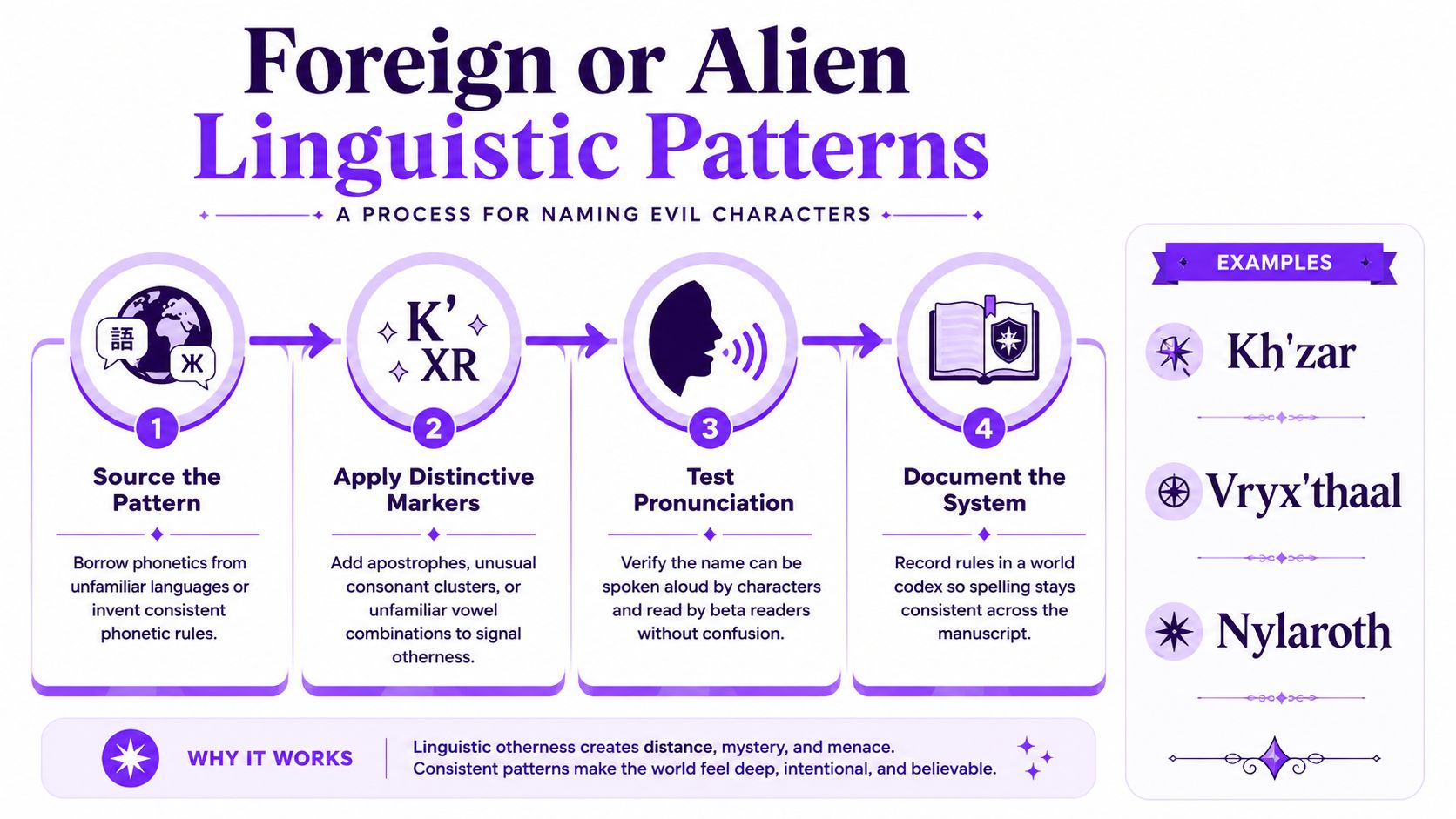
Kh'zar, Vryx'thaal, Nylaroth, Sh'gathax, and K'then signal otherness through unfamiliar structure. The apostrophes, consonant clusters, and unusual syllable patterns tell the reader that the character belongs to a linguistic system outside the surrounding culture. That can create distance and threat, especially in science fiction and fantasy.
Random strangeness won't do. Readers accept names from invented cultures when the names share rules. A documented constructed language should govern recurring sounds, apostrophes, syllable shapes, honorifics, and transliteration. Star Wars alien names and culturally derived names in Dune work because they belong to broader naming environments, not because every name contains punctuation.
Give the reader a usable pronunciation. A name that nobody can say becomes a formatting obstacle rather than a menace. You can make pronunciation difficulty part of characterization, particularly if human characters keep failing and the villain corrects them, refuses to correct them, or uses the mistake to judge them.
Your World Codex should store the linguistic rule, pronunciation, alternate human rendering, and forbidden forms. Search tools also need care. Apostrophes and unusual characters can produce false negatives in find-and-replace audits, leaving one misspelled version buried in a late chapter.
Track cultural knowledge as carefully as spelling. Does the protagonist know that the name is a birth name, a war title, or an insult? Does the villain use a translated version with enemies and the original form with allies? Those distinctions can reveal identity and power without exposition.
9. Name Transformation or Corruption Arcs
A name can show moral descent more efficiently than a paragraph of explanation. Samuel becomes Sam, then That Thing. The Heir becomes The King, then The Tyrant. Each change alters the reader's relationship to the character and records what the surrounding people believe has happened.
The technique works because names are social agreements. When characters stop using a personal name, they aren't merely shortening prose. They're withdrawing recognition. A character who reclaims the original name at the climax can turn that act into resistance, repentance, or a refusal to accept the villain's imposed identity.
This method demands chapter-level precision. Track the corruption arc alongside the events that authorize each new form. Note the first use, the speaker, the audience, the character's reaction, and whether the old name remains acceptable to particular allies. A character may accept “The King” in public while a sibling insists on “Samuel” in private.
A renamed villain creates a continuity problem unless every name has an owner, a start point, and a reason.
Automated audits can find missing or obsolete forms, but context still matters. One character may call the villain “It” as an act of horror, while the narration uses the birth name to preserve interior access. Don't globally replace either term. Mark the transition, then review each occurrence by scene.
Refusal matters too. A prisoner who keeps saying the old name may be preserving the villain's humanity, mocking the new title, or asserting that power hasn't changed the underlying person. Track that refusal as deliberately as the new name.
10. Non-Human or Object-Based Naming
Forge, Carrion, Ash, Mirror, The Clock, Rot, Blight, and Flame deny the antagonist an ordinary human category. The name positions the character as a force, object, animal, or process. That works for systemic, natural, and seemingly inevitable threats, particularly when the villain's philosophy matches the object.
The match must be behavioral. Mirror should reflect, imitate, or return other people's desires. Rot should corrupt structures rather than merely wear black clothing. The Clock should impose sequence, deadline, repetition, or mechanical inevitability. If the name's associations never appear in the character's choices, the effect collapses into decoration.
Establish whether the name is literal, metaphorical, or assigned by witnesses. A villain called Carrion may feed on corpses, be named by survivors, or use the word to describe a worldview. Each origin creates different consequences for dialogue and worldbuilding. Record who accepts the name and who resists it.
Natural-disaster names can make a character feel larger than personal grievance, but don't let scale erase agency. Readers still need to understand how the antagonist chooses. A force with no choices is an obstacle. A person who has made herself into a force is a villain.
Track the object logic across scenes. If Mirror reflects in one chapter, lies in another, and suddenly burns evidence in the next without thematic connection, the name won't stabilize the character. Consistency doesn't mean repeating the metaphor mechanically. It means the metaphor remains legible as the villain's behavior evolves.
10-Point Comparison of Villain Naming Styles
| Naming Pattern | 🔄 Implementation complexity | ⚡ Resource requirements | 📊 Expected outcomes | 💡 Ideal use cases | ⭐ Key advantages |
|---|---|---|---|---|---|
| Phonetically Harsh Consonants | 🔄 Low–Moderate: craft consonant clusters; test aloud | ⚡ Low: minimal research, phonetic testing | 📊 High immediate menace and memorability; risk of predictability | 💡 Primary antagonists needing instant threat signal | ⭐ Immediate recognition; distinctive |
| Inverted Virtue Names | 🔄 Moderate: requires thematic justification and payoff | ⚡ Moderate: setup scenes, thematic scaffolding | 📊 Ironic tension and thematic depth if earned; may feel pretentious | 💡 Thematically central villains or moral-contrast stories | ⭐ Name-as-characterization; subtle sophistication |
| Aristocratic / Hereditary Patterns | 🔄 Low–Moderate: assign titles and lineage consistently | ⚡ Moderate: worldbuilding (family trees, institutions) | 📊 Signals systemic power and entitlement; can distance readers | 💡 Antagonists of institution, privilege, intergenerational corruption | ⭐ Quickly establishes hierarchy and authority |
| Occupational / Descriptive Titles | 🔄 Low: choose role-as-name convention and stick to it | ⚡ Low: decide capitalization and usage rules | 📊 Depersonalizes villain; clarifies sphere of influence | 💡 Institutional, bureaucratic, or role-based evil (horror/thriller) | ⭐ Instant functional clarity; dehumanizing effect |
| Corrupted / Inverted Common Names | 🔄 Moderate: devise consistent spelling/pronunciation rules | ⚡ Moderate: editorial tracking and proofreading | 📊 Quiet uncanny unease; subtle and sophisticated if consistent | 💡 Psychological or transliteration-driven stories | ⭐ Subtlety; pattern violation that rewards repetition |
| Names Referencing Absence / Void | 🔄 Moderate: abstract concept must be grounded narratively | ⚡ Moderate: thematic grounding and concrete actions | 📊 Creates existential or cosmic threat; memorable in right context | 💡 Cosmic, nihilistic, or existential antagonists | ⭐ Philosophical depth; elevates stakes beyond personal |
| Historical / Literary Resonance | 🔄 Moderate–High: requires research and sensitive handling | ⚡ Moderate–High: cultural knowledge, careful contextualization | 📊 Instant resonance and baggage; reduces exposition but carries risk | 💡 Intertextual narratives, thematic parallels, allegory | ⭐ Rich shorthand; deep thematic resonance |
| Foreign / Alien Linguistic Patterns | 🔄 High: invent or borrow systematic linguistic rules | ⚡ High: document phonology, pronunciation guides for readers | 📊 Strong signal of otherness; can alienate if awkward | 💡 SF/Fantasy with nonhuman cultures or conlangs | ⭐ Distinctive worldbuilding; marks nonhuman identity |
| Name Transformation / Corruption Arcs | 🔄 High: track staged name changes tied to arc | ⚡ High: meticulous tracking, revision management | 📊 Makes moral descent visible; rewards attentive readers | 💡 Character-driven corruption arcs and identity shifts | ⭐ Dynamic characterization; narrative momentum |
| Non-Human or Object-Based Naming | 🔄 Moderate: ensure object connotations match behavior | ⚡ Low–Moderate: thematic justification and consistent use | 📊 Denies personhood; frames antagonist as force or phenomenon | 💡 Systemic, natural, or mythic threats | ⭐ Immediate conceptualization; memorable and thematic |
Make the Name Survive the Whole Manuscript
A memorable villain name and a reliable naming system aren't the same thing. The first creates an impression. The second keeps that impression intact through an 80,000-word manuscript, a large cast, recurring characters, flashbacks, multiple points of view, and the inevitable pressure of revision.
Choose the reader effect first. Decide whether you want social power, ironic contradiction, alienation, identity loss, or the dread of an impersonal force. Then test the candidate in actual dialogue and narration. Say it aloud in a threat, a whispered warning, a legal document, a lover's memory, and a chapter opening. A name that works in a character sheet but sounds ridiculous in ordinary sentences doesn't belong in the novel.
Document the mechanics that readers can't see in your head:
- Pronunciation: Record the spoken form and any regional or character-specific variation.
- Spelling: Preserve deliberate deviations, transliterations, apostrophes, and obsolete forms.
- Aliases: Note who uses each alias and whether the villain accepts it.
- Titles: Attach title changes to coronations, promotions, exile, inheritance, or disgrace.
- Knowledge states: Record which characters know the birth name, secret identity, alias, or historical reference at each point.
- Arc changes: Mark when the manuscript shifts from a personal name to a title, pronoun, insult, or object-based label.
That information belongs in character tracking, not only in character development. A development document explains who the villain is, what the villain wants, and how the arc is supposed to work. A tracking system records what has changed on the page, when it changed, who witnessed it, and whether later scenes respect the change.
Static profiles fail because they freeze the character at the moment you create them. Complex manuscripts don't stay frozen. The villain gains a title, loses an ally, reveals a birth name, changes pronunciation, acquires a public epithet, or becomes known as “The Thing” after a transformation. If the profile doesn't evolve with the draft, it becomes a museum label for an earlier version of the story.
The common failures are small but damaging. A guard uses an alias before learning it. A dead villain's former title appears in a present-tense report. A character who rejected a name in chapter twelve suddenly accepts it in chapter thirty. The narration uses an intimate birth name during a point of view that has never learned it. A culturally grounded spelling becomes a standardized one after a revision pass. None of these errors requires a bad writer. They require a system that tracks state rather than storing trivia.
Novelium's Character Tracker and World Codex are designed for that practical problem. They automatically extract and track character details, relationships, events, knowledge states, naming inconsistencies, and other continuity changes across a manuscript. The platform can surface contradictory character information, timeline problems, and impossible sequences while you revise, so you can spend your attention on whether the name creates the right effect instead of hunting every occurrence by hand.
Use the name as a weapon, but track it like evidence. The best villain name doesn't merely sound evil in isolation. It keeps changing the reader's understanding while remaining precise enough to survive the whole book.
Novelium's Character Tracker and World Codex can extract aliases, titles, relationships, knowledge states, and naming inconsistencies across your draft. Visit Novelium to check whether your villain's name remains coherent from the opening chapter through the final transformation.