Mystery & Thriller Writing Conventions That Actually Hold
The most popular advice about mystery and thriller writing is also the least useful: treat them as points on a single spectrum, with mystery moving slowly and thriller moving quickly. That model produces manuscripts that borrow the surface features of both genres while honoring neither contract. A mystery isn't merely a slower thriller, and a thriller isn't a mystery with shorter chapters. Each runs on a different information system, and an 80,000-word draft will expose every place where the writer confuses them.
Novelium's manuscript analysis work repeatedly shows the same failures. A detective suddenly knows what the reader was never shown. A thriller's deadline sits unchanged for half the book. A red herring has no plausible interpretation except the author's intended one. A character remembers an event that happened before they learned about it. These aren't cosmetic defects. They break the reader's ability to trust the story.
The distinction matters whether you're writing a fair-play puzzle, a domestic suspense novel, a police procedural, a psychological thriller, or a hybrid. It also matters beyond fiction. Even a campaign built around small business social strategies depends on controlling what an audience learns, when they learn it, and what action the information makes possible. Mystery and thriller writers do the same work with higher stakes and less room for hand-waving.
Why Mystery and Thriller Are Not the Same Job
Most craft advice treats mystery and thriller as neighboring speeds. That comparison is convenient and wrong. Speed is an output. The underlying engine is different.
A mystery is organized around revelation. The reader receives evidence, forms a theory, revises it, and gradually approaches an explanation. The central question is usually who did it, how it was done, or why the apparent version of events can't hold. The author controls interpretation more than raw movement.
A thriller is organized around pressure. The protagonist faces danger, pursuit, a deadline, or consequences that keep worsening. The central question is what happens next, and whether the protagonist can act before the threat closes. Information matters, but it serves the pressure system rather than replacing it.
The mystery glossary is useful for naming the conventions involved, but definitions alone won't save a draft. You need to diagnose what each scene changes.
Working distinction: A mystery changes what the reader can explain. A thriller changes what the protagonist can survive.
That distinction explains why a quiet interview can be electric in a mystery and dead in a thriller. In the mystery, the interview may eliminate a suspect, expose a false timeline, or turn an innocent detail into evidence. In the thriller, the same interview needs a threat, a narrowing window, or a consequence that makes the next action unavoidable. If it only delivers background, it isn't tension. It's paperwork.
Mystery and thriller manuscripts often blend successfully, but blending isn't the same as averaging. A mystery with chase scenes still needs a solvable evidence chain. A thriller with an enigmatic crime still needs escalating risk. Writers get into trouble when they use a thriller's withholding to conceal a mystery's decisive clue, or use a mystery's long explanatory pause after a thriller has trained the reader to expect immediate danger.
The rest of the work follows from this split. Track information, interpretation, and reader access in a mystery. Track threat, time, capability, and cost in a thriller. Track both when you're writing across the boundary, but don't pretend one spreadsheet column can substitute for two different narrative machines.
The Conventions Each Genre Inherits
Mystery and thriller inherit different operating rules. Mystery fiction still draws on the structure associated with the historical overview of the Golden Age, commonly placed in the 1920s and 1930s, though some accounts extend it from 1920 to 1945 or define it more broadly as 1914 to 1945. The tradition matters because readers still recognize the load-bearing arrangement: a central investigator, a concealed crime, a finite suspect group, distributed clues, misleading evidence, and a final explanation.
Agatha Christie's first novel, The Mysterious Affair at Styles, appeared in 1920 and introduced Hercule Poirot. Christie, Dorothy L. Sayers, Margery Allingham, and Ngaio Marsh became known as the “Queens of Crime.” American writers including S. S. Van Dine, John Dickson Carr, and Ellery Queen also shaped the period. Their shared inheritance established a reader expectation that the solution can be reconstructed from the information provided, even when the interpretation remains difficult. In an 80,000-word draft, that expectation makes clue placement and suspect behavior continuity work, not decorative detail.
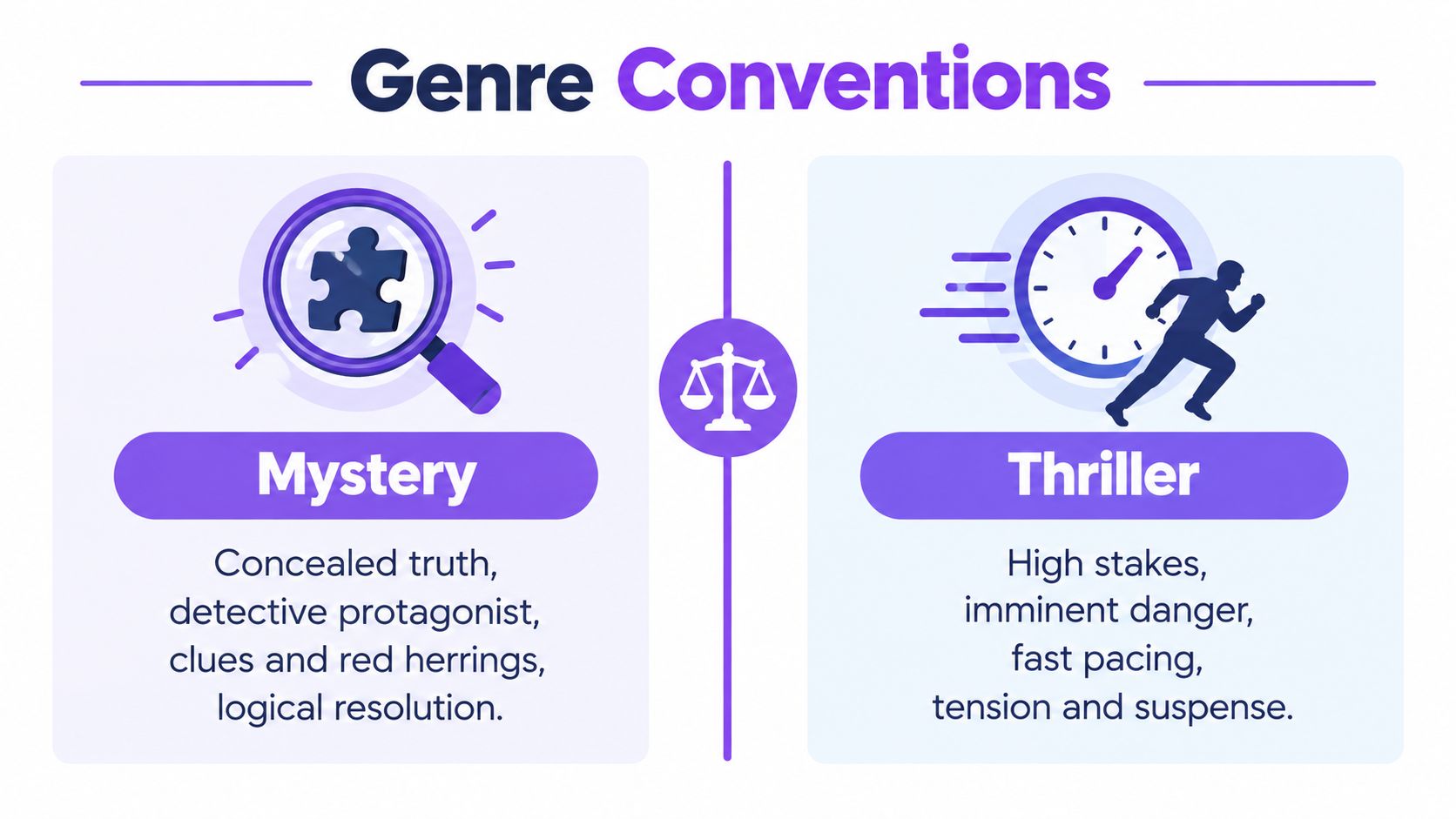
The mystery contract
The fair-play principle requires more than scattering clues across chapters. Readers should have access to the essential information available to the detective, and the solution should emerge through deduction rather than coincidence, an unmotivated confession, or a fact introduced at the end (fair-play detective fiction principles). A clue may support several interpretations. It cannot remain invisible until the explanation.
Ronald Knox's 1928 Detective Story Decalogue makes the traditional expectations more concrete. Its rules include introducing the criminal early, making discoveries available to the reader and the Watson figure, and avoiding solutions based on supernatural explanations, concealed discoveries, multiple secret passages, or a murderer who appears only at the end (Knox's detective story rules).
Writers can break these rules, but the breach needs a design purpose. An unreliable narrator may withhold information because that concealment shapes the book. A detective finding decisive evidence in chapter thirty-five because the author needs a solution is a continuity failure. Check every late clue against earlier scenes, stated knowledge, and the investigator's available choices.
The thriller contract
Thrillers inherit a pressure system. Danger must become harder to avoid, response time must shrink, and failure must acquire a personal cost before the plot expands toward institutional or global stakes. A large threat without an immediate consequence feels abstract. A personal threat without escalation feels static.
A thriller may contain a puzzle, but the puzzle does not provide its only propulsion. The protagonist might identify a mole, survive a pursuit, stop an attack, expose a conspiracy, or protect someone who becomes harder to reach. Each sequence should alter the threat model. If the danger stays unchanged while characters discuss it, the manuscript has stopped moving, regardless of how urgent the dialogue sounds.
Mystery promises a reconstructable explanation. Thriller promises worsening pressure and consequential action. A hybrid promises both, so its draft must preserve both systems: clue access and solution logic on one side, threat escalation and action cost on the other. Continuity checks should record which system each scene advances, because a scene that satisfies neither becomes expensive dead weight.
Tone, Stakes, and Pacing as Operational Variables
Writers often describe tone as atmosphere, stakes as importance, and pacing as speed. Those labels are too vague to diagnose a failing manuscript. Treat all three as variables you can inspect on the page.
In a mystery, tone establishes the reader's relationship to uncertainty. The prose can be comic, gothic, procedural, or psychologically severe, but it needs to preserve the possibility of interpretation. The reader should understand what remains unknown and why competing explanations still exist. A chapter that withholds every relevant fact doesn't create elegant ambiguity. It removes the reader from the investigation.
Thriller tone operates differently. The prose can be sleek, brutal, paranoid, or intimate, but it needs to preserve the sense that something can go wrong now. A reflective passage works when it complicates the protagonist's next decision or exposes a vulnerability the threat can exploit. It fails when it pauses the danger without changing the reader's understanding of it.
A side-by-side diagnostic
Mystery stakes usually grow through meaning. A clue changes the interpretation of a death. A suspect's alibi becomes unstable. The detective realizes the crime is connected to an older event. The pressure comes from the need to explain what happened before another person manipulates the evidence or escapes accountability.
Thriller stakes grow through cost. A safe location is compromised. A trusted ally becomes unavailable. The deadline moves closer. The protagonist's failure will harm a named person, destroy their remaining options, or force an irreversible choice.
Pacing, then, isn't how quickly characters move. It's the rate at which the controlling variable changes. The pacing glossary is useful language for this, but the practical test belongs in the manuscript itself.
| Variable | Mystery | Thriller |
|---|---|---|
| Primary movement | New information and revised interpretation | Escalating danger, time pressure, and consequence |
| Reader's main question | What happened, and who is responsible? | What happens next, and can anyone stop it? |
| Quiet scene requirement | It must alter the evidence model | It must preserve or sharpen the threat |
| Common failure | Withheld facts masquerading as a twist | Repeated danger with no increased cost |
Read any chapter and mark three things: new information, changed risk, and forward compulsion. A mystery scene can advance mainly through information. A thriller scene should normally advance through risk or time pressure. If a scene changes none of the three, it is probably exposition wearing a nice coat.
The practical fix depends on the genre. If a mystery chapter feels too fast, don't automatically add description. Give the investigator room to compare evidence, test an assumption, or notice a contradiction. If a thriller chapter feels slow, don't merely shorten it. Make the protagonist choose under pressure, remove an option, or pay for the last decision.
Writing Mystery and Thriller Scenes That Earn Their Place
A scene earns its place by changing the reader's working model. The model differs by genre, but the audit can remain consistent.
In a mystery, a scene should add a fact, prune a suspect, or reframe a clue. Suppose the detective interviews a housekeeper who claims she heard the conservatory door close at a particular time. The scene matters if that sound contradicts the established route, reveals that the housekeeper misidentified the visitor, or makes a previously harmless object part of the crime's mechanism. The conversation itself isn't the point. The altered inference is.
In a thriller, a scene should raise the cost of inaction, narrow the available time, or make the next move unavoidable. Suppose the protagonist is trying to reach a source before a surveillance team finds them. The scene earns its place when the safe route is exposed, the source sends a message that changes the meeting point, or the protagonist must choose between preserving evidence and protecting an accomplice. Running through a corridor without changing the threat is choreography, not escalation.
The three-variable scene test
Label every scene with new information, changed risk, and forward compulsion. You don't need all three in equal measure, but you should know which one carries the scene.
A mystery chapter might introduce a receipt, reveal that one suspect knew about it, and send the detective toward a second interview. The risk may remain stable, but the investigative model has changed. A thriller chapter might reveal no new fact at all, yet force the protagonist to abandon a vehicle, lose access to a protected witness, and act before the pursuer arrives. That is valid because the pressure has moved.
Sentence-level control follows the same logic. High-risk thriller scenes benefit from shorter syntax, active verbs, and reduced description because compression increases urgency (suspense revision guidance from Writer's Digest). Mystery scenes often need more interpretive space, not more ornamental prose. Let the detective notice the wrong detail, compare versions, and sit with an inconsistency long enough for the reader to work.
The scene and sequel framework can help with alternating action and reflection, but don't turn it into a template. In a thriller, the sequel must preserve threat. In a mystery, the reflection must produce a sharper hypothesis. If neither happens, cut the scene or rebuild its function.
Tropes That Still Work and Tropes That Are Starting to Fail
Tropes don't fail because readers have seen them. They fail because writers use them to avoid paying the contract attached to them.
The unreliable narrator still works in mystery when the narration's distortions have a coherent cause and the text leaves a fair trail of contradictions. The narrator can misunderstand, repress, misremember, or lie, but the reader needs a way to distinguish uncertainty from authorial cheating. Track what the narrator knows, what they claim to know, and what the surrounding evidence permits.
The fair-play clue chain remains durable because it gives readers something to do. A clue can serve several questions at once, and a red herring can be genuine evidence that supports the wrong theory. Crime-fiction analysis treats clues and red herrings as related objects whose classification changes through interpretation (analysis of clues and red herrings). A red herring that has no plausible alternative reading is just camouflage.
The closed-circle setting still creates useful pressure because it limits access, movement, and suspects. The locked-room puzzle also works when the physical conditions and solution mechanism appear before the reveal. It collapses when the trick depends on an object, passage, twin, or capability the manuscript never prepared.
Thriller tropes need harder boundaries
The ticking clock remains effective when the deadline changes decisions rather than decorating the opening pages. A mole works when the infiltrator has credible access and the investigation records how trust erodes. Personal-stakes escalation works when the protagonist cannot return to the original plan after the threat reaches someone they love.
The shortcuts are familiar. The omniscient hacker can access whatever the plot needs. Technology conveniently fails when the protagonist would otherwise solve the problem. An algorithm or artificial intelligence system behaves as omniscient in one chapter and helpless in the next. These devices don't feel futuristic. They feel unedited.
Technologically current thrillers need consistent constraints, not exhaustive technical lectures. Establish who has access, which permissions apply, what timestamps mean, how evidence can be altered, and where the system fails. The fact that data exists doesn't mean a character can interpret it, authenticate it, or use it in time.
A simplified system with stable limits is more credible than a sophisticated system that changes rules whenever the plot gets stuck.
Use trope tracking as a continuity check. Record the first setup, the operating rule, the exceptions, and the payoff. If the final reveal requires a new exception, the trope has stopped doing narrative work and started covering a hole.
Where Mystery and Thriller Continuity Breaks
The failures that matter most rarely show up in the outline. They surface when a long manuscript asks the same character to remember, conceal, discover, and misread information across dozens of scenes.
Mystery breaks first at the clue chain. A detective finds a torn receipt, ties it to a suspect, and announces the solution later. If the draft does not show what the reader saw first, what the detective thought it meant, which alternative explanation stayed alive, and what later evidence changed that reading, the reveal may be correct and still feel unearned.
Late-arriving suspects create the same problem. If the culprit appears only when the plot needs one, readers cannot judge motive, access, or opportunity. Knox's rules, covered earlier, stress introducing the criminal early and making discoveries available to the reader and Watson figure. Track each suspect's first appearance, knowledge state, location, motive, and last verified movement.
The failure patterns worth auditing
Red herrings fail when they never support a believable theory. If a character suspects the gardener because of a muddy boot, the manuscript needs to show why that suspicion made sense before later evidence knocks it out. Record the observed detail, the interpretation, the competing theory, the contradiction, and the final classification. That is the chain readers follow.
A reveal crosses the fair-play line when it depends on evidence the story withheld until the solution. Reinterpretation is fine. Retroactive invention is not. Mark the first appearance of every decisive clue and check whether the reader could have seen it before the detective explained it.
Thrillers break in different places. A Monday becomes Tuesday because the writer moved a chapter without moving travel time. A character knows about a message before anyone sent it. A phone reveals a location in one scene and becomes useless in another without a stated failure. The protagonist avoids a cost the opening promised would not be avoidable. Each slip weakens pressure because readers stop trusting time, knowledge, and consequence.
The fix is a disciplined tracking pass. Record scene date and time, location, character presence, knowledge changes, object state, technology limits, and consequence. That same discipline matters when maintaining an AI series with the same characters, because recurring identity, continuity, and state have to survive across installments instead of resetting for convenience.
The point is not to limit invention. It is to keep invention from contradicting what the manuscript already established.
A Working Continuity Habit at 80,000 Words
A character development document tells you who someone is. A character tracking system tells you what that person knows in chapter twenty-six, who gave them that knowledge, what they believe incorrectly, what they have done, what they possess, and what the reader has been allowed to see. Those are different documents serving different jobs.
For a mystery, track clue presentation, suspect access, alibis, interpretations, red herrings, reveal dependencies, and the reader's information state. For a thriller, track deadlines, threat escalation, surveillance, escape routes, injuries, resources, technology rules, and the costs already paid. For both, track dates, locations, relationships, object movement, and every character's knowledge changes.
Profiles must evolve with the manuscript. If the detective begins believing the witness, later learns the witness lied, and then forgets that discovery during the climax, the profile is not merely incomplete. It's actively misleading. Update state after each scene, not only after a major rewrite.
A spreadsheet can work for a small cast. At length, it becomes another manuscript to maintain, especially across a series. The useful system is event-based and reader-aware. It records when a fact enters the story, whose perspective carries it, how the character interprets it, whether that interpretation changes, and whether the final explanation depends on it.
Novelium's Character Tracker and World Codex automatically extract and track character details across manuscripts, including traits, knowledge states, relationships, events, timelines, and object or information inconsistencies. It can be used alongside a spreadsheet, a Scrivener project, or a manual editorial pass, provided you still make the judgment calls about narrative fairness and effect.
Don't track everything. Track whatever can contradict the reader's understanding of the story.
That means a charming detail about a suspect's favorite drink is optional unless it becomes evidence. A character's access to a locked room, knowledge of a password, possession of a weapon, or ability to reach a location is not optional. Worldbuilding is pleasant. Continuity is structural.
The habit scales when every revision asks the same questions. What changed? Who knows? When did they learn it? What can they do now that they couldn't do before? What does the reader believe at this point? If you can't answer those questions, the draft is asking memory to perform database work. Memory loses.
If your mystery's clues, thriller's pressure system, or recurring cast is breaking across a long draft, use Novelium to track character knowledge, timelines, events, clues, and continuity conflicts as the manuscript evolves. Import your working draft, run a consistency pass, and find the impossible sequences before readers do.