Where Stories Go to Die: The Rising Action
Most complications live in the long, treacherous middle of a story. We call it the rising action. It’s the territory between the inciting incident and the climax. This is Act Two, and frankly, it’s where stories either find their legs or die a slow, painful death.
I’ve looked at thousands of manuscripts, and the pattern is brutally consistent. The thrill of the inciting incident wears off, the climax feels a million miles away, and the plot gets bogged down in the narrative quicksand of Act Two. This is the graveyard of unfinished novels, not because the ideas are bad, but because the mechanical momentum collapses.
The conventional advice to just ‘raise the stakes’ is a joke when you’re staring down a 100,000-word manuscript. That's like telling a marathon runner who’s hitting a wall to just ‘run faster.’ It completely misses the mechanical failure happening under the hood. The middle of a novel isn't just a string of bad things happening; it's an engine of causality.
Beyond Just Adding Problems
The biggest failure we see is writers treating complications like episodic speed bumps. A car chase, a sudden betrayal, a freak storm. They can be exciting, but they often feel disconnected, like you're just checking items off a list of ‘stuff that can go wrong.’ Real narrative drive comes when each complication isn't just another obstacle, but a genuine re-engineering of the hero's entire understanding of the central conflict.
A powerful complication does two things at once:
- It’s a direct consequence of a choice the protagonist made earlier.
- It forces a new, even harder choice that invalidates their previous game plan.
This is how you build an inescapable chain of cause and effect. Your protagonist isn't just getting hit by random problems; they are wrestling with the direct results of their own actions. Each event flows logically, almost inevitably, from the last. This pulls the reader forward not just with suspense, but with the deep satisfaction of a well-built plot. You can dig deeper into these mechanics in our guide to rising action.
The middle doesn’t sag because it’s long; it sags because its connective tissue is weak. A story with a propulsive middle ensures every obstacle is a reaction to a prior action, creating a sense of inevitability that makes the plot feel driven, not meandering.
So instead of just piling on more trouble, architect a sequence where each complication torpedoes the hero’s previous plan. It’s not just about making things harder; it’s about making the old solutions impossible. This forces real character growth and makes your second act feel less like a grueling slog and more like a high-stakes chess match where every move changes the board.
And that’s the difference between a novel that gets finished and one that gets left in a drawer.
Complications Are Causal Chains, Not Signposts
Let’s be honest, the craft world is obsessed with plot points. The midpoint, the pinch points, the ‘all is lost’ moment. We talk about them like they’re sacred waypoints on a map. But I’ve analyzed enough manuscripts to see exactly where this goes wrong. Too many authors plant these flags in all the right places but completely forget to build the road between them. The result is a story that feels technically sound but emotionally hollow.
Those plot points aren't the story. They’re just signs telling you a turn has been made. The actual engine of your plot, the thing that generates real narrative momentum, is the causal chain of complications that links them all together. A story doesn’t move forward because a midpoint happens; it moves forward because the protagonist’s choices create a problem that forces the midpoint into existence.
This is the heart of the rising action, where complications build on each other to create the momentum that carries the story from its initial spark to its peak.
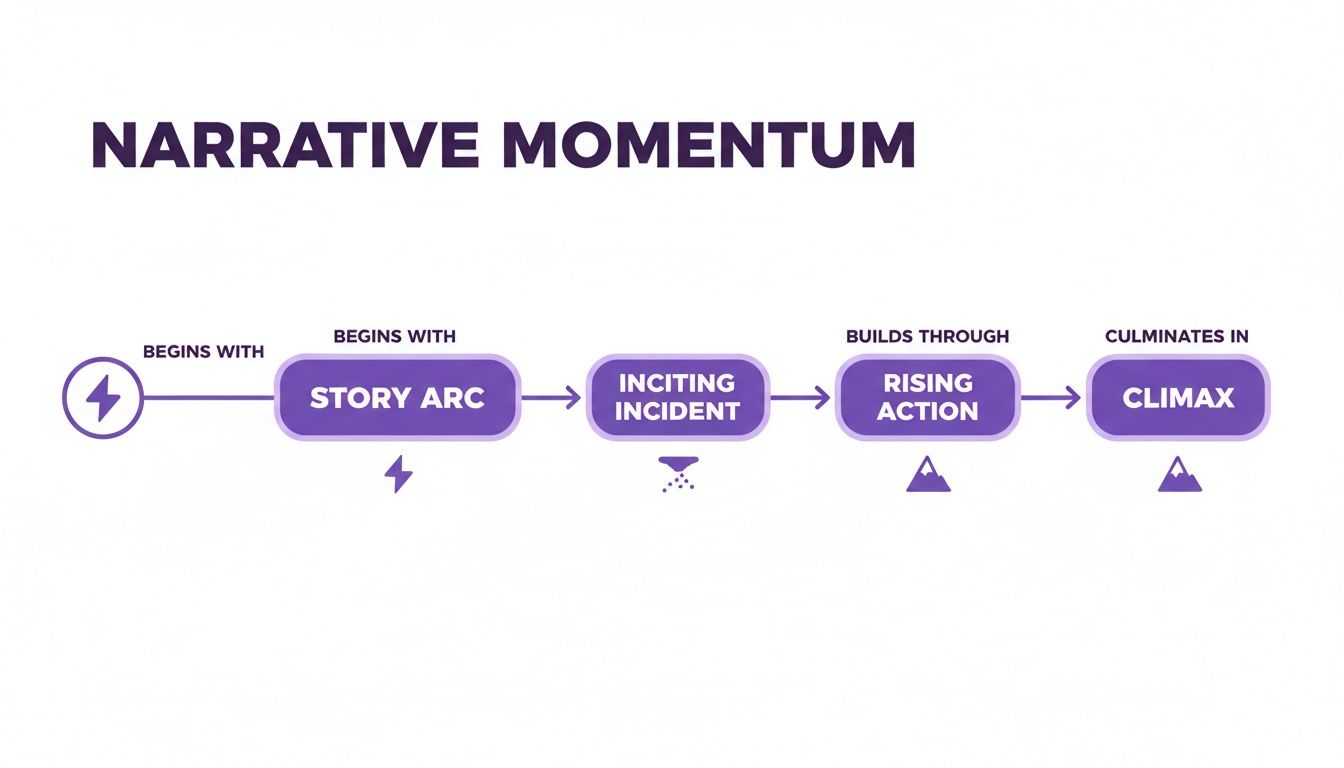
As you can see, the rising action isn't a single event. It’s a sustained, escalating series of causal links that methodically builds pressure, pushing everything toward the climax.
The Event vs. The Complication
Here’s a distinction that separates a functional plot from a broken one. An event is something that simply happens to your protagonist. A meteor strikes. They win the lottery. A long-lost uncle appears out of nowhere. It's an external occurrence, injecting a dose of randomness.
A complication, though, is different. A true complication is born from two things:
- It is a direct, logical consequence of a previous choice the protagonist made.
- It forces the protagonist to make a new, more difficult choice they were trying to avoid.
This isn't just semantics. It's the core of narrative logic. An event can be interesting, but a complication is binding. It shows the reader that actions have consequences and that this story-world has rules that can't be broken. When a character’s desperate decision to lie in chapter five directly leads to their partner being arrested in chapter ten, that’s a complication.
A complication is not an inconvenience. It is a debt coming due. It's the inevitable, often painful, result of a character's own agency, which is far more compelling than random misfortune.
This is where so many manuscripts falter. Across the thousands of books we've analyzed, the pattern is clear: structural problems almost always stem from weak connections between plot points, not from the plot points themselves. The emotional pull that makes readers turn the page comes from seeing how these moments lock together through clear cause-and-effect. Without that intentional causality, even the most creative plot points end up feeling like a series of disconnected, arbitrary scenes. You can read a more detailed breakdown of this very issue in this excellent article on the problem with plot points.
So stop plotting from signpost to signpost. Start building an unbreakable chain of cause and effect. Every obstacle your character faces should feel like an invoice for a past decision. When you do that, your plot doesn’t just move forward; it accelerates with an unstoppable logic that pulls the reader right along with it.
Calibrating Your Escalation Engine
Think of your story’s rising action as an engine. Like any engine, it needs precise calibration to work right. If you ramp up the conflict too slowly, you’ll lose your reader’s attention. But if you go too fast, you risk burning out the plot before it even hits the climax, leaving the final showdown feeling weak and unearned. It's a tricky balance, an art form that's also deeply mechanical.
A lot of writers fall into the trap of thinking escalation is linear, just make each problem bigger than the last. That's a surefire recipe for a monotonous, grinding read. A much better way to think about it is calibrated escalation. This isn't just about the size of the conflict, but its nature.
The trick is to vary the flavor of the conflict. Follow up a brutal, external firefight with a quiet, trust-shattering argument between two allies. Juxtapose a physical threat with a soul-crushing moral dilemma. This rhythm keeps the reader engaged and off-balance.
Pacing with False Victories and Respite
Constant, relentless pressure is exhausting. It wears down your characters, and it definitely wears down your reader. You have to build in moments of respite to control the pacing, and one of the most powerful tools for this is the false victory.
Let your protagonist achieve a small goal. Maybe they solve a key piece of the puzzle or seem to neutralize a threat. This gives them, and the reader, a precious moment to breathe and feel a sense of progress.
But it’s a trap, of course. That small win should, almost immediately, trigger a much larger, unforeseen complication. It’s like they’ve taken one step forward, only to reveal they’re now standing at the edge of a cliff they didn't see before. This creates a satisfying rhythm of tension and release that feels dynamic, not just punishing.
You can also use quiet moments of reflection or even a bit of dark humor to serve the same purpose. Give the story some texture before you unleash the next storm. For a deeper look at this, check out our guide on raising the stakes effectively.
Getting this calibration right is absolutely critical. The middle of a novel is notoriously the hardest part to write, and our analysis of manuscripts confirms this. The saggy middle, where the stakes fail to escalate properly, is one of the top reasons manuscripts get rejected or require massive structural edits. The cost of fixing a messy, disorganized middle is often a complete teardown of Act Two, a far more expensive fix than getting the causal chain right from the start. You can see more on the topic of common plot problems here.
An expertly paced rising action doesn't just climb; it surges, retreats, and pivots. It uses moments of calm to make the subsequent storms more violent, ensuring the escalation feels both earned and unpredictable.
This approach isn't about just throwing random obstacles at your hero. It's about conducting an orchestra of conflict, perfectly timed for maximum impact. By alternating your conflict types and using calculated moments of relief, you build tension that feels earned. Each new complication should feel like the logical next step, ratcheting up the pressure until the final confrontation feels like the only possible outcome.
The Difference Between Complexity and Complication
A lot of writers, even experienced ones, use the words complexity and complication interchangeably. They shouldn’t. They’re not the same thing at all.
A good plot has complications—meaningful obstacles that arise from a character's choices and, in turn, create brand-new problems. A bad plot has unnecessary complexity, which is just a fancy term for narrative noise.
Looking at the manuscripts we’ve analyzed, the most tangled and confusing plots don't suffer from too many meaningful obstacles. They suffer from bloat. We see redundant characters, subplots that go nowhere, and jarring point-of-view shifts that do nothing but throw the reader off track. That isn't depth; it's a structural failure that actively hurts the story.
Pruning Narrative Dead Weight
First things first: you have to perform a ruthless audit of your cast and subplots. Do you have two characters who basically serve the same narrative purpose? For instance, maybe you have a grizzled old mentor and a wise librarian who both just sit around dispensing exposition. Merge them. One stronger, more memorable character is always better than two weak ones.
The same logic applies to your subplots. Every single subplot has to eventually connect back to the main plot, ideally right as you're hitting the climax. If you could cut an entire subplot out and the ending of your main story wouldn't change one bit, it’s dead weight. Either cut it loose or figure out how to weave it into the hero's final confrontation so it feels essential.
This isn’t about stifling your creativity. It’s about strategic simplification that makes your core story hit harder.
The True Cost of a Bloated Manuscript
Excess complexity doesn't just annoy readers—it often grinds a story to a complete halt. Our analysis shows a recurring theme: overly complex narratives often fail due to too many characters, not because the core plot itself is flawed.
Another common failure point we observe is manuscripts with plotlines or characters that never meaningfully converge by the story's end. This just shatters the story’s coherence and sends reader satisfaction plummeting. You can find more great insights on this topic over at Helping Writers Become Authors.
Complexity is the enemy of momentum. Every redundant character, every meandering subplot, is another anchor dragging your pacing into the mud. A powerful story is a focused one.
Ultimately, a disciplined approach is what separates a sprawling mess from an intricate masterpiece. A complex world is fantastic, but a convoluted plot is a story-killer. Complications should feel like a natural part of your story’s chain of events, not something you’ve shoehorned in with an overstuffed cast or a tangle of irrelevant side quests.
This is especially true when you remember where most complications unfold: during a plot's rising action, a phase that absolutely demands forward momentum. So, trim the fat. Focus the conflict. Your story will thank you for it.
Tracking Conflict Ripples Across Your Manuscript
Every single complication—every obstacle your protagonist overcomes, or fails to overcome—creates ripples. And those ripples have to spread across your entire manuscript. It’s not just an event; it’s a change of state. A character learns a secret. A trusted friend is revealed as a traitor. A vital piece of gear breaks. These things can't just happen and then be forgotten.
The single biggest reason complex, long-form stories fall apart is a failure to track these evolving states. It’s always the small stuff that shatters the reader's suspension of disbelief. The hero who was shot in the left shoulder in Chapter 10 is suddenly using that same arm to hoist himself up a cliff in Chapter 15. The detective acts on a clue she won’t actually discover for another fifty pages. These aren't just typos; they’re fundamental breaches of your story's internal logic.
Static Profiles vs. Dynamic Tracking
This is exactly where the traditional character questionnaire—or that sprawling, color-coded spreadsheet—completely fails. They are static documents. They’re great for capturing a snapshot of a character at the start of the story: their backstory, their core wound, their eye color. But they are absolutely terrible at tracking the dynamic evolution of that character’s knowledge, physical state, and emotional condition from one scene to the next.
The solution isn't to take more notes. It’s to use a smarter system. What really matters isn't a fifty-question profile filled with hypotheticals, but a living timeline that links your character’s state directly to the plot. You need to know, without a shadow of a doubt, what Character A knows after their tense conversation with Character B in Scene 34. And you need that information at your fingertips when you’re writing Scene 72.
A character profile is a photograph taken before the journey begins. A tracking system is a live GPS feed of the journey itself. One is a keepsake; the other is a mission-critical tool for navigating the chaos.
The High Cost of a Single Error
Let’s be brutally honest. A single, glaring continuity error can completely undermine hundreds of pages of your most brilliant prose and intricate plotting. It sends a clear message to the reader: you, the author, aren’t paying close enough attention. If you can’t even remember that your hero has a broken leg, why should they trust that the complex web of clues you’ve laid for your central mystery will actually pay off?
This problem gets exponentially worse in a series or a novel with a big cast. The sheer mental load of manually tracking who knows what, who has which object, and who is currently furious with whom becomes completely unsustainable. The rising action, where most complications unfold during a plot's narrative, turns into a minefield of potential contradictions. For a deeper dive into managing these moving parts, you can explore our resources on effective arc tracking.
A dynamic tracking system isn’t about stifling your creativity—it’s about honoring it. It ensures the consequences of your carefully crafted complications are actually felt throughout the story, which in turn creates a richer, more cohesive, and ultimately more believable world for your reader. It transforms your manuscript from a loose collection of scenes into a true, unbreakable causal chain.
A Few Lingering Questions
When we talk to writers, especially those deep in the weeds of their second act, a few questions about complications pop up again and again. Let's tackle them head-on.
How Do You Know If You Have Too Many Complications?
You’ll feel it. The plot starts to feel less like a tense, winding road and more like a series of unfortunate, disconnected events.
A huge red flag is when new problems don’t feel like a consequence of a character's choice or a previous event. It's just... stuff happening. Another sign is when your subplots drift away from the main story, spinning off into their own orbits instead of pulling everything tighter toward the climax.
If you’re struggling to remember who knows what and which event caused the other, your reader is already hopelessly lost. A good plot is a chain of dominoes, one tipping over the next. A bad one is just a random pile of bad luck. Try mapping it out—if you can’t draw a straight line of cause-and-effect from one complication to the next, you might need to start snipping.
What’s the Best Way to Escalate Stakes Without Seeming Unbelievable?
Believability isn't about avoiding big events; it's about making them feel earned. The key is to root every escalation in character choices and the logic of your world.
Don't go from a stolen lunch in chapter two to a city-destroying earthquake in chapter four. That jump feels cheap. The escalation needs to track the protagonist’s own journey and decisions.
Start small, with personal stakes. Then, as the character makes bigger and bolder moves, widen the fallout to affect their friends, their community, or their most deeply held beliefs. Each new problem should feel like a direct, proportional consequence of what came before. When the hero takes a desperate gamble, the resulting mess should feel inevitable, not like a random meteor just decided to crash the party.
Can a Complication Hit Too Early or Too Late?
Oh, absolutely. Timing is everything.
Throw a massive, game-changing problem at the reader before they've even had a chance to care about the character's initial goal, and it just feels overwhelming. We need a sense of "normal" to be broken before we can appreciate the chaos.
On the flip side, introducing a huge, out-of-nowhere complication right before the climax often reads like a cheat—a last-ditch effort to inject drama.
The rising action needs a rhythm. Early complications should poke holes in the hero's first, naive plan. Complications around the midpoint should force them to scrap the plan entirely and rethink everything. And the ones just before the climax? Those should strip away their safety nets and allies, leaving them alone and exposed for the final showdown.
Pacing is just managing that rhythm. Since most complications unfold during a plot's rising action, their timing and sequence are what build that unstoppable momentum. Get it right, and your climax will feel like a freight train hitting its destination. Get it wrong, and the whole story can feel like it's sputtering out right when it should be roaring.
Juggling that intricate web of causes, effects, and consequences is, hands down, the hardest part of writing a novel. Novelium was built from the ground up to solve this exact headache. Our platform reads your manuscript and automatically keeps track of your plot's causal chains, character knowledge, and timelines.
You get to focus on the story, not the spreadsheet. Stop drowning in continuity details and start writing with confidence. Try it for free at https://novelium.so.