Line Editing vs Copyediting: What Pro Novelists Need to Know
Look, if you're a professional novelist, the line editing vs. copyediting debate isn't some academic exercise. It's a real-world budget decision with serious consequences for your book. It boils down to this: Line editing is about the art of your prose. It digs into the rhythm, flow, and emotional punch of every single sentence. Copyediting, on the other hand, is pure science. It’s all about enforcing the rules of grammar, punctuation, and consistency.
What Is the Core Difference?
Getting these two mixed up is the quickest way to waste a ton of money on an edit that completely misses the mark. You wouldn’t hire a world-class violinist to tune your piano, and you don’t ask the tuner to interpret a concerto. Same deal here. A line editor is focused on the subjective, artistic impact of your language. A copyeditor’s job is to make sure your manuscript follows objective, universally accepted standards.
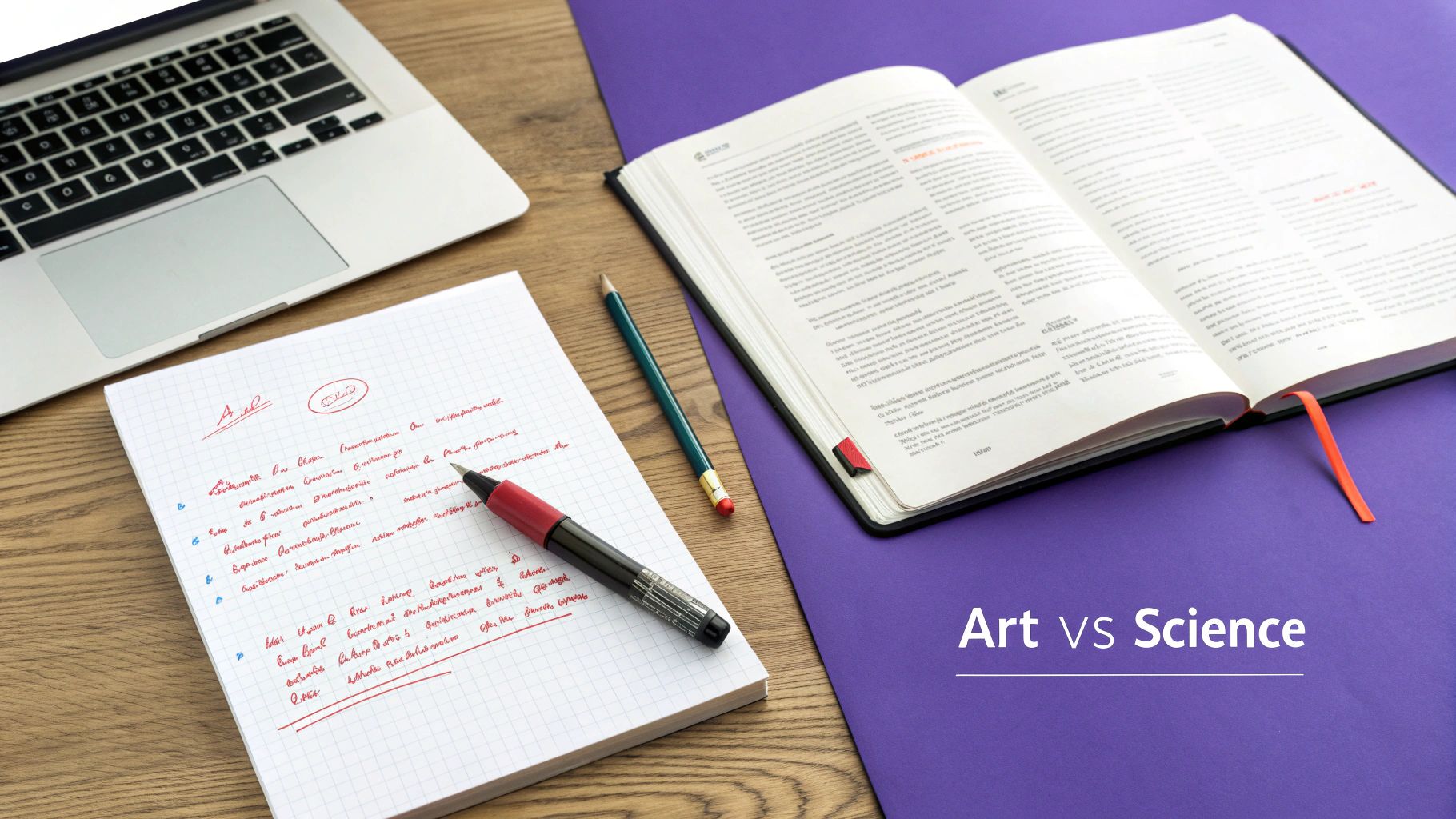
This distinction changes everything: the cost, the timeline, and the entire focus of the work. A line editor might lose an hour debating the subtle shift in meaning between three different synonyms in one sentence. In that same hour, a copyeditor will be hunting down every comma splice, hyphenation error, and dialogue tag across three chapters, making sure it’s all flawless according to the style guide.
A line editor asks, "Does this sentence feel right?" A copyeditor asks, "Is this sentence technically correct?" Answering one question doesn't answer the other.
One polishes the soul of your work; the other polishes the surface. You absolutely need both for a book that looks and feels professional. But understanding their separate roles is the first step to a smarter, more efficient process. It lets you figure out what your manuscript actually needs and put your money where it'll make the biggest difference.
Line Editing vs Copyediting: A Quick Comparison
This table breaks down the fundamental distinction between the two editing stages, helping you quickly figure out which service your manuscript is crying out for right now.
| Aspect | Line Editing (The Art of Prose) | Copyediting (The Rules of Grammar) |
|---|---|---|
| Primary Goal | To enhance voice, style, and emotional impact. | To ensure correctness, clarity, and consistency. |
| Core Question | "How can this sentence be more powerful?" | "Is this sentence grammatically correct?" |
| Area of Focus | Rhythm, flow, pacing, tone, word choice, sentence structure. | Grammar, spelling, punctuation, syntax, style guide adherence. |
| Analogy | The Music Director, focused on artistic interpretation. | The Conductor, ensuring every note is played correctly. |
| Typical Cost | Higher per-word rate due to subjective, intensive analysis. | Lower per-word rate, focused on rule-based application. |
Ultimately, one edit makes your story sing, and the other makes sure it's ready for the stage. Knowing which one you need first is key.
Where Did This Distinction Even Come From?
You wouldn't have hired a "line editor" a century ago. It wasn't a job. Instead, you'd hire a "manuscript editor" who handled everything from clunky sentences to misplaced commas. The roles we know today—line editor and copyeditor—are a surprisingly modern invention.
So what happened? The answer lies in the explosive growth of mass-market publishing and the standardization it required. This isn't just a fun fact; it explains the entire logic of the modern editing workflow and why getting it out of order is a great way to light your money on fire.
From Generalist to Specialist
Back in the early 1900s, publishing was a much smaller, almost bespoke industry. A single editor would often work hand-in-glove with an author on every aspect of their book. But as publishing scaled up after World War II, consistency across a publisher's entire catalog became an obsession. This is where style guides came in.
The cover of The Chicago Manual of Style, one of the key culprits in standardizing the copyediting role.
Manuals like the Chicago Manual of Style turned manuscript prep from a loose art form into a precise science. Suddenly, there was a need for a specialist who lived and breathed these rules. This created a distinct, rule-based job: the copyeditor.
The copyeditor’s entire world became enforcing these new standards—grammar, punctuation, and house style. Their job was to make a book technically perfect and consistent with every other book that publisher put out. It was an efficient and essential role for large-scale production.
With copyediting now laser-focused on technical rules, a gap opened up. Who was looking after the art of the writing? The rhythm, voice, pacing, and emotional punch that no style guide can teach you? This void is what created the modern role of the line editor.
By the late 20th century, the split was complete. Big publishing houses in the US and UK had two distinct roles. Line editing was the messy, creative work of refining the prose. Copyediting was the final, meticulous guardian of mechanical correctness.
The Inviolate Order of Operations
This history lesson isn't just for kicks. It created a workflow that is both necessary and logical: line editing must always, always come before copyediting. The reason is simple, and it has everything to do with your wallet.
A line editor’s job is to tear down and rebuild. They might rewrite a paragraph for flow, slash dialogue to ramp up tension, or combine two sentences just to change the rhythm. It's often brutal work.
Now, imagine a copyeditor has already spent hours perfecting the grammar and punctuation on those exact sentences. All that meticulous work gets vaporized the moment the line editor rewrites them. You literally end up paying a highly skilled technician to fix sentences that are about to be deleted. It’s like hiring someone to polish the brass on a ship you’re about to scuttle.
This is why the industry is so rigid about the sequence. First, the line editor works with you to shape the prose into its most powerful form. Only after the sentences are artistically "locked" does the copyeditor step in to apply the final, technical polish. Following this order respects what each editor does best and makes sure you aren't paying for work that gets thrown away.
What Are They Actually Looking For?
So you've hired an editor. They've just cracked open your manuscript file. What are they actually looking for?
The answer hinges entirely on whether you brought them on for a line edit or a copyedit. Their brains are wired for completely different missions, and getting that distinction right is everything when it comes to hiring the right pro for the job.

Here's a practical way to think about it: A copyeditor sees a repeated word in a paragraph and flags it. It's a mechanical redundancy, a small error to be fixed. But a line editor sees that same repeated word and has to ask why. Is it a lazy oversight, or is it a deliberate choice reflecting a character's frantic, spiraling state of mind?
One editor sees a rule violation; the other sees a potential artistic tool. This difference in perspective changes everything.
The View from the Trenches
Let's zoom in on what this looks like, sentence by sentence. A copyeditor is your guardian of the rules. Their world is governed by your chosen style guide—be it Chicago, AP, or something else—and their job is to make sure every comma, em dash, and quotation mark is perfectly placed according to that objective standard. They are there to eliminate technical errors and ensure clarity.
A line editor, on the other hand, lives in the much messier, subjective world of artistic effect. They’re less concerned with the rules and more with the why behind your choices. They'll question a sentence structure that feels clunky, even if it's grammatically sound. They'll highlight dialogue that sounds wooden and push you to find a more potent, evocative verb. Their focus is squarely on the reader's experience.
The core difference is this: a copyeditor cleans the window so the reader can see through it without distraction. A line editor adjusts the lighting in the room to make sure the reader feels something when they look through it.
To make this crystal clear, the table below breaks down the different battlegrounds where these two editors operate. It shows the real-world tasks that separate a line edit from a copyedit.
Line Editing vs Copyediting Core Functions at a Glance
This table provides a direct comparison of the primary objectives and specific tasks handled by line editors and copyeditors, highlighting their distinct roles in the fiction editing process.
| Focus Area | Line Editor's Responsibility (The Art) | Copyeditor's Responsibility (The Rules) |
|---|---|---|
| Dialogue | Assesses if the dialogue sounds authentic to the character and situation. Does it reveal subtext and advance the plot? | Corrects punctuation in dialogue tags and ensures consistent formatting (e.g., "said" vs. "he said"). |
| Pacing & Rhythm | Analyzes the flow of sentences and paragraphs. Uses varied sentence length to control tension and speed. | Checks for run-on sentences and comma splices that disrupt readability, regardless of intended rhythm. |
| Word Choice | Questions weak verbs, clichés, and overused words. Pushes for language that is more precise, evocative, and original. | Flags words that are misspelled or used incorrectly (e.g., "affect" vs. "effect"). Notes repetitive word usage. |
| Tone & Voice | Ensures the narrative voice is consistent and serves the story's mood. Identifies jarring tonal shifts. | Verifies consistent capitalization and treatment of terms according to the style sheet. |
| Syntax | Restructures awkward or confusing sentences to improve clarity and impact, even if they are grammatically correct. | Corrects grammatical errors like subject-verb agreement, dangling modifiers, and incorrect pronoun cases. |
| Consistency | Scrutinizes the emotional consistency of a character's voice and actions from one scene to the next. | Checks for factual consistency (e.g., character's eye color, timeline details) against a style sheet. |
This isn't just an academic exercise. Understanding this split directly impacts how you prepare your manuscript and which expert you hire to solve its specific problems. You hire one to fix what’s broken according to the rules, and the other to elevate what’s already working into something unforgettable.
The Financial Reality of Editing Your Novel
Alright, let's talk money. Because professional editing isn't just a step in the process; it's a serious line item in your budget. The price tags for line editing versus copyediting tell a pretty clear story about where the intense work happens. Getting your head around the costs isn't just about crunching numbers—it's about making a cold, hard strategic call for your book.

The blunt truth? Line editing almost always costs more. It's not an arbitrary markup. A copyeditor is working from a defined rulebook, the style guide, which makes their job more objective and, frankly, faster. A line editor, on the other hand, is getting into an artistic wrestling match with every single one of your sentences. They’re weighing nuance, rhythm, and emotional punch. That deep, interpretive labor just plain demands a premium.
Breaking Down the Per-Word Rates
When you start shopping for editors and getting quotes, the difference becomes crystal clear. According to rates from the Editorial Freelancers Association, fiction copyediting usually falls somewhere between $0.021 to $0.030 per word. Industry data consistently shows that line editing will set you back about 10–20% more.
Sometimes, that premium is even higher. Take a major service like BookBaby, for example. They list copyediting around $0.025 per word, but their line editing service is priced at a level that suggests a roughly 40% price premium. That's a significant jump. You can dig deeper into these industry rates over on Daniel Tortora's blog.
This gap isn't trivial, especially when you're working with an 80,000-word manuscript. Let’s do the math on a 90,000-word fantasy novel:
- Copyediting: Based on the EFA's suggested rates, you're looking at a bill between $1,890 and $2,700.
- Line Editing: Take that same manuscript, and with a conservative 15% premium, you’ll be paying anywhere from $2,173 to $3,105.
That difference of several hundred, or even a thousand, dollars is exactly where your strategy comes in. It forces you to ask the hard question: which of these services will give me the most bang for my buck, right now?
The price difference between line editing and copyediting isn't just a cost—it's a signal. It tells you that the market values the difficult, subjective work of refining prose at a premium over the more straightforward, rule-based work of correcting it.
Your Budget Is a Strategic Tool
This financial reality should light a fire under your self-editing process. Every cliché you hunt down, every clunky sentence you rephrase, and every tonal wobble you smooth over before you even think about hiring an editor is money in your pocket. Better yet, it’s money you can put toward the editor who can make the biggest impact.
Think about it: a manuscript riddled with basic mechanical errors forces your expensive line editor to waste their time fixing comma splices instead of sharpening your voice. A clean draft, however, lets them focus entirely on the high-value artistic work you're actually paying them for. This is where a tool like Novelium can be a huge help; its manuscript intelligence platform helps you clear out those consistency issues and other snags ahead of time. You can see how it works here.
Your editing budget is finite. Knowing a line edit is going to take a bigger bite should be all the motivation you need to hand over the cleanest manuscript possible. It ensures that when you finally make that big investment, every dollar goes toward elevating your art, not just cleaning up after it.
Preparing Your Manuscript for a Professional Editor
Handing your manuscript to an editor when it’s still riddled with continuity errors is like asking a master painter to patch drywall. You're paying top dollar for work you could have done yourself, and worse, it keeps them from doing the high-level work you actually hired them for. Before a single dollar leaves your bank account, your mission is to hunt down and eliminate every last piece of low-hanging fruit.
This isn’t about perfecting your prose just yet. It's about a rigorous internal check for the kinds of mistakes that drive editors mad: plot holes, impossible timelines, and character inconsistencies. These are the things that completely derail a reader’s focus and, just as importantly, your editor’s workflow. Think of it as cleaning up the logical scaffolding of your story so your editor has a solid foundation to build upon.
Why Self-Policing Your Manuscript Is Critical
When a line editor has to stop sharpening your character's voice to ask why he's holding a sword that was destroyed three chapters ago, their creative momentum grinds to a halt. When a copyeditor is forced to build a timeline from scratch just to check if a character’s alibi even works, they aren't looking for comma splices or grammatical nuance. You're burning through their time and focus—their most valuable resources—on basic consistency checks.
The sheer complexity of a novel makes these errors almost inevitable, even at the highest levels of publishing. Industry editors admit that books from the “Big Five,” even after multiple professional passes, can still contain hundreds of errors. In some cases, proofreaders have found over 700 issues in a single, previously edited manuscript. Jane Friedman’s blog has some fascinating insights on this reality. It all points to one critical truth: the more errors you fix upfront, the deeper your editor can go.
An editor’s job is to elevate your story, not to be your continuity police. Every plot hole or character contradiction you fix yourself is another hour they can spend refining your prose or perfecting your grammar.
A manuscript free of these foundational problems makes for a much more productive partnership. Your line editor can focus solely on the art of the sentence, and your copyeditor can dig into the subtle rules of the style guide. You’ll maximize your investment and end up with a significantly stronger book.
The Power of Systematic Tracking
So, how do you actually catch these mistakes, especially when you're wrestling with a 100,000-word manuscript and a sprawling cast? The answer is to move from static documents to a dynamic tracking system. Character sheets and worldbuilding wikis are great for brainstorming, but they fall apart when you need to track a character's state, knowledge, or physical condition as the story unfolds.
This is where specialized tools become so important. Instead of relying on manual checks, you can use novel writing software built with manuscript intelligence to automate the whole process. Rather than manually flipping between chapter 4 and chapter 27 to see if your protagonist knows a certain secret yet, the system flags the contradiction for you.
This kind of automated pre-flight check does a few crucial things:
- It flags timeline impossibilities. Did your characters travel 500 miles on foot in a single day? A system will catch that.
- It tracks character knowledge. It stops characters from knowing things they haven't learned yet—a common and frustrating error for readers.
- It ensures object consistency. The system remembers what happened to that magical amulet, even if you forgot you destroyed it.
By running this sort of systematic analysis first, you hand your editor a manuscript that’s logically sound and internally consistent. You've already patched the drywall. Now you can let the master painter get to work on the mural. It's the single most effective way to prepare your book for the kind of edit that makes a real difference.
Frequently Asked Questions About Editing
Let's clear the air on a few common points of confusion. Even for authors who’ve been around the block, the line between these editing stages can get fuzzy, leading to wasted money and frustrating delays. Here are the straight-up answers to the questions we see most often.
Which Type of Editing Should I Get First?
Line editing always, always comes before copyediting. This isn't just a friendly suggestion; it’s a structural necessity.
Think of it this way: a line editor’s job is to mess with your prose on an artistic level. They’ll rewrite sentences for rhythm, slash words to make a point land harder, and tweak dialogue until it sings with character. A copyeditor then takes that artistically "final" text and makes sure it's mechanically perfect.
Doing it backward is a recipe for disaster. You’ll pay a copyeditor to painstakingly correct the grammar on sentences your line editor might just delete entirely. It’s the fastest way I know to pay for the same work twice.
Can One Editor Do Both Line Editing and Copyediting?
While plenty of talented editors have the skills for both, it’s almost always better to treat them as two separate jobs. It’s like an editor wearing two completely different hats.
The line editing "hat" is all about creative flow, subjective impact, and the art of the sentence. The copyediting "hat" is about technical precision, objective rules, and sticking to a style guide. Trying to wear both hats at once means something usually gets compromised. An editor might get so focused on fixing a comma splice that they miss a clunky sentence rhythm, or vice versa.
For the best possible result, book them as distinct passes, even if it's with the same person. Giving each function its own dedicated round of edits ensures both the art and the rules get the undivided attention they deserve.
Does My Manuscript Need a Line Edit if I Have a Strong Voice?
Yes, almost certainly. In fact, a strong voice is precisely why you need a line edit. Your voice is the foundation, but a line editor is the craftsperson who hones it.
They aren't there to erase your voice—they’re there to elevate it. A great line editor makes sure your unique style is consistent from the first page to the last, punching up word choices for maximum impact and spotting the rare moments where the rhythm stumbles. It’s about taking something that’s already good and making it unforgettable. If you're curious about the modern writer's toolkit, you can read more about the ethics of writing with modern tools.
This decision tree helps visualize where you are in the process and what your next step should be before hiring a pro.
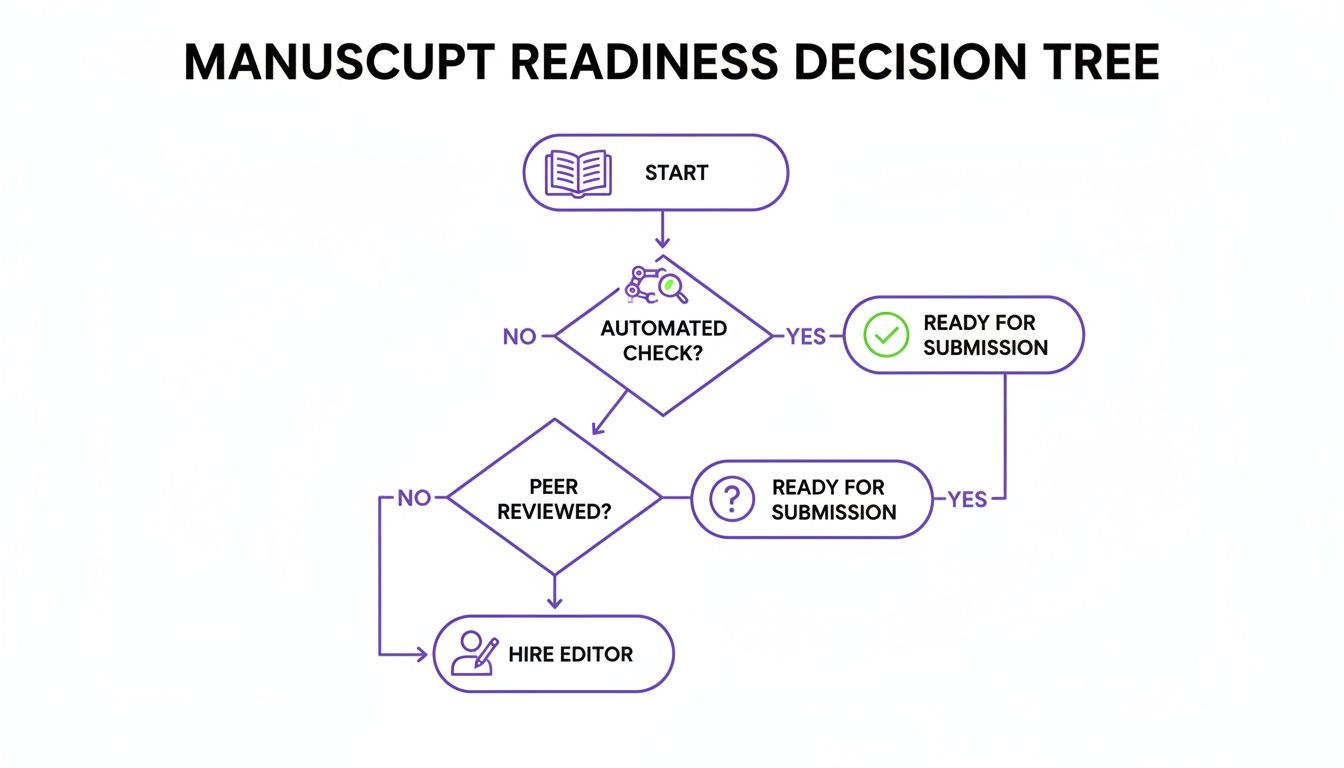
The big takeaway here is that running an automated check for your story’s internal logic is no longer just a nice-to-have. It’s a professional first step that frees up your human editors to do their most valuable work on your story.