Limited Omniscient POV: How to Write It Without Head-Hopping
Most limited omniscient POV failures aren't caused by a writer misunderstanding the definition. They happen because the manuscript changes its information rules. A narrator starts close to Maria, then reports what her colleague secretly fears, then slips into a villain's private certainty several chapters later. By the time an editor marks the drift, the prose may still sound polished. The reader's trust has already been rewired.
That's why limited omniscient POV works better when treated as an information-management system, not a label chosen on a manuscript's first page. In literary history, third-person omniscient narration was especially common in nineteenth-century fiction, while modern reference sources describe third-person narration as ranging from total omniscience to limited omniscience, where access is restricted to one character's perceptions (the history and definition of third-person limited narration). The practical question for a long novel is simple: whose thoughts, sensations, assumptions, and anticipations are available in this scene, and which facts must remain outside the reader's reach?
The Problem Most Drafts Hit Before They Touch POV
The manuscript usually looks innocent at the start. Chapter one stays with the detective, chapter two follows the suspect, and each transition feels deliberate. Then the cast expands, scenes get drafted out of order, and the narrator begins carrying knowledge from one character into another character's paragraph.
That's where POV drift becomes expensive. A sentence such as “Jonah wondered whether Elise had recognized him” belongs to Jonah's interiority. “Elise suspected he was lying” belongs to Elise. Put both in the same scene without a controlled shift, and the reader has no stable answer to the most important question in the room: whose experience is organizing the information?
Practical rule: Limited omniscient POV is a permission system. Every interior sentence needs an authorized owner.
The problem gets worse in manuscripts with recurring characters, parallel plotlines, or scenes drafted months apart. Writers remember what the author knows, not what the focal character knew at that moment. A secret revealed in chapter twenty begins tinting chapter twelve. A character reacts to a clue they haven't encountered. A supporting character's private motive appears in a gesture that the focal character couldn't interpret with that confidence.
This is why a head-hopping reference is useful only if it leads to sentence-level decisions. Mark the focal character before drafting each scene. Track what that character knows, suspects, misremembers, and cannot yet understand. Limited omniscient POV then becomes a working constraint, not a hope that instinct will remain consistent across a long draft.
What Limited Omniscient Actually Means
Limited omniscient POV combines an external narrator with restricted interior access. The narrator can describe the wider setting and report events beyond the focal character's direct position, but the reader enters the mind of one designated viewpoint character per scene. That character's perceptions shape the emotional and interpretive layer of the prose.
Reference definitions distinguish this mode from full omniscience by one foundational rule. The narrator can't freely access every character's inner life at once. Britannica's discussion of point of view places limited narration within the broader movement toward psychologically centered fiction, while full omniscience remains associated with panoramic narration and earlier canonical forms.
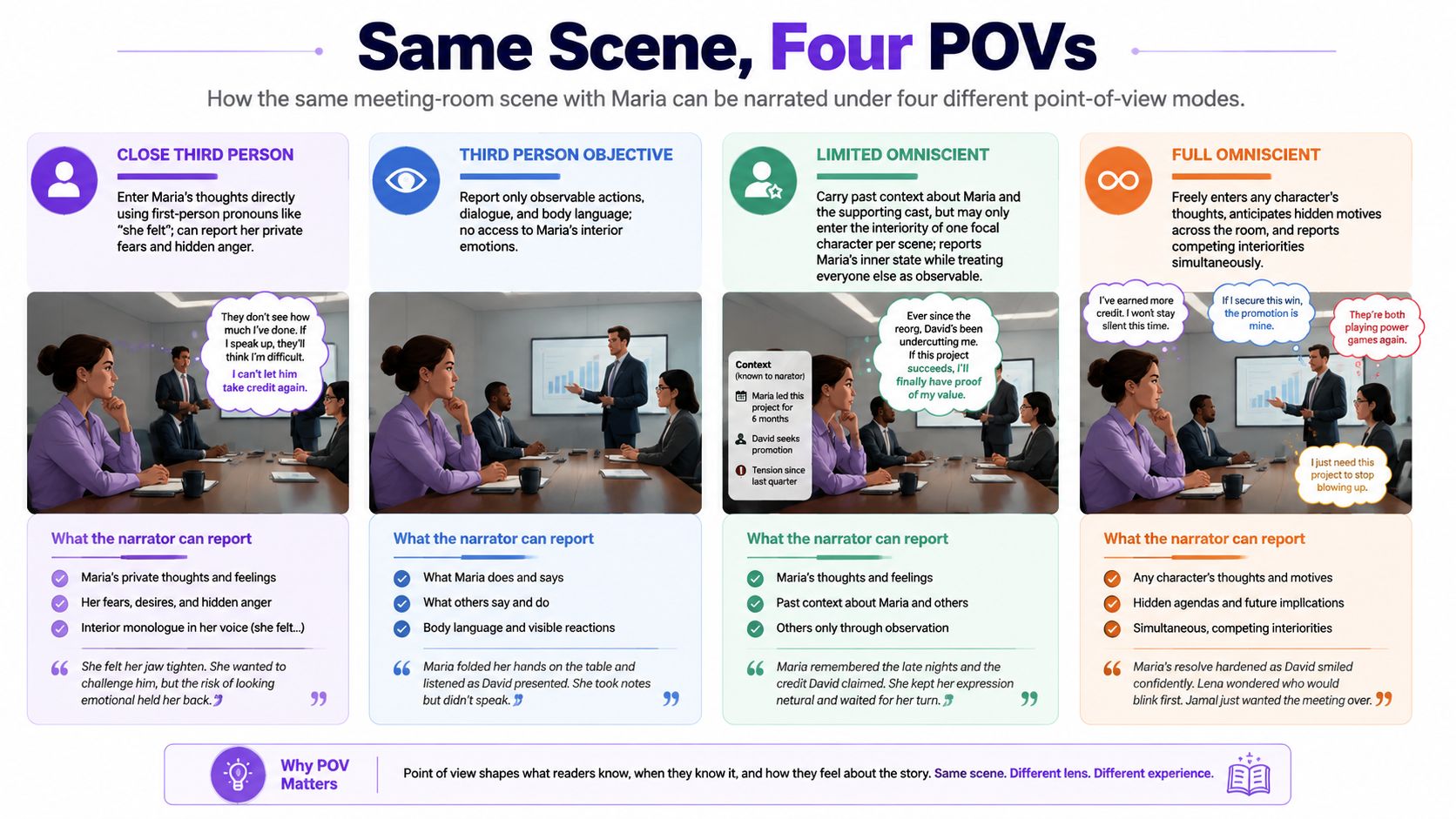
Take the same meeting-room action. Maria enters, hides her anger, and sees two colleagues watching her.
| POV Mode | What the Narrator May Report |
|---|---|
| Close third person | Maria's private fear, anger, sensory experience, and direct thought. |
| Third-person objective | Maria's entrance, dialogue, posture, and visible behavior, but not her interior emotion. |
| Limited omniscient | Maria's inner state, plus external context and observable behavior from everyone else in the room. |
| Full omniscient | Maria's anger, one colleague's anxiety, another colleague's concealed motive, and competing interiorities in the same passage. |
Close third and limited omniscient overlap in practice, which is why writers often use the terms loosely. A close third person guide generally emphasizes deep alignment with one character's consciousness, while limited omniscient emphasizes the narrator's external flexibility alongside that single-head restriction.
The difference becomes visible in the verbs. Close third might say, “Maria felt the old anger rise.” Objective narration can only say, “Maria tightened her grip on the folder.” Limited omniscient can give Maria's anger directly, then show her colleague's tightened mouth as behavior Maria interprets, not as proof of his private fear.
The boundary is per scene, not automatically per chapter. A chapter can contain several scenes, and each scene can establish a new focal character if the transition is clear. A hard rule remains useful: if another character's interiority matters, end the scene and begin a new one from that viewpoint rather than switching minds mid-paragraph. Writers looking beyond definitions can also find useful storytelling tips from best tweets when testing how information and reader attention move through a scene.
Annotated Examples That Show the Boundary
The clean version usually feels less restrictive than writers expect because the focal character can interpret almost everything in the room. The narration just has to distinguish what Maria knows, what Maria infers, and what the author knows but Maria doesn't.

The controlled passage
Maria entered the conference room with the folder pressed against her ribs. [Focal access] The anger had settled beneath her sternum, hot and compact, but she kept her face still.
Daniel stopped shuffling the papers. [Observable behavior] He looked up too quickly, then lowered his eyes.
He seemed nervous. [Inferred access] Maria decided he'd already heard about the missing contract. [Focal access]
Across the table, Priya smiled and gestured to the empty chair. [Observable behavior] Maria couldn't tell whether the welcome was genuine or rehearsed. [Focal access and uncertainty]
The passage can report Maria's private anger. It can also report Daniel's movement and Maria's interpretation of it. It cannot state that Daniel felt guilty unless Daniel's interiority becomes the authorized viewpoint.
That distinction matters because inference is not a weaker form of omniscience. “He seemed nervous” belongs to Maria's reading of visible evidence. “He was nervous” may sound like an objective fact, but in a restricted scene it can imply unauthorized access unless the context makes the observation unmistakable.
The seam that breaks
Maria entered the conference room and pressed the folder against her ribs. [Focal access] She hated Daniel for making her come here.
Daniel wondered whether she'd found the second set of invoices. [POV breach]
He smiled to hide his panic. [POV breach] Priya, meanwhile, realized that the meeting could destroy her promotion. [POV breach]
Maria saw Daniel's smile and knew he was lying. [Focal access, but overconfident inference]
The first line establishes Maria. The next line enters Daniel's thoughts without a scene break. The third gives the reader Daniel's concealed emotion, then jumps into Priya's private calculation. By the final line, Maria's certainty about Daniel may be dramatically justified, but the narration hasn't shown how she knows it. The paragraph has become full omniscience by accident.
The most treacherous breaches use hedge words. “Daniel seemed guilty,” “Priya perhaps understood,” and “he must have known” can look cautious, but they still create problems when the focal character has no evidence for the conclusion. They're often the manuscript's first drift points, especially beside dialogue tags and body-language verbs.
When the subject of a sentence isn't the focal character, ask two questions:
- Could the focal character observe or reasonably infer this?
- If so, what exact evidence produced the inference?
If the answer to either question is no, rewrite the sentence as behavior, move the information into dialogue, or shift the scene's focalization deliberately. A point-of-view break reference helps name the fault, but the repair comes from restoring the information boundary.
Drafting and Editing Tactics That Hold the Line
Decide the focal character before you draft the scene, not after the prose has acquired momentum. Write one private anchor sentence in your scene notes: “Maria must leave this room believing Daniel is afraid, whether or not he is.” That sentence identifies the emotional lens and prevents the narrator from wandering toward the more interesting secret in someone else's head.
A beat log keeps the decision alive across chapters. Record the scene location, focal character, what that character knows, what they wrongly believe, and what they notice first. Don't build a decorative profile that tells you a character's favorite meal if the manuscript never needs it. Track information states that affect action and interpretation.
During revision, convert unauthorized interiority into evidence. Replace “Daniel regretted the lie” with “Daniel folded the corner of the invoice until the paper split.” Then let Maria infer the meaning, or refuse to infer it. That refusal can produce more tension than a direct explanation because the reader shares her uncertainty.
Read every sentence as if the focal character is standing beside you, asking, “How do you know that?”
Run two separate passes rather than trying to solve everything at once. In the first, read aloud and flag any sentence that the focal character couldn't perceive, remember, or conclude. In the second, search for verbs of interiority such as realized, wondered, decided, remembered, feared, suspected, and check whether the subject owns the scene's viewpoint.
Useful marginalia should identify the repair, not merely announce failure:
- “Convert mind access to behavior.”
- “What evidence does Maria have?”
- “Move this reveal to Daniel's scene.”
- “Keep the fact, change the access.”
That last note is often the right one. Supporting characters don't become flat because the narrator can't enter them. They become legible through choices, omissions, physical responses, speech patterns, and the focal character's sometimes-wrong interpretation of those signals.
Where the Standard Advice Quietly Fails
“Stay in one head” is a useful emergency rule, but it's too crude for a complex novel. POV isn't a binary switch between interiority and no interiority. A scene can sit close to Maria's emotional experience while still giving the narrator room to describe a city block, a legal document, or an event she sees but doesn't understand.
Scene breaks don't automatically solve drift either. A silent cut from Maria to Daniel can obey the technical rule and still alienate the reader if nothing marks the change. The reader needs a reason for the new focal character and enough orientation to recognize the shift. Multiple-POV novels don't need theatrical announcements, but they do need reliable signals through voice, setting, desire, or immediate sensory emphasis.
Another common error confuses intimacy with depth. A narrator can be intimate with Maria's perceptions without reproducing her exact diction. Conversely, a passage can use intimate language while reporting information Maria has no access to. The prose sounds close, but the knowledge structure is false.
Consistency isn't the goal. Controlled access is.
The diagnostic question isn't “Did I leave the focal character's head?” It's “Can the reader tell whose head organizes this moment, and why this character owns it now?” A buried focal switch, a silent cut, or a hedge word applied to a stranger's private feeling can all pass a superficial compliance check while damaging reader orientation.
A Maintenance Routine for Complex Manuscripts
A long manuscript needs maintenance because POV decisions decay under revision. Start with a chapter-by-chapter map. Name the focal character for every scene, then write the reason that character owns the scene. If the reason is merely “they were already there,” the scene may be running on convenience rather than narrative pressure.
The sentence-level pass hunts for unauthorized interiority. Search for verbs of knowing and emotion, then inspect the character attached to each verb. Don't delete every instance of “wondered” or “realized.” Confirm that the focal character is the one doing the wondering or realizing, and that the thought belongs at that point in their knowledge timeline.
A continuity pass checks emotional logic against the focal character's baseline. If Maria hasn't learned about the missing contract, her suspicion can't have the precision of hindsight. If she misread Daniel in an earlier scene, later narration shouldn't upgrade that interpretation into fact unless the manuscript shows what changed.
Finish with a cold read at speed. Line edits make perspective slips feel smooth because the editor has already slowed down and isolated each sentence. A fast read restores the reader's experience and exposes the friction points where the manuscript suddenly knows too much, changes emotional center, or asks the reader to infer an invisible switch.
Before shipping, ask one question at a random page: Can a beta reader name whose head they're in within one sentence, and does that answer feel intentional? If not, the manuscript doesn't need another character questionnaire. It needs an information map that tracks knowledge, access, and change scene by scene.
Novelium offers a Character Tracker and World Codex that extract and track character details, knowledge states, relationships, events, and POV structure across a manuscript. Visit Novelium to check complex drafts for POV drift and continuity failures before they reach readers.